
Amouage proved that Oman’s fragrance heritage could become modern high perfumery. OMANLUXURY shows the story did not end in 1983.
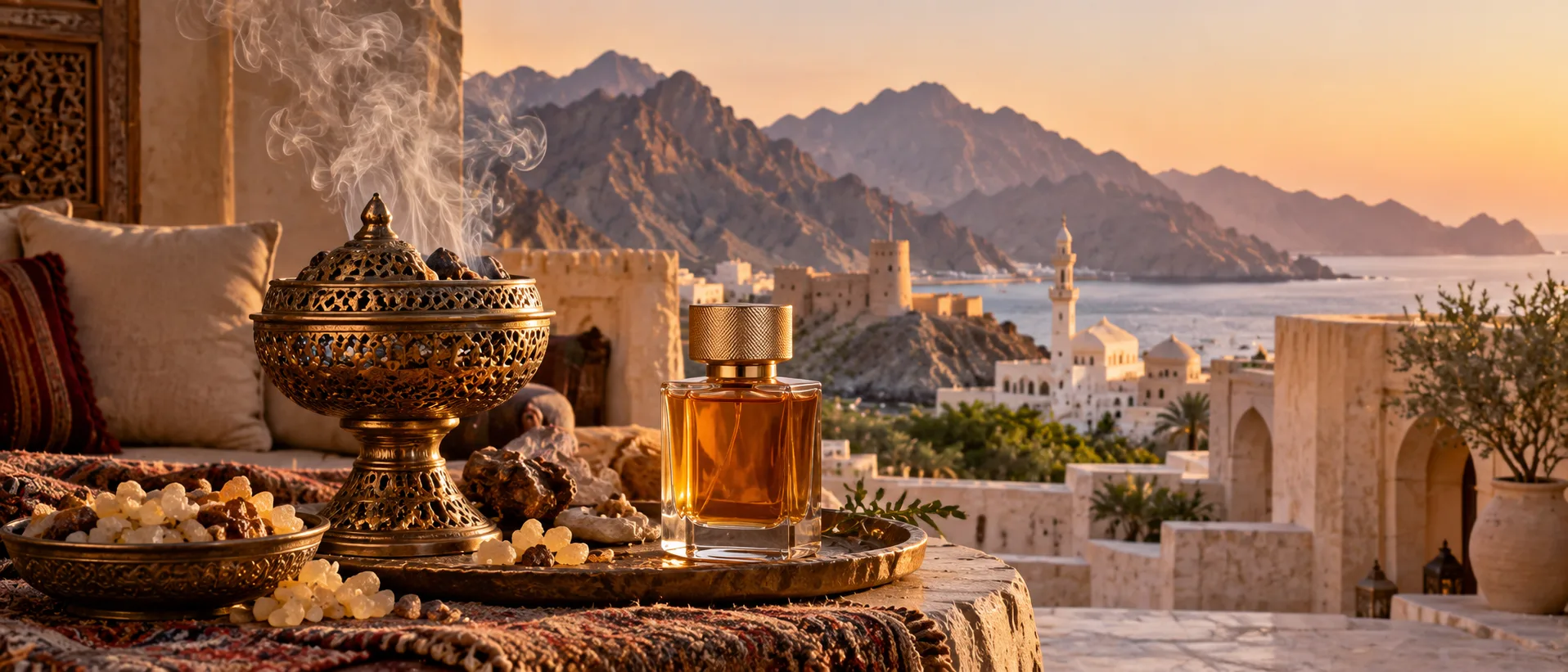
Oman did not need to invent a relationship with fragrance. The country had frankincense, bukhoor, trade routes and a culture of scent long before 1983. What Amouage changed was the scale and language of the ambition.
Oman smelled like luxury before luxury had a perfume counter
Long before Oman had an international fragrance house, Dhofar frankincense was moving through caravan routes and ports toward distant markets. Resin, smoke and perfume were already connected to hospitality, trade and prestige.
Modern Omani perfumery therefore did not need to invent a fragrant national identity. The difficult task was different: how do you take an old material culture and create a modern luxury house without turning heritage into costume?
The cleanest Amouage origin story is slightly different from the popular one
Amouage is often described as a project Sultan Qaboos personally ordered his cousin to create. The house’s own help centre gives a more precise version: founder Sayyid Hamad bin Hamoud Al Busaidi went to the late Sultan Qaboos with a proposal for an Omani brand that would introduce the country’s perfume heritage to the world. The Sultan supported the vision.
Amouage’s current official story says the house was founded in the Sultanate of Oman in 1983 by the Albusaidi family to be ‘The Gift of Kings’. These versions are compatible on the broad point: royal-family initiative, Sultan Qaboos’s era, and a deliberate ambition to turn Oman’s perfume heritage into an international luxury language.
The modern perfume bottle did not replace the frankincense burner. Oman found room for both.
Meskaoui
1983 mattered because the project was not simply a souvenir brand
The house launched in Muscat in 1983. The National Museum’s recent exhibitions have highlighted early Amouage Gold bottles made with crystal, gold and silver, and note the role of the fragrance as a royal gift.
That matters because the ambition was unusually high from the beginning. The goal was not a pleasant bottle of local frankincense oil for tourists. It was high perfumery capable of standing in the same conversation as established European luxury houses.
Gold connected Oman to French perfumery without erasing Oman
The inaugural Gold fragrance is associated with French perfumer Guy Robert and an opulent classical style. This is one of the most interesting parts of the story: Omani heritage did not mean rejecting outside expertise.
Instead, the house used international perfumery technique to frame materials and symbols connected to Oman. Cultural confidence sometimes looks like collaboration, not isolation.
The bottle itself carried national references
Omani museum presentations note that the men’s Amouage bottle drew inspiration from the Omani khanjar and that early fragrances became gifts associated with Sultan Qaboos’s hospitality, reinforcing the ‘Gift of Kings’ language.
Luxury branding often searches for symbols after the product exists. Amouage had the opposite challenge: Oman already had powerful symbols. The house had to use them without reducing the country to decoration.
Frankincense is heritage, but it is also an ingredient that must perform
Frankincense appears repeatedly across Amouage creations today, from Purpose 50 to Overture 41, Rose Incense and others. The material works because it can be bright, mineral, smoky, resinous, citrus-like or solemn depending on extraction and composition.
This flexibility is important. If frankincense always smelled like a traditional burner, modern Omani perfumery would become repetitive. High perfumery asks the same raw material to speak in several accents.
Heritage becomes interesting when it creates something new instead of asking us only to admire the past.
Meskaoui
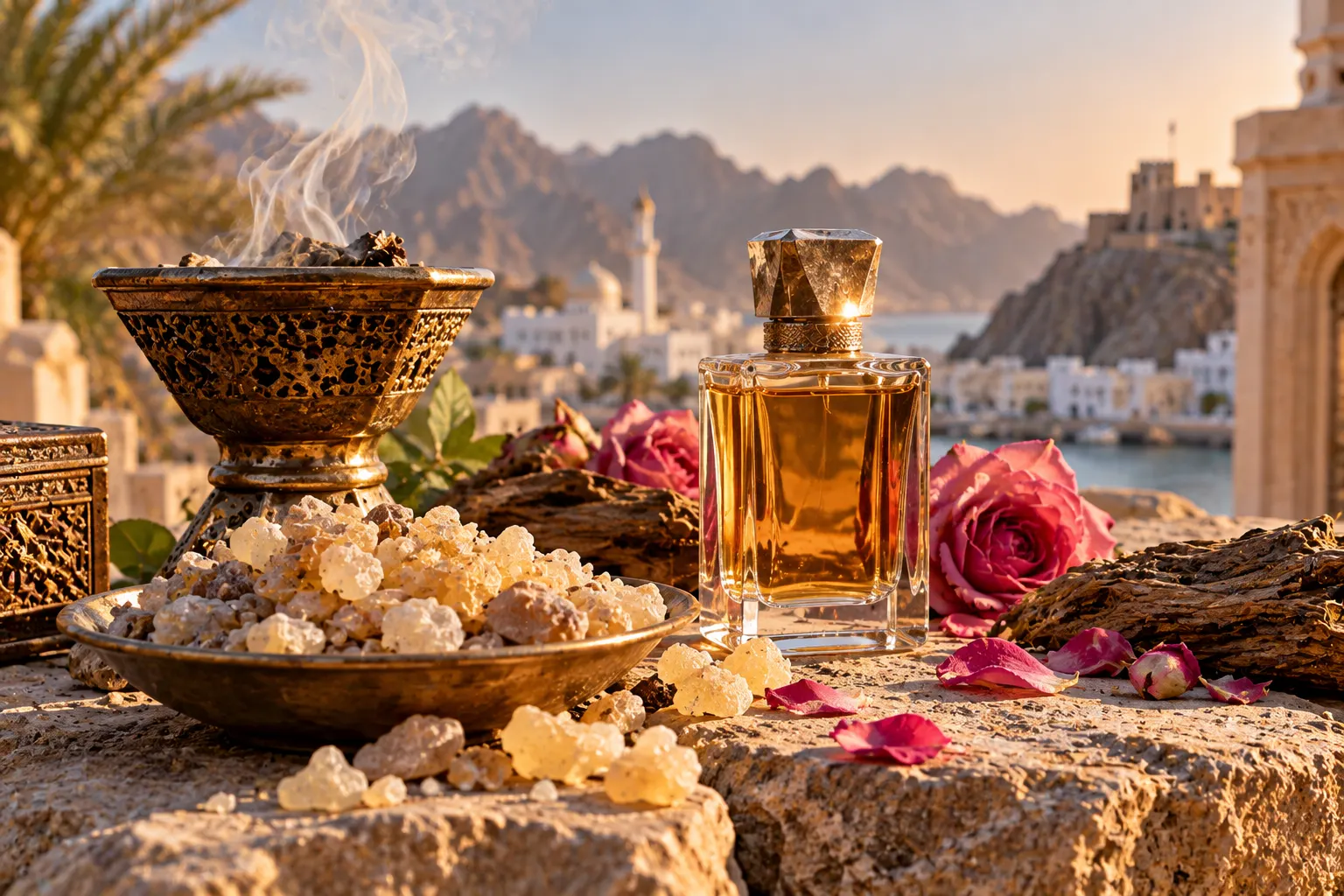
The Muscat factory makes the national claim physical
Amouage’s official site highlights its factory and visitor centre in Muscat, where visitors can see stages from ingredient selection and extraction through filling and packaging. Experience Oman also presents the centre as a place to understand perfume creation from sourcing to final production.
That local production matters to the story. ‘Omani brand’ becomes stronger when creation and manufacturing have a real base in Oman rather than only a national narrative attached to production elsewhere.
Wadi Dawkah is now entering the modern value chain
In 2026 Amouage described work at Wadi Dawkah to develop a traceable and sustainable sourcing methodology for Omani frankincense. The ambition is to connect tree, resin and bottle with more transparency.
This may be one of the most important modern chapters. Heritage becomes more credible when a luxury house takes responsibility for the living material at its source, not only for the story printed on packaging.
Then came another Omani house: OMANLUXURY
OMANLUXURY describes itself as an Omani fragrance house established in Muscat in 2012, founded by Muatasim Al Hinai and Muadh Al Sinawi. Its official story explicitly links contemporary fine perfumery with Oman’s centuries-old frankincense traditions.
This matters because a country’s perfume identity is stronger when it is not carried by one house alone. Amouage can be the landmark without being the entire map.
OMANLUXURY belongs to a different generation
Founded nearly three decades after Amouage, OMANLUXURY did not need to prove that an Omani luxury perfume house was possible. That door had already been opened.
Its opportunity was different: speak to a global niche-perfume audience that now actively seeks regional houses, strong storytelling and distinctive material identity. The market itself had changed.
Oman now has a perfume ecosystem larger than two brands
In January 2026, Oman News Agency reported that the sixth Oman Perfume Exhibition opened with more than 200 local, regional and international exhibitors. That is not proof that Oman dominates global perfumery, but it is evidence of an active fragrance market and growing sector.
I would therefore avoid saying Oman has ‘the biggest perfume houses in the world’. A better and defensible sentence is that Oman has produced internationally recognised luxury perfume houses and built a serious regional perfume culture around them.
Bakhoor and fine fragrance are not enemies
Traditional incense and modern eau de parfum often get placed on opposite sides: heritage versus sophistication. In Oman that division makes little sense. Frankincense, bukhoor and attar belong to the cultural background from which modern perfumery can draw.
The modern bottle does not replace the mabkhara. They answer different moments. One can sit in daily or ceremonial hospitality, the other on skin as an individual composition.
The danger is turning heritage into a perfume note list
Oman is more than frankincense, rose and amber. If every Omani perfume simply adds those ingredients and calls itself heritage, the idea becomes weak very quickly.
Real cultural depth comes from understanding materials, landscapes, craft, trade history and contemporary Omani taste. Heritage should shape creative thinking, not function as a checklist.
Why this belongs in the MESKI Journal
MESKI writes about honey, but the Journal was never supposed to be only about honey. Frankincense roads, gifts, hospitality, trees and perfume belong to the same wider world of materials carrying memory and value.
Our article on the Frankincense Roads of Oman follows the resin before the bottle. Our Trees of Oman article puts Boswellia sacra back among the country’s other trees.
From a royal gift to a modern industry
The most interesting thing is not that Oman created one famous perfume house. It is that a country with an ancient fragrance culture found a way to translate that inheritance into modern high perfumery, then saw a new generation of houses emerge after it.
That translation is never finished. If Oman continues protecting its materials, training talent and allowing new brands to speak differently, the perfume story can become larger than nostalgia.
The perfume story also belongs to hospitality
Omani fragrance culture is not only about personal scent. Frankincense and bukhoor participate in homes, visits, celebrations and the sensory memory of receiving people.
That social background helps explain why a perfume house conceived as a royal gift could make cultural sense. Fragrance already carried the language of honour and welcome.
Why ‘Gift of Kings’ worked
The phrase succeeded because it joined product positioning to actual patterns of gifting and royal hospitality. Museum accounts of early Amouage bottles presented by Sultan Qaboos to guests make the language more than an invented slogan.
Luxury becomes strongest when the marketing phrase has a real practice behind it.
A future beyond heritage
The next challenge for Omani perfumery may be to produce work that is recognisably Omani without always announcing frankincense in the first sentence. A mature perfume culture should be able to surprise itself.
Amouage and OMANLUXURY matter not because every fragrance smells traditional, but because they make it plausible for Omani creative identity to move in many directions.
One last MESKI rule
I would rather leave a documented limit visible than fill it with a perfect story. A tree can be real and a honey claim still need proof. A brand can be prestigious and a historical anecdote still need sourcing.
That distinction is part of the Journal’s voice. Curiosity is stronger when it is allowed to say: this is what we know, and this is where the evidence stops.
What makes the story worth publishing
The subject earns its place when it teaches something beyond the product: how a landscape works, how a gift carries meaning, how a material moves through history or how a beekeeper reads a season.
If the reader only remembers the jar, we have written an advertisement. If the jar becomes more interesting because the world around it is clearer, we have written MESKI.
One last MESKI rule
I would rather leave a documented limit visible than fill it with a perfect story. A tree can be real and a honey claim still need proof. A brand can be prestigious and a historical anecdote still need sourcing.
That distinction is part of the Journal’s voice. Curiosity is stronger when it is allowed to say: this is what we know, and this is where the evidence stops.
What makes the story worth publishing
The subject earns its place when it teaches something beyond the product: how a landscape works, how a gift carries meaning, how a material moves through history or how a beekeeper reads a season.
If the reader only remembers the jar, we have written an advertisement. If the jar becomes more interesting because the world around it is clearer, we have written MESKI.
Questions People Ask
Amouage was founded in Oman in 1983 and describes itself as a high perfumery house created by the Albusaidi family to be ‘The Gift of Kings’.
Amouage’s own help centre identifies Sayyid Hamad bin Hamoud Al Busaidi as the founder who proposed the idea to Sultan Qaboos.
Popular retellings sometimes say this, but Amouage’s help centre says Sayyid Hamad proposed the project to Sultan Qaboos, who supported the vision.
Amouage Gold was the founding fragrance released in 1983 and is associated with perfumer Guy Robert.
Frankincense is central to Oman’s fragrance heritage and appears across many Amouage compositions in different modern interpretations.
Amouage operates a factory and visitor centre in Muscat where production stages can be seen.
OMANLUXURY is an Omani fine fragrance house established in Muscat in 2012 by Muatasim Al Hinai and Muadh Al Sinawi.
Yes. The 2026 Oman Perfume Exhibition brought together more than 200 local, regional and international exhibitors.
No. Frankincense is an important heritage material, but modern Omani houses use a wide range of ingredients, styles and international perfumery techniques.
Follow Oman’s fragrance before and after the bottle
Continue through the Frankincense Roads and Trees of Oman, then return to Muscat where ancient materials became modern perfumery.