
Four trees open four different Omans: wadi, dry plain, Dhofar mountain and irrigated oasis.
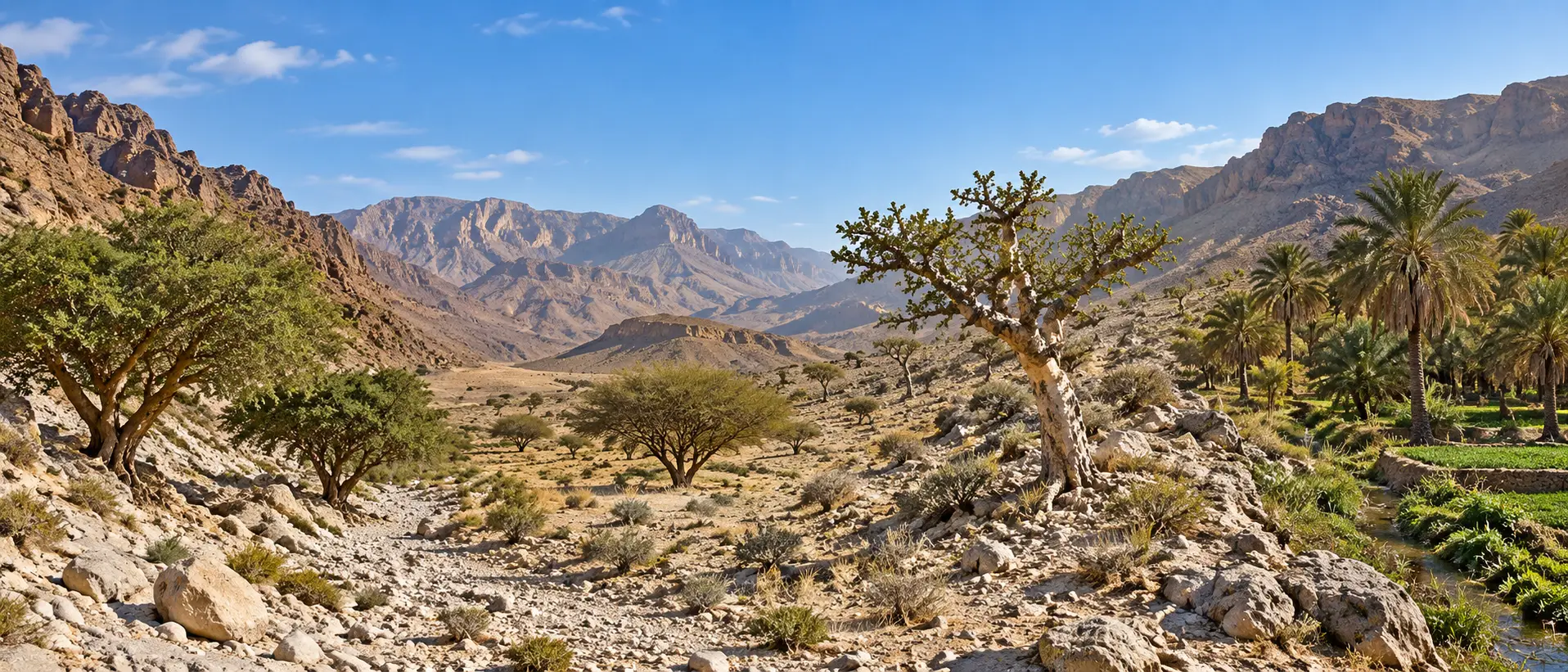
Oman becomes easier to understand when trees replace borders. Sidr asks us to look at wadis and farms. Samar asks us to understand heat. Frankincense pulls us south to Dhofar. The date palm brings us back to water, settlement and human engineering.
Four trees are enough to show why Oman cannot be read as one desert
Sidr, Samar, frankincense and the date palm do not occupy the same ecological role. One is associated with wadis and cultivated landscapes, another with dry acacia country, one with the rocky slopes and monsoon-influenced south, and one depends heavily on human water management. Put them together and Oman stops looking like one beige landscape.
This is why trees are such a useful way into the country. They force geography to become specific. Where is the water? How high are we? Is this a wild population or a cultivated grove? Which season matters? What can people harvest from the tree without destroying it?
Sidr: familiar name, local differences
Oman’s Environment Authority includes Sidr among the well-known wild trees used in national planting initiatives. Across the country, Sidr is valued for shade, fruit, traditional uses and, in some regions and seasons, nectar for bees.
But ‘Sidr’ is still a local name before it is a perfect taxonomic answer. Species and planted forms can vary, and the ecological context changes from northern wadis to farms and settlements. For honey, this is why a regional name should accompany the tree name whenever possible.
A country can share one flag and still contain several botanical worlds.
Meskaoui
Samar: built for heat and dry country
Samar belongs to the acacia world of Oman and appears in official environmental programmes as one of the country’s familiar wild trees. It thrives in harsh dry environments where flowering can become crucial forage for bees.
Commercially, Samar honey is one of Oman’s major harvests. That gives the tree a direct bridge between ecology and rural income. The tree is not important because honey brands discovered it. Honey became important because the tree was already part of the landscape.
Frankincense: a tree whose wound became world trade
Boswellia sacra is different. Its global fame comes from resin, not fruit or shade. In Dhofar the tree grows naturally on rocky slopes and dry wadis, and careful tapping produces the aromatic resin known as luban.
UNESCO’s Land of Frankincense connects the living tree at Wadi Dawkah with Shisr and the ancient ports of Khor Rori and Al Baleed. Few trees make the relationship between botany and trade history this visible.
The date palm is a cultivated ecosystem
Phoenix dactylifera should not be treated as just another wild desert tree. Its Omani story is inseparable from irrigation, settlement and human care. UNESCO’s inscription of date-palm knowledge and practices includes Oman, recognising not only the fruit but the skills and traditions around cultivation and use.
The aflaj systems make that relationship concrete. Water channels, shares and agricultural land allowed palms and other crops to survive in extremely arid conditions. A palm grove is therefore partly botanical and partly social engineering.
Altitude creates another Oman
Oman’s mountains add species and habitats that the four headline trees do not cover. The Environment Authority describes lower elevations in Jabal Akhdar with species including Sidr and Samar, while higher zones support wild olive and juniper-type forests.
This matters because any national tree article risks becoming a lowland article by accident. Oman rises sharply. Temperature, moisture and exposure change with altitude, and the flora changes with them.
Trees do not need to produce honey to deserve our attention. That would be a very convenient rule for us, but nature did not write it.
Meskaoui
Ghaf, Shua, Talha and the trees outside the headline
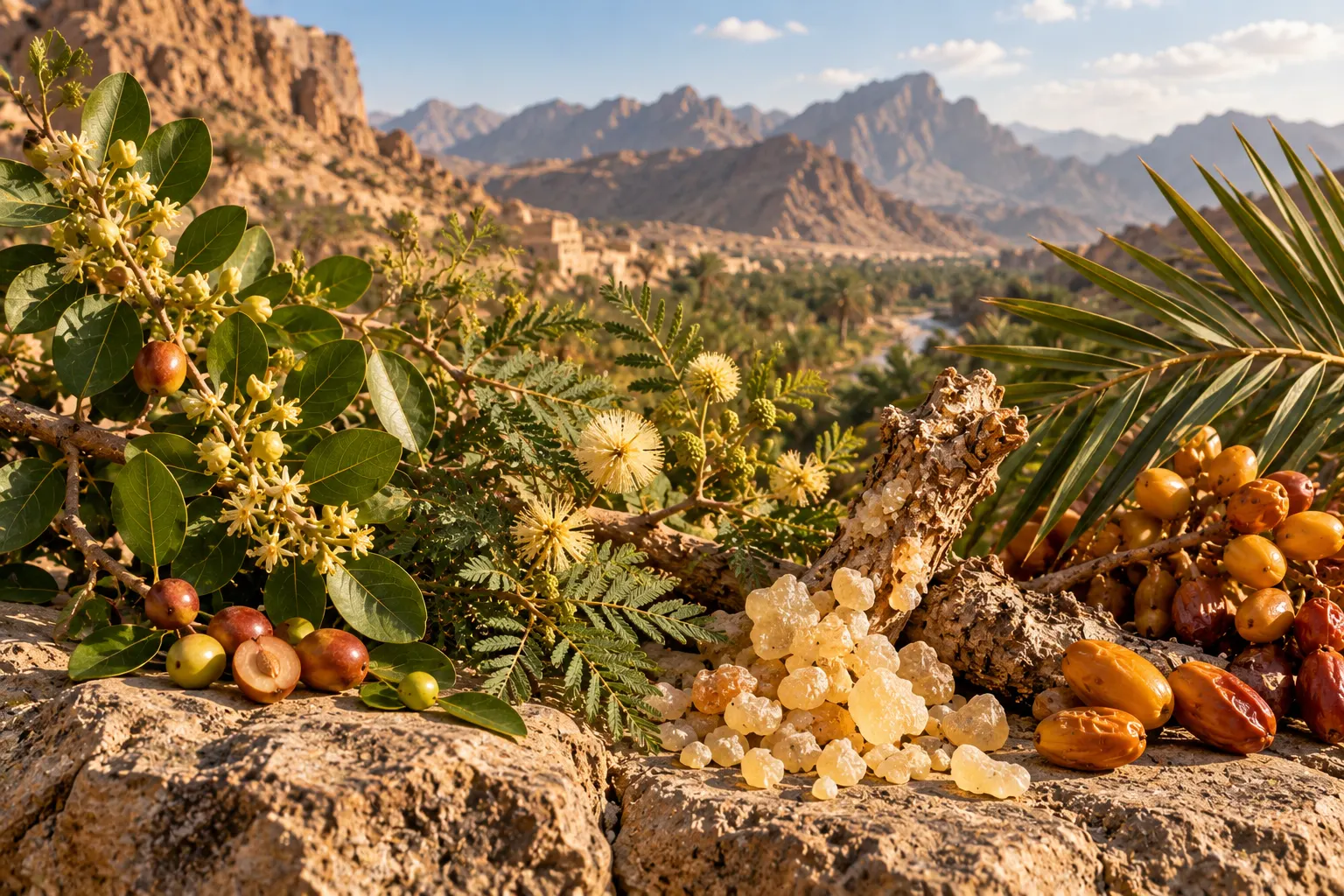
The Environment Authority’s wild-tree programmes also include Ghaf, Shua, Talha and other species. A reserve in South Al Sharqiyah protects Ghaf habitat alongside Samar, Sidr and seasonal vegetation.
I like keeping these names visible even if the article cannot give each one a full chapter. A tree atlas should grow over time. The first version should create doors, not pretend the house is complete.
Does every important tree produce honey?
No. This is one of the most useful lessons for MESKI. A culturally important tree may be wind-pollinated, may offer pollen more than nectar, may flower too sparsely for a monofloral harvest, or may be important for people for reasons that have nothing to do with bees.
Sidr and Samar are established honey plants. Boswellia sacra can support honey from its flowers according to Razat Royal Farm. The date palm may be visited by insects, but its cultural importance should not be distorted into a major monofloral honey claim. Trees do not need to become products to deserve an article.
What water changes
Water decides more than whether a tree survives. In an oasis it can support dense palms and cultivated vegetation. In a wadi, runoff can create temporary concentration of forage. In Dhofar, seasonal moisture changes the whole ecological rhythm. In high mountains, rainfall and cooler conditions open habitats unavailable on the plain.
This is why our earlier article When the Stars Decided Who Received the Water belongs naturally beside a tree atlas. Water management and vegetation are parts of the same historical system.
What people take from trees
Fruit, fodder, firewood, shade, resin, fibres, leaves, timber, fragrance and nectar are only part of the list. The value of a tree changes according to the community and period. Some uses are ancient, some modern, some declining and some returning through conservation projects.
We should also separate traditional medicinal use from medical proof. Oman has a deep heritage of plant use, and the Environment Authority highlights medicinal and aromatic plants, but heritage records do not automatically establish clinical effectiveness.
Conservation changes the modern story
Oman’s national initiative to plant millions of wild trees shows that tree history is not only about the past. Nurseries, seed collection, protected areas and replanting are part of today’s landscape management.
That matters especially for slow-growing or locally pressured species. A tree can be culturally familiar and ecologically vulnerable at the same time. Popularity is not protection.
The tree atlas should stay unfinished
Our future Honey Atlas and tree articles will eventually separate Sidr, Samar, frankincense, Ghaf, Moringa, juniper and more. This page is a map of doors rather than an encyclopedia.
That is intentional. The hub should make you curious enough to choose one tree and enter its world. The individual article can then ask about botany, altitude, water, history, trade, traditional use and, only if justified, honey.
A fifth tree changes the altitude story: juniper
High in the Hajar mountains, juniper-type woodland shows how far Oman’s vegetation can move from the lowland desert image. The Environment Authority describes these higher-elevation communities in Jabal Akhdar above lower zones containing Sidr and Samar.
Juniper is not included here because of honey marketing. It is included because altitude deserves a tree of its own.
Why the date palm belongs beside wild trees
A cultivated palm might seem out of place in a tree article that also discusses native wild species. I think the contrast is useful. It shows that landscapes are built by both ecology and human management.
Oman’s oasis vegetation is not less real because people channelled water toward it. Human care is part of the ecosystem history.
The conservation map is becoming part of the cultural map
Protected areas and national planting programmes are creating a new chapter in how Oman relates to trees. Seed collection, nurseries and habitat restoration may sound administrative, but they determine which species remain visible to the next generation.
Heritage without regeneration becomes a memory. Trees make that truth very literal.
A note on certainty
One rule matters across all MESKI field articles: separate what the source proves from what the landscape merely suggests. A flowering tree does not prove a monofloral honey. A famous market does not prove harvest origin. A mountain photograph does not prove remoteness.
This restraint can make the prose less dramatic, but it makes the story stronger. The reader should know where evidence ends and interpretation begins.
Why this matters commercially too
Good editorial work and good commerce are not enemies. A customer who understands season, tree and origin is more difficult to impress with empty packaging, but also more capable of appreciating a genuinely rare harvest.
That is the kind of customer MESKI should want. Authority built through careful explanation lasts longer than a slogan.
A note on certainty
One rule matters across all MESKI field articles: separate what the source proves from what the landscape merely suggests. A flowering tree does not prove a monofloral honey. A famous market does not prove harvest origin. A mountain photograph does not prove remoteness.
This restraint can make the prose less dramatic, but it makes the story stronger. The reader should know where evidence ends and interpretation begins.
Why this matters commercially too
Good editorial work and good commerce are not enemies. A customer who understands season, tree and origin is more difficult to impress with empty packaging, but also more capable of appreciating a genuinely rare harvest.
That is the kind of customer MESKI should want. Authority built through careful explanation lasts longer than a slogan.
A note on certainty
One rule matters across all MESKI field articles: separate what the source proves from what the landscape merely suggests. A flowering tree does not prove a monofloral honey. A famous market does not prove harvest origin. A mountain photograph does not prove remoteness.
This restraint can make the prose less dramatic, but it makes the story stronger. The reader should know where evidence ends and interpretation begins.
Why this matters commercially too
Good editorial work and good commerce are not enemies. A customer who understands season, tree and origin is more difficult to impress with empty packaging, but also more capable of appreciating a genuinely rare harvest.
That is the kind of customer MESKI should want. Authority built through careful explanation lasts longer than a slogan.
Questions People Ask
Sidr, Samar, Boswellia sacra frankincense and the date palm are four major examples, alongside Ghaf, Shua, Talha, juniper, wild olive and others.
Sidr is part of Oman’s wild and cultivated landscapes and is included among native-tree planting priorities, though precise species and local forms should be identified carefully.
Samar is a local name associated with drought-adapted acacia-type trees important for forage, shade and major Omani honey harvests.
Boswellia sacra grows naturally in Dhofar, especially on rocky slopes and dry wadis.
They are central to oasis agriculture, food, crafts and settlement, and their cultivation is closely linked to irrigation systems such as aflaj.
Razat Royal Farm states that honey is produced from Boswellia sacra flowers in Dhofar.
No. Botanical importance and honey production are different questions. Nectar quantity, flowering density and bee access all matter.
The Environment Authority describes wild olive and juniper-type woodland at higher parts of Jabal Akhdar, with different species at lower elevations.
National programmes aim to conserve biodiversity, expand native vegetation, combat desertification and restore suitable species to appropriate habitats.
Choose a tree and enter its world
Use this page as a doorway into Oman, then follow Sidr, Samar, frankincense and the date palm into their own landscapes.