
On 2 December, do not only look at the flags. Follow the roads.
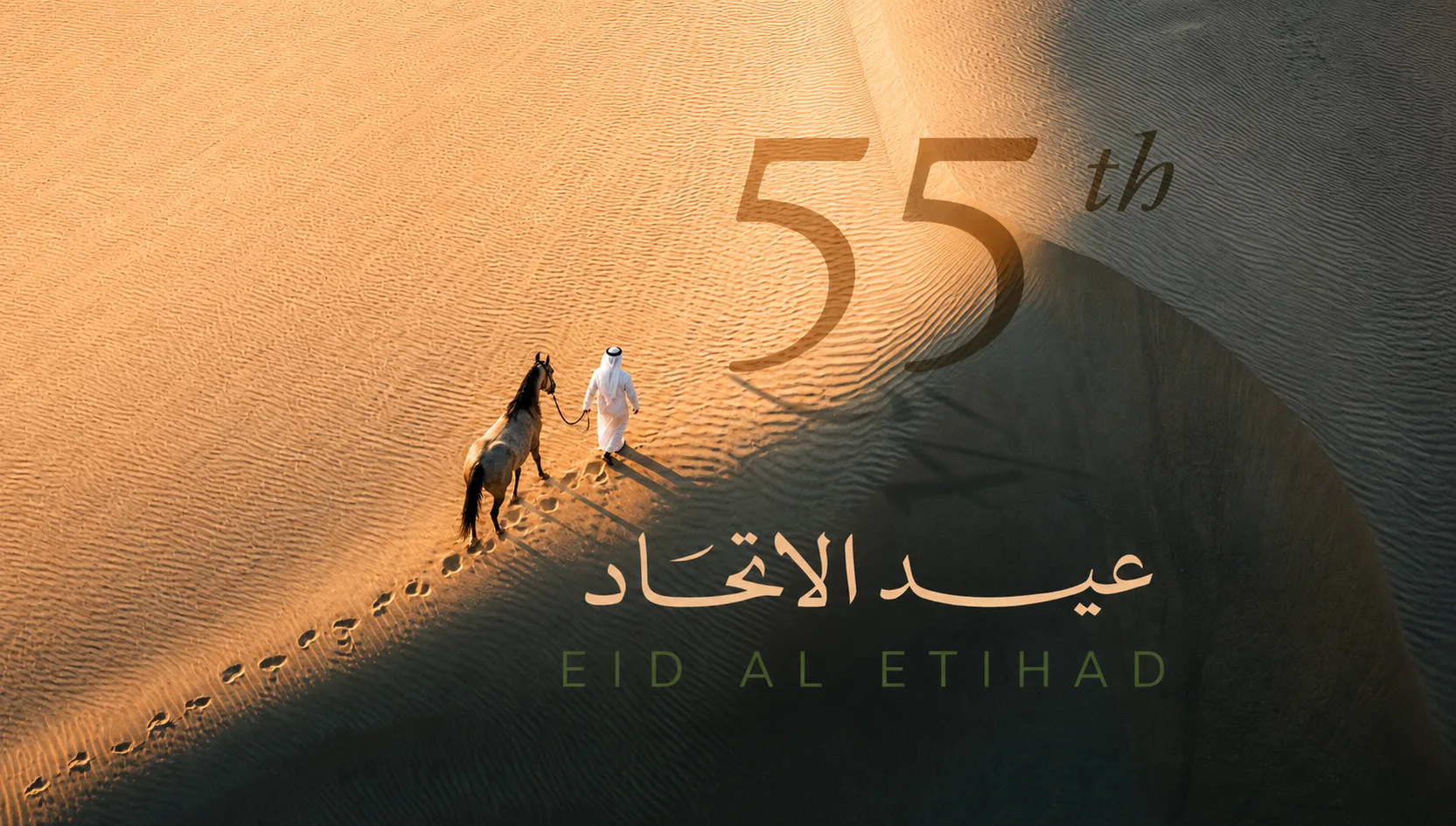
There is a moment every year when the UAE seems to become even more UAE.
Flags appear on balconies. Cars wear the colours of the nation. Children carry them. Buildings light up. Families prepare to go out. Fireworks are discussed before anyone has even decided where to watch them.
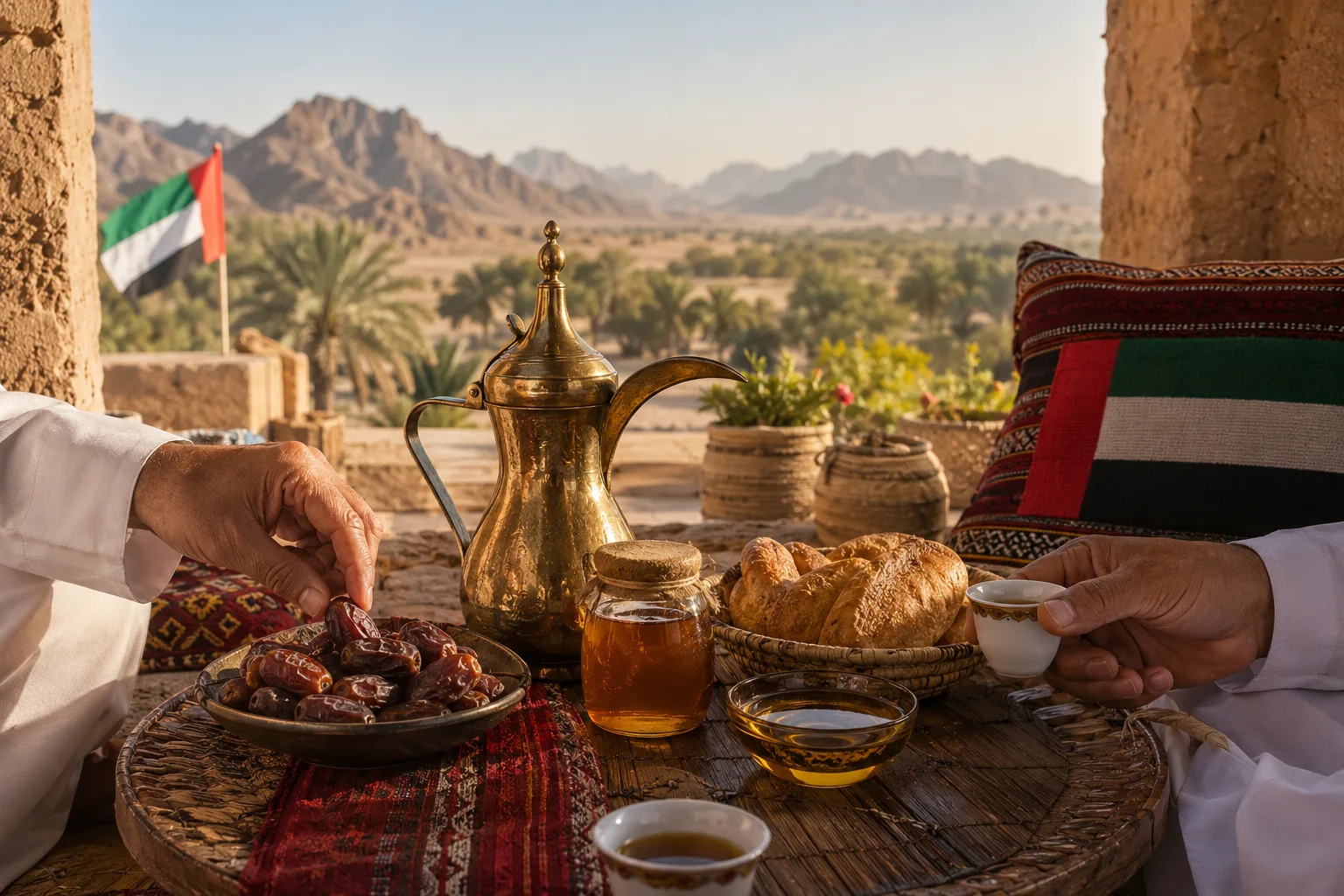
Coffee is poured. Dates appear on tables. Someone inevitably asks where everyone will meet.
And on 2 December 2026, the United Arab Emirates will celebrate fifty-five years since the formation of the federation in 1971.
Today, the celebration is increasingly known by the name that perhaps says it best: Eid Al Etihad.
The celebration of the Union.
But whenever I hear those words, I think of something very simple. A union only becomes interesting when you look at what was united. Not one landscape. Seven. Not one rhythm. Seven. Not one road. Many roads meeting one another.
So for Eid Al Etihad 2026, I do not want to remain underneath the fireworks in Downtown Dubai.
Come. Take the car. We have seven Emirates to cross.
Before the towers, there was the Union
It is easy today to look at the UAE and imagine that everything was inevitable. Dubai was always going to become Dubai. Abu Dhabi was always going to become Abu Dhabi. Airports, highways, ports, museums, islands, skyscrapers and millions of residents from around the world somehow appear to belong naturally to the landscape.
History is rarely that simple.
The federation formally began in 1971.
And this is perhaps the first thing worth remembering during Eid Al Etihad. The celebration is not simply the birthday of a modern country. It is the memory of a political decision: to build together.
That distinction matters. Because once you leave the city centres and begin travelling across the Emirates, you realise how different the pieces actually are.
Abu Dhabi alone moves from islands and mangroves to Al Ain’s oasis and the enormous desert landscapes of Al Dhafra. Sharjah reaches from the Gulf side toward Khorfakkan and Kalba on the eastern coast. Fujairah faces the Gulf of Oman beneath the Hajar Mountains. Ras Al Khaimah rises toward mountains. Ajman is the smallest emirate. Umm Al Quwain slows toward mangroves, coast and older rhythms. Dubai can take you from Sheikh Zayed Road to Hatta.
Seven Emirates. One federation. That is already a remarkable story.
1. ABU DHABI: Where the Union has room to breathe
If I had to begin an Eid Al Etihad journey somewhere, Abu Dhabi would make sense. Not because it is the largest. Not because it is the capital. Because Abu Dhabi forces you immediately to abandon the idea that an Emirate is simply a city.
Drive through Abu Dhabi city and you have towers, the Corniche, mosques, islands and modern architecture. Continue. The landscape changes. Mangroves. Desert. Oasis. Mountains.
Three worlds inside one Emirate. And that is before we have reached number two of seven.
Al Ain: the green surprise
I have always liked places that contradict the image people had before arriving. Al Ain does that.
You are in a desert country. Then suddenly: palms, shade, water, farms. An oasis.
Stand beneath those palms during an Eid Al Etihad journey and the UAE story changes again. Because suddenly the date on the celebration table is no longer merely a sweet fruit beside the Arabic coffee. It becomes agriculture. Water management. Patience. Generations. Survival. A landscape transformed carefully enough to feed people.
That is also the UAE.
Al Dhafra: when the country becomes enormous
Then travel west. Here the skyline disappears. Good. Sometimes we need it to disappear.
The desert gives scale differently. A skyscraper tells you what humans can build. A dune tells you how small you remain.
Both can be beautiful. But they speak different languages. And for me, Eid Al Etihad needs both.
2. DUBAI: The Emirate everybody thinks they already know
Dubai has a strange problem. It is so famous that many people stop discovering it.
They arrive knowing the photographs they want. Burj Khalifa. Palm Jumeirah. Dubai Marina. Burj Al Arab. Downtown. Maybe the Museum of the Future. Perhaps Deira if somebody told them to see old Dubai.
And yes, go. I still enjoy looking up. I still enjoy architecture. I still enjoy the madness of seeing an idea become a building and then watching somebody decide the next building must be even more impossible.
Why pretend otherwise? Luxury can be enjoyable. A beautiful hotel can be enjoyable. A restaurant can be excellent. A swimming pool overlooking the Palm can make somebody genuinely happy. Good. Enjoy it.
But Dubai becomes more interesting when you refuse to stop there.
Follow the Creek
Before another observation deck, go toward the Creek. Watch the abras. Walk. Look at the shops. Listen. Smell spices. Oud. Perfume. Food. Tea. Coffee.
Old trading districts remind us that Dubai did not suddenly discover international commerce when the skyscrapers arrived. Movement was already part of its character.
People came. Goods came. Stories came. And they left again. Honey does the same.
A jar of Yemeni Sidr honey can arrive in Dubai. An Omani honey can arrive. Saudi honey can arrive. Moroccan honey can arrive.
But, as our little bee taught us recently: Yemeni Sidr sold in Dubai does not become Dubai honey.
Then leave Dubai while remaining in Dubai
Drive toward Hatta. The glass begins to disappear. Mountains enter.
And suddenly the phrase Emirati honey acquires another landscape. Sidr. Bees. Farms. Rock. Mountain air.
The Dubai most people came to photograph is far behind you. Yet you are still in the Emirate of Dubai.
This is exactly why I love the idea of seven landscapes for Eid Al Etihad. Even one Emirate refuses to remain one landscape.
A small cup of coffee between Emirates
We stop. Someone pours Arabic coffee. There are dates. Maybe bread. Maybe honey. Nothing extraordinary.
And yet I have increasingly come to believe that countries are understood in moments like these. Not only inside museums. Not only during official ceremonies. Around tables.
The dallah passes from hand to hand. A small finjan is filled. Conversation begins. Someone insists you eat. You say you already ate. They insist again.
Now we are discussing serious Gulf diplomacy. Hahaha.
Hospitality does not need a national celebration. But a national celebration reminds us how deeply hospitality belongs to the social fabric.
3. SHARJAH: The Emirate that asks you to read
If Dubai often makes me look upward, Sharjah makes me slow down. Museums. Heritage. Books. Archaeology. Architecture. Family spaces. Culture is not decoration here. It is part of the Emirate’s identity.
And Sharjah also destroys another lazy idea about the UAE: that everything began recently.
At Jebel Faya, archaeological evidence reaches extraordinarily far into human history. Think about that during Eid Al Etihad. The federation is fifty-five years old in 2026. Human presence on this land reaches unimaginably further back.
Modern nation. Ancient land. Both truths can sit beside each other.
And Sharjah crosses the mountains
Then there is another surprise. Khorfakkan. Kalba. The east coast.
Sharjah is not geographically one simple block around Sharjah city. Cross toward the Gulf of Oman and the landscape changes dramatically. Mountains descend toward the sea. Kalba brings mangroves and wildlife. Khorfakkan brings coast and mountain together.
Again: one Emirate. Several worlds.
4. AJMAN: Small does not mean empty
Ajman is the smallest Emirate. And perhaps because of that, people travelling through the UAE can treat it like punctuation between bigger names.
Dubai. Sharjah. Ras Al Khaimah. Wait. You missed one. Ajman.
I like that. Because not everything valuable needs to shout.
The coast has its own rhythm. Then Ajman’s territory surprises again around Masfout, where mountains replace the coastal landscape.
This is what our Eid Al Etihad road trip keeps teaching us. The Emirates do not line up neatly according to the stereotypes we give them.
Small Ajman has mountains. Dubai has mountain villages. Abu Dhabi has an oasis. Sharjah reaches another coast. The map keeps laughing at us. Maybe our bee drew it.
5. UMM AL QUWAIN: Sometimes the luxury is that nothing is rushing you
Now slow down. Really.
Umm Al Quwain does not need to become Dubai. That sentence matters.
Development too often gets imagined as a race toward sameness. Bigger. Higher. Busier. More expensive. More photographed.
But what if the value of a place is partly that it preserved another rhythm?
Umm Al Quwain offers coast, water, mangrove environments and Emirati heritage. For me, this belongs in an Eid Al Etihad article precisely because it would be easy to leave it out.
Seven Emirates means seven. Not Dubai plus Abu Dhabi plus five names in smaller letters. Seven. Union becomes meaningless if we celebrate only the members we already know.
6. RAS AL KHAIMAH: Look up again, but this time at a mountain
We have spent enough time looking at towers. Now lift your head toward rock.
Ras Al Khaimah changes the scale again. Mountains. Wadis. Desert. Coast. Old settlements. Agriculture. And the great mountain presence of Jebel Jais.
This is another UAE that first-time visitors sometimes do not expect. You can begin a morning near the sea and later find yourself climbing through mountain roads. The temperature changes. Vegetation changes. The colour of the land changes.
And if you are writing about honey, this matters. Because bees do not forage inside our tourism slogans. They forage inside ecosystems. Different elevation. Different plants. Different flowering windows. Different water availability.
Remember our bee? I can already hear her. “Finally. Flowers again.” Yes. Flowers again.
7. FUJAIRAH: The Emirates turn toward another sea
And finally we reach Fujairah. The orientation changes. Fujairah faces the Gulf of Oman.
Mountains meet coast. Old forts remain in the landscape. Fishing, sea and mountain histories become part of the story.
If you began our journey beneath Abu Dhabi’s skyline, crossed Dubai, climbed toward Hatta, travelled through Sharjah, slowed in Ajman and Umm Al Quwain, looked upward at Ras Al Khaimah’s mountains and finally reached Fujairah’s eastern coast, now look at the map again.
This is what was united.
Seven Emirates, but not seven boxes
It is tempting to write: Abu Dhabi equals desert. Dubai equals skyscrapers. Sharjah equals culture. Ajman equals small. Umm Al Quwain equals quiet. Ras Al Khaimah equals mountains. Fujairah equals sea.
Nice. Simple. Wrong.
Abu Dhabi also has islands, mangroves, oasis agriculture and mountains. Dubai also has Creek history and Hatta. Sharjah also has desert, mountains, mangroves and an eastern coastline. Ajman has Masfout. Ras Al Khaimah has coast. Fujairah has agriculture and mountain settlements.
The UAE becomes richer when the boxes fail.
Eid Al Etihad is not only fireworks
Do I enjoy fireworks? Of course. Put me somewhere with a good view and I will look up with everybody else.
But if we reduce Eid Al Etihad 2026 to fireworks schedules, hotel offers and shopping promotions, we lose the most interesting part.
The day asks a deeper question: What does Union mean?
For the founding generation, it was political and practical. For later generations, it became inheritance. For residents who arrived from dozens of countries, it can mean something else again: the place where children were born, businesses were built, friendships formed, families grew and memories accumulated.
The UAE is young as a federation. Yet millions of lives have already attached themselves to it.
The table of the Union
Now imagine our seven-Emirate journey returning to one table.
Arabic coffee. Dates. Bread. Rice. Meat. Sweets. Perhaps honey. Perhaps somebody brought something from Oman. Someone else brought Yemeni Sidr. Another jar came from Hatta. A family member brought perfume. Another brought oud.
Children are moving too quickly around the room. Someone is telling them to sit down. Nobody listens. Now this feels realistic. Hahaha.
The beautiful thing is that hospitality does not require every object on the table to have been produced within one border. The Gulf has always exchanged. Food moves. People move. Perfume moves. Spices move. Honey moves. Traditions influence one another.
Identity does not become weaker because people share. Sometimes it becomes clearer.
Emirati coffee, dates and the art of receiving someone
If there is one scene I would place beside all the spectacular Eid Al Etihad images, it is much quieter.
A guest enters. Coffee is offered. Dates are nearby. Sit. Talk. Eat. Have another. No, really. Another. Hahaha.
The majlis represents something architecture alone cannot explain: relationship.
You can build an extraordinary room and still fail at hospitality. You can sit on a simple carpet and make somebody feel honoured.
Luxury and hospitality are not synonyms. I enjoy luxury. But I refuse to give it ownership of generosity.
And yes, there can be honey
We sell honey. So eventually someone will expect me to mention it. Here it is. Hahaha.
Honey belongs naturally beside dates, bread, coffee, gifts and hospitality. The UAE also has genuine local beekeeping traditions and floral environments, particularly around areas such as Hatta and other suitable landscapes.
Sidr. Samar. Ghaf.
But Eid Al Etihad should not become an excuse for me to turn every paragraph into BUY EMIRATI HONEY UAE BEST HONEY DUBAI GOLD SIDR HONEY EMIRATES. Our bee would resign.
Instead, honey can do what food often does best. Sit quietly on the table until somebody reaches for it.
A gift should say: I thought about you
Eid Al Etihad gifts will appear everywhere. Corporate gifts. Family gifts. Luxury gifts. Perfume. Oud. Dates. Chocolate. Coffee. Honey. Beautiful boxes. Gold. Ribbons. Logos.
There is nothing wrong with any of that. But I think the best gift still contains one invisible ingredient: attention.
Why this person? Why this object? Why this origin? Why this presentation?
A gift becomes memorable when the answer is better than: because it was expensive.
The UAE’s two luxuries
I have written before about two kinds of luxury.
The first is obvious. A suite overlooking the Palm. A table in a beautiful restaurant. A spectacular lobby. A supercar passing outside. Architecture designed to make you stop. Dubai and Abu Dhabi know how to produce that feeling extraordinarily well. Enjoy it. I do.
But there is another luxury. Desert silence. A horse. A camel. Stars. A fire. Coffee. Bread torn with your fingers. Olive oil. Honey. A conversation without checking the time.
For me, the second one often wins. For me. That matters.
Maybe you reading these words would be infinitely happier beside a swimming pool overlooking Palm Jumeirah. Hahaha. Then go. Enjoy it. My richness does not need to become yours. And yours does not threaten mine.
Perhaps that is another small lesson hidden inside a Union.
2 December: look at the people too
National celebrations naturally produce symbols. Flags. Colours. Music. Fireworks. Military displays. Decorations.
But look slightly lower than the fireworks. At the families. Grandparents. Children. People taking photographs. Workers finishing shifts. Shopkeepers. Drivers. People born here. People who arrived last month. People who arrived thirty years ago.
The country exists in institutions and borders. But daily life exists in people.
And countries become emotionally real through ordinary repetition. The road to work. The bakery. The mosque. School. A neighbour. Friday lunch. A favourite beach. A mountain visited every winter. A coffee shop where somebody already knows the order.
Home is often built from small habits before we realise we have built it.
What should you do for Eid Al Etihad 2026?
I could give you the usual list. Watch fireworks. Visit heritage villages. Go to concerts. See decorations. Visit malls. Attend cultural events. Enjoy family activities.
And yes, once official Eid Al Etihad 2026 events are announced closer to December, choose whatever makes you happy.
But I want to suggest something else. Discover one piece of the UAE you have never seen.
If you live in Dubai, go beyond Dubai. If you know Abu Dhabi city, go toward Al Ain or Al Dhafra. If you have never visited Umm Al Quwain, why not? If Fujairah is only a road sign to you, follow it. If you think Sharjah means only Sharjah city, cross toward Khorfakkan or Kalba. If Ras Al Khaimah means only a hotel weekend, look beyond the hotel. If you have never been to Hatta because “I already know Dubai,” then perhaps you do not know Dubai yet.
That seems a beautiful way to celebrate a federation. Meet another member of it.
Fifty-five years is young
In 2026, the federation turns fifty-five. For a country, that is young. Some people alive today remember the years around its creation.
Think about that. The photographs are not ancient. The voices are not lost to some unreachable millennium.
Modern UAE history still overlaps living memory. And yet the physical transformation has been extraordinary.
This should make us curious rather than merely impressed. How did people live? How did water shape settlements? Where were the date palms? How did people move? What did coastal communities trade? What did mountain communities grow? What foods travelled? What changed? What remained?
A country becomes more interesting when we stop treating its history as the introduction before the skyscrapers.
Before oil, there were already lives
The phrase “before oil” can itself become lazy. As though nothing existed. Then oil arrived. Then history began.
No.
People lived. They traded. Fished. Dived for pearls. Raised animals. Cultivated dates. Moved through desert and mountain environments. Built settlements. Maintained family networks. Practised hospitality. Prayed. Married. Raised children. Buried parents. Remembered stories. Survived difficult years.
The modern UAE did not replace emptiness. It transformed societies that already had histories.
That distinction deserves respect.
The palm tree understood the UAE before we did
I keep returning to the date palm. Perhaps because it is such an extraordinary symbol for this region.
Look at it. Heat. Dryness. Salt in some environments. Limited water. And still: shade, fruit, material, life.
The palm does not deny the desert. It negotiates with it.
There is something very Emirati in that. Not defeating the environment. Learning where possibility exists inside it.
Our bee returns
I knew she would.
We were somewhere between a coffee cup and a Sidr tree when she appeared.
“Seven countries today?”
“Emirates.”
“Same thing?”
“No.”
“Seven Emirates. One country.”
She landed. “Humans again.”
“Yes.”
“Did the bees vote?”
“No.”
“Did the Sidr trees?”
“No.”
“Then why should I care?”
I thought for a moment. “Because people decided they could build more together than separately.”
She looked toward the flowers. “Did it work?”
I looked at the roads, cities, farms, ports, schools, hospitals, airports, families and millions of lives that now occupy this small corner of Arabia.
“I think you can decide.”
She flew away. Probably toward the flowers. Always the flowers.
Seven landscapes. One table.
At the end of our journey, I do not want seven winners.
I don’t want: Best Emirate 2026. Hahaha. Please no.
Dubai does not need to defeat Abu Dhabi. Abu Dhabi does not need to defeat Sharjah. Ras Al Khaimah does not need taller towers. Fujairah does not need Dubai’s coastline. Umm Al Quwain does not need to become busier to prove it matters. Ajman does not need to become larger. Sharjah does not need to become louder.
Each contributes something precisely because each is not identical.
Maybe that is the simplest definition of a successful union: difference without separation.
If you come for Eid Al Etihad 2026
Come for the celebration. Enjoy the flags. Watch the fireworks. Take photographs. Eat. Drink coffee. Buy a gift if you want. Wear the colours. Let the children enjoy themselves.
But if you have time: drive. Leave the most obvious road. See an oasis. See a mountain. See mangroves. See the eastern coast. Walk through an old neighbourhood. Sit in a majlis. Listen to someone older than you. Ask how things were. Try food you did not plan to try. Drink the coffee even if it is different from yours.
And if somebody offers you honey, ask where the flowers were. Hahaha. Our bee would appreciate that.
Eid Al Etihad
Fifty-five years. Seven Emirates. One UAE.
But perhaps numbers are not enough.
A federation cannot be understood only from the date it was declared. You understand it by travelling through what it brought together.
Abu Dhabi’s scale. Al Ain’s palms. Al Dhafra’s dunes. Dubai’s impossible ambition and Hatta’s mountains. Sharjah’s memory and eastern coast. Ajman’s quieter corners. Umm Al Quwain’s slower water. Ras Al Khaimah’s rock. Fujairah looking toward another sea.
Then return to the table. Coffee. Dates. Family. Guests. Stories. Maybe honey.
And suddenly the flag above you is no longer an abstract symbol. You have travelled through some of what it represents.
Meskaoui
“A union is not beautiful because everyone becomes the same. It is beautiful when different landscapes can share the same horizon.”
— Meskaoui
Do not spend the entire celebration looking at the sky
If there is one thing I would wish for anyone celebrating Eid Al Etihad 2026, Emirati or not, it is this: do not spend the entire celebration looking at the sky.
The fireworks will be beautiful.
But look around too.
There is an entire country underneath them.
Seven Emirates. Seven landscapes. One UAE.
And we have barely discovered it.
Continue the Journey
If this story brought you here, continue the journey through related stories from The House of Meski.