
I started with a simple question about an old souk and ended up thinking about palaces, gold coffee, hospitality and what luxury really means in Abu Dhabi.
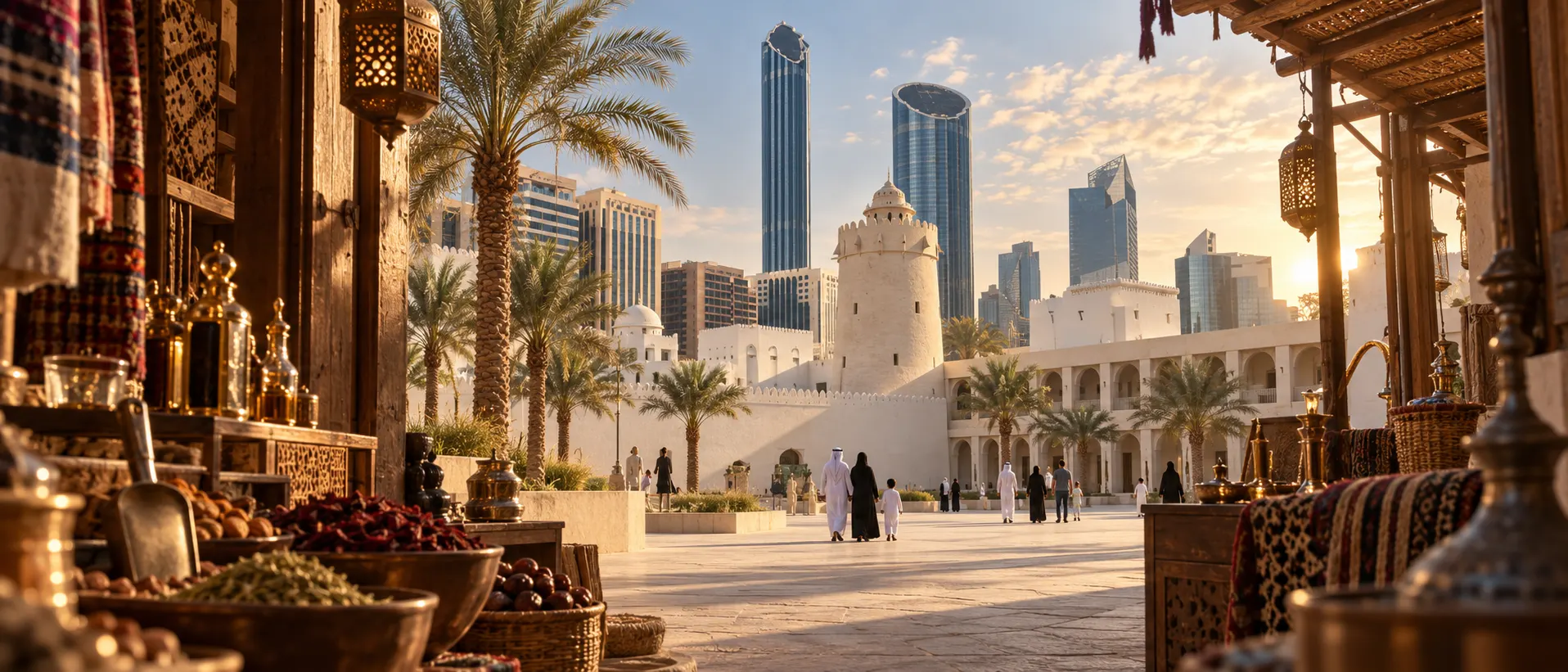
I was not looking for luxury when this journey began. I was looking for a souk. Not a mall with a few arches added for decoration, but somewhere that could still give me a feeling of the older trading city: perfume, spices, fabrics, coffee, people talking, perhaps something made by hand, and that particular pleasure of walking without knowing exactly what you are going to buy. In Abu Dhabi, that simple search quickly became something larger.
I Was Looking for a Souk, Not a Palace
Dubai makes certain kinds of discovery easy because old trading districts such as Deira and the Creek remain visually present. Abu Dhabi asks you to look differently. The capital is wider, calmer in many places, and its history is not always arranged along one obvious tourist path. I had the simple desire to find a traditional souk and see what remained of that atmosphere.
The first useful lesson is that the word “traditional” needs honesty. A place can preserve the feeling of a souk without being an untouched market from a century ago. The World Trade Center Souk, for example, stands on the story of Abu Dhabi’s old Central Market but is a contemporary reimagining. It mixes traditional forms with a modern commercial setting. I actually find that tension interesting rather than disappointing, because it says something about Abu Dhabi itself.
You can walk among perfumes, jewellery, textiles and spices, then step back into a capital of glass towers, broad roads and international hotels. The transition is fast. Tradition has not vanished; it has been reorganised, polished, sometimes reconstructed and sometimes protected with much greater care than before.
Qasr Al Hosn Changes the Question
If the souk makes you ask what has been preserved, Qasr Al Hosn gives the city a firmer historical anchor. It is Abu Dhabi’s oldest and most significant building, built around the city’s first permanent watchtower. Long before the skyline, the site watched over a growing coastal settlement tied to fishing, pearling and maritime trade.
This matters because Abu Dhabi can look so new that a visitor may unconsciously imagine the story began with oil, airports and towers. Qasr Al Hosn corrects that impression. It has been a fort, a home of the ruling family, a seat of government and, later, a national monument. The city around it changed almost beyond recognition, but the walls remained to tell a slower story.
For Meski, places like this are always more interesting than a perfect postcard. We work with products that also carry two lives at once: honey is ancient and ordinary, yet it can be presented today in a highly refined way. The old thing does not disappear simply because the setting around it changes.
Then the City Opens Toward the Corniche
From the older centre, Abu Dhabi gradually opens toward the sea. The Corniche stretches for kilometres along the waterfront, but what interests me is less the measurement than the change in atmosphere. The horizon becomes wider. Families walk. People cycle. Children play. Cafés and landscaped spaces soften the scale of the capital.
This is where Abu Dhabi begins to show one of its most attractive contradictions. The city can be monumental without feeling continuously rushed. There are large roads, large buildings and enormous investments in architecture, yet the sea keeps interrupting the urban ambition. You can look at a five-star hotel and then turn your head toward someone simply walking by the water.
Follow the Corniche west and the architecture becomes increasingly ceremonial. The St. Regis Abu Dhabi appears along Corniche Road. Continue toward West Corniche and the cluster around Conrad Abu Dhabi Etihad Towers, Bab Al Qasr and Emirates Palace creates a very different mood from the older market streets. This is not the Abu Dhabi I was originally searching for, but by now I had stopped trying to force the city into one category.
When Hotels Become Part of the Landscape
In many cities, luxury hotels are private islands that you deliberately enter. In this part of Abu Dhabi they also act as landmarks. Etihad Towers rise beside the Corniche as a complete complex of residences, offices, shopping and a five-star hotel. The St. Regis brings another interpretation of international luxury. Bab Al Qasr mixes contemporary scale with Arab and Moroccan-inspired design. Then Emirates Palace changes the visual language again.
I would not turn this into a ranking of luxury hotels. That misses the point. What is interesting is how close these different forms of prestige sit to the sea, to public roads and to places carrying older layers of Abu Dhabi’s story. A few kilometres can move you from the memory of a traditional market to architecture built to receive presidents, delegations, business travellers and families celebrating important occasions.
That is also why the area naturally raises the subject of gifts. Hotels like these host weddings, corporate meetings, diplomatic visits, dinners and private celebrations. A gift here can be expensive, but it does not have to be. The real question is whether it feels chosen for the person receiving it.
The Famous Coffee with Gold
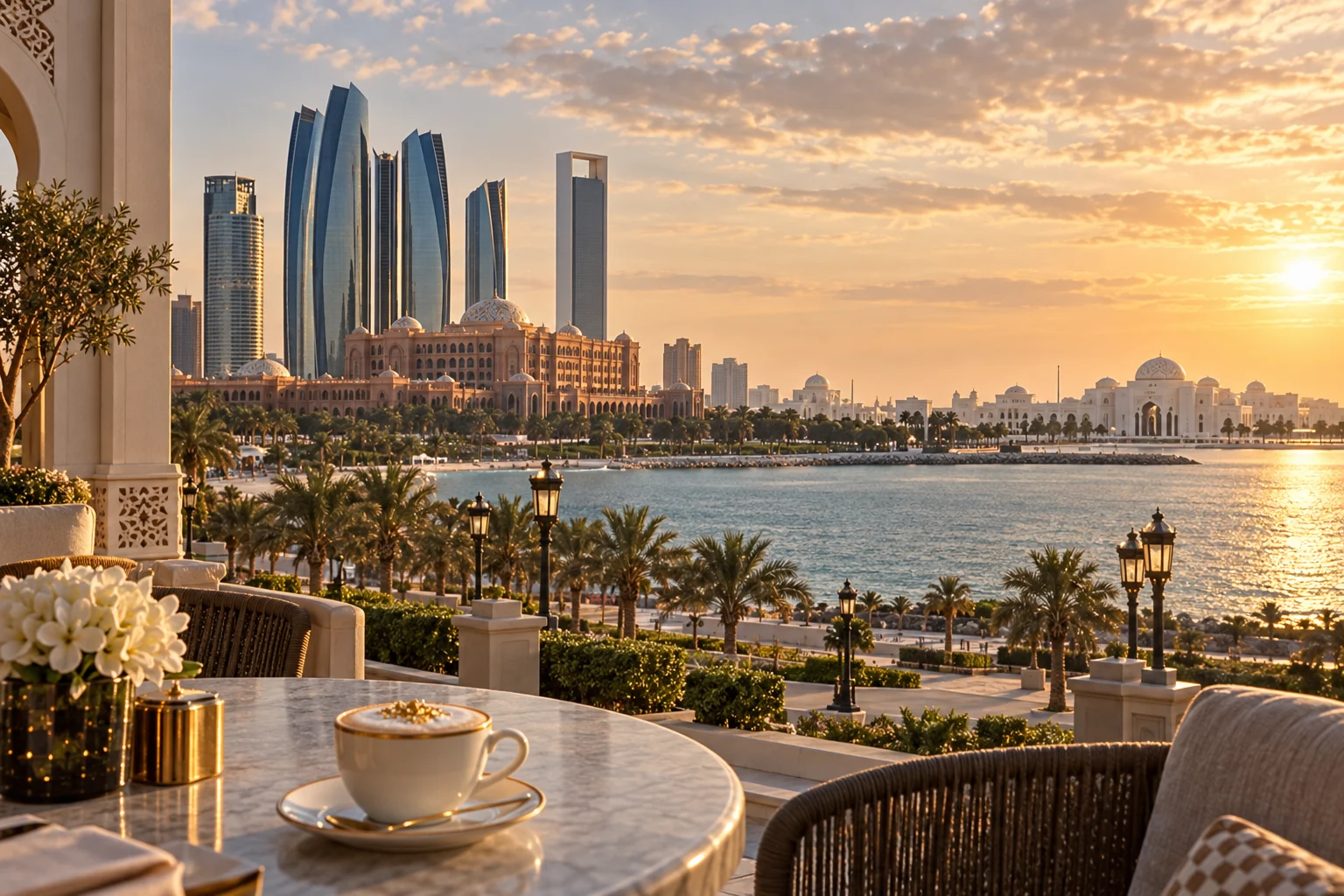
Emirates Palace has long been associated with one small detail that visitors remember almost as much as the building itself: coffee decorated with edible gold. The gold-sprinkled cappuccino became one of those Abu Dhabi experiences that sounds excessive until you place it inside the setting. Marble, domes, chandeliers, ceremonial scale and then, naturally, a little gold on the coffee.
It makes me smile for another reason. At Meski, we put edible 23-carat gold in honey. Not because honey needs gold in order to be good. A beautiful raw Sidr should be able to stand on its own. The gold belongs to another language: celebration, presentation, gifting and the pleasure of making an ordinary gesture feel extraordinary.
Coffee and honey have something else in common. Both can be served in the simplest home and in the grandest palace. The cup may change. The spoon may change. The box may become more elaborate. But the underlying gesture is familiar: I have something good, and I want to place it in front of you.
Gold Does Not Create Meaning by Itself
This is where I would resist the easy conclusion that luxury is simply a matter of adding gold. Gold can be beautiful. It can also be empty if the product underneath it has no story, quality or purpose. The same is true of an expensive hotel, an expensive perfume or an expensive gift.
A jar of honest Sidr honey with no decoration can be a more meaningful gift than a spectacular box chosen without thought. At the same time, there are moments when presentation matters. A wedding, an important guest, a corporate relationship, Eid, Ramadan or a family celebration may justify something more ceremonial.
That is why our own approach to luxury honey gifts begins with the honey rather than the decoration. Origin, taste and trust come first. If the occasion calls for something more elaborate, the presentation can follow.
Qasr Al Watan: Luxury with a Different Responsibility
Continue toward Al Ras Al Akhdar and Qasr Al Watan changes the conversation again. It is a working Presidential palace and a cultural landmark open to visitors. The architecture is deliberately grand, but the visit is not only about photographing a large dome. The palace presents themes of knowledge, governance, Arab intellectual heritage and the formation of the UAE.
That difference matters. A palace can be visually impressive for five minutes and then leave you with very little. Qasr Al Watan tries to use its scale to communicate something about the country: how it wants to remember its past, explain its institutions and place knowledge inside the national story.
After starting the day looking for a souk, arriving here feels almost absurdly far from the original question. Yet the route makes sense. Market, fort, Corniche, hotels, palace. Commerce, memory, hospitality, power and culture. They are different layers of the same capital.
What Does Luxury Mean in Abu Dhabi?
Abu Dhabi has no shortage of things that can be described as luxurious. Five-star hotels, private beaches, monumental architecture, fine dining, jewellery and cars are easy to see. But the places that stay with me are often the ones where luxury is attached to space, calm, craftsmanship or hospitality rather than only price.
The city can make a grand gesture without turning every moment into spectacle. That is one difference I feel between parts of Abu Dhabi and the more visibly performative districts of Dubai. It is a personal impression, not a universal rule, but Abu Dhabi often gives me the sense that prestige is allowed to be quieter.
Perhaps that is why the idea of a gift works so naturally here. A gift does not need to shout. It can be a box intended for a VIP, but it can also be dates, perfume, coffee, a small handmade object or a jar of honey taken to someone’s home.
A Gift Can Be Royal, or Very Simple
In Gulf hospitality, the act of arriving with something for the host carries meaning beyond the object itself. The most expensive choice is not automatically the most respectful. What matters is attention: who are you visiting, what do they enjoy, what does the occasion require, and what can you give without turning generosity into performance?
Honey fits comfortably across that entire range. A simple jar can go to a family table. A carefully selected Omani, Emirati or Yemeni Sidr can become a gift for someone who cares about origin. If you want to understand how those origins differ, our Sidr honey by country guide explains why UAE, Oman and Yemen should not be treated as interchangeable labels.
And yes, there are moments when we go much further. Our Royal Sidr Honey Collection combines Emirati Sidr with edible gold, Omani Sidr with silver and Do’ani Sidr with saffron. It belongs to the ceremonial end of gifting. But I would never say that this makes an undecorated jar less meaningful. They serve different moments.
If You Make This Journey, Do Not Rush It
You can turn this part of Abu Dhabi into a checklist and finish it quickly: souk, fort, Corniche, coffee, palace, photograph, done. I think that would waste the best part. Give the transitions time. Walk through the souk slowly enough to notice what is genuinely traditional and what is a modern interpretation. Stay at Qasr Al Hosn long enough to remember that the city existed before the skyline. Let the Corniche reset the rhythm before entering the palace district.
And when you reach the most luxurious part of the route, do not assume that luxury is the opposite of tradition. Abu Dhabi is more interesting than that. The question is not whether the city chose old or new. It is how it keeps negotiating between the two.
I went looking for a souk. I found one version of it, then a fort, a coastline, hotels, gold coffee and a presidential palace. That is not a bad way to discover a capital.
Frequently Asked Questions
The World Trade Center Souk is a modern reimagining of Abu Dhabi’s historic Central Market and offers perfumes, textiles, jewellery and spices in a traditional-inspired setting. For deeper historical context, pair it with Qasr Al Hosn and the House of Artisans.
Yes. Qasr Al Hosn is Abu Dhabi’s oldest and most significant building and gives essential context for the city before its modern skyline.
Yes. Qasr Al Watan is a working Presidential palace and cultural landmark that welcomes visitors through its visitor centre, subject to current opening arrangements and official guidance.
Both are in the western Corniche and Al Ras Al Akhdar area, making them natural stops on the same broader journey through this monumental side of Abu Dhabi.
Emirates Palace has long been known for a cappuccino decorated with edible gold, an experience also promoted in official Abu Dhabi tourism material. Dining offerings can change, so check the current hotel menu before visiting for that specific item.
Dates, Arabic coffee items, perfume or oud, local craft and premium honey can all be thoughtful choices. The best gift depends on the person and occasion rather than price alone.
No. Meski offers both natural honeys and more ceremonial gift collections. Gold is a presentation choice for certain occasions; provenance and honey quality remain more important.
Continue the Journey
If this Abu Dhabi journey brought you here, continue through Meski stories about Gulf hospitality, honey and meaningful gifts.