
From Zenobia’s Palmyra to Dihya’s North Africa, the libraries of Cordoba and the Mediterranean politics of Tetouan.
We left the first road at the Indian Ocean
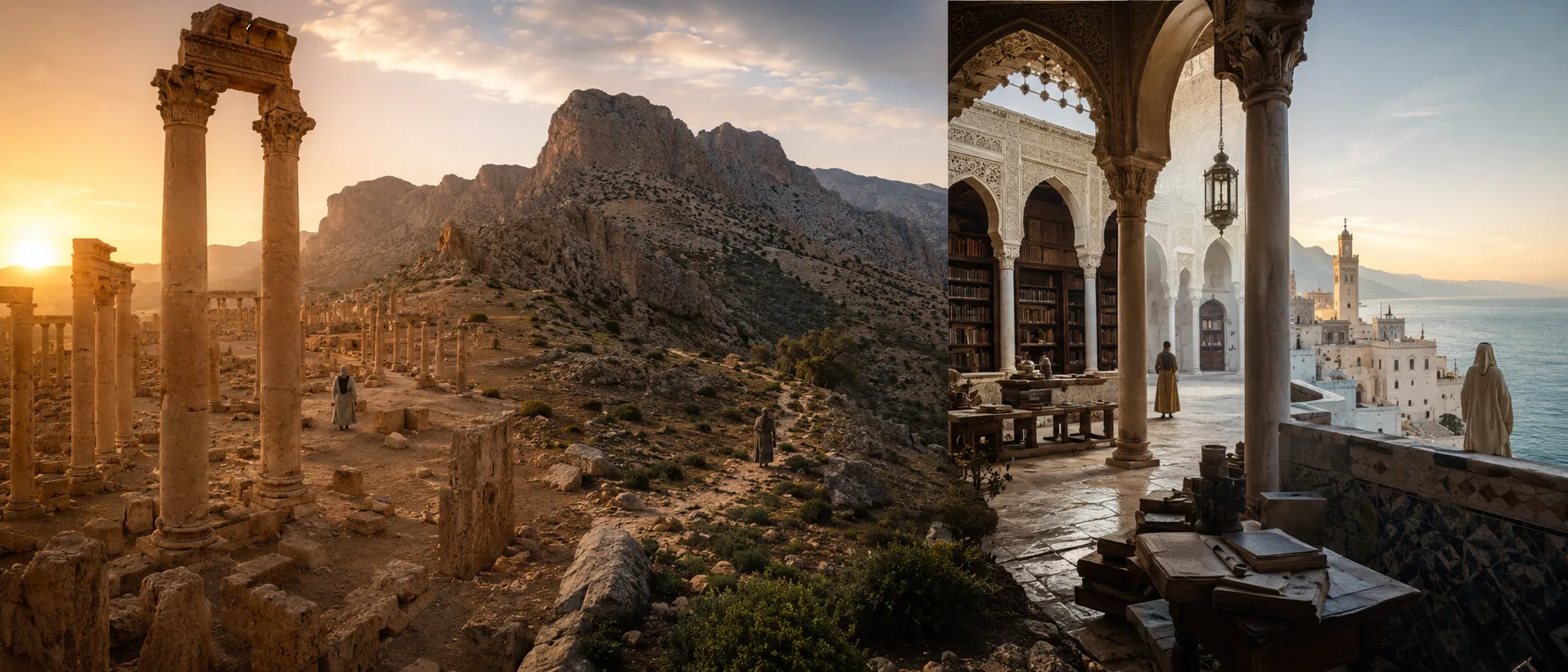
Part I ended with Salama bint Said writing memories of Zanzibar and Oman from Europe. For this second journey, we travel backward in time and westward across the map. The first landscape is stone, desert light and columns: Palmyra.
Again, this is not a ranking of powerful women. It is a road through different kinds of memory. Some left poetry. Some were described by enemies. Some became symbols long after death.
Palmyra before Zenobia
Palmyra stood at a meeting point between the Roman world and trade networks reaching east. Its architecture and inscriptions reveal a city that cannot be reduced to a simple choice between Roman and Arab, East and West. Languages, gods, clothing, commerce and loyalties overlapped.
That mixed world produced one of antiquity’s most famous queens.
Zenobia
Zenobia rose to power in Palmyra in the third century CE after the death of her husband Odaenathus. Acting initially in the name of her young son, she presided over a dramatic expansion of Palmyrene power. Her forces took Egypt and controlled territories across parts of the Roman East.
For a brief moment, Palmyra became the centre of an ambitious political project.
The challenge to Rome
The emperor Aurelian eventually moved against Palmyra. Zenobia’s forces were defeated, the queen was captured, and the rebellion ended. Later accounts embroidered what happened afterward and gave her different endings.
That is often the fate of a famous woman from antiquity: the documented political career ends, and storytellers rush in to complete the portrait.
Was Zenobia Arab?
Modern identities fit awkwardly onto ancient people. Palmyra was a Semitic, multilingual city deeply connected to the Roman Near East and caravan networks. Ancient and later sources have described Zenobia through several cultural labels.
She matters here not because we need to force her into a modern passport category, but because Palmyra belongs to the history of the region now called Syria and to the long history of the Arab world.
The ruins remember differently
Palmyra’s columns survived empires, abandonment, archaeology, tourism and terrible destruction in our own century. When we speak Zenobia’s name today, we also speak about the fragility of cultural heritage.
A queen can become a symbol. A ruined city reminds us that symbols need places.
West toward the Aurès
From Syria we cross to North Africa and move forward several centuries. Here we meet a woman known by names that already tell us the story is complicated: Dihya, often called al-Kahina in Arabic historical traditions.
She belongs to Amazigh history. An article about women who shaped the Arab world does not require every woman inside it to have been Arab.
Dihya and the problem of sources
Dihya is remembered as an Amazigh leader who resisted advancing Umayyad forces in North Africa around the end of the seventh century. Later Arabic chronicles describe her authority and conflict with Hassan ibn al-Nu’man.
Many colourful details repeated online come from later sources and accumulated legend. Her religion, family and aspects of her military story are debated. A responsible portrait should say where certainty becomes thin.
Al-Kahina
The name or title al-Kahina is often rendered as ‘the diviner’ or ‘the priestess’. It became the name through which Arabic historiography remembered her. Modern Amazigh memory often prefers Dihya and has made her a symbol of indigenous resistance.
Both memories matter, but neither is automatically a contemporary eyewitness biography.
The Aurès are not a footnote
The mountains matter. Resistance happens in terrain. The Aurès in present-day Algeria form a rugged landscape with a long history of local communities and resistance.
To write Dihya only as ‘the woman who fought the Arabs’ would reduce North African history. The Maghreb was already a complex world of Amazigh societies, Roman and Byzantine legacies, Christian communities, trade routes and local powers.
A history made of layers
Arabisation and Islamisation unfolded over long periods and cannot be explained by one battle or one queen. Dihya’s resistance belongs to that larger transformation, but it did not freeze history.
Later societies created new combinations of Amazigh and Arab language, identity, dynasties and culture. History kept mixing what modern arguments sometimes try to separate.
Meskaoui
“A civilisation is not measured only by the kings it remembers, but also by the voices it refused to let disappear.”
— Meskaoui
Across the sea to Al-Andalus
Now the road crosses the Mediterranean to Cordoba. We leave queens and battlefields for libraries, manuscripts, poetry and salons. If every woman in our article carries a sword or crown, we simply create another narrow version of history.
Intellectual life can shape a civilisation as deeply as conquest.
Lubna of Cordoba
Lubna is remembered as a learned woman associated with the court of the Umayyad caliph al-Hakam II in tenth-century Cordoba. She is connected with books, writing and the intellectual environment surrounding the caliphal library.
Popular retellings sometimes add precise job descriptions and achievements with more confidence than surviving evidence allows. We should resist turning a fascinating learned woman into a modern résumé.
Cordoba and the culture of books
Al-Hakam II’s Cordoba cultivated an extraordinary culture of collecting, copying and studying books. Manuscripts travelled, scribes worked, scholars debated and knowledge became part of political prestige.
A woman remembered inside that world changes the image of the library. The intellectual history of Al-Andalus was not inhabited only by the famous men whose names survived in textbooks.
Why small evidence matters
Sometimes historians have inscriptions. Sometimes chronicles written generations later. Sometimes a person’s surviving trace is much smaller. The honest response is not to inflate it.
A small window into a woman’s intellectual life can be more valuable than a beautiful invented biography.
Wallada enters the room
A century later, Cordoba gives us a different figure. Wallada bint al-Mustakfi was an Umayyad princess and poet whose father had briefly been caliph during the political fragmentation of eleventh-century Al-Andalus.
Wallada became famous for poetry, for a literary gathering associated with her, and for her celebrated and turbulent relationship with the poet Ibn Zaydun.
Poetry as presence
Wallada survives partly because words survive. Poetry allows a historical personality to feel unusually close, though we still need care about attribution and later romanticisation.
She is often presented as a modern rebel born a thousand years too early. I prefer to let her belong to her century first.
The love story can swallow the woman
Ibn Zaydun is important to Wallada’s biography, but a woman poet should not become merely the female half of a famous romance. Love stories are memorable, which is precisely why they can consume everything around them.
Wallada’s place in the literary memory of Cordoba deserves space beyond whom she loved and why they separated.
Al-Andalus without the postcard
People speak about Al-Andalus as paradise or catastrophe depending on the argument they want to make today. Both habits flatten centuries of conflict, achievement, inequality, coexistence, violence and change.
Lubna and Wallada let us enter through smaller doors: a library, a poem, a room where people gathered to speak.
From Cordoba toward Morocco
The fall of Muslim-ruled cities in Iberia sent people, memories, skills and families across the Strait of Gibraltar. Northern Morocco became one place where Andalusian displacement reshaped urban culture.
Our final figure belongs to that Mediterranean world.
Sayyida al-Hurra
Sayyida al-Hurra is associated above all with Tetouan in northern Morocco in the first half of the sixteenth century. She came from a family connected to Andalusian refugee history and became a ruler of Tetouan, exercising authority in a city positioned between Morocco, Iberia and the western Mediterranean.
Her name itself is a title, usually understood as ‘the noble lady’ or ‘the free lady’. Later retellings have sometimes made her story more cinematic than the evidence.
Tetouan after Al-Andalus
Tetouan’s reconstruction and growth were deeply connected to Andalusian refugees. The city looked north across a sea that was both road and frontier. Iberian powers expanded along the North African coast while Muslim polities, corsairs, merchants and local rulers competed across the Mediterranean.
This is the environment in which Sayyida al-Hurra’s political importance makes sense.
The Mediterranean was not peaceful
Modern photographs make the Strait look like a beautiful blue separation between continents. In the sixteenth century it was also a zone of war, raiding, captivity, trade and negotiation. Maritime violence was practised by competing powers on different shores.
Sayyida al-Hurra is frequently labelled a ‘pirate queen’. The phrase is irresistible to headlines but too small for the politics of the period.
The marriage that did not erase Tetouan
She later married the Wattasid sultan Ahmad al-Wattasi. The marriage is remembered partly because the sultan travelled to Tetouan for the ceremony rather than requiring her to abandon her political centre for Fez.
Whether symbolism or practical politics, the scene fits the larger picture: Tetouan was the base of her authority.
Morocco as a meeting place
Her story connects Chefchaouen and Tetouan, Andalusian displacement, Moroccan dynastic politics, Iberian expansion and Mediterranean networks. One woman opens five doors at once.
This is why biography works in the MESKI Journal. A person gives us a reason to enter a landscape, but the landscape quickly becomes larger than the person.
Not every famous detail is safe
Online biographies often repeat exact dates, pirate partnerships, family stories and dramatic claims without distinguishing contemporary evidence from later reconstruction. The same happens with Dihya and Wallada.
We do not lose beauty by admitting uncertainty. We gain trust.
Women and the archive
One reason historical women can seem absent is that archives were produced unevenly. Political chronicles prioritised rulers, wars and male elites. Legal documents, inscriptions, poetry, architecture and later biographies preserve other fragments, but not equally.
Absence of a full biography is not evidence that women were absent from society. It may tell us what institutions considered worth recording.
But we should not invent to repair silence
If the archive gives us five facts, we should not create fifteen because we want the woman to feel more important. Historical silence cannot be repaired with fiction presented as fact.
We can describe the silence itself. That too teaches us something.
The problem with ’empowered women’
Another shortcut is to label every independent historical woman ’empowered’. The word can hide more than it reveals. Empowered by whom? Within what laws? Over whom did she exercise authority? What inequalities remained around her?
Zenobia ruled an expanding state. Dihya led resistance. Wallada had elite privilege. Sayyida al-Hurra governed a strategic city. Their agency was real, but it was not the same.
Beauty is not the explanation
Old chronicles and modern retellings often spend surprising energy telling us whether a powerful woman was beautiful. Sometimes that detail becomes almost an explanation for influence.
I would rather know how she negotiated, governed, wrote, financed, commanded or survived. Beauty may belong to a source, but it should not become our theory of history.
A map without modern borders
Palmyra, the Aurès, Cordoba and Tetouan belong today to Syria, Algeria, Spain and Morocco. The people in our story did not experience those modern borders. Empires, languages, dynasties and religious networks created different maps.
Reading history requires the humility to put our passport map down for a moment.
Syria is more than the news
Zenobia gives us another way into Syria. Palmyra was a city of merchants, temples, inscriptions and political ambition long before modern borders. Remembering that depth does not minimise contemporary suffering. It restores a dimension that news cycles cannot carry.
A country should never be reduced to the worst decade of its history.
Algeria before Algeria
Dihya takes us into a North Africa older than the modern Algerian state and older than Arab political dominance in the region. Amazigh history is not a preface that ends when Arabic arrives.
It remains one of the living foundations of the Maghreb.
Cordoba beyond nostalgia
Lubna and Wallada prevent Cordoba from becoming only architecture. The Great Mosque, bridges and old streets are magnificent, but civilisation is also what happened in rooms we cannot reconstruct: reading, copying, teaching, arguing, composing poetry.
Sometimes the invisible city is the one I most want to visit.
Tetouan looking north
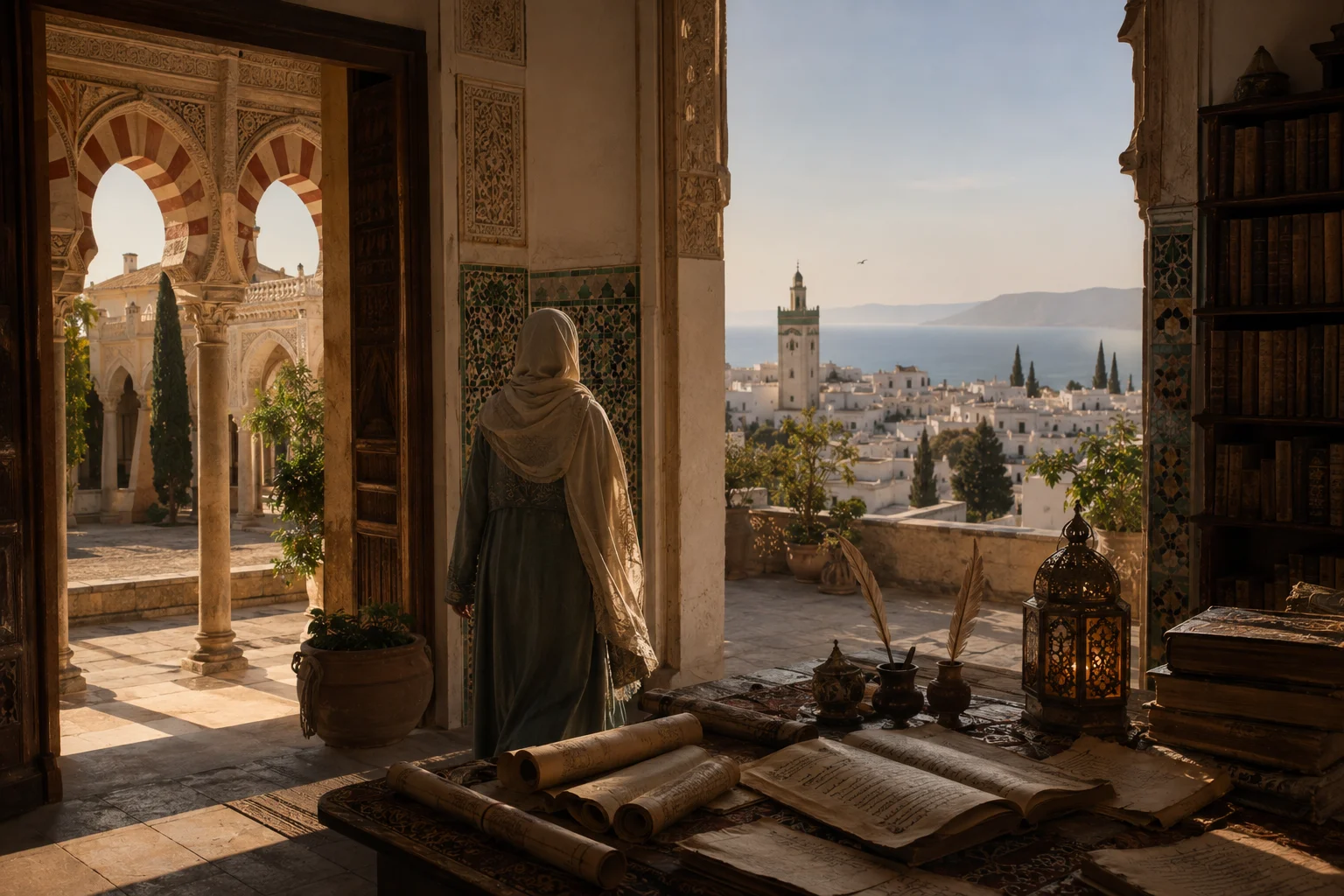
In Tetouan, the Mediterranean is close enough to shape the imagination. Andalusian heritage is visible in the city’s history, architecture and families, but it should not be frozen into decoration. It came through displacement as well as exchange.
Culture often grows from journeys people did not choose.
Meskaoui
“Do not let anyone explain a culture to you in a few sentences. Walk through it, read it, question it. Then make your own journey.”
— Meskaoui
What the article is not saying
It is not saying women possessed equal political or social power across these societies. They did not. It is not saying medieval societies were secretly modern. They were not. It is not saying every legend must be true because it is inspiring.
It is saying that a history told only through men is incomplete.
Learn the culture, not the slogan
Every civilisation is vulnerable to slogans, including flattering ones. ‘Golden age’ can become as misleading as ‘dark age’ when we stop asking questions. A culture deserves better than praise without knowledge.
Read the sources. Notice contradictions. Learn why historians disagree. Curiosity is a form of respect.
The women were there
Zenobia was there when Palmyra challenged Rome. Dihya was remembered in the struggle over North Africa. Lubna appears in Cordoba’s learned world. Wallada’s poetry crossed centuries. Sayyida al-Hurra governed Tetouan in a Mediterranean under pressure.
Their lives were not identical, and their evidence is not equally strong. We do them no service by pretending otherwise.
Palmyra and the caravan world
Palmyra’s wealth was connected to movement between worlds. Merchants and caravans linked the Mediterranean to regions farther east, while the city developed its own distinctive elite culture under Roman imperial structures.
Zenobia’s ambition makes more sense when we understand that Palmyra was already accustomed to being a connector rather than a remote provincial town.
An empire can look weak from the frontier
The third-century Roman Empire faced repeated crises. Local military leaders on the eastern frontier could become indispensable, and Odaenathus had already accumulated unusual authority before his death.
Zenobia inherited not an ordinary household but a political structure created in a moment when imperial weakness opened space for regional power.
Egypt mattered to Zenobia
The Palmyrene seizure of Egypt was not a decorative conquest. Egypt was wealthy, strategically crucial and essential to Roman grain supply. Control there announced that Palmyra’s ambitions had moved far beyond local defence.
That is why Rome could not simply ignore what was happening in the East.
The end of a rebellion, the beginning of a legend
Defeat often simplifies political figures. Once Zenobia was captured, later writers could turn her into whatever their own age needed: proud queen, exotic beauty, tragic captive or courageous rebel.
The historian’s task is to walk backward through those images toward the political woman underneath.
Dihya between memory and identity
Few figures show the relationship between history and modern identity as clearly as Dihya. For many Amazigh people, she represents continuity, resistance and the refusal to let North Africa’s pre-Arab past disappear.
That modern meaning is historically important in its own right, even when it should be distinguished from what we can prove about the seventh-century woman.
Religion and Dihya
Popular articles confidently call Dihya Jewish, Christian or pagan depending on the author. The evidence is much less secure than these claims suggest. Later sources and interpretations have generated competing theories.
Sometimes the most accurate sentence is simply: we do not know.
North Africa was changing before the Umayyads
By the time Arab armies expanded westward, Byzantine authority in North Africa was uneven and local powers had their own interests. Amazigh groups were not one unified political nation waiting for a single leader.
Dihya’s coalition and resistance therefore belonged to a fragmented and changing landscape.
From conquest to new societies
The centuries after Dihya did not produce a simple replacement of one population by another. Amazigh dynasties later built major Islamic states, Arabic spread unevenly, and regional identities continued evolving.
Morocco, Algeria and the wider Maghreb became products of these long interactions rather than one decisive moment.
Books are also monuments
A manuscript does not dominate a skyline like a palace, but intellectual culture can outlive buildings. Cordoba’s libraries represented accumulated labour: paper, parchment, copyists, collectors, scholars, catalogues and money.
Remembering Lubna lets us honour that quieter infrastructure of civilisation.
Women of learning beyond Lubna
Lubna should not be used to claim that women had equal access to education in Al-Andalus. They did not. But neither should structural inequality make individual learned women disappear from our account.
History can hold both facts at the same time.
Wallada and privilege
Wallada’s independence was connected partly to her elite status and inheritance. A princess could possess forms of social and financial freedom unavailable to many women around her.
Acknowledging privilege does not diminish her poetry. It explains the conditions that made her public literary life possible.
A poem can travel farther than a palace
Dynasties collapse. Walls are rebuilt. A line of poetry can survive because someone copied it, quoted it or loved it enough to repeat it.
That chain of transmission is fragile, which makes survival itself part of the story.
Andalusian memory in Morocco
When families crossed from Iberia into Morocco, they carried more than nostalgia. They carried skills, music, recipes, architecture, religious learning, commercial relationships and memories of lost towns.
Northern Moroccan culture was shaped by these arrivals while remaining deeply Moroccan and connected to older local histories.
Sayyida al-Hurra and the sea
Her maritime politics make sense only if we stop treating the sea as empty space between countries. The western Mediterranean was a political arena. Ships could carry goods one day and armed men another.
Control of coastal relationships meant money, security, leverage and danger.
Pirate or corsair?
The language we choose matters. ‘Pirate’ suggests private criminal adventure; ‘corsair’ can indicate maritime raiding tied to political authority. Early modern Mediterranean practice blurred lines that modern legal categories make seem neat.
Calling Sayyida al-Hurra simply a pirate queen sells the movie and loses the history.
Chefchaouen, Tetouan and displacement
Her family background is linked in later accounts to Chefchaouen and to the Andalusian refugee world. Northern Morocco’s mountain and coastal cities became places where memories of Iberia were rebuilt into new lives.
Exile does not reproduce the lost home exactly. It creates something new from what people carry.
The city as a woman’s political base
Tetouan matters because it prevents us from imagining Sayyida al-Hurra’s power as purely personal. Authority needs institutions, alliances, families, revenue and a place from which decisions can be enforced.
A ruler without a city is only a story.
Five portraits are not enough
Zenobia, Dihya, Lubna, Wallada and Sayyida al-Hurra cannot represent every woman from Syria to Morocco across thirteen centuries. They are doors, not a census.
Behind them are patrons, merchants, scholars, mothers, artisans, physicians and women whose names were never recorded.
Why uncertainty belongs in a beautiful article
A Journal can be lyrical without becoming careless. In fact, uncertainty can produce better writing because it forces us to show the reader how memory is made.
‘We do not know’ can be the beginning of curiosity rather than the end of a paragraph.
What MESKI found by following roads
We began with honey, places and the people behind them. Honey follows flowers, mountains, markets and caravan roads. Roads lead to cities. Cities lead to history. History leads to names we did not expect to meet.
That is why this story belongs here even without a product at the end.
A final thought
Cultural wealth is not something we possess merely because we were born near it. We possess only the chance to learn it. Heritage we never question becomes decoration.
Keep the names, but also keep the questions. Zenobia. Dihya. Lubna. Wallada. Sayyida al-Hurra. Then go farther than this page.
The danger of making Zenobia ours
Modern nations naturally look backward for ancestors and heroes. Syria has embraced Zenobia as a powerful symbol, and artists across the Arab world have retold her story. That cultural afterlife is real and worth studying.
But admiration should not require us to pretend that a third-century Palmyrene queen thought in twentieth-century national categories.
What Rome saw
Roman accounts of defeated enemies were never neutral mirrors. Aurelian’s victory needed to be presented as worthy of imperial celebration, which could encourage writers to emphasise the strength or exoticism of the opponent.
When the victor writes about the defeated queen, we should read both the queen and the victor.
What later Muslims saw in Dihya
Arabic historians wrote about the conquest of North Africa from perspectives shaped by later Islamic societies. Their accounts preserved Dihya’s name while also interpreting her through categories meaningful to their own readers.
The fact that a source preserves someone is not the same as the source understanding that person exactly as she understood herself.
The word Amazigh
Using Amazigh rather than the older European term Berber is increasingly preferred when speaking about the indigenous peoples and languages of North Africa. Even vocabulary carries history.
Names are never a trivial detail when an article is about who gets remembered.
Cordoba after the caliphate
Wallada lived after the collapse of the unified Umayyad caliphate of Cordoba, during the age of competing taifa kingdoms. Political fragmentation did not end cultural production. Courts continued to compete through poetry, scholarship and prestige.
Sometimes political instability and artistic brilliance occupy the same century.
A salon is also power
Gathering writers and intellectuals does not look like military power, but it shapes reputation and networks. Wallada’s literary presence reminds us that social spaces can influence culture without issuing decrees.
Not every form of authority needs an army.
The Strait is narrow, history is wide
From southern Spain, the mountains of Morocco can sometimes feel almost within reach. The Strait of Gibraltar is geographically narrow, yet centuries of war, migration, commerce and exile passed across it.
Wallada and Sayyida al-Hurra stand on different sides of a long Andalusian story separated by centuries.
What refugees carry
People forced from a home cannot carry buildings with them. They carry language, recipes, songs, craft knowledge, family names, religious practices and memories. These portable forms of culture can transform the next city.
Tetouan’s Andalusian inheritance belongs to that human process, not merely to an architectural style.
A queen, a leader, a scholar, a poet, a ruler
Even our labels reveal variety. Zenobia is remembered as queen; Dihya as military and political leader; Lubna through learning; Wallada through poetry; Sayyida al-Hurra through urban and maritime rule.
If we had selected only queens, we would have missed half the point.
The story continues beyond Morocco
From Tetouan we could continue south to other women of the Maghreb, east toward Fatimid and Abbasid worlds, or return to the Arabian Peninsula. There is no natural final border for this subject.
History is generous with roads once we stop insisting on a definitive list.
Questions from the journey
Zenobia became the dominant ruler of Palmyra during its third-century expansion and challenge to Roman authority, initially ruling in connection with her young son after Odaenathus’s death.
No. Dihya is remembered as an Amazigh leader of North Africa. She belongs here because Amazigh history is fundamental to the history of the Maghreb and wider Arab world.
Wallada was an eleventh-century Umayyad princess and poet of Cordoba, remembered for her poetry, literary presence and relationship with Ibn Zaydun.
She was a sixteenth-century ruler associated with Tetouan in northern Morocco, connected to Andalusian refugee history, Moroccan politics and Mediterranean maritime power.
Because several famous women accumulated stories long after their deaths. Separating strong evidence from later tradition keeps their real historical importance credible.
Continue the Journey
If this story brought you here, continue the journey through related stories from The House of Meski.