
Five women, many centuries, and a road through Saba, the Hajj routes, Jibla, Cairo and the Indian Ocean.
History taught us the names of kings
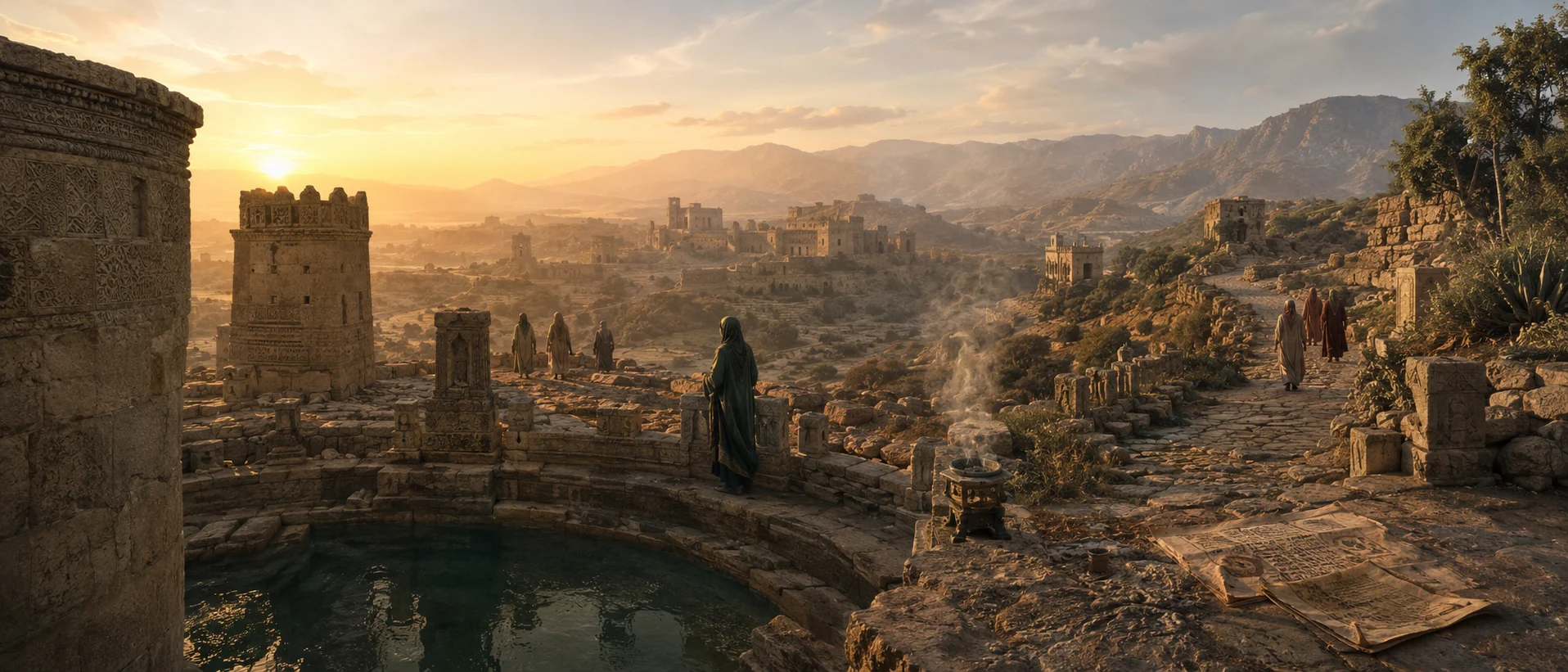
History is very good at teaching us the names of kings. We learn their wars, their sons, the cities they conquered and the palaces they left behind. Then, if we look between those familiar names, another landscape appears. Women were ruling, financing roads, negotiating dynasties, protecting cities, writing memories and shaping the societies around them.
This is not an attempt to rewrite the past into something more comfortable for the present. It is the opposite. The women in this journey did not share one identity or one kind of power. One even stands partly between scripture, tradition and archaeology. Their differences are exactly why the journey matters.
The road begins in South Arabia
To begin with Sheba is to begin with a landscape larger than one biography. Ancient South Arabia, in present-day Yemen and neighbouring lands, grew wealthy through agriculture and long-distance trade, including frankincense and myrrh. Saba was one of its major kingdoms. Inscriptions and archaeology reveal an organised political and commercial world.
Then comes a queen whose fame travelled much farther than the kingdom itself.
Balqis, the woman known as the Queen of Sheba
In the Qur’an, the ruler of Saba is not named Balqis. She appears as a woman ruling her people, receiving a letter from the prophet-king Sulayman, consulting her council and making a political judgement. Later Islamic tradition gave her the name Balqis. Biblical tradition remembers a Queen of Sheba visiting Solomon.
Archaeology gives us abundant evidence for Saba, but not archaeological proof identifying the famous Queen of Sheba as a historical individual in Yemen. That uncertainty does not weaken the story. It tells us where faith, memory, literature and the historical reality of South Arabia meet.
What I notice in the story
What stays with me is the way authority is shown. The ruler receives information, gathers advisers, listens and decides. The story contains diplomacy, intelligence, wealth and the limits of worldly power.
We can read it devotionally, historically or culturally, but those are not identical exercises. Respect for a story also means being precise about what the source says and what later storytellers added.
Marib beyond the legend
Even without proving the identity of Balqis, ancient Marib and the Sabaean world deserve attention on their own. South Arabia participated in networks connecting incense-producing regions with the Red Sea and Mediterranean. Water management, temples, inscriptions and trade speak of sophisticated societies.
Yemen is too often introduced through the tragedies of the present. Walking backward into Saba reminds us that Yemen carries millennia of urban, agricultural and commercial history.
A queen larger than a kingdom
Balqis became a name used far beyond archaeology. She appears in religious commentary, poetry, folklore and art. People preserved her through stories about wisdom, authority, faith and ambition.
The responsible way to tell her story is not to choose one later legend and call it fact. Let the layers remain visible.
From Saba to the road to Makkah
Centuries pass. Islam has emerged, Baghdad has become the centre of an enormous empire, and pilgrims cross difficult landscapes toward Makkah. Our next woman did not become famous for conquering a kingdom. Her name became attached to a road.
History is not shaped only by crowns and armies. Sometimes it is shaped by water.
Zubayda bint Ja’far
Zubayda bint Ja’far was a member of the Abbasid elite and wife of Caliph Harun al-Rashid. Her name became inseparable from charitable works serving pilgrims travelling from Iraq toward Makkah. The route from Kufa through Arabia became known as Darb Zubaydah.
UNESCO describes a network of wells, reservoirs, pools, dams, stations, road markers, rest facilities and paved sections. Earlier rulers developed the road too, so it was not created from nothing by one woman. Zubayda’s patronage, however, became so strongly remembered that her name attached itself to the route.
Water is power in another form
A reservoir in the desert may look less dramatic in a history book than a battle. To a thirsty pilgrim it is not less important. The road crossed environments where water and rest could determine whether a journey was merely difficult or dangerous.
Patronage turned wealth into infrastructure. Money disappears quickly when it is used only to display itself. A well can keep serving people who never knew who paid for it.
The road was bigger than one woman
We should not turn Zubayda into the sole engineer of a 1,300-kilometre system. Abbasid rulers, administrators, engineers, workers and other patrons contributed over generations. UNESCO notes that charitable competition encouraged donors to finance wells, shelters and reservoirs.
Her importance becomes more credible when we tell the whole story. She was a major patron inside a vast institutional project.
Kufa, Baghdad and Arabia connected by footsteps
Imagine the road not as a line on a map but as movement: pilgrims on foot, riders, merchants, animals needing water, stations filling and emptying with the seasons. The Hajj route was religious, but it also carried conversation, trade, knowledge and news.
Roads connect cultures long before anyone invents the phrase cultural exchange.
Meskaoui
“Cultural wealth will always be greater than material wealth. Money can build a palace. Culture is what gives people a reason to remember it.”
— Meskaoui
South again, to the mountains of Yemen
Our road returns to Yemen, but not to antiquity. We move to the eleventh and twelfth centuries, to the Sulayhid period and to Jibla, where Arwa al-Sulayhi became one of the most remarkable rulers in medieval Arabian history.
Here we leave the partly legendary world of Balqis and meet a woman whose political career belongs firmly to medieval Yemeni history.
Arwa al-Sulayhi
Arwa was connected by marriage to the Sulayhid ruling house and became deeply involved in government. After her husband’s decline and death, she exercised authority for decades, until her death in 1138.
She was not simply a ceremonial queen standing beside male power. She governed and participated in dynastic and religious politics. Her long career unfolded within the complicated relationship between Yemen’s Sulayhid rulers and the Fatimid world.
Jibla changes the picture of Yemen
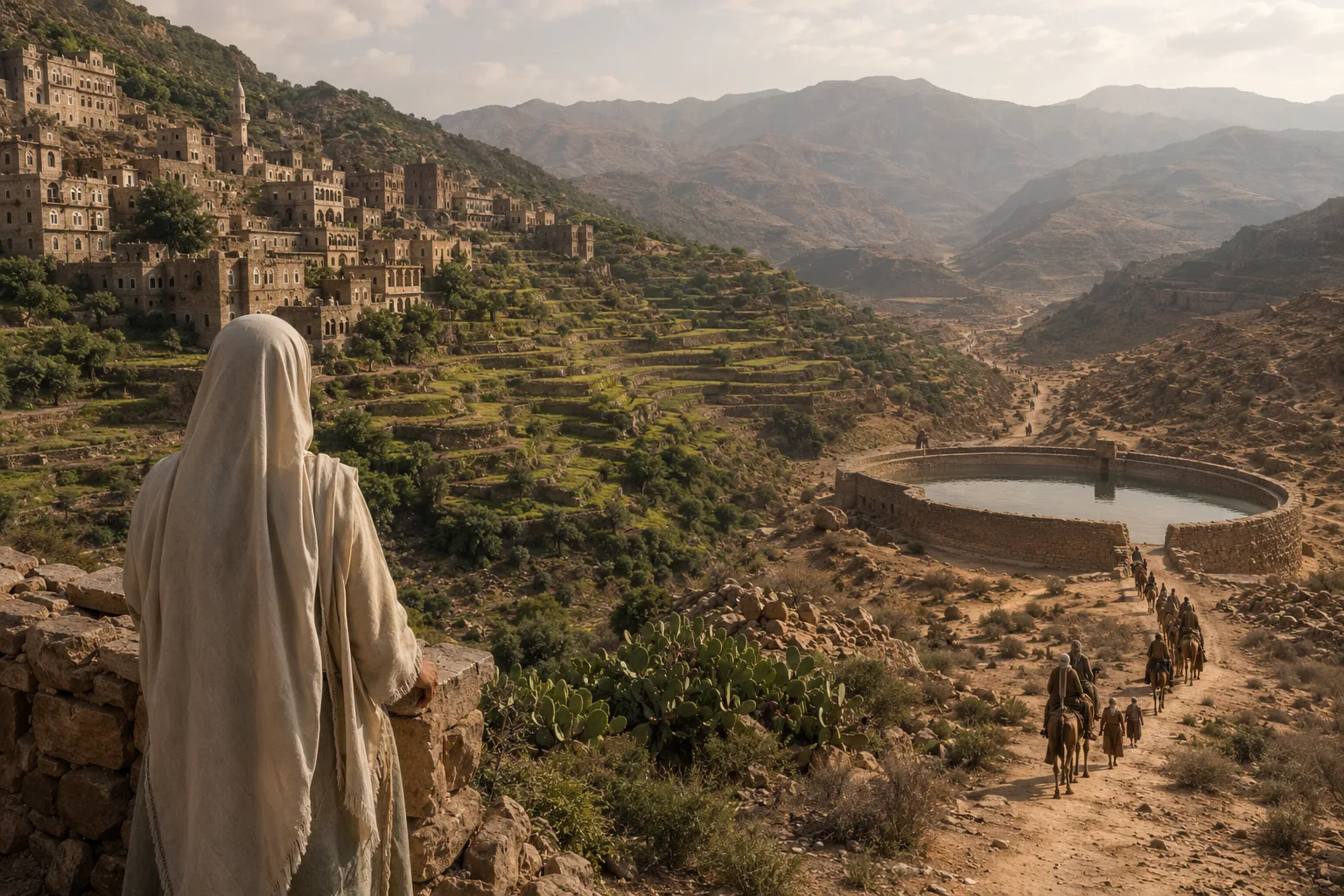
Jibla changes the imagination: mountain slopes, old stone architecture, cultivated terraces and a medieval political centre associated with a queen. Yemen’s highlands created very different human environments from its coasts and deserts.
To write about Queen Arwa without writing about place would flatten her world.
Power and religion
Arwa’s political authority was inseparable from the religious landscape of her time. The Sulayhids were allied with the Fatimid Ismaili order, and later developments within Ismailism gave her an important religious role as well.
These histories are complex. What matters here is that a woman in medieval Yemen occupied a position of sustained political and religious importance for decades.
The mosque and the memory
Jibla still carries her name through the Queen Arwa Mosque, where tradition places her burial. Architecture makes historical memory physical.
A building says that someone was here long enough, and mattered enough, for a city to keep speaking her name.
Yemen is not one story
Balqis and Arwa are separated by more than a millennium. One stands at the intersection of sacred text, tradition and ancient Saba. The other belongs to medieval Islamic Yemen. Putting them together should not blur those differences.
It should show that Yemen contains many histories: ancient kingdoms, religious communities, Islamic dynasties, mountain towns, coastal trade and Indian Ocean connections.
Across the Red Sea to Egypt
The next road takes us to thirteenth-century Egypt. Crusading armies threaten the region, the Ayyubid order is weakening and the military households that will form the Mamluk state are rising. In that unstable moment appears Shajar al-Durr.
Her life reminds us that power can come from places a political system did not originally intend.
Shajar al-Durr
Shajar al-Durr had been enslaved before becoming the wife of the Ayyubid sultan al-Salih Ayyub. During the crisis surrounding his death in 1249 and the Seventh Crusade, she played a central political role. After the death of his heir Turanshah, she was proclaimed ruler in Egypt in 1250.
Her independent reign was brief and contested, but the transition around her is central to the emergence of Mamluk power. The Metropolitan Museum notes that the Bahri Mamluks supported the installation of al-Salih’s widow on the throne.
A throne that exposed the rules
Shajar al-Durr’s story is fascinating partly because of the resistance her rule provoked. Political legitimacy involved dynasty, military power, recognition and religious authority. A woman on the throne made those tensions visible.
Her story did not end as a fairy tale. She married the Mamluk commander Aybak, power shifted again, and later conflict ended violently for both. History does not need a happy ending to matter.
Cairo in transition
Cairo was becoming one of the great centres of the Islamic world. Architecture, religious institutions and military power were being reorganised. Shajar al-Durr commissioned the mausoleum of al-Salih Ayyub, another reminder that women shaped the built landscape through patronage.
A tomb, like a road or a mosque, can be a political sentence written in stone.
Do not make every woman a modern heroine
There is a temptation to make every historical woman admirable in every dimension. That is not history. These women belonged to systems that could be violent, hierarchical and very different from our assumptions.
We can recognise agency without turning biography into worship.
Toward the Indian Ocean
From Cairo we travel centuries forward and southeast, into the nineteenth-century world linking Oman and Zanzibar. The Indian Ocean carried merchants, sailors, enslaved people, diplomats, spices, ivory, ideas and empires between Arabia, East Africa, India and Europe.
Here our final woman does something none of the others can do in the same way: she leaves a substantial account in her own voice.
Salama bint Said
Salama bint Said was born in Zanzibar in 1844, a daughter of Said bin Sultan, ruler of Oman and Zanzibar. Later known in Europe as Emily Ruete, she left Zanzibar, married the German merchant Rudolph Heinrich Ruete and settled in Germany.
Her life crossed worlds nineteenth-century Europeans often imagined as separate. She knew palace life in Zanzibar from inside, then experienced Europe as a woman building another life there.
Memoirs of an Arabian Princess
Her memoirs were first published in German in 1886. The Library of Congress describes the book as an account of her royal youth and the culture and society of Zanzibar as experienced by an Arab girl growing into adulthood. She wrote about meals, education, festivals, family life, marriage customs and the people around her.
That makes the book precious, but not neutral. Memoir is memory and interpretation. Ruete also defended aspects of her society, including views on slavery that a modern reader must confront critically rather than quietly pass over.
A woman answering Europe
One of the most interesting aspects of her writing is her desire to challenge European assumptions about Arab women. The Library of Congress notes that she explicitly sought to correct what she considered false European views about women’s position in the East.
Whether we agree with every argument is not the point. The important change is that she was no longer merely being described. She was describing back.
Oman inside the Zanzibar story
Her father, Said bin Sultan, linked Oman and Zanzibar within one political and commercial world. That relationship is essential to understanding nineteenth-century Omani history. Oman was not looking only inland across Arabia. Its maritime networks stretched across the Indian Ocean.
Salama’s biography makes that geography human. Oman, Zanzibar and Germany stop being three disconnected labels and become stages in one woman’s life.
The uncomfortable parts belong in the story
Zanzibar’s prosperity was tied to plantation economies, ivory and slavery. We should not romanticise the palace world because its architecture and ceremonies fascinate us. Ruete herself could be sympathetic to slavery in ways that reveal the assumptions and interests of her social position.
Culture becomes poorer, not richer, when we protect it from difficult truths.
From a queen remembered by others to a princess writing herself
This is why I wanted Part I to end with Salama. We began with a ruler of Saba whose famous identity reaches us through sacred texts and traditions retold across centuries. We end with a woman sitting down to write a memoir of her own world.
Between them are reservoirs, pilgrimage roads, mountain cities, thrones, mosques and the Indian Ocean. The form of memory changes, but the women were there.
Meskaoui
“Women were never absent from the history of the Arab world. Sometimes it is not history that forgot them. It is simply that we stopped learning their names.”
— Meskaoui
What these five women do not have in common
They were not a movement. They did not share one idea of womanhood. Balqis belongs partly to religious and legendary memory; Zubayda to Abbasid patronage; Arwa to Yemeni sovereignty; Shajar al-Durr to a military transition in Egypt; Salama to the nineteenth-century Indian Ocean.
The point is not to force them into one category. The point is to notice how many categories women were already inside.
The map is the real protagonist
Look at the places we crossed: Saba and Marib, Baghdad and Kufa, the road to Makkah, Jibla, Cairo, Oman, Zanzibar and Hamburg. The map itself destroys the idea of a closed Arab world.
People, beliefs, goods and memories moved constantly. Women moved through those networks too, as rulers, patrons, through marriage and exile, and through books.
The pilgrimage road as cultural memory
Darb Zubaydah deserves another look because it joins so many themes in this journey. It is engineering, charity, religion, state planning and movement through the desert at once. UNESCO identifies major stations and substations, wells, pools, dams, forts and paved stretches across a route of roughly 1,300 kilometres.
A road named after a woman is not proof that she built every stone. It is evidence that collective memory associated her strongly with making the journey possible. That distinction is important, and beautiful enough without exaggeration.
The desert does not forgive bad planning
Modern travel makes distance easy to underestimate. A flight from Baghdad to Jeddah turns a geography that once required weeks into a few hours. On foot or by animal, water infrastructure was survival infrastructure.
When I imagine pilgrims reaching a reservoir after a difficult stretch, Zubayda’s story becomes less about royal generosity as an abstract virtue and more about practical human need.
Wealth that moves
A palace concentrates wealth in one place. A pilgrimage road distributes it across distance. That contrast stays with me. The donor may live in Baghdad, the mason may work in Arabia, and the person who drinks from the cistern may have travelled from much farther east.
Culture is often created by these chains of people who never meet.
Jibla as a political capital
Queen Arwa’s decision to govern from Jibla gives us another lesson about maps. Capitals are not always the cities modern travellers expect. Political importance can move with dynasties, security, trade and geography.
The terraces and mountain climate of Yemen remind us again that Arabia is not one endless desert. The physical diversity of the peninsula produced different economies and different centres of power.
Women around Arwa
Arwa did not appear from nowhere. Her mother-in-law Asma bint Shihab is also remembered as an influential Sulayhid woman. Even when an article focuses on one famous queen, the surrounding political household can reveal that female influence was not necessarily an isolated miracle.
This matters because the phrase ‘exceptional woman’ can accidentally suggest that every other woman was invisible. History is rarely that simple.
Cairo and the meaning of legitimacy
Shajar al-Durr’s brief sovereignty raises a question that follows many women rulers: what makes rule legitimate? Bloodline, military support, religious recognition, public proclamation, coinage, marriage, administration? Medieval political systems answered differently depending on circumstance.
Her reign became a pressure point where those answers collided. That is more interesting than reducing her to ‘the first woman to’ anything.
Power can be temporary and still historical
We often measure importance by duration. A reign of decades seems automatically more significant than a reign of months. But moments of transition can compress enormous change into very little time.
Shajar al-Durr stood inside one of those moments, between the Ayyubid order and Mamluk ascendancy.
Salama and the danger of a single witness
Because Salama wrote so vividly, there is a temptation to treat her memoir as a window through which we can see all women in Zanzibar or Oman. It is not. She wrote from the position of a royal woman with a particular family, education and later European experience.
A first-person source is invaluable precisely when we remember whose first person it is.
The Indian Ocean Arab world
The phrase Arab world can make us imagine a map running horizontally from Morocco to the Gulf. Salama forces the map downward toward East Africa. For centuries, Arabian and Swahili coasts were connected by monsoon sailing, commerce, migration, intermarriage and political power.
Zanzibar belongs to this history without becoming simply an extension of Arabia. East Africa had its own peoples, languages and histories, and the relationship included both exchange and domination.
Culture without innocence
I love cultural history, but love should not require innocence. Incense trade, pilgrimage, dynasties, poetry and architecture can be beautiful subjects. The same societies could contain slavery, warfare, hierarchy and exploitation.
Learning a culture means accepting the whole archive, not selecting only what looks good in a photograph.
Why no honey here
MESKI can publish this story without forcing a jar into it. Yemen and Oman naturally belong to our wider geography, but Queen Arwa does not need to become a bridge to Sidr honey, and Salama does not need to end beside a product.
Sometimes the strongest proof that a Journal has a real culture is that it knows when not to sell.
Before we travel west
Our first journey ends at the Indian Ocean. The second begins beneath the columns of Palmyra and moves west through the Aurès, Cordoba and Tetouan.
There we meet a queen who challenged Rome, an Amazigh leader tangled with legend, women of books and poetry in Al-Andalus, and a ruler of Tetouan whose Mediterranean politics reached across the sea.
A name is not enough
Learning a forgotten name is only the beginning. If we remember Balqis but know nothing about Saba, or Arwa without Jibla, we have collected names rather than learned history. Biography should open the landscape around the person.
That is why each woman in this journey keeps leading us away from herself: toward incense routes, water systems, sectarian politics, crusading armies, maritime networks and migration.
Ancient Yemen before our categories
Ancient South Arabia did not call itself the modern nation-state of Yemen. Saba, Qataban, Hadramawt and other kingdoms had their own political identities. Using Yemen helps a modern reader locate the geography, but we should not project today’s borders backward without explanation.
The same caution will matter later with Syria, Algeria, Spain and Morocco.
The incense road behind Sheba
Frankincense and myrrh helped connect South Arabia with markets far away. Caravans and ships carried aromatic resins toward Egypt, the Levant and Mediterranean worlds. Wealth accumulated not from one magical commodity but from control, agriculture, taxation and networks.
When later generations imagined the Queen of Sheba arriving with extraordinary gifts, they were remembering a southern land already associated with luxury and long-distance trade.
Consultation and authority
One reason the Qur’anic ruler of Saba remains compelling is that consultation appears inside the scene of power. She does not disappear when advisers speak. Nor does consultation make her weak. She listens and retains responsibility for the decision.
It is a small narrative detail with a long cultural afterlife.
The people whose names the road forgot
Darb Zubaydah carries one famous woman’s name, but thousands of unnamed people made and maintained it: labourers moving stone, engineers calculating water, guards, guides, cooks, camel handlers and residents of stations.
Remembering a patron should not erase the hands that turned patronage into infrastructure.
Hajj and equality of need
Pilgrims arrived with different wealth and status, but thirst is democratic. The desert reduces social distinctions quickly when water is scarce. Infrastructure serving pilgrimage therefore had both practical and spiritual meaning.
A reservoir did not ask whether the traveller was famous before giving water.
Arwa and duration
More than five decades of influence cannot be dismissed as a brief accident. Longevity required alliances, administration and the ability to survive changing political circumstances. That is one reason Arwa deserves more than a paragraph in a list of famous women.
Her reign lets us discuss governance rather than merely symbolic visibility.
A city keeps what a textbook loses
Sometimes local memory preserves a historical figure more naturally than international education does. A mosque name, a tomb tradition, a neighbourhood story or a road can keep someone present even when global textbooks barely mention them.
Travel can therefore correct the limits of the syllabus.
Shajar al-Durr and the crusading world
Her political rise happened while Louis IX’s crusade placed enormous pressure on Egypt. The crisis was military and dynastic at once. Concealing the sultan’s death for a time, maintaining government and managing succession were not ceremonial tasks.
The episode reminds us how quickly political authority can become practical work when institutions are under threat.
Salama between languages
Writing in German about an Arabic-speaking royal childhood already changes memory. Words, customs and relationships have to cross language before they reach the reader. Translation then moves them again into English and other languages.
Every crossing adds another layer between the childhood lived and the childhood we read.
What a memoir preserves
Political chronicles tell us who ruled. Memoirs can tell us what people ate, how children learned, how families celebrated, how rooms were organised and what a young person noticed. These ordinary details are not secondary to history.
They are often the place where a vanished world becomes human.
Five women, five kinds of evidence
Sacred text and later tradition for Balqis. Material remains and historical documentation around Zubayda’s road. Medieval chronicles and religious histories for Arwa. Political and architectural evidence for Shajar al-Durr. A published autobiography for Salama.
Placing them together teaches not only women’s history but how history itself is built from unequal kinds of evidence.
The lesson I keep
Do not ask only whether women were present. Ask where the archive lets us see them, who recorded them, why a particular name survived and what was happening around her.
Those questions turn a gallery of portraits into history.
Questions from the journey
Saba is archaeologically well documented, but there is no archaeological proof identifying the famous Queen of Sheba as a specific historical ruler in Yemen. The Qur’anic, Biblical and later traditional accounts should be distinguished from archaeological evidence.
Arwa al-Sulayhi was a major medieval Yemeni ruler associated with the Sulayhid dynasty and Jibla. She exercised political authority for decades and died in 1138.
It was a major Abbasid pilgrimage route linking Kufa in Iraq with Makkah. It became strongly associated with Zubayda bint Ja’far because of her patronage of facilities serving pilgrims.
Yes. She was proclaimed ruler in 1250 during the transition from Ayyubid to Mamluk power, although her independent reign was brief and contested.
Emily Ruete was Salama bint Said, a princess of Zanzibar and Oman born in 1844. She later lived in Germany and published Memoirs of an Arabian Princess.
Continue the Journey
If this story brought you here, continue the journey through related stories from The House of Meski.