
From my grandmother’s coffee in Ksar Meski to Saudi Arabia, the UAE, Qatar and Oman: one ritual, many tastes.
Before Riyadh, Dubai, Doha or Muscat, there was my grandmother
Before I learned to compare coffees between countries, coffee already had a geography for me. It was not Riyadh, Dubai, Doha or Muscat. It was home. It was Ksar Meski, a room, familiar hands, voices I did not need to understand because I already belonged to them, and the coffee of my grandmother. Childhood does not classify aromas. A child does not ask whether the roast is light or medium, whether cardamom was measured, or whether a preparation belongs to one regional tradition. He remembers that a smell meant somebody was home. Years later I travelled, tasted coffee in beautiful hotels, desert camps, restaurants, family homes and majalis, and discovered something amusing: the cup kept changing, yet the invitation behind it remained strangely familiar.
Same name, never exactly the same cup
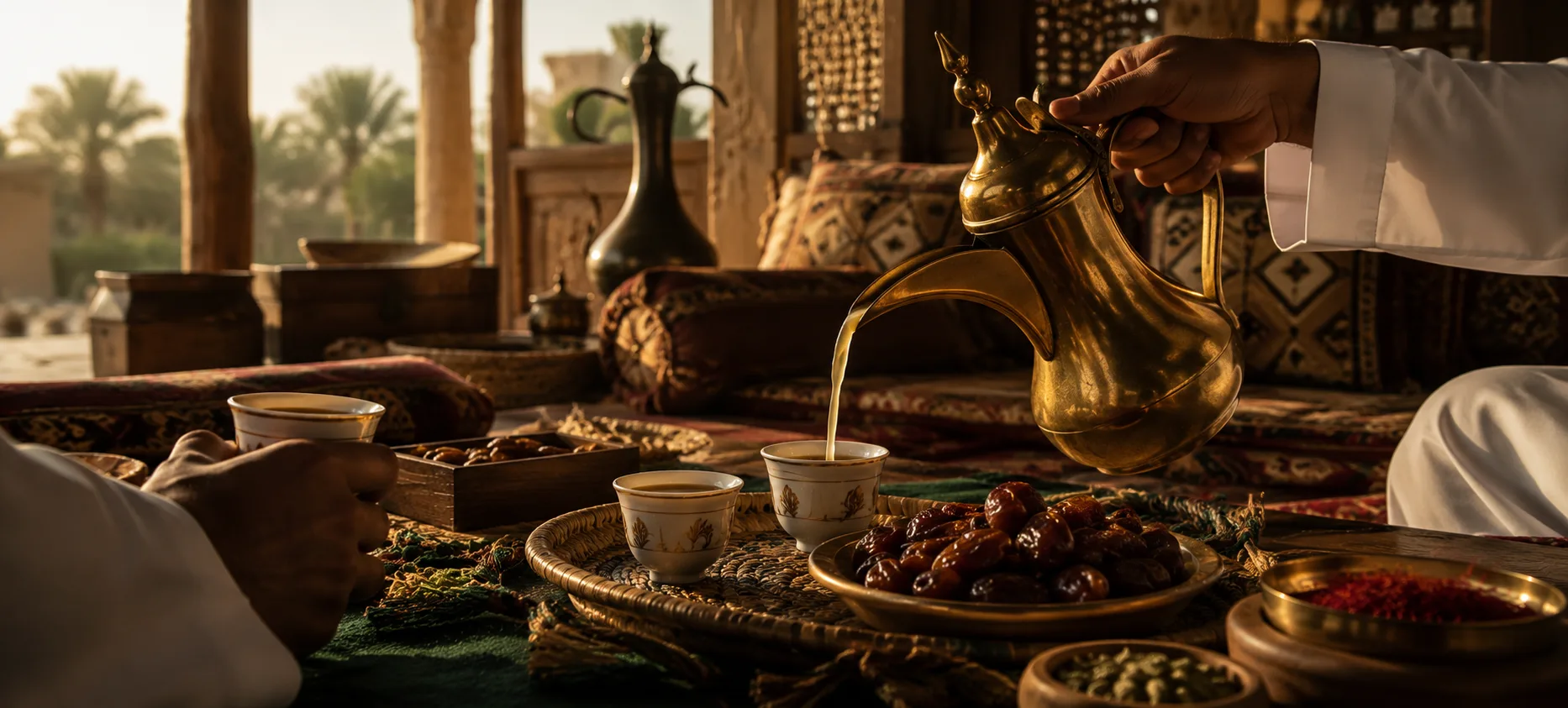
We say Arabic coffee as though one recipe could explain an entire region. It cannot. Even inside one country, two families can prepare it differently. The roast changes. The amount of cardamom changes. Saffron appears in one house and disappears in another. Clove, ginger, rose water, mastic or other aromas may enter according to region and family. The colour can move from pale gold to a deeper brown. What remains easier to recognise is the social language around the cup. Someone arrives. Someone welcomes. The dallah appears. A small finjan is offered. Conversation begins. The coffee is therefore both a drink and a verb: to receive, to sit, to listen, to make room for another person.
A heritage shared across borders
Arabic coffee is not only a poetic symbol we invented for this story. In 2015, the United Arab Emirates, Saudi Arabia, Oman and Qatar jointly secured its inscription on UNESCO’s Representative List of the Intangible Cultural Heritage of Humanity as a symbol of generosity. In 2024 the element was extended to include Jordan. UNESCO describes preparation, service, etiquette and transmission within families as part of the living heritage. That matters because it confirms what travellers often feel without knowing how to name it: the cup belongs to a larger culture of hospitality. Borders give the coffee accents. Families give it personality. The majlis gives it a place to speak.
The bean begins green
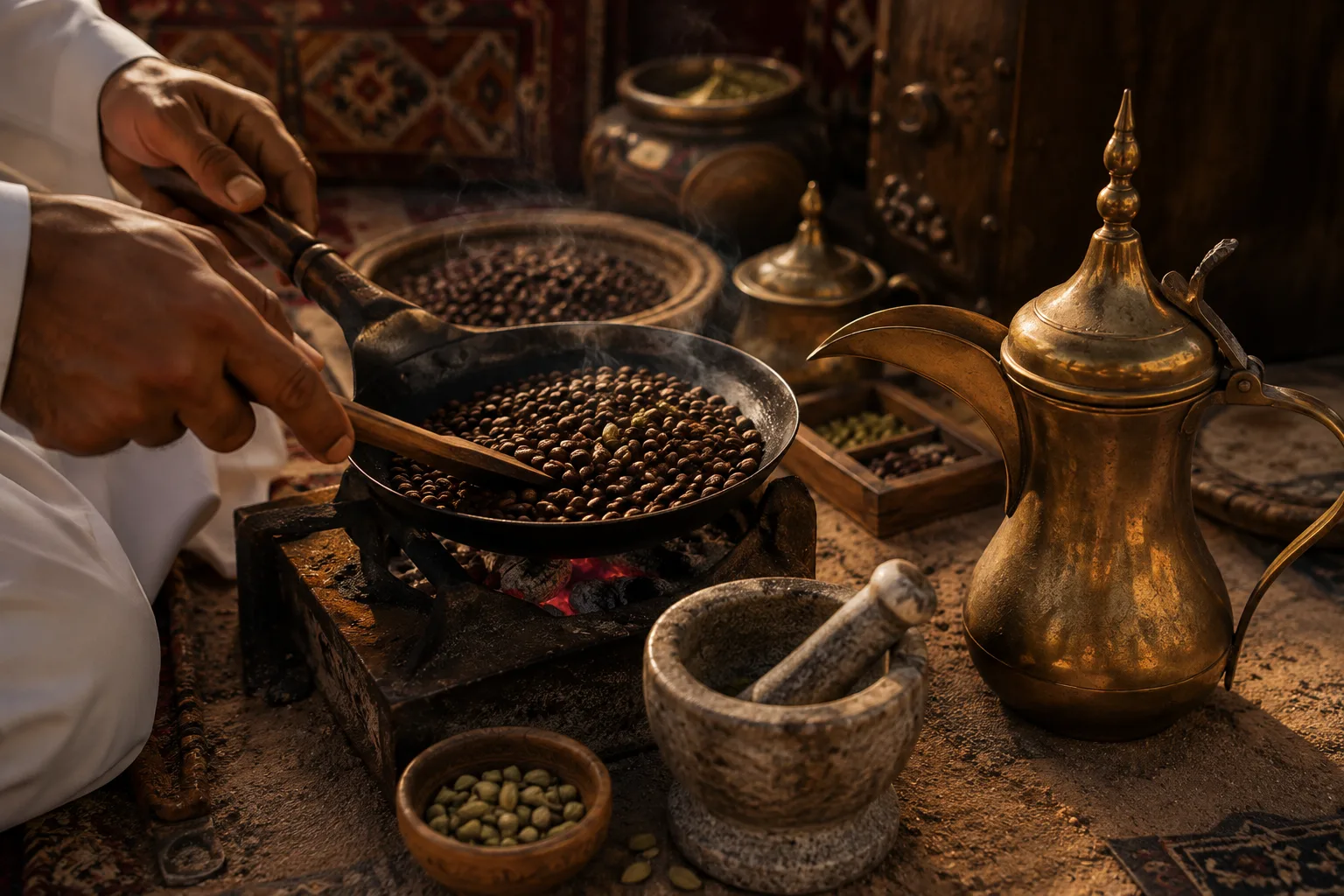
Before the perfume of cardamom and before the polished dallah, there is an ordinary-looking green coffee bean. Traditional preparation begins with selection, then roasting. UNESCO’s description of the practice speaks of beans lightly roasted in a shallow pan over a fire before being pounded and brewed. Modern homes may use different equipment, but the transformation remains fascinating. Heat does not simply darken the bean. It changes aroma, sweetness, bitterness and body. A lighter roast preserves a very different personality from the dark roasts many espresso drinkers know. This is one reason a first encounter with Gulf coffee can surprise someone expecting a small version of European black coffee. It belongs to another grammar.
Light roast does not mean weak culture
Colour can deceive. A pale cup may look delicate, yet its perfume can be remarkably expressive. Cardamom can arrive before the coffee itself. Saffron can add another aromatic layer. The drink may feel lighter in body than an espresso, but it is not trying to imitate espresso. Judging one by the rules of the other is like judging a dhow because it is not a yacht. Different tools, different journeys. The pleasure is in understanding what the drink is trying to do. Arabic coffee often accompanies conversation rather than interrupting it with a heavy dose. The small cup can be refilled, and the rhythm of drinking becomes part of the visit.
Roasting as a moment, not only a technique
In older settings roasting could happen in front of guests. Fire, pan, movement and aroma made preparation visible. Abu Dhabi’s cultural documentation describes specialised traditional tools for roasting, handling coals, grinding and brewing. The process turned hospitality into something witnessed. Today convenience has changed many kitchens, as it has everywhere, but the old sequence helps us understand why coffee carries so much symbolism. The host was not merely opening a packet. Time was being spent. Beans were being transformed. The sound of grinding and the smell of roasting announced that the guest mattered enough for preparation.
Ground, yes, but for another method
People sometimes imagine Arabic coffee uses barely ground beans because the drink looks so different from espresso. In fact the roasted coffee is ground or pounded before brewing. What changes is the method. Espresso forces hot water through compacted fine coffee under pressure. Traditional Arabic coffee is brewed in water and transferred through pots according to local practice. That difference affects extraction, texture and the way spices integrate. It also explains why copying an espresso recipe with Arabic coffee ingredients does not recreate the same cup. Technique is part of flavour. The dallah is not decorative packaging around the coffee; historically it belongs to the preparation and service itself.
The dallah speaks before anyone does
There are objects that become symbols because people use them for generations. The dallah is one of them. In the Emirates it appears in heritage imagery, public art and hospitality settings because its silhouette immediately communicates gahwa. Abu Dhabi’s heritage documentation distinguishes pots historically used for boiling, filtering and serving. Whether every modern household follows the older three-pot sequence is not the point. The important thing is that the object remembers a chain of gestures. Held in the hand, tilted above a finjan, it tells the guest what is about to happen before a word is spoken.
A quarter cup can contain a lot
UNESCO’s description notes that the small cup is traditionally filled only about a quarter full and may then be refilled. The oldest or most important guest is served first. These details look tiny until we understand that etiquette is made from tiny details. Hospitality is rarely one spectacular gesture. It is attention repeated: who enters first, where someone sits, who is served, which hand is used, whether the guest wants another cup. A full cup is not automatically more generous. Sometimes generosity is leaving room for the ritual to continue.
Saudi Arabia: even one country contains many coffees
Saudi coffee destroys the idea that one national recipe is enough. Saudipedia documents substantial regional variation. In central Saudi Arabia the roast tends toward a golden colour, with cloves and saffron sometimes added. Northern preparations can be darker. Southern regions may use lighter coffee with a broader range of spices, while western and eastern traditions have their own preferences. This is important for our story because saying ‘Saudi coffee is lighter’ can be a useful traveller’s impression but not a universal rule. Saudi Arabia is too large and culturally varied for one cup to represent every home.
The golden Saudi cup
Still, there is a visual memory many travellers associate with Saudi hospitality: that pale or golden coffee, fragrant with cardamom, served in a small cup beside dates. It can feel almost weightless to someone accustomed to dark café coffee. Then the aroma arrives. This contrast is part of its charm. I like drinks that reveal themselves slowly. A dark espresso announces itself immediately. A pale Saudi coffee can look modest while carrying a room in its perfume. Perhaps hospitality works the same way. The most memorable welcome is not always the loudest.
Dates are not decoration
Put dates beside coffee and suddenly bitterness, perfume and sweetness begin to negotiate. The date is not merely a prop for a photograph. Saudi Arabia has extraordinary date culture, with varieties carrying different textures and sweetness. Ajwa, Sukkari, Khalas and many others create different pairings. A very sweet soft date changes the next sip of coffee. A firmer, less syrupy date changes it differently. This gives us a simple lesson: pairing is not only for expensive restaurants. Families have been balancing flavours around coffee tables for generations without needing a tasting chart.
Medina, memory and the palm
For me, Saudi Arabia also means the palm. Around Medina, date gardens make the relationship between hospitality and agriculture visible. A finjan and a date can look like two small things on a tray, yet behind them are landscapes, farmers, harvests and family habits. We often separate food from geography because supermarkets make everything appear everywhere. Travel puts geography back into taste. A date eaten near where palms have shaped life for centuries does not become chemically different, but the mind tastes context too.
UAE: balance, movement and the majlis
In the Emirates my personal impression is often of balance. That is an impression, not a law for every Emirati household. Gahwa remains a central symbol of Emirati hospitality, and Abu Dhabi’s cultural authorities describe it as a tradition at the forefront of majlis customs and social occasions. What fascinates me is how naturally it survives inside a country associated with extreme modernity. You can leave a glass tower, cross a polished hotel lobby, enter a family gathering or heritage setting and meet a gesture much older than the skyline.
Dubai does not erase the dallah
Dubai is often photographed vertically: Burj Khalifa, towers on Sheikh Zayed Road, hotels on the Palm, Marina lights. Coffee brings the city back to human scale. A finjan fits in one hand. This contrast is useful when trying to understand the Emirates. Modern architecture did not require hospitality to become modern in the sense of forgetting itself. The same city can contain tasting menus, international coffee chains and an Emirati gahwa service. One does not cancel the other. Culture is strongest when it can enter the future without dressing as a museum.
From Downtown to the desert
I enjoy the spectacular side of Dubai. There is no reason to pretend otherwise. A beautiful hotel, a restaurant with a view, the lights of Downtown or the Marina can be fun. But move toward the desert and the scale changes. The sky becomes larger because the buildings disappear. Coffee beside sand and silence tastes different even when the recipe has not changed. Perhaps the tongue is not the only organ tasting. Place participates. A cup under stars carries another rhythm than the same cup beside an elevator.
Hatta: mountains change the conversation
Hatta adds another UAE landscape. Mountains, farms, wadis and beekeeping traditions give us a different vocabulary from Downtown Dubai. Here coffee can sit naturally beside dates, local food and conversations about Sidr trees and bees without the article becoming an advertisement. This is exactly why I love regional travel. The country becomes larger when we stop using its most famous skyline as its only definition. A cup of gahwa in a mountain setting reminds us that Emirati culture was shaped by several environments, not one postcard.
Abu Dhabi: coffee as continuity
Abu Dhabi has invested heavily in documenting and safeguarding gahwa traditions. The Bait Al Gahwa initiative and cultural guides preserve knowledge of preparation, tools and etiquette. I find this important because heritage can disappear quietly. First the tool becomes decoration. Then nobody remembers why it existed. Then the gesture survives only for tourists. Documentation cannot replace families practising a tradition, but it can help keep the vocabulary alive. Coffee remains strongest when it is still poured because someone has arrived, not because a camera has.
Qatar: Doha, Souq Waqif and the familiar cup
Doha gives the same ritual another setting. Walk through Souq Waqif and you meet spices, dates, oud, textiles, food and the constant movement of residents and visitors. Qatar was one of the four countries in the original UNESCO nomination for Arabic coffee. Again, the important word is not identical. The practice is shared, but houses and preferences vary. This is what makes travelling through the Gulf enjoyable: recognition without repetition. You know the dallah. You know the finjan. You know the invitation. Then you taste and discover another household.
The majlis is larger than furniture
Foreign visitors sometimes reduce the majlis to a room with cushions. That misses the idea. A majlis is social architecture. It creates a place to receive, talk, listen, negotiate, celebrate, remember and sometimes reconcile. UNESCO’s updated description of Arabic coffee even mentions gatherings connected with reconciliation and conflict resolution. Coffee belongs there because conversation needs time. The cup slows the arrival. Nobody has to begin with the difficult subject in the first ten seconds. First, sit. First, drink.
An oryx, a desert breakfast and why context matters
In Qatar we recently found another way to tell cultural stories through the oryx, the country’s national animal. The same principle applies here. A desert breakfast can include coffee and dates without turning an article about wildlife into a product page. Culture is made of connections. Animals, landscapes, food, hospitality and memory occupy the same world. SEO often teaches people to separate everything into isolated keywords. Real life does the opposite. Real life puts the oryx outside, coffee in the hand, dates on the plate and conversation between people.
Oman: coffee beside halwa
Oman changes the table again. Coffee, dates and Omani halwa form one of the country’s most recognisable hospitality combinations. The sweetness and perfume of halwa make the coffee behave differently on the palate. Muscat gives one setting; Nizwa another; mountain villages another. Oman also reminds us that frankincense and aromatic culture have long histories here. Even when frankincense is not literally inside the cup, the broader Omani world is one where fragrance matters. Coffee enters a sensory culture already rich with smoke, spice, rose, dates and sweets.
Nizwa mornings
Nizwa is a place where I would never want to write only ‘Omani honey’ and leave. The fort, souq, mountains beyond, date culture and agricultural life give us too much material. Coffee belongs naturally in that morning landscape. You can imagine traders beginning early, families moving through the market, dates changing hands, halwa cut and shared. A cup becomes a bridge between food and place. This is the kind of SEO I prefer: if Google disappeared tomorrow, the paragraph should still deserve to exist.
The Hajar Mountains and another kind of richness
Travel into the Hajar and luxury changes definition. Air, stone, altitude, silence, terraces and the work required to cultivate difficult land become the story. Coffee in such a landscape reminds me why I distrust a single definition of richness. A five-star lobby can be beautiful. So can a simple cup after a mountain road. They are not enemies. They satisfy different parts of us. I can enjoy both and still know which one quiets my mind.
Morocco enters and changes the rules
Then we return west, and Morocco refuses to behave like a fifth Gulf country. Good. It should not. Moroccan coffee traditions are their own world, and family preparations can include spices in combinations that make me smile when I compare them with the Gulf. The point is not to invent one official ‘Moroccan Arabic coffee’ recipe. There isn’t one universal household formula. The point is memory: coffee can carry cinnamon, cardamom or other aromatic touches according to family habits, and in my mind it immediately opens the door of home.
My grandmother did not need a tasting note
I wish sometimes that I had asked more questions when I was young. How much of this? Why that spice? How long on the fire? Children assume grandparents will always be available for interviews later. They are not. So memory keeps fragments instead of measurements. I remember the coffee as part of the house, not as a recipe card. Perhaps that is why I resist pretending every traditional food can be reduced to grams and minutes. Technique matters, but affection is an ingredient science has difficulty weighing.
Ksar Meski: where taste becomes place
Ksar Meski gives this article its beginning and its return. The old rooms, family well, garden, palm trees, bread, tea, coffee, meals and voices belong to the same archive in my head. When I write about Saudi, Emirati, Qatari or Omani hospitality, I am not comparing them from nowhere. I carry my own house into every comparison. We all do. The first table teaches us how to read later tables.
Meskaoui
“Before I tasted coffee in Riyadh, Dubai, Doha or Muscat, coffee already had a taste for me. It was my grandmother’s. Travel taught me the differences. Memory taught me why they mattered.” — Meskaoui
Coffee and language
Saudi Arabia, the Emirates, Qatar and Oman share Arabic, yet accents immediately tell us that sameness contains difference. Coffee behaves similarly. We recognise the family and then hear the accent. A Saudi cup can speak through its roast and spices. An Emirati cup through another balance. An Omani table adds halwa. A Qatari majlis gives the ritual its own local atmosphere. Nobody needs to win. Food culture becomes poorer when we turn every difference into a ranking.
There is no best cup
Search engines love the word best. Best coffee in Dubai. Best Arabic coffee in Doha. Best Saudi coffee. Best restaurant in Abu Dhabi. Human experience is less obedient. A cup can be technically excellent and leave no memory. Another can be imperfect and stay with you for twenty years because of who poured it. This does not mean quality is irrelevant. It means quality has more than one dimension. Ingredient, technique, place, company and intention all participate.
The restaurant question
The same applies when someone asks me for the best restaurant. I have favourites, of course. But why eat the same rice every day if tomorrow I can discover noodles, meat, fish or something I cannot pronounce yet? Discovery is a form of wealth. A modest kitchen with a cook who cares can give more pleasure than an expensive dining room on the wrong night. So I try, change and return. Coffee taught me the same lesson: comparison should increase curiosity, not close it.
Coffee in the luxury hotel
A beautifully served Arabic coffee in a Dubai or Abu Dhabi hotel can be excellent. Tradition does not become fake merely because the floor is marble. What matters is whether the gesture is understood or merely used as decoration. Some hotels take Emirati hospitality seriously, train staff and work with cultural guidance. Others may reduce the dallah to an exotic object. As travellers, we can enjoy luxury while remaining curious about the tradition underneath it.
Coffee in the desert
Then there is the opposite scene: no chandelier, no skyline, perhaps no table at all. Sand, a rug, a fire, a few people, coffee. For me this can feel richer than the expensive room because silence is one of the luxuries I value most. But that is my wealth, not a universal law. Someone reading this may be happiest in an infinity pool overlooking the Palm, and I will not argue. Culture should open choices, not dictate taste.
The hand matters
Arabic coffee etiquette reminds us that hands communicate. The server traditionally holds the dallah and presents the cup according to established customs; the guest receives it with the right hand. The cup can be gently shaken to indicate enough. These movements are small, almost invisible to someone rushing. Yet they turn drinking into exchange. Hospitality is choreography without a stage.
Why the cup is small
The small finjan makes sense when we stop imagining coffee as a caffeine delivery system. It allows repeated service. It keeps the host attentive and the guest engaged. It creates pauses in conversation. A giant takeaway cup belongs to movement; the finjan belongs to presence. Neither is morally superior. They simply organise time differently. I drink both. But I would be sad if the first replaced the second everywhere.
Coffee, poetry and memory
UNESCO notes that Arabic coffee in gatherings can accompany poetry, discussion and the exchange of memories. That sentence could almost describe why this article exists. A drink becomes an archive because people repeatedly place stories around it. Grandparents tell something. A traveller arrives. A disagreement softens. News is exchanged. A child watches without appearing to listen. Years later that child remembers the smell more clearly than the words.
The spice argument
Cardamom may be the great common voice, but spices create endless friendly arguments. How much is too much? Should saffron be obvious or discreet? Does clove improve the cup or dominate it? Family recipes answer differently. I like that. Standardisation is useful for factories, but homes should be allowed personality. If every grandmother followed the same global specification, memory would lose its accent.
Coffee and dates: a natural bridge to honey
Dates are the most natural sweet companion in much of the Gulf, but the wider hospitality table can include halwa, pastries, fruit and sometimes honey. Honey should not be forced into every coffee story. A strong Sidr can dominate a delicate cup if eaten immediately before it. A milder honey creates another pairing. The interesting question is not ‘does honey belong?’ but ‘what is on this family’s table, in this place, on this day?’
Hatta Sidr, Oman Sidr and the landscape behind sweetness
When honey does appear, origin matters just as it does with coffee. Hatta’s mountain environment, Oman’s wadis and mountains, Yemen’s famous Sidr regions and other Arabian landscapes produce different honey traditions. Coffee gives us a useful analogy: saying ‘Sidr honey’ does not mean every jar tastes identical, just as saying ‘Arabic coffee’ does not mean every dallah contains the same recipe. Plant, climate, season, handling and place leave signatures.
A table can be a map
Put Saudi coffee, Emirati dates, Omani halwa and Sidr honey on one table and you have accidentally created a map of Arabia. Add Moroccan bread and olive oil and the map stretches west. Food does this effortlessly. It crosses borders without erasing them. This is why I prefer cultural writing to endless product descriptions. A jar has more meaning when the reader understands the landscapes and habits around it.
What modern coffee culture adds
Specialty cafés across Riyadh, Dubai, Doha and Muscat have created another layer. Young baristas discuss origin, processing, extraction and roast profiles with scientific precision. This does not have to threaten traditional gahwa. In fact the two worlds can make each other more interesting. One teaches us to examine the bean; the other teaches us to examine the relationship around the cup. A culture can hold an espresso machine and a dallah in the same city.
Do not freeze tradition
Tradition survives by being practised, and practice always contains change. Gas replaced some fires. Electric grinders replaced some mortars. Coffee may be prepared in larger quantities for events. Hotels adapt service to international guests. None of this automatically destroys authenticity. The more useful question is whether the values, knowledge and etiquette are still understood. Heritage is not a photograph. It is something people continue doing.
Same majlis, same language
After travelling through these coffee cultures, I return to the phrase that started this article: same majlis, same language, different taste. Not literally the same room and not literally one recipe. The same language is hospitality. Sit. Take the cup. Eat a date. Tell me where you came from. Tell me about your family. Stay a little longer. This language needs very little translation.
Meskaoui
“The coffee changes. The dates change. Even the spices argue with each other. But sit down, take the finjan, and suddenly we are speaking the same language.” — Meskaoui
Back to my grandmother
I travelled thousands of kilometres after the coffee of my childhood. I found paler cups, darker cups, cardamom that arrived like perfume, saffron hiding in the background, dates soft as caramel, Omani halwa, desert mornings and hotel lobbies. I learned names for things my grandmother never needed to explain to me. And after all that learning, one truth remains stubbornly simple. Taste has memory. Sometimes a smell crosses a room and distance collapses. Dubai disappears. Doha disappears. Muscat and Riyadh disappear. I am back in Ksar Meski, and coffee is not a subject. It is home.
Continue the Journey
If this story brought you here, continue the journey through related stories from The House of Meski.