
A national animal, a survivor, and a reminder that Qatar begins long before the skyline.
Before Doha had a skyline
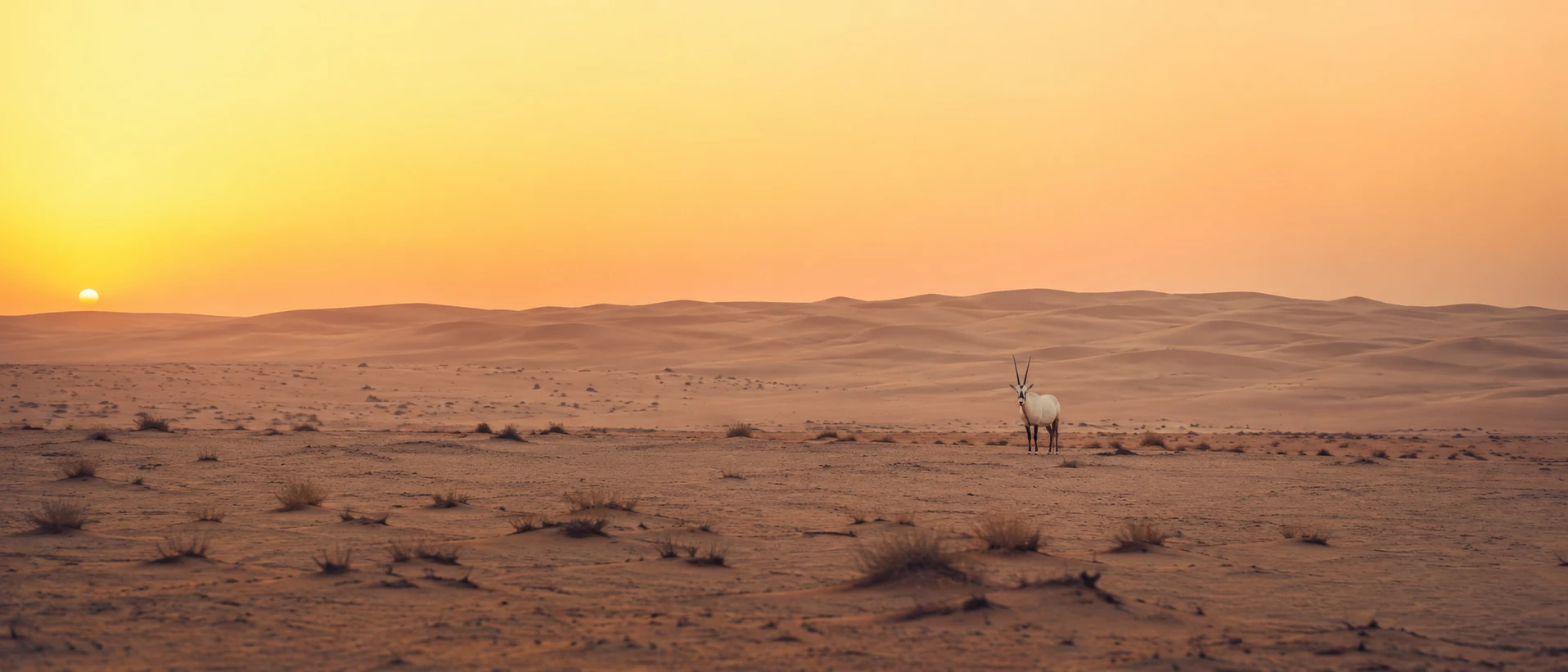
Long before glass towers reflected the Gulf, another white shape belonged to this peninsula. It did not need an architect, a road or a sign to announce itself. The Arabian oryx was already here, moving through a landscape that from a distance can look empty and, once you learn to watch it, is anything but empty.
Qatar chose the Arabian oryx as its national animal. That choice makes sense to me. Its beauty is obvious, but beauty alone would be too easy. What interests me is endurance. The animal is built for a place where shade is precious, water is uncertain and distance has a different meaning.
The white animal of the desert
The Arabian oryx is immediately recognisable. Its coat is bright, almost startling against stone and sand. That pale coat helps reflect the sun. Its hooves are broad enough to make movement over soft ground easier, and both males and females carry the long, nearly straight horns that give the animal its unmistakable silhouette.
Visit Qatar notes that an oryx can cover more than seventy kilometres during a night. I like that fact because it destroys the idea of the desert animal as something standing still for our photographs. The oryx is a traveller. We may see it for a minute; its life is measured across a much larger landscape.
An animal made for scarcity
Survival in Arabia is rarely about abundance. It is about knowing how to live when abundance is absent. The oryx feeds on desert vegetation and has evolved for harsh, dry conditions. Its body, behaviour and movement are answers to heat and scarcity.
We often describe the desert by what it lacks. The oryx teaches the opposite lesson. Look at what remains. Look at what adapts. Look at the intelligence written into an animal that can cross country most of us would hesitate to walk through for an hour.
The horns and the illusion of one
Seen from the side, the two long horns can align so perfectly that the animal appears to carry a single horn. It is easy to understand why the oryx has gathered stories around itself. The shape is almost too elegant to seem practical.
But those horns are not decoration. The animal is alert and can defend itself by lowering its head and presenting them forward. Beauty and survival are not opposites here. In the desert they often occupy the same body.
Qatar’s national animal
Calling the Arabian oryx Qatar’s national animal gives it a modern symbolic role, but the relationship between people of the Arabian Peninsula and the oryx is much older than the modern state. For centuries it has been admired for its form, endurance and ability to inhabit a severe landscape.
I would not reduce that relationship to a logo. A national animal should make us curious about the land that produced it. If the oryx becomes only an emblem on a page, we lose the most interesting part.
The desert is not empty
When visitors first leave Doha, the city can disappear surprisingly quickly. Buildings give way to open ground, scrub and long horizons. At first the eye searches for something large. Then it begins to notice smaller signs: tracks, plants, birds, changes in sand, movement at the edge of vision.
The oryx belongs to this second way of seeing. It rewards patience. The desert does not perform on command, and that is one of the reasons I respect it.
A history that nearly ended
The modern story of the Arabian oryx contains a warning. The species disappeared from the wild in 1972 after hunting and capture had reduced wild populations to extinction. That date is not ancient history. It is within living memory.
Reintroduction programmes later returned Arabian oryx to the wild. UNESCO records the first free-ranging herd after that global wild extinction as being reintroduced in Oman in 1982. The return of an animal does not erase the fact that people once pushed it out.
Conservation is not a decorative word
Conservation stories are often told as clean victories. Reality is less comfortable. Reintroduced populations can still face poaching, habitat pressure and difficult management decisions. The history of the Arabian oryx sanctuary in Oman is proof that recovery can be followed by decline when protection weakens.
For me this matters even in an article about Qatar. Wildlife does not understand our borders in the way our websites do. The Arabian oryx is a shared natural heritage of the peninsula, and its survival depends on serious protection across the region.
Operation Oryx and the return
Qatar has also participated in conservation and captive breeding efforts. Visit Qatar describes the role of conservation measures and breeding, and points to Al Maha sanctuary as a place associated with breeding Arabian oryx in the country.
The important word is not attraction. It is continuity. A species that vanished from the wild needed people to decide that its absence was unacceptable.
Al Maha and the responsibility of seeing
There is a difference between seeing an animal and understanding it. A sanctuary can give people the first opportunity, but the second depends on how we look. If we arrive only for a photograph, the oryx becomes scenery.
If we ask why it is here, why it disappeared, how it survives and what its return required, the same encounter becomes education.
What does an oryx eat?
The Arabian oryx is herbivorous. Desert grasses, herbs, shrubs and other vegetation form its diet. This sounds simple until you remember the environment. A green field offers food everywhere; a desert makes every patch of vegetation meaningful.
Movement therefore becomes part of feeding. The animal must read a landscape whose resources change with rain and season.
Rain that may have fallen somewhere else
Desert animals cannot build their lives around our calendars. Rain may transform one area while leaving another almost untouched. Vegetation responds, and animals respond to vegetation.
This is one of the things I love about desert ecology: the landscape is connected by signals most of us no longer know how to read.
Night belongs to another Qatar
Much of what we imagine about Qatar happens in daylight photographs: architecture, beaches, roads, museums. But the desert after sunset is another country of temperature and movement.
An animal capable of travelling enormous distances at night reminds us that darkness is not the end of the desert day. For many creatures it is when the landscape becomes more possible.
White against sand
Photographers naturally love the Arabian oryx. The white body, dark facial markings and long horns create a graphic image even from a distance. Yet the most beautiful photograph can also create the wrong impression if it makes the animal look like an ornament.
I prefer an image with space around it. Let the desert remain large. Let the oryx be part of the landscape rather than the owner of the frame.
Not a camel, and that matters
The camel dominates the international imagination of Arabia, and rightly has an extraordinary relationship with human life in the region. But Arabia’s wildlife is much broader than the camel.
The oryx opens another door. It takes us from domesticated partnership into wild adaptation. It asks us to think about what lived here without being built around human needs.
Children and the national animal
If I were explaining Qatar to a child, I would not begin only with the tallest building or the newest stadium. I would show the oryx. Then I would ask: why is it white? Why are its feet shaped that way? How can it live here?
Three questions about one animal can teach climate, biology, history and responsibility without feeling like a lesson.
The danger of turning wildlife into luxury
In the Gulf, almost anything beautiful can eventually be wrapped in the language of luxury. I would resist doing that to the oryx. Its value does not come from exclusivity, price or the fact that someone can arrange a private encounter.
It was valuable before there were resorts. It will remain valuable when nobody is watching.
The desert majlis
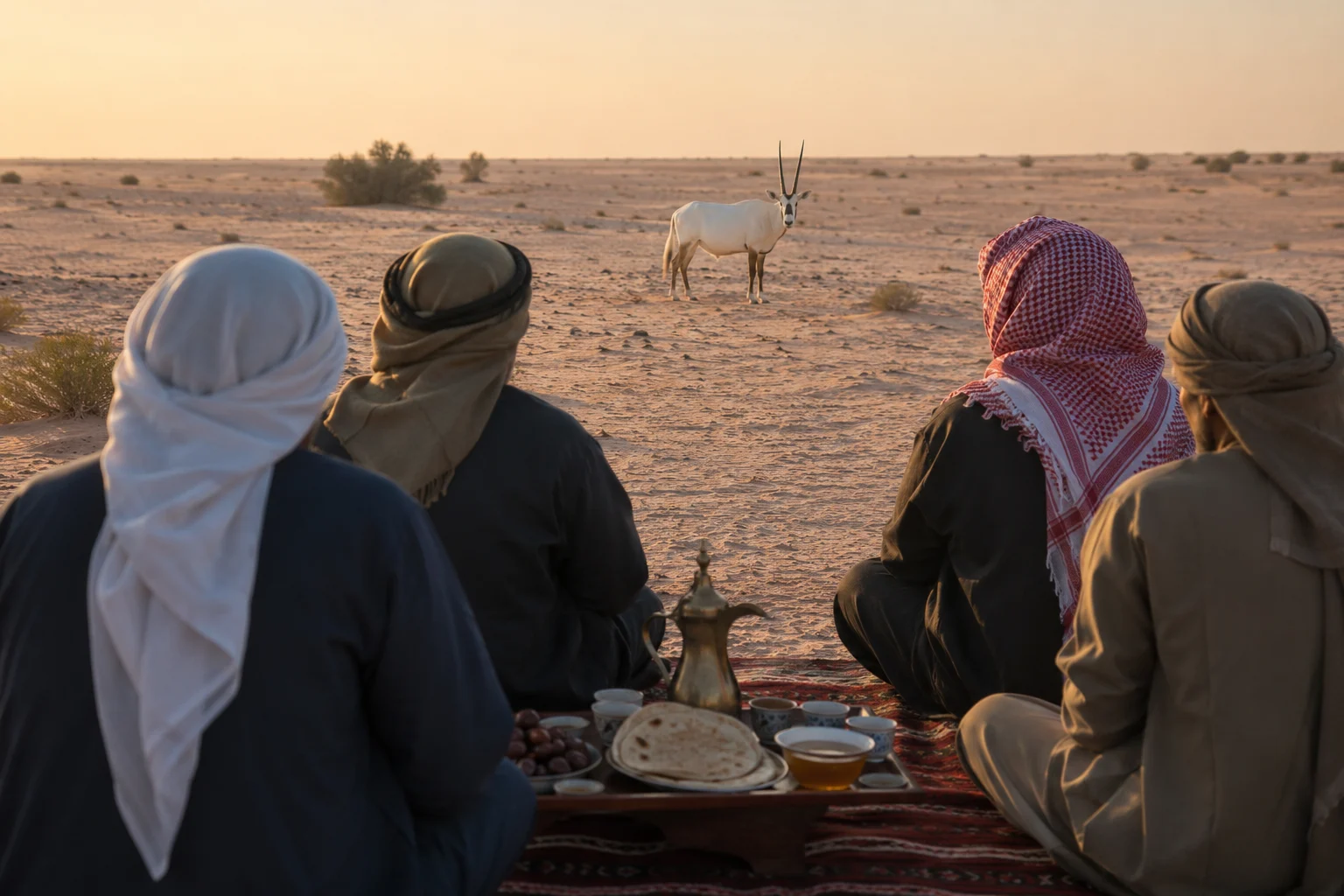
There is, however, a human way of meeting the desert that I find beautiful: sitting rather than conquering it. A carpet, cushions, coffee, dates, bread, conversation. The majlis does not need walls to be a majlis.
From there, if an oryx appears at a respectful distance, the moment does not need to be manufactured. You simply become quiet.
Coffee before the photograph
I have noticed that the best moments often happen when people stop trying to collect them. Someone pours Arabic coffee. Another person breaks bread. A child looks away from the table and sees movement first.
Suddenly everyone turns in the same direction. The phones may come out eventually, but for a few seconds there is only attention.
Honey on the breakfast table
Sometimes there may be honey with breakfast. Not as a product presentation. Just honey, beside bread, dates and coffee, where food belongs.
This is exactly how I want MESKI to appear in stories like this: almost not at all. The animal is the story. The desert is the story. The people sharing the morning are the story.
The oryx does not need our brand
We sell honey. That does not mean every beautiful thing in Arabia must lead back to a jar. Some stories deserve to remain larger than commerce.
If a little honey happens to be on the table while we watch an oryx, that is enough. We do not need to ask the animal to advertise anything.
What the oryx represents to me
I see patience, adaptation and dignity. I also see a warning about what disappears when humans take too much and assume nature will repair itself.
Perhaps that is why the animal feels so appropriate for Qatar: a country transformed at extraordinary speed still choosing an ancient desert animal to represent it.
A symbol between past and future
Modern Qatar is often discussed through energy, aviation, architecture, sport and global ambition. The oryx points in another direction, toward ecology, land and memory.
Those two Qatars are not enemies. The interesting question is whether the future can leave enough room for the older landscape to continue breathing.
Do not chase it
Wildlife appreciation requires distance. An animal should not have to change its behaviour because we want a closer photograph. If the oryx moves away, let it move away.
Respect sometimes means accepting a worse picture.
The privilege of still being able to see one
After knowing that the Arabian oryx disappeared from the wild in 1972, seeing one carries a different weight. It is no longer simply a beautiful antelope.
It is an animal whose presence today depends partly on people deciding to reverse a loss created by people.
Qatar beyond Doha
Doha deserves its fascination, but Qatar is not only Doha. To understand the national animal, we have to let our eyes leave the skyline and adjust to open country.
That movement from city to desert is not an escape from Qatar. It is a movement deeper into it.
The silence around an oryx
There are animals whose presence creates excitement. The oryx, for me, creates silence. Maybe it is the distance, maybe the horns, maybe the white body against a huge landscape.
I do not need to explain every silence. Some are useful exactly because they interrupt us.
A national animal should remain an animal
Symbols can become so familiar that we stop seeing the living creature behind them. The oryx appears in names, identities and imagery across the Gulf, but the real animal still needs habitat, food, protection and responsible management.
That reality should remain stronger than the symbol.
What we carry back to the city
After a morning in the desert, Doha feels louder. The roads fill again, messages return, coffee becomes takeaway coffee, and the day accelerates.
But sometimes one image stays: an oryx standing at a distance, doing absolutely nothing for us.
Breakfast with an oryx
Today it is possible to sit in a desert-style majlis, drink coffee, eat breakfast and admire an oryx nearby in a managed setting. I understand why people love the experience. It connects food, hospitality and the animal that Qatar chose as a national symbol.
But the order matters to me. We are not having breakfast so the oryx can decorate it. We are fortunate that while we eat, there is still an oryx to admire.
The last cup of coffee
The coffee cools. Someone takes another date. There is bread on the table and perhaps a little honey. Nobody is talking about honey anymore.
We are looking at the oryx.
The white shadow remains
Maybe that is the right ending. No shop, no booking link, no list of places to buy something. Just an animal that survived a history it should never have had to survive.
Qatar’s white shadow of the desert is beautiful because it belongs to the desert before it belongs to any of us.
The Arabian Peninsula before borders
The Arabian oryx belongs to a geography older than today’s frontiers. Qatar, Saudi Arabia, Oman and the wider peninsula share environmental histories that animals crossed without passports. Modern conservation is organised by states, but the ecological story is regional.
That shared history is worth remembering because national pride and regional responsibility do not contradict each other. Qatar can celebrate the oryx as a national animal while recognising that the species belongs to a much larger Arabian landscape.
What extinction in the wild really means
The phrase ‘extinct in the wild’ can sound technical. It means there were still animals alive under human care, but none left living freely in the landscapes where the species had evolved. The wild story had stopped.
That distinction is important. Keeping an animal alive in captivity is valuable, but restoring a self-sustaining population to suitable habitat is a much more difficult ambition.
Reintroduction is a second chance, not a reset
When an animal is returned to the wild, history does not return to zero. The causes that removed it may still exist. Habitat may have changed. Human pressure may remain. Populations may be small and vulnerable.
The oryx therefore teaches a conservation lesson beyond Qatar: bringing a species back is only the beginning. Protection has to survive political cycles, economic pressure and the moment when public attention moves elsewhere.
Poaching and the price of rarity
Rarity can make an animal more precious to conservationists and more attractive to people who want to possess it. That is one of the cruel paradoxes of wildlife protection. The fewer individuals remain, the more damaging every illegal capture becomes.
UNESCO’s records from Oman show how poaching contributed to severe declines even after successful reintroduction. The lesson is uncomfortable but useful: admiration without protection is not enough.
Habitat is part of the animal
We sometimes speak about saving a species as if we could separate it from its landscape. We cannot. An oryx without enough suitable habitat is an animal living on borrowed time.
Protecting wildlife therefore means protecting space, vegetation, movement and ecological processes that are less photogenic than the animal itself.
The patience of desert observation
In a forest, life can surround you immediately. In the desert, observation often asks for patience. You learn to scan distances, notice tracks, recognise the difference between a shrub moved by wind and an animal moving behind it.
This slower attention changes the visitor too. The desert becomes less empty as your expectations become less noisy.
Why the oryx looks almost unreal
The combination of white coat, dark markings and extremely long horns creates an animal that seems designed by an illustrator. Yet every part exists inside the practical demands of survival.
That tension between elegance and toughness may explain part of the oryx’s cultural power. It looks delicate from far away and is anything but fragile.
The national symbol and the living population
National symbols are repeated endlessly because repetition makes them recognisable. Wildlife needs the opposite: specific attention. How many animals? Where are they? What habitat do they have? How are breeding populations managed?
The symbol should lead us back to these questions. Otherwise we celebrate an image while forgetting the living animal.
A photograph I would want
If I could choose one image for this article, I would not place the oryx enormous in the centre. I would place it small, with most of the frame given to desert and morning light.
The picture would say: this animal is magnificent, but the world around it matters too.
What a visitor should take away
Seeing an Arabian oryx should not become another box ticked beside museum, souq and desert drive. Take away one fact about its adaptation, one fact about its near disappearance and one reason its habitat matters.
Then the encounter remains useful after the photograph disappears into a phone.
The breakfast is not the destination
A desert breakfast with coffee, dates, bread and honey can be beautiful. I understand why people seek it. Hospitality gives warmth to a landscape that can otherwise feel intimidating to a visitor.
But if an oryx is present, the meal should make us more attentive to the place, not turn the animal into part of the table decoration.
Honey is sweet, attention is sweeter
I could easily end with a sentence about honey because honey is our world. But the more honest ending is about attention. The jar can wait. The coffee can cool.
When an animal that once vanished from the wild stands in front of you, look at it properly.
The desert after the city
Leaving Doha for open country changes scale. In the city, human decisions dominate the view. In the desert, even a road feels temporary beside the horizon. The oryx belongs to that larger scale.
Perhaps this is why seeing it can be calming. For a moment the city is not the centre of the story.
A story worth telling without selling
Some of the strongest pages in a brand journal should be allowed to exist without a commercial objective in every paragraph. Trust grows when readers understand that our curiosity is real.
The Arabian oryx deserves that kind of page. If the story eventually reaches a breakfast table with coffee and honey, it should feel like life entering the article, not advertising entering through the back door.
One animal, many questions
How does it manage heat? How far does it move? What happened in 1972? Why did reintroduction matter? What does Qatar’s choice of national animal say about the relationship between a modern country and its desert past?
An emblem becomes interesting when it makes us ask better questions.
Questions readers ask
Yes. The Arabian oryx is Qatar’s national animal and is native to the Arabian Peninsula.
Its pale coat reflects sunlight, an adaptation that helps it live in a harsh desert environment.
Yes. Qatar’s official tourism information notes that they can sometimes cover more than 70 km during a night.
Yes. It disappeared from the wild in 1972 before conservation and reintroduction programmes returned populations to free-ranging habitats.
Visit Qatar identifies Al Maha sanctuary in Ash-Shahaniyah as a breeding location for Arabian oryx.
It is herbivorous and feeds on desert vegetation such as grasses, herbs and shrubs.
Continue the Journey
If this story brought you here, continue the journey through related stories from The House of Meski.