
Why we still carry honey, coffee, spices and recipes across borders even when almost everything can now be bought abroad.
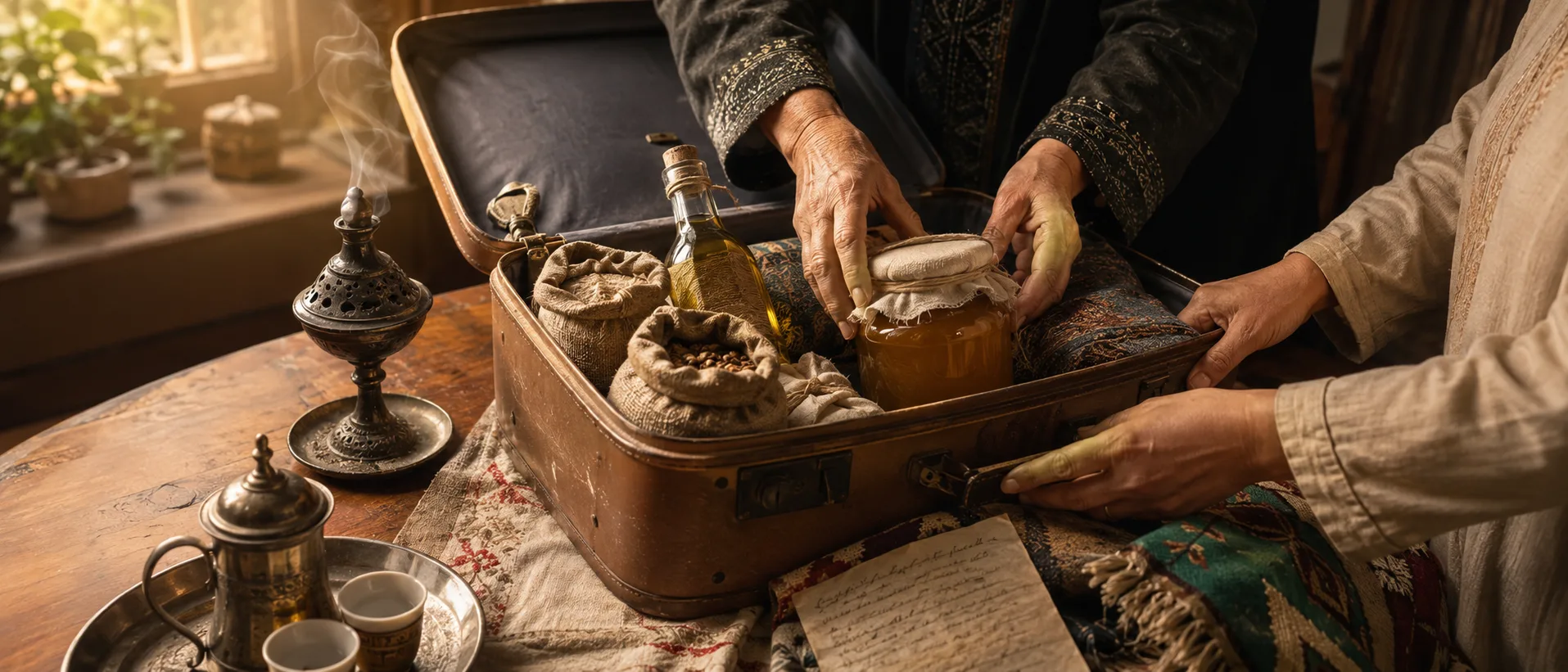
The suitcase is never only a suitcase
When people leave home, they pack practical things first. Clothes. Documents. A charger that will somehow still be forgotten. Then, if there is space, the strange little things begin to enter the suitcase.
A bag of spices wrapped twice because somebody is afraid it will open. Coffee from the shop the family trusts. Olive oil in a bottle that has been checked three times. Honey from a beekeeper, a village or a region whose name means more to the traveller than it means to the customs officer. Incense. Dates. A handwritten recipe. Something from the kitchen that can easily be bought abroad, but apparently not this one.
I understand this very well.
Today we live in a world where export has made distance smaller. In Dubai, Doha, Paris or London, you can find products from countries thousands of kilometres away. Yemeni Sidr honey, Omani frankincense, Moroccan olive oil, Palestinian za’atar, Saudi dates, cardamom, coffee, rose water, spices. Sometimes the imported version is excellent.
And still, somebody asks his mother to put another jar in the suitcase.
Why?
Because taste has two tongues
There is the taste measured by the mouth. Sweet, bitter, floral, smoky, acidic, soft, strong. We can compare it. We can discuss quality, origin, freshness and technique.
Then there is another taste that is much more difficult to measure.
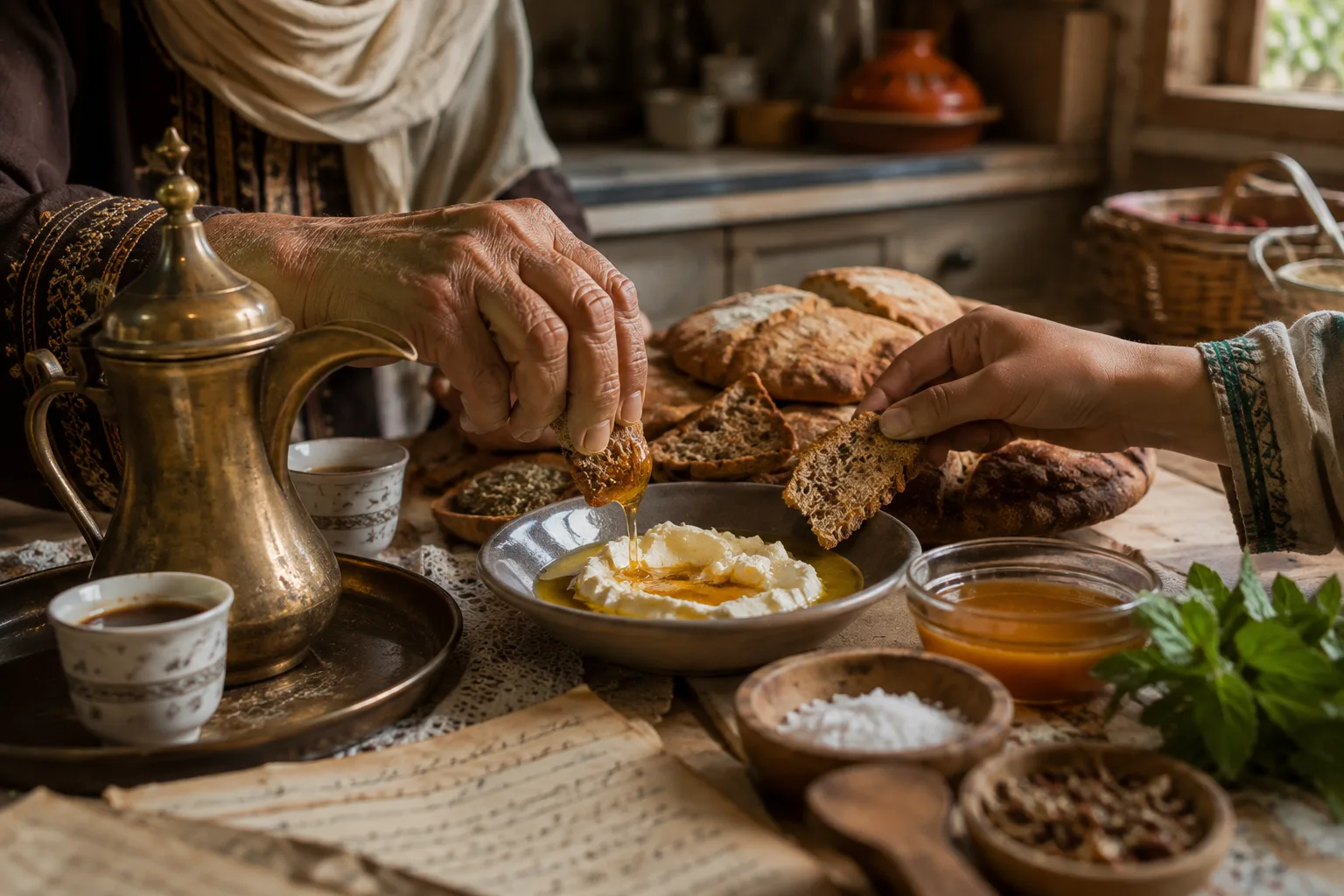
The taste of a kitchen where you ate as a child. The smell that arrived before guests. The honey your father put on bread. The oil your grandmother poured without measuring. The coffee whose recipe nobody wrote because everybody at home was supposed to know it.
The second taste is not always objectively better. That is the beautiful part.
Memory is not a laboratory.
Meskaoui
“Today we can export almost everything: honey, coffee, spices, perfume, olive oil. But nobody has learned how to export the memory of home.”
— Meskaoui
The jar from home does not need to win a competition
Sometimes we make a mistake when talking about traditional food. We feel obliged to declare that our mother’s recipe is the best in the world, our village has the best oil, our country has the best honey and everybody else is wrong.
I do not need that.
My mother’s jar does not have to defeat your mother’s jar. The honey I remember does not have to score higher than another honey in a blind tasting. Memory is not asking for a medal.
A product can be technically excellent and still fail to move me. Another can be imperfect and immediately return me to a table, a person, a season or a house.
This is why food carried across borders is often carrying something invisible.
What Yemen can fit inside a jar
Think of Yemen. For many people, Sidr honey is not simply a premium product searched online as Yemeni Sidr honey or Do’ani Sidr honey. It is connected to valleys, harvests, family knowledge, gifting, reputation and a country whose history is much larger than the headlines through which outsiders often encounter it.
A jar travelling from Yemen can therefore carry two journeys at once. There is the physical journey of honey from flower to hive, harvest to container, country to country. Then there is the emotional journey of the person opening it far from home.
The aroma may bring back a breakfast, a Ramadan table, an uncle, a market, a village name or somebody who is no longer sitting at the table.
No shipping label records that second origin.
Oman can travel as smoke
Oman gives us another beautiful example because memory does not always travel through food. Sometimes it travels through smoke.
Frankincense, especially the traditions associated with Dhofar, can turn a room into a place of memory within seconds. Burn a little and the geography changes. A home in another country suddenly carries an aroma associated with Oman, family gatherings, clothing, hospitality or religious and social occasions.
Then there is Omani honey: Sidr from areas such as the interior, Samar honey, other seasonal honeys. Coffee, dates and spices join the same domestic vocabulary.
An Omani family living abroad can buy many of these things locally today. Yet a packet brought by a relative can still feel different before it has even been opened.
Because the relative is part of the package.
Morocco travels in oil, bread and a handful of spice
In Morocco, I think immediately of olive oil. Not olive oil as a generic product with a pretty Mediterranean label. I mean the oil connected to a particular family, press, village or harvest.
Someone tastes it and says, this is from home.
That sentence is interesting. Home may be two thousand kilometres away. The bottle is sitting on a table in France, Belgium, the Gulf or elsewhere. Yet for one second the speaker has moved.
Moroccan families carry spices, tea habits, preserved foods, recipes, sweets, oils and regional tastes with them. A kitchen abroad becomes a small map. One cupboard can contain the Rif, Fes, Tafilalet, the Atlas, Souss and a French supermarket at the same time.
Migration creates unusual pantries.
Ksar Meski and the taste that belongs to a place
For me, places such as Ksar Meski make this relationship between taste and geography impossible to ignore. An oasis is not an abstract origin. It is water, palms, earth, family stories, heat, shade and the memory of people moving through the same spaces before you.
When a product is connected to a place like that, the name is not only useful for marketing. It can be a thread.
You pull it and a landscape appears.
Palestine, the olive tree and the meaning of keeping a taste
For Palestinian families, olive oil and za’atar can carry an especially powerful relationship with land, household and continuity. It would be disrespectful to reduce that relationship to a fashionable food trend.
A bottle of oil can be food, agricultural work, family connection and memory at once. A spice mixture can carry the taste of breakfast and the geography of belonging.
This is true in different ways across many displaced and migrant communities: the ordinary food becomes more emotionally visible after distance enters the story.
At home, you may not explain the bread. Away from home, suddenly you explain everything.
Syria, Lebanon and the recipes that refuse to stay behind
Levantine kitchens have travelled widely with migration. Dishes change slightly as ingredients change, as families settle in new cities, as children grow up speaking another language, as restaurants adapt to local customers.
Some people worry that adaptation means loss. Sometimes it does. But adaptation can also be survival.
A grandmother cooked by touch. Her daughter writes approximate quantities. A grandchild records a video. The recipe has changed form three times, yet something continues.
Tradition is not a museum object. It survives by being cooked again.
Saudi Arabia: dates, coffee and the smell of welcome
Saudi families carry their own regional variations of coffee, dates, spices, incense and food traditions. A box of dates can be an everyday food, a gift, a Ramadan gesture or something sent to relatives abroad.
Arabic coffee again demonstrates how memory lives in variation. One family likes a certain roast. Another uses more cardamom. Someone adds saffron. Somebody insists that the coffee made by an aunt tastes different even when everyone watched her use the same ingredients.
Of course it tastes different.
She made it.
The Gulf is now one of the places where everybody’s cupboard meets
Dubai and Doha make this story especially interesting because migration and trade have placed foods from many regions beside one another.
A Yemeni can find honey. A Moroccan can find familiar oil or spices. An Omani can find products from home. South Asian, Levantine, North African and Gulf ingredients share supermarket aisles and neighbourhood shops. Restaurants reproduce dishes from cities thousands of kilometres away.
This abundance changes migration. Previous generations often had to improvise because ingredients were unavailable. Today the problem may be the opposite: almost everything is available.
And still the suitcase comes back full.
If everything is available, why do we still bring it?
Because availability and belonging are not the same thing.
The jar on the supermarket shelf may be authentic. The spice may genuinely come from the same country. The coffee may even be better quality. But nobody at the shop said, I packed this for you.
That sentence changes the product.
A mother gives food differently from a retailer. A father sends something because he remembers what you like. A neighbour adds a packet because there was extra. An aunt refuses to accept that you already have enough.
Commerce moves goods. Relationships move meaning.
The mother’s measurement system
Family recipes have their own mathematics.
How much flour? Enough.
How much water? You will see.
How long? Until it is ready.
This is torture for the person trying to preserve the recipe. Hahaha.
But it reveals something important. Knowledge can live in hands rather than written instructions. Texture tells the cook when to stop. Smell announces the next step. A sound in the pan means the heat is right.
When families migrate, this embodied knowledge has to cross a border too.
Write it down before ‘a little’ disappears
I love oral tradition, but I also believe we should record more of it.
Ask your mother what she does. Ask your father where he buys the coffee. Ask your grandmother why she adds that ingredient at that moment. Record the name of the village. Write the word in the language she uses, not only its translation.
One day, ‘a little of this’ can disappear because the person who knew what a little meant is no longer there.
Preserving culture does not always require a museum. Sometimes it requires a notebook.
Perfume is another form of edible memory without eating
Smell may be even faster than taste.
Oud, bakhoor, frankincense, rose, orange blossom, musk accords, a particular soap, the perfume a parent wore: aroma can reopen a room you thought you had forgotten.
This is why families do not carry only food. They carry perfume and incense. They reproduce the smell of welcome.
A house can be new, the furniture can be new, the country can be new, and one familiar smoke rising from a mabkhara can suddenly make the place feel inhabited rather than rented.
Coffee is a ritual before it is a beverage
Coffee travels exceptionally well because the bean is only part of the story. The pot, roast, spices, cup, order of serving and people present around it all contribute.
In one home, coffee means morning. In another, guests. In another, condolences, celebration, Ramadan nights, business, family or the moment after a meal.
So when somebody packs coffee from home, perhaps they are not really transporting caffeine.
They are transporting the possibility of repeating a scene.
Honey survives the journey differently
Honey has its own advantage: it keeps the landscape inside it in a very literal way. Nectar sources, climate, season and beekeeping practices influence what reaches the jar.
Sidr honey from Yemen is not identical to Sidr honey from Oman, the UAE, Saudi Arabia or Morocco. Even within one country, region and harvest matter. Samar honey tells another botanical and seasonal story.
This makes honey unusually suited to memory. It is both food and geography.
But memory adds a layer that no laboratory analysis can quantify.
The dangerous sentence: ‘it tastes exactly like home’
Sometimes it does not.
That is another truth worth accepting.
You buy the same ingredient. Follow the same recipe. Use the same pot. It is good, but something is missing.
Maybe the flour is different. The water is different. The vegetables grew in another climate. Maybe the old oven mattered. Maybe memory edited the original taste until nothing in reality can reproduce it perfectly.
Or maybe the missing ingredient is simply the people who were there.
No import company can solve that.
Children born somewhere else inherit memories they never lived
This is one of the most fascinating parts of migration.
A child can grow up in Paris and call a village in Morocco home even if he visits only during holidays. Another can grow up in London with a Yemeni dish that represents a place he knows mainly through parents. A child in Dubai may inherit Syrian, Palestinian, Omani or Indian food memories without ever having lived the childhood that created them.
Families lend memories to the next generation.
Food helps because it makes an inherited story physical. You can taste what your parents are describing.
Names travel too
We should not stop at the kitchen.
Families carry names. A child receives the name of a grandfather, grandmother, historical figure, village memory or beloved relative. Suddenly a person who lived decades earlier is spoken again every day.
Names are tiny archives.
They cross borders without taking any space in the suitcase.
Language hides inside the recipe
Recipes also protect words.
The ingredient may have a local name that does not translate neatly. A cooking action may be described with a verb used mostly at home. Children who answer their parents in another language may still know the kitchen vocabulary perfectly.
This is why food writing should preserve original words when they matter. Translation can explain them, but it should not erase them.
A language survives partly because people continue needing its words.
Poetry is luggage with no weight limit
Then there are poems, proverbs, prayers, songs and family sayings.
People carry lines they heard from parents. Sometimes they do not even know the author. The phrase simply belongs to the house.
Unlike olive oil, poetry never breaks inside the suitcase.
It can travel through generations with no customs declaration.
Hospitality is one of the traditions migrants rebuild first
A family arrives somewhere new. The apartment may be smaller. The furniture may be temporary. Money may be tight. Yet a guest comes and suddenly the old rules return.
Sit.
Eat.
Have coffee.
No, eat more.
You said no? Excellent, here is more anyway.
Some traditions survive because they are repeated socially. Hospitality is one of them. You do not need the ancestral house to recreate the gesture of making room.
Ramadan makes distance louder
Ramadan can intensify all of this. Food, time, family, prayer, invitations and memory become closely connected. People remember Ramadan tables from childhood, particular soups, breads, sweets, drinks, coffee, dates and the rhythm of evenings.
For someone living away from family, reproducing one dish can become a way of reducing the distance.
This is also why Ramadan gifts travel so naturally through diaspora communities. A box of dates, honey, sweets or coffee is not merely seasonal merchandise when it is sent with intention. It says: I remember you during a month when remembering people matters.
Eid and the suitcase going in the other direction
Migration does not create a one-way flow.
People take products from home to the country where they live. Then they return for holidays carrying chocolate, perfume, clothes, gifts for children, products unavailable or expensive back home.
The suitcase becomes a trade route operated by affection.
No customs economist has fully calculated the auntie economy. Hahaha.
Export changed the pantry, not the heart
Modern logistics deserve some appreciation. Cold chains, air freight, e-commerce and specialist importers allow families to maintain culinary connections that previous generations could only dream of.
This is a good thing. I do not romanticise the era when somebody had to wait a year for a familiar ingredient.
But easier access does not eliminate emotional preference. In fact, abundance can make us more precise. We do not simply want honey. We want Sidr honey from a particular origin. Not merely olive oil, but the oil from a known place. Not merely coffee, but the roast that tastes familiar.
Global trade made the world smaller. Memory keeps making certain places irreplaceable.
When a product becomes a story, responsibility increases
There is also a responsibility for people like us who sell products connected to origin.
It is easy to turn nostalgia into marketing language. Put a mountain on a label, say ancient tradition, add gold, and hope nobody asks questions.
I prefer the harder route.
If we speak about origin, we should know the origin. If we speak about a harvest, we should respect the harvest. If we use a cultural story, the story should not be decoration pasted onto an unrelated product.
Memory deserves traceability too.
Luxury gifting and the humble thing inside
A luxury gift can contain something very simple: honey.
That contrast interests me. The outer box may involve beautiful materials, careful typography, metal, glass, ribbons or gold. Inside is something bees made from a landscape.
The packaging belongs to the present. The food connects us to something much older.
Neither needs to apologise for the other. Beauty can honour a product. The danger begins only when presentation becomes louder than origin.
What migrants teach luxury brands
Perhaps luxury brands could learn something from the suitcase.
People do not keep transporting their mother’s spices because the packaging is perfect. They do it because the product is attached to trust, story and emotion.
Real luxury therefore cannot be only scarcity and price. It can also be specificity: this place, this person, this harvest, this memory.
The more global everything becomes, the more valuable genuine particularity may become.
Meskaoui
“Sometimes my mother’s jar is not the best jar in the world. It is simply the best jar in my world. There is the taste of the mouth, and there is the taste of the heart.”
— Meskaoui
Do not laugh at the strange things people pack
So next time you see somebody protecting a jar as if it were jewellery, be kind.
Maybe the same product is available ten minutes from their home abroad.
That is not the point.
The jar may have been filled by somebody they love. The spice may come from a shop their father used for thirty years. The honey may belong to a region that forms part of their identity. The handwritten recipe may be the last one written in a grandmother’s hand.
Objects become heavy with things scales cannot measure.
The invisible house
I think this is what families really build after migration.
An invisible house.
It is not made from the same walls as the house they left. It is assembled from habits. A smell in the entrance. A dish on Friday. Coffee served a certain way. A phrase spoken when guests arrive. A family name. A jar on the shelf. A song somebody plays when they miss people.
Slowly the new place stops being only new.
The old home has not been recreated. Something else has been made from pieces of both.
Children will change it again, and that is allowed
The next generation will not preserve everything exactly.
They may put the family honey on a breakfast their grandparents never ate. They may use an old spice in a new dish. They may speak Arabic, French and English around the same table. Their coffee may be less sweet. Their Ramadan may contain traditions from several countries because their friends and spouses come from elsewhere.
This is not automatically cultural loss.
Culture has always moved through contact. The question is whether people still know enough of the story to understand what they are changing.
Ask before the answer disappears
If this article makes you do one thing, let it be simple.
Ask.
Where did we buy this when you were young? Who taught you this recipe? What did your mother call it? Which village did this honey come from? Why do we serve this at weddings? Why do you put that spice in coffee? Who was I named after?
Do not wait until the person who knows becomes a photograph.
What no border can stop
Borders can regulate goods. Airlines can limit luggage. Customs can inspect jars. Supply chains can fail. Recipes can change.
But memory is stubborn.
It hides in language, smell, gestures and appetite. It appears unexpectedly when coffee is poured, when bread touches olive oil, when incense burns, when honey reaches the tongue.
For a moment, distance collapses.
Home is sometimes a flavour, sometimes a person
We often say we miss home when what we really miss is a person.
The kitchen is still there. The street is still there. The same product can still be bought. Yet without one voice, one hand or one laugh, the place tastes different.
This is why I do not want to romanticise objects too much. Honey is honey. Coffee is coffee. A recipe is a recipe.
People are the ones who teach these things how to carry love.
The final jar
Perhaps one day export becomes so efficient that every regional product is available everywhere. Every Sidr honey, every spice, every olive oil, every incense, every coffee roast. Click today, receive tomorrow.
I will celebrate the convenience.
And then, when someone I love visits home, I will probably still say: if you have space, bring me one jar.
Not because the internet failed.
Because the heart is unreasonable in very beautiful ways.
What are you carrying?
Maybe your object is not honey. Maybe it is tea, a perfume, a recipe, a piece of fabric, a song, a photograph, a coffee cup or a word only your family uses.
Whatever it is, look at it again.
You may discover that the ordinary thing on your shelf has been doing the work of a bridge.
We leave houses. We cross countries. We learn new tastes. We build new lives. That is not betrayal. Discovery is part of life.
But sometimes we open one jar, and for a few seconds, the road back home becomes very short.
Food, migration and memory
Because food can carry family trust, memory, a specific origin and the gesture of the person who packed it. Availability can reproduce a product, but not always its emotional meaning.
Honey reflects nectar sources, season, climate and beekeeping practices. Sidr and Samar honeys can therefore differ between countries, regions and harvests.
They survive through repeated cooking, oral teaching, written recipes, videos and adaptation to new ingredients. Recording names, techniques and family stories can help preserve context.
Yes. Living traditions regularly adapt to new countries, languages, ingredients and generations. Change does not necessarily erase culture when people retain knowledge of its origins and meaning.
It varies widely, but honey, olive oil, coffee, dates, spices, breads, sweets and family recipes often become powerful carriers of memory because they are repeatedly linked to home and hospitality.
Continue the Journey
If this story brought you here, continue the journey through related stories from The House of Meski.