
From Bedouin tents to classical verse — how a breed became the living archive of a civilisation’s deepest values.
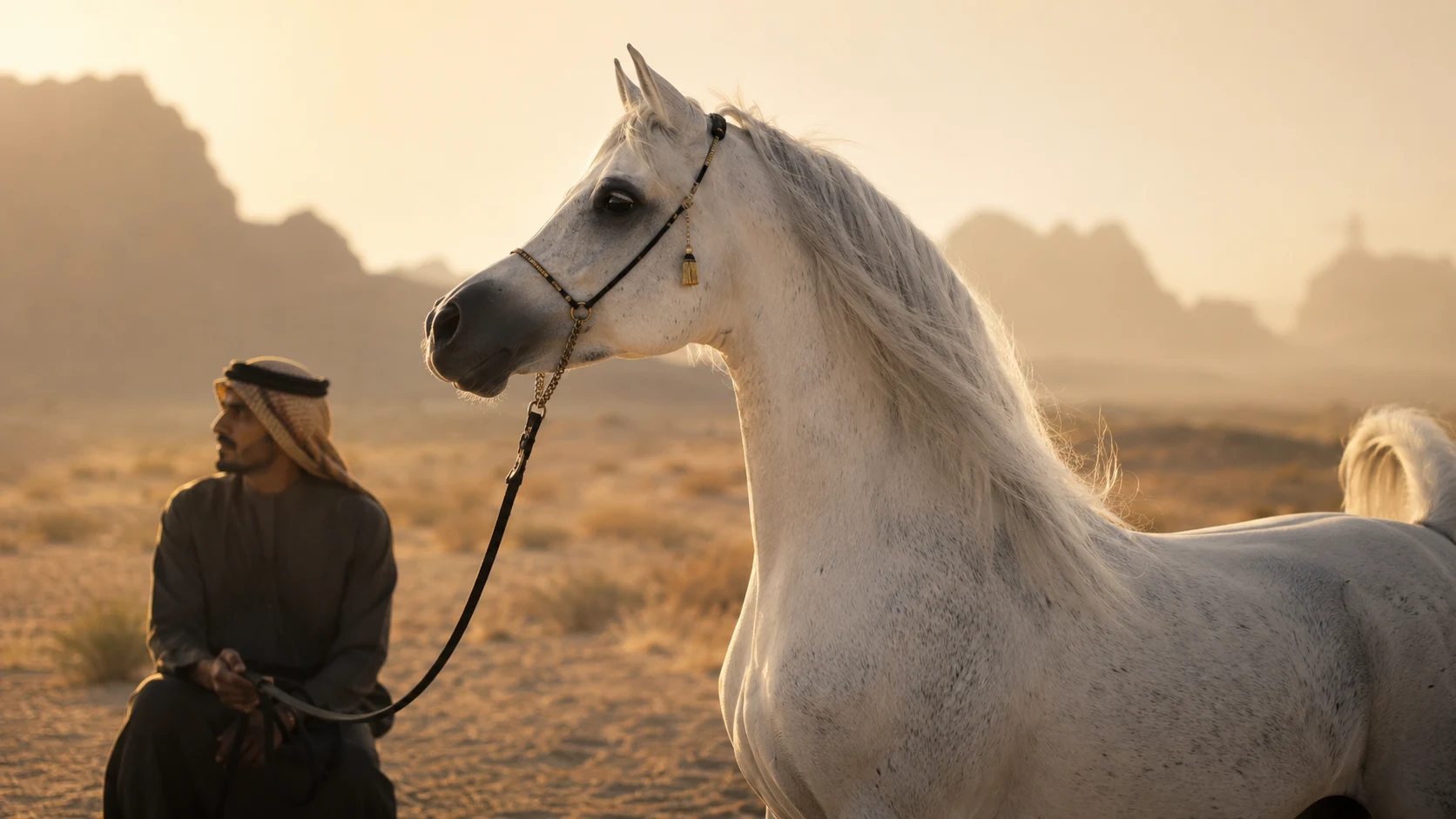
The Arabian horse carried messengers across battlefields, stood beside the Bedouin tent at nightfall, was praised in verse, and mourned like a companion when lost. Across the long centuries of Arabian heritage, this horse was never merely a means of transport. It was a mirror — reflecting back the values a people held most dear.
More Than Strength
The Arabian horse is among the oldest documented breeds in the world. Rock art discovered on the Arabian Peninsula depicts horses with recognisable characteristics dating back several thousand years, and evidence suggests that the people of the peninsula were among the earliest to breed horses with deliberate care and intention. This is not merely a claim of regional pride. It is a story grounded in archaeology, in landscape, and in the particular demands of desert life.
Breeding a horse to survive — and to excel — in extreme heat, across shifting sands, on minimal water and scarce grazing, required not only knowledge. It required patience, observation, and a relationship between human and animal that went far beyond the practical. Bedouin tribes did not breed horses only for warfare or speed. They bred them for temperament. For intelligence. For the willingness to stay close, to trust, and to endure.
There is a reason Bedouin families traditionally kept their mares inside the tent, sharing shelter with the family through cold desert nights. The mare was not livestock. She was a companion. This proximity created a bond that shaped the Arabian breed over generations — a horse unusually attuned to human emotion, sensitive to tone and gesture, responsive in ways that surprised travellers from other parts of the world when they first encountered the breed.
The physical qualities for which the Arabian became celebrated — the arched neck, the large eye set wide in an expressive face, the high tail carriage, the deep chest that houses remarkable lung capacity — were not bred for elegance alone. Each served a purpose in the desert. The great chest sustained endurance across distances that would exhaust other breeds. The wide nostrils drew air efficiently in parching heat. And yet, over time, those same qualities came to be read as something more than physical. They came to signify dignity. Bearing. A presence that commanded attention without demanding it.
A Symbol of Honour and Loyalty
In Bedouin culture, owning a mare of pure lineage — known as asil, meaning of noble and unbroken descent — was a matter of deep honour. The bloodline of the horse was recorded and transmitted orally, from father to son, with the same seriousness given to a family’s own genealogy. To compromise that lineage through careless breeding was considered a form of dishonesty, a betrayal of a trust that went back generations.
This attachment to lineage was not vanity. In a world where survival often depended on the qualities of the animal beside you, purity of breed represented reliability. A horse whose ancestors had been brave in battle, enduring in the desert, and loyal to their riders would, in the Bedouin understanding, carry those qualities forward. The horse’s history was a promise about its character.
Loyalty ran in both directions. There are accounts — passed through oral tradition and recorded in various forms — of riders who refused to sell their mares even in times of need, of families who would share their last provisions with a horse before themselves, of men who returned from raids empty-handed rather than risk their companion. These accounts, whether historical or legendary, reveal something important: the Arabian horse was understood as a being worthy of moral consideration. Not a tool. A partner.
Courage, too, was a quality the horse was expected to carry. The high-crested neck — called in Arabic mitbah — was read as a sign of courage in traditional Bedouin observation. The horse’s willingness to move forward without hesitation, to remain calm under fire, to carry its rider through the chaos of a raid, made it a living embodiment of the virtues most valued by the warrior traditions of the Arabian Peninsula.
In this way, the horse became inseparable from the ideal of the Arab warrior: courageous, dignified, generous, and loyal. It was not merely that a warrior happened to ride a horse. The horse completed him. Together, they formed a single image of Arabian cultural identity that would persist long after the age of raiding and desert campaigns had passed.
Horses in Arab Poetry and Memory
Perhaps nowhere is the depth of this relationship more visible than in Arabic literature.
The great classical Arab poets did not merely mention horses in passing. They devoted entire poems to them — describing their movement, their breath, their appearance at dawn, their courage in the charge. The horse was a subject worthy of the highest craft. Its presence in Arabic verse was not decorative. It carried meaning.
One of the most celebrated lines in the entire classical Arabic tradition belongs to Abu al-Tayyib al-Mutanabbi, the tenth-century poet from Kufa considered by many scholars to be the greatest Arabic poet who ever lived. In his own voice, he declared:
الخيلُ والليلُ والبيداءُ تعرفني
والسيفُ والرمحُ والقرطاسُ والقلمُThe horse, the night and the desert know me,
as do the sword, the spear, the parchment and the pen.
The verse is remarkable for what it places first. Before the sword. Before the spear. Before even the pen — the very instrument of poetry and immortality — al-Mutanabbi names the horse. The horse is the first witness to his existence. It is the being that knows him. In Arabic literary tradition, this is not merely rhetorical choice. It is a statement of relationship, of mutual recognition, between a man and the animal that shared his most demanding hours.
This single verse has been memorised by generations of Arab schoolchildren, copied onto classroom walls, quoted at ceremonies, recited at gatherings from Baghdad to Marrakech. It endures not because it is technically perfect — though it is — but because it speaks to something felt. The horse, the night, the open desert: these are the companions of the solitary soul reaching for greatness. They have always been understood that way.
Nabati poetry — the vernacular tradition of the Arabian Peninsula, still very much alive today — also gives the horse a prominent place. Poets praise the mare’s endurance on long night rides, celebrate her loyalty in difficult terrain, mourn her passing as they would mourn a person. In this oral tradition, the horse is embedded in the fabric of daily emotional life in ways that no formal literature fully captures.
Even in religious memory, the horse occupies an honoured position. The Quran mentions the horse in several verses, including one that describes horses as a gift of beauty and utility: «And (He created) the horses, mules and donkeys for you to ride and as adornment» (Quran 16:8). The Prophet Muhammad ﷺ is reported to have said: «Goodness will remain in the forelocks of horses until the Day of Resurrection» (narrated by al-Bukhari and Muslim). These references wove the horse into the spiritual consciousness of Muslim communities across the Arab world, elevating it from a cultural symbol to one with sacred resonance.
A Living Heritage
The Arabian horse did not remain merely a memory. It remained alive.
Across Saudi Arabia, the UAE, Qatar, Oman and beyond, the preservation of the pure Arabian bloodline — the asil horse — continues to be a matter of active commitment. Institutions such as the King Abdulaziz Arabian Horse Center in Saudi Arabia maintain official registers of lineages, organise major festivals, and support communities of breeders who regard their work as a form of cultural stewardship rather than commercial enterprise.
The Janadriyah National Festival, held annually near Riyadh and attended by well over a million visitors, has always included the Arabian horse as a central feature — alongside traditional crafts, poetry, and music. These are not displays of nostalgia. They are affirmations. They say: this is still part of who we are.
Similar festivals take place across the Gulf. In the UAE, equestrian heritage is woven into the national identity. The Arabian horse appears alongside the falcon as one of the most recognisable cultural symbols of the region. In Saudi Arabia, the horse stands — with the date palm, the falcon, the historical souq and the national flag — as one of the five symbols officially identified as connecting the Kingdom to its roots.
Each of these symbols speaks to a different dimension of Arabian culture. The date palm represents sustenance and resilience — the tree that made desert life possible, offering food, shade, fibre and wood for generations without asking for much in return. The falcon embodies vigilance and aspiration — patience transformed into sudden, precise action. Frankincense carries the memory of ancient trade routes, of Arabia’s connection to the wider world, of the sacred smoke rising in a tent or a temple. Arabic coffee — qahwa — is the gesture of welcome made tangible, the first offering extended to any guest who crosses the threshold of a home.
The Arabian horse belongs among these symbols not as decoration but as the fullest expression of what they all share: the idea that beauty and function need not be separated. That what is useful can also be noble. That an animal, a tree, a cup of coffee, a bird — any of these — can carry the weight of a culture’s deepest values if a people decides to make it so.
Why the Legend Endures
It would be easy to explain the enduring prestige of the Arabian horse through aesthetics alone. The breed is genuinely beautiful — this is simply true, and requires no exaggeration. But beauty, on its own, does not survive millennia. It does not make its way into holy scripture. It does not earn its place in the opening line of a poet’s greatest verse.
The Arabian horse endures because it became the carrier of something that cannot be bred or purchased: a set of values that a people chose to see in it and, through the act of seeing, chose to pass on.
Courage. The horse that moves forward when others would turn.
Loyalty. The companion that stays close through difficulty, that does not abandon the one who tends to it.
Generosity. In traditional Bedouin culture, a man’s willingness to share his mare, to lend her to a neighbour in need, reflected the same generosity expected of a host toward his guest. The horse was not only the owner’s property. It was a measure of his character.
Endurance. The capacity to continue — across burning sand, through thirst, over long nights — without surrender. This quality, observed first in the horse, became a quality the people recognised in themselves. The desert asked endurance of everyone. The horse modelled it without complaint.
Dignity. The way an Arabian horse carries itself — the high head, the alert eye, the unhurried quality of its presence — was read, across centuries of Arabian cultural life, as an embodiment of how a person of character should move through the world. Without arrogance. Without submission. With awareness.
These are not qualities that belong to any one generation. They are not specific to any single country. They are values that communities reach for when they want to describe what they aspire to be. The horse became the image through which that aspiration was made visible.
That is why, when Saudi Arabia officially designated its five founding symbols, the Arabian horse stood among them. That is why equestrian festivals across the Gulf continue to draw enormous audiences — not only out of sporting interest, but out of something deeper: the recognition that this animal carries a story that belongs to everyone present.
And that is why, in Bedouin poetry composed today — in the same vernacular tradition that stretches back centuries — the horse still appears. Still ridden through the night. Still worthy of praise. Still a witness to a man’s or woman’s truest hours.
Final Thoughts
A civilisation is remembered not only for the monuments it built, but also for the values it chose to carry forward. The Arabian horse became one of those values.
It is, in the end, a story about what people decide to honour. About which qualities they decide to celebrate, preserve, and transmit to the next generation. About the way a living creature — breathing, running, standing quietly in firelight — can become the vessel for everything a culture believes about courage, loyalty, beauty and the right way to move through a difficult world.
The horse itself does not know this. It simply is what it is: an animal of remarkable endurance and unusual sensitivity, shaped over thousands of years by people who observed it closely and valued what they saw.
What those people chose to make of that observation — the poetry, the care, the festivals, the lineages preserved across generations, the name given in full seriousness to a newborn foal — that is the story worth telling.
That story has not ended. It is still being told, every time a rider mounts a mare in the early morning light, every time a verse is recited at a gathering in the Gulf, every time a child hears for the first time the lines that al-Mutanabbi wrote more than a thousand years ago and understands, without explanation, exactly what they mean.
نسأل الله أن يبارك لكم فيما رزقكم
May God bless you in all that He has granted you.
A note on the Horse Strength Sidr Honey
In the tradition of Arabian heritage, the horse has long been associated with vitality and endurance. MESKI pays tribute to this symbolism with its Horse Strength Sidr Honey — a precious infusion honouring the values the Arabian horse has always carried.
Frequently Asked Questions
The Arabian horse is significant not only because of its physical qualities, but because it became a symbol of the values most admired in Arabian culture: courage, loyalty, endurance, dignity and generosity. Across centuries of poetry, religious reference, daily Bedouin life and formal ceremony, the horse came to represent an ideal of character that communities chose to pass from one generation to the next.
Yes. The Quran mentions the horse in several verses, including Surah Al-Nahl (16:8), which describes horses as created for riding and adornment. The Prophet Muhammad ﷺ is also reported in authenticated hadith, narrated by al-Bukhari and Muslim, to have said: «Goodness will remain in the forelocks of horses until the Day of Resurrection.» These references gave the horse a place of honour in Islamic culture beyond its practical uses.
Asil (أصيل) is an Arabic term meaning of noble, pure and unbroken descent. In the context of the Arabian horse, it refers to bloodlines whose purity has been maintained and transmitted without interruption, recorded through oral tradition and later through formal registers. The preservation of asil lineages remains an active cultural and institutional commitment across the Arabian Peninsula today.
The Arabian horse is one of several enduring symbols of the region — alongside the date palm, the falcon, frankincense and Arabic coffee. Each reflects a different dimension of Arabian heritage: the date palm represents sustenance and resilience; the falcon, patience and aspiration; frankincense, ancient connection to wider civilisations; coffee, the gesture of welcome. The horse represents the full combination of physical excellence and moral virtue — the belief that beauty, courage and loyalty can coexist in a single living being.
The Arabian horse is celebrated through major annual festivals, including the Janadriyah National Festival in Saudi Arabia, the Riyadh Purebred Arabian Horse Festival, and various equestrian events across the UAE, Qatar and Oman. These gatherings combine competitions, heritage displays, poetry recitation and communal celebration. They serve as public affirmations that the values carried by this breed — and the traditions surrounding it — remain meaningful and alive.
Keeping mares inside the tent served practical purposes — protecting the animal from the cold desert night and ensuring its immediate readiness. But it also reflected the depth of the relationship between Bedouin families and their horses. The mare was not considered mere property. She was a companion whose wellbeing was the family’s responsibility. This closeness, sustained across generations, shaped the Arabian breed’s unusual sensitivity to human presence and emotion.
Continue the Journey Through Arabian Heritage
The Arabian horse is one symbol among many that carry the values of a civilisation. Explore more stories from the Heritage Series — and discover honey honoured by the same tradition of excellence.