
The last leg of our one-evening world tour asks the most important question: is Global Village cultural discovery, entertainment, or simply a beginning?
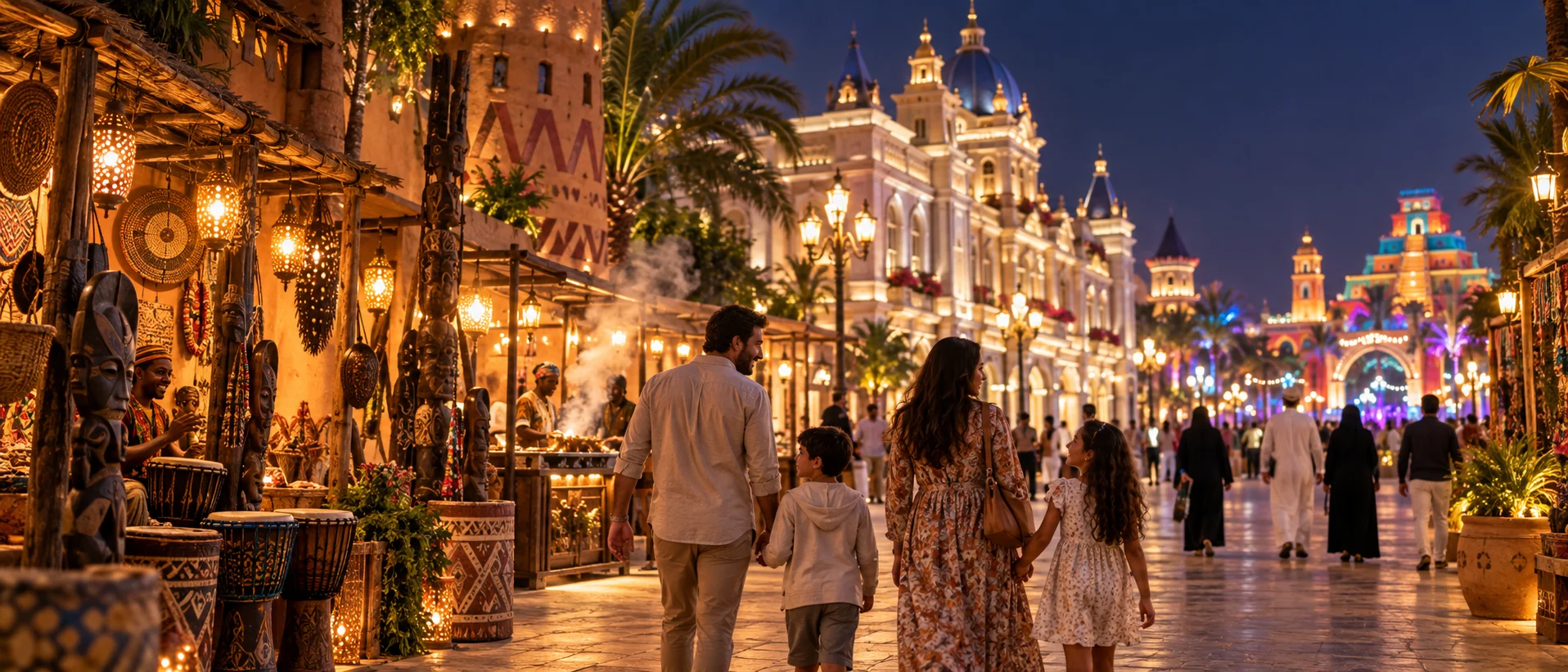
By Part III, the geography becomes almost comic: Africa, Europe and the Americas can all fit into the same evening. That is exactly why this final chapter matters. The goal is no longer to count pavilions. It is to decide what this kind of cultural shortcut can genuinely give a family, and what it never can.
The Third Part Begins With a Problem: Whole Continents in One Pavilion
By the time you reach the third part of a Global Village evening, the scale of the exercise becomes almost absurd in the best possible way. We have already walked through Arab pavilions and then crossed into Asia. Now signs point toward Africa, Europe and the Americas, as if entire continents could politely wait behind three entrances.
This is where I think Global Village becomes most useful if you stop taking it literally. Africa is not one culture. Europe is not one culture. The Americas are certainly not one culture. A pavilion can offer objects, flavours, music and visual references. It cannot offer a continent.
The current Global Village map makes this compression visible. Egypt and Morocco have their own pavilions, while another broad Africa Pavilion brings together references from elsewhere on the continent. Europe is grouped into one pavilion alongside separate Russia and Türkiye pavilions. North and South America meet inside the Americas Pavilion.
That arrangement is not a geography lesson. It is a commercial cultural festival. Once we accept that, we can ask better questions.
Africa: The Continent That Should Make Us Slow Down
The Africa Pavilion is perhaps the clearest reminder that one label can hide extraordinary diversity. Its current official description uses a gateway with masks, carvings and earthy textures, drawing visual inspiration from Maasai and Nubian traditions, with references such as Arusha. Inside, the shopping list leans toward shea products, soaps, handmade baskets, bags and crafts.
Those are real cultural and commercial threads, but they do not define Africa. The continent contains thousands of communities, languages and local histories. Even the words “African craft” can become too convenient if we do not ask who made the object and where.
This is why I would not rush this pavilion. Pick one basket. One carving. One cosmetic ingredient such as shea butter. Ask where it comes from. If the answer remains only “Africa,” keep asking.
Specificity is a form of respect.
A Dance Can Open a Door, but It Can Also Become a Shortcut
Global Village is full of cultural performance, and the Africa Pavilion has long been associated with energetic dance and music. For families, this is often what children remember first.
I like that. Culture should be seen and heard, not only read from a wall. But I also think we should resist the easy sentence: “This is African dance.” Which country? Which people? Which occasion? What has been adapted for the stage?
The same rule applied to our Arab and Asian parts applies here. A five-minute show can be wonderful. It just should not carry the impossible burden of representing millions of people.
Enjoy the rhythm, then let it create a question.
Shea Butter, Baskets, Soap: Why Everyday Things Matter
One reason I enjoy markets more than polished cultural summaries is that ordinary objects often tell better stories.
Shea butter immediately leads to questions about trees, climate, women’s work, processing and trade. A woven basket leads to material, technique and region. Soap can tell us what plants or oils are locally valued. These are not grand monuments, but they are closer to daily life.
MESKI began with the same instinct around food. Honey is interesting to us not because a jar looks luxurious, but because the jar can lead backward toward a tree, a flowering season, a beekeeper and a landscape.
The object becomes a map when we know how to read it.
Europe: When a Continent Becomes Landmarks and a Pantry
Then Europe changes the visual language completely. The official pavilion moves quickly from the Eiffel Tower to Pisa, a clock tower reminiscent of Big Ben, Renaissance Florence and Vienna’s Schönbrunn Palace. It is a continent presented as a collage of recognisable architecture.
Inside, the listed products are almost charmingly domestic: olive oil, pasta, guitars, shoes and honey.
Honey interests me here because it breaks the mental association many Gulf buyers have between premium honey and only Yemen, Oman or the UAE. Europe has its own strong honey traditions shaped by forests, mountains, Mediterranean scrub, chestnut, acacia and many other floral sources.
That is why our Honey Atlas also travels outside Arabia, and why we keep origins such as Corsican honey. Different continent, same question: what did the bees actually forage?
Global Village can make that question visible in a single evening.
The Gift Changes, but the Instinct to Bring Something Home Does Not
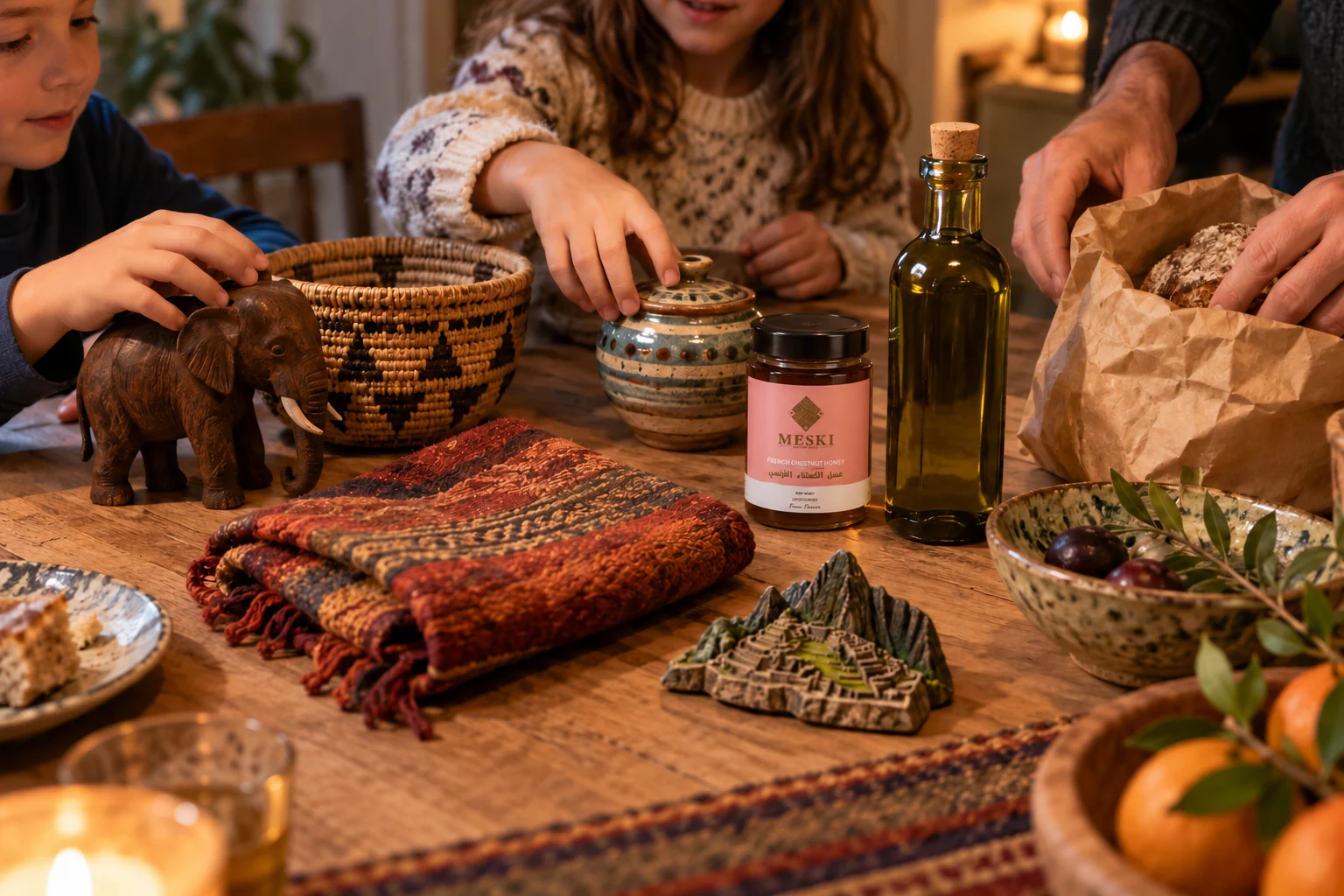
Europe is also where the idea of the souvenir becomes obvious. Pasta, olive oil, a small decorative object, a jar of honey: none of these can contain a country, yet people still like to bring them home.
I think we do this because travel creates an urge to make memory physical. We want something that can sit on a table two weeks later and return us to a place for a moment.
This is close to the question we explored in What to Buy in Dubai Beyond Malls and Luxury Brands. A good gift is rarely good simply because it was expensive. It is good because the giver understands why this object belongs to this place or this person.
A five-dirham spice can carry more memory than a luxury box chosen without thought.
The Americas: The Most Compressed Pavilion of All
The Americas Pavilion may be the strongest example of cultural compression. The official description moves from Mexico and Mayan references to the Statue of Liberty, Sitting Bull, Incan art and Brazilian rhythms. North America, Central America, South America and Indigenous histories appear within one visitor route.
That can be visually entertaining, but it is also where I would become especially careful with children. A dream catcher, a poncho or a feathered headdress can easily turn living cultures into costume if we never explain that these objects come from specific peoples and histories.
The pavilion itself is not the problem. The shortcut becomes a problem only when we stop at the shortcut.
Ask whether a souvenir is actually made in Peru or Mexico. Ask what tradition a pattern belongs to. Ask whether an object has ceremonial meaning before treating it like a generic decoration.
Mexico, Peru, Brazil, the United States: Four Names Are Already Four Different Worlds
The official shopping material has highlighted Peruvian souvenirs, hand-painted kitchen utensils from Mexico, ornaments and ponchos. The pavilion description adds Incan art and Brazilian rhythms alongside North American symbols.
Even those few references are enough to show why “the Americas” cannot be treated as one cultural block. Food alone would make the point. Music would make it again. Language, Indigenous histories, migration and religion would make it again.
If your child leaves knowing only that Mexico is not Peru and Brazil is not the United States, that may sound basic. It is still more useful than leaving with one blended image called America.
What About Honey Here?
Global Village’s wider shopping pages describe honey and oils from around the world, and the Europe Pavilion specifically lists honey among its products. I would not pretend that honey is the defining thread of Africa or the Americas pavilions unless a current seller genuinely makes it one.
This is important editorially. MESKI sells honey, but not every cultural story needs to bend toward our product.
If you want the honey route, follow the MESKI Honey Atlas. If you want Global Village, follow the cultures in front of you. The two paths can cross naturally without forcing the meeting.
Sometimes the honest sentence is simply: there was no honey story here tonight, and that was perfectly fine.
The Family Question: How Much Can Children Really Learn in One Evening?
More than we think, and less than the advertising language might suggest.
A child will not understand Africa after one pavilion. But a child can learn that a continent contains many peoples. They will not understand Europe from a miniature Eiffel Tower, but they may connect olive oil to the Mediterranean or recognise that food changes across borders. They will not understand Indigenous American history from one object, but they can learn that symbols have owners and stories.
That is already valuable.
I would rather a child come home with five new questions than fifty facts memorised without context.
Food Is Often the Best Bridge
When everyone becomes tired of explanations, food rescues the evening.
Eat something you cannot pronounce perfectly. Share it. Ask what is inside. Compare it to something familiar. Children who refuse a history lesson may happily discuss why one bread is softer, why another sauce is smoky, why a sweet uses nuts or honey, or why a tea tastes completely different.
Food does not replace history, but it lowers the door.
And family discovery should have some pleasure in it. Otherwise we have simply turned Global Village into homework.
Shopping: Buy Less, Ask More
My rule for Global Village shopping would be simple: buy less, ask more.
A handmade basket with a clear origin is more interesting than five anonymous souvenirs. A bottle of olive oil with a region is more useful than a decorative product whose story ends at the cash register. A jar of honey with a floral source and traceable harvest is more compelling than one carrying only the word “premium.”
The same applies to luxury gifts. Expensive packaging can be beautiful, and we make luxury boxes ourselves. But packaging should amplify a story, not substitute for one.
The gift is strongest when you can tell the person receiving it where it came from and why you chose it.
Global Village: Yes or No?
After three parts, this is the question I promised to answer.
Yes.
But not because Global Village lets you visit the world in one night. It does not.
I say yes because it can make the world feel closer to a family that cannot travel everywhere. It can put a Moroccan tea glass, an Omani incense burner, an Afghan carpet, Japanese tea, African shea butter, European olive oil and a Mexican craft within the same evening. That proximity can create curiosity.
For somebody without the time or budget to travel widely, that matters. You are allowed to enjoy a first taste without pretending it is the whole meal.
What It Cannot Replace
It cannot replace waking up in a country and realising the weather feels different. It cannot replace driving between cities and seeing what exists between tourist stops. It cannot replace a family home, a neighbourhood café, a quiet mosque, a village market, a language you do not understand, or the awkwardness of being somewhere genuinely unfamiliar.
Real travel changes the scale of things. You discover that the monument was only one small part of the place.
Global Village gives highlights. Travel gives proportion.
What It Can Give You
It can give a child a first image of a country. It can give an adult a food they had never tasted. It can make somebody curious about a dance, a plant, a craft or a language. It can let a family spend one evening moving through differences rather than staying inside the culture they already know.
If you are joining this series here, return to Part I across the Arab world and Part II across Asia. The three pieces are designed as one journey, not three ranking pages.
Season 31 is currently announced for October 2026 to May 2027. The official site is between seasons as I write this, so exact vendors, shows and pavilion details can change. That is another reason not to write this as a rigid checklist.
Leave With an Appetite, Not a Certificate
My favourite way to leave Global Village would be with the feeling that we did not finish.
Maybe the children keep talking about one dance. Maybe you bought a small gift. Maybe you tasted honey from a place you had never connected with beekeeping. Maybe one pavilion made you open a map in the car.
That is enough.
Do not leave saying you have seen the world.
Leave wanting to see more of it.
Questions People Ask
Yes, if you treat it as a multicultural family and entertainment experience that can introduce food, crafts, performance and questions. It does not replace visiting the countries represented.
The current official page highlights a broad Africa Pavilion with Maasai and Nubian-inspired visual references, crafts, shea products, soaps, baskets and cultural performance.
The official pavilion mixes European landmark references and lists items such as olive oil, pasta, guitars, shoes and honey.
It combines references from North and South America, including Mexico, Mayan and Incan imagery, the United States and Brazilian rhythms. It is a compressed introduction, not a full cultural representation.
Yes, honey appears in Global Village shopping content and is specifically listed in the Europe Pavilion. Availability and individual sellers can change by season.
Yes. It works especially well when parents use food, music, crafts and architecture to start questions rather than treating every pavilion as a complete lesson about a country.
No. It can give a first taste and inspire curiosity, but real travel provides everyday life, landscape, people and context that a pavilion cannot reproduce.
The official site currently states October 2026 to May 2027. Exact pavilion shops and shows should be checked when the season opens.
Finish the Journey, Then Start a Real One
The three Global Village chapters are a beginning. Follow the countries, foods and traditions that made you want to know more.