
Before Mocha became a world word, coffee had to survive Yemen’s terraces, drought, harvests and generations of farmers who turned Arabica into a global traveller.
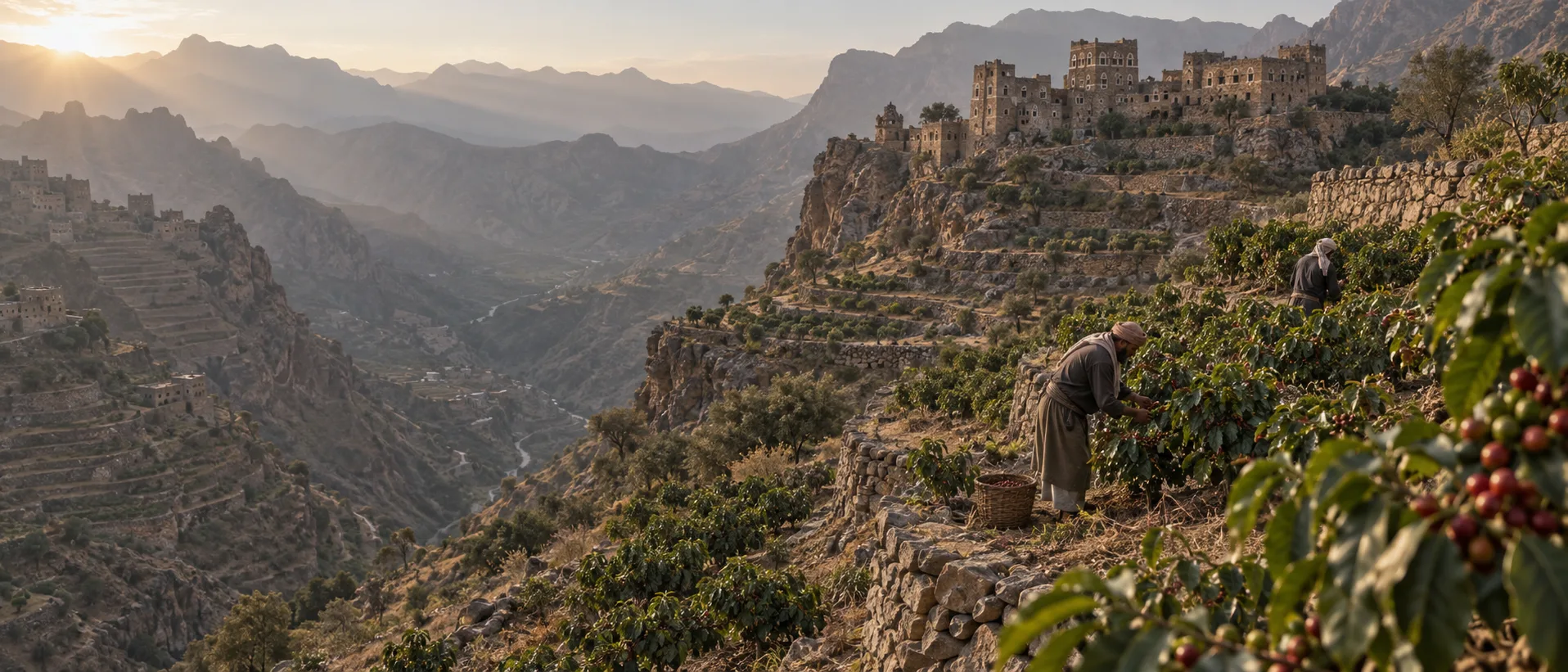
I thought I already understood why Yemen mattered to coffee. Then I started reading past the port. Al-Makha gave the world the word Mocha, but the port was only the last Yemeni stop before the sea. The real story begins higher up, on terraces where Arabica had to learn another climate, where farmers selected trees for generations, and where a small seed prepared for one of the longest journeys in food history.
The Port Gave the World a Name, but the Mountains Made the Coffee
In Before Mocha Was a Flavour, It Was a Port, I followed the word Mocha back to Al-Makha on Yemen’s Red Sea coast.
That article answered one question: how did a Yemeni port lend its name to a word now printed on café menus around the world?
This article begins one step earlier.
Before the sacks reached the port, somebody had to grow the coffee.
Before a merchant could sell Mocha, a farmer had to build a life on a mountain.
One Important Correction: Arabica Was Not Born in Yemen
I love Yemen’s coffee history, but admiration is not a reason to simplify it.
Coffea arabica is native to Ethiopia and South Sudan. Yemen became one of its great domestication centres after coffee crossed the Red Sea.
That distinction actually makes the story more impressive, not less.
Scientific studies show that the vast majority of cultivated Arabica varieties grown outside Ethiopia passed through Yemen before spreading across the world.
Yemen was not the botanical birthplace of the species. It became the great historical gateway through which cultivated Arabica conquered continents.
A Plant Arrived, Then Yemen Changed It
Coffee did not simply arrive in Yemen and remain untouched.
Farmers had to make it live in a country with very different conditions from the forests where Arabica evolved.
Yemen is hot, dry and mountainous. Rain can be scarce. Soil and water cannot be wasted.
Over centuries, coffee was selected, replanted and adapted to terraces where survival itself became part of quality.
A 2021 genetic study found several distinct Arabica genetic clusters in Yemen, including one group not observed among the worldwide cultivated varieties examined in that research.
That means Yemen did not merely preserve an old crop. It preserved genetic diversity that still matters to coffee science today.
The Terraces Are Part of the Taste
The first thing I want to see when I think about Yemeni coffee is not a café cup.
It is a mountain wall covered in terraces.
FAO describes Yemeni Arabica as a crop of terraced highlands, grown under distinctive agro-climatic conditions and still commonly dry-processed through long-established methods.
Terraces are beautiful from a distance, but they are not decoration.
They hold soil, manage water and make farming possible on slopes where a flat field does not exist.
The cup begins with architecture made from stone and patience.
Haraz, Matari and the Danger of Turning Names Into Simple Labels
Coffee lovers encounter names such as Haraz and Matari, along with Yemeni vernacular names including Udaini, Tufahi, Dawairi, Yafei and others.
These names are useful, but they need care.
An FAO country report documents many local coffee names, while later genetic research found that farmers’ vernacular names do not map neatly onto genetic clusters.
So I would never tell a reader that one local name automatically equals one precise genetic variety and one guaranteed flavour.
Yemeni coffee is more complicated than a tidy supermarket label.
And I think that complexity is part of its beauty.
Coffee in Yemen Had to Learn Drought
One detail from the genetic research stays with me.
Yemeni coffee grows under some of the hottest and driest conditions found in Arabica production.
For centuries, farmers selected trees capable of surviving those limits.
Researchers now see Yemen’s genetic diversity as potentially important for the future resilience of coffee under climate pressure.
A bean that survived old droughts may still have something to teach a warming world.
That is a remarkable second life for a heritage crop.
Harvest Is Only the Beginning
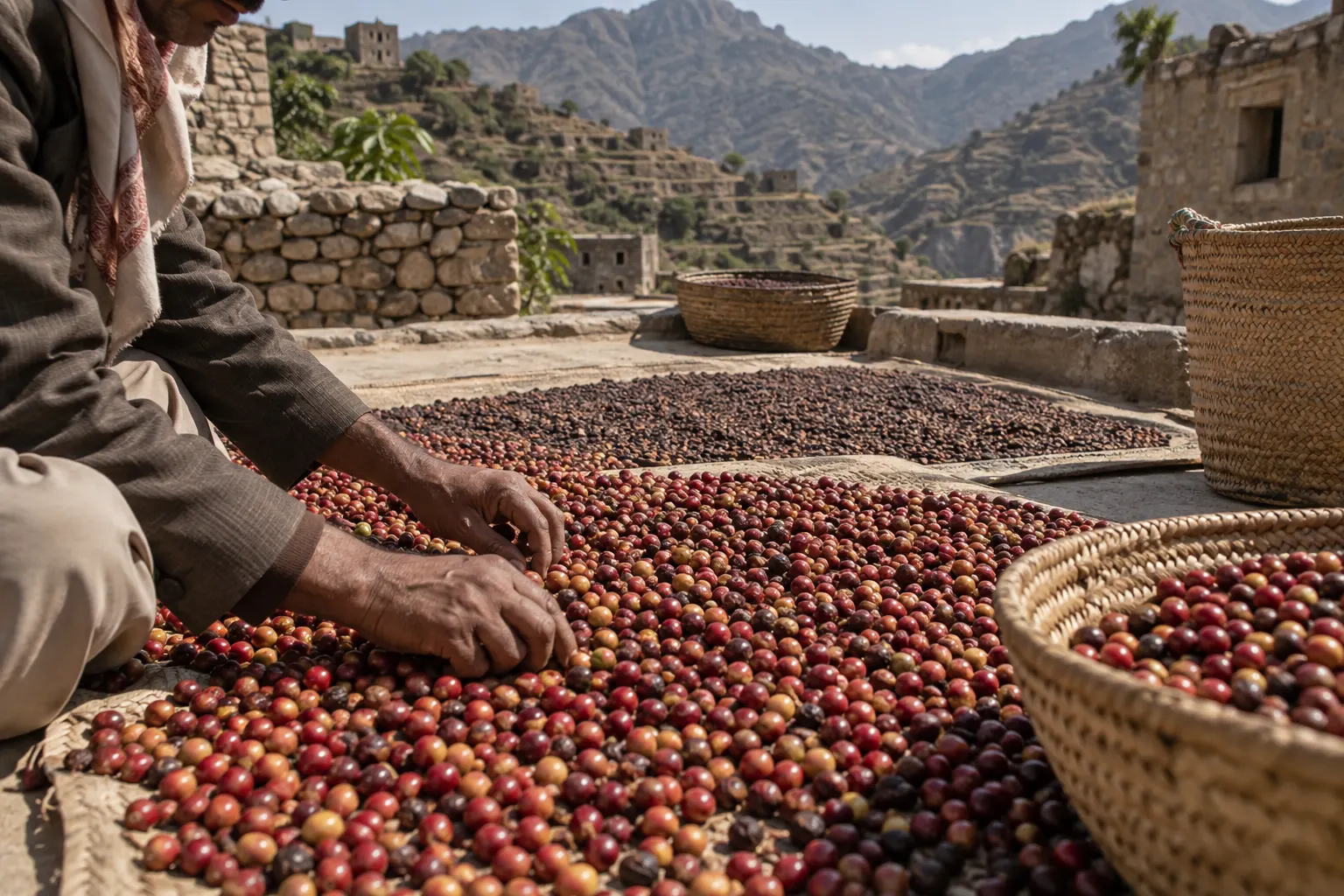
Once the cherries ripen, another transformation starts.
Yemeni coffee is strongly associated with natural dry processing. The harvested cherries are dried before the seed is separated from the fruit.
That method is old, practical in a dry climate and capable of producing highly distinctive cups.
Depending on lot, region, roast and preparation, drinkers may find dried fruit, cocoa, dates, apricot, caramel, spice, earthy tones or wine-like fruitiness.
I am deliberately saying may.
No serious coffee origin should be reduced to one tasting note.
The Same Country Can Give You Completely Different Cups
This is where my own coffee journey has made me cautious.
In I Thought I Didn’t Like Black Coffee Until I Started Travelling, I wrote about learning that black coffee does not have to mean bitter coffee.
Ethiopia, Vietnam, Arabic coffee and even Sudanese coffee with ginger pushed my taste in different directions.
Yemen deserves the same freedom.
A lighter roast can reveal one side. A darker roast another. One harvest may lean toward fruit, another toward chocolate or spice.
The country is an origin, not a flavour syrup.
From Mountain Village to Al-Makha
At some point, the dried coffee had to leave the mountains.
Bags moved through traders and routes toward the Red Sea, and Al-Makha became the name the wider world remembered.
The port did something the terraces could not.
It concentrated coffee from inland landscapes into a point merchants could recognise, buy from and sail away from.
The mountains created the bean.
The port created the global name.
Then the Bean Escaped the Map
Coffee did not remain a Yemeni monopoly forever.
Seeds and plants moved out of Yemen toward India, Asia and islands controlled by European powers.
Typica and Bourbon, two lineages that later became enormously important in world coffee, are tied to that outward movement through Yemen.
The result is almost strange to think about.
A crop native to Africa crossed into Arabia, was transformed by centuries of Yemeni cultivation, then left Arabia again and became one of the most global agricultural products on earth.
Few beans have travelled through so many identities.
The Word Mocha Travelled Even Farther Than the Bean
Once coffee became global, the name Mocha developed a second life.
Many people today hear mocha and think immediately of chocolate and coffee.
I used to understand the word mainly through café culture too.
Now I cannot separate it from Al-Makha.
The modern drink is part of the story, but the old port comes first.
Knowing the origin does not make the modern mocha less enjoyable. It gives the word another layer.
Coffee Does Not Only Travel Through Geography. It Travels Through Smell
I learned that in Vietnam in a completely different way.
One day, while walking through the streets, the smell of coffee pulled me toward a place I had not planned to enter.
That smell led me to a coffee dessert so good that I went back again and again during the trip.
I do not even need the street name to remember it.
The aroma brings the memory back before the map does.
That is what makes coffee powerful. Sometimes the road from one culture to another begins through the nose.
So Follow the Aroma in the Gulf Too
Today the setting can be completely different.
In Dubai Marina, hotel lounges openly serve artisan coffee beside polished waterfront interiors. At Burj Al Arab, Sahn Eddar even serves a signature gold cappuccino made with 100 percent Arabica and 24-carat gold.
At Emirates Palace Mandarin Oriental in Abu Dhabi, Café Fountain describes a menu built around artisanal coffees and fragrant teas. In Doha, Four Seasons lists Arabic coffee beside espresso, French press, cappuccino, Turkish coffee and mocha. In Riyadh, Four Seasons Obaya Lounge places Saudi coffee on the same menu as espresso, cappuccino, French press and modern signature drinks.
I am not saying those cups are Yemeni unless the origin is stated.
I am saying the journey of coffee has become extraordinary.
An old Arabian coffee history now lives beside marble, towers, hotel lobbies and city lights.
Jumeirah, Sheikh Zayed Road, Abu Dhabi, Doha, Riyadh: Look at the Cups
If you walk through Jumeirah, Dubai Marina, Sheikh Zayed Road, the hotel districts around Emirates Palace, Doha or Riyadh, do not only look at the architecture.
Look at the coffee.
Look at how it is served.
Look at whether the cup is tiny or enormous, light or dark, spiced or creamy, traditional or theatrical.
Our Sheikh Zayed Road story was about how movement changed Dubai. Coffee tells a smaller version of the same thing.
The roads changed. The cup kept travelling.
Gold Is Not the History, but It Is a Beautiful Contrast
I like the image of a gold cappuccino in a place like Burj Al Arab because of the contrast, not because gold explains coffee.
Centuries ago, Yemeni coffee travelled in sacks from mountain farms toward a Red Sea port.
Today Arabica can appear beneath chandeliers and even beneath a dusting of gold.
The luxury is new.
The fascination with the bean is not.
Yemen Still Has More Than Coffee to Tell Me
This is where Yemen keeps defeating every attempt I make to reduce it to one subject.
I came to Yemen first through honey.
Through Do’ani Sidr Honey, the jujube valleys and the idea that a taste can carry an origin.
Then came Balqees, old routes, the coffee port of Al-Makha, mountain terraces and the genetics of Arabica.
Then there is Socotra, an island that feels like another chapter entirely, with unusual trees, biodiversity and rare honey traditions.
And even beyond those famous stories there are mangoes, pomegranates, mountain agriculture and food cultures that deserve their own space.
The Conflict Is Real, but It Is Not the Whole Country
It would be dishonest to write about Yemen today and pretend the conflict does not exist.
It has made travel difficult, damaged infrastructure and separated many people from the country’s landscapes and markets.
But it would be equally dishonest to let conflict become the only sentence we use for Yemen.
Coffee still grows.
Honey still travels.
Fruit still ripens.
Families still preserve techniques and tastes.
A country can suffer and still remain culturally immense.
I Still Want to Taste Yemen More Seriously
My own position is simple.
I am fascinated by Yemeni coffee, but I am not ready to declare a favourite region or cup.
I need to taste more.
I want to compare coffees, roasts and preparations rather than fall in love only with the history.
That curiosity is exactly what keeps the subject alive for me.
I know the route now.
I still need to know the cup.
Sources and Further Reading
FAO’s Yemen coffee profile documents terraced highland cultivation, dry processing, the Al-Makha origin of the word Mocha and Yemen’s long coffee heritage.
For local names including Al-Matari, Udaini, Tufahi, Dawairi and Yafei, see the FAO country report on plant genetic resources.
For the deeper genetic story, the open research article Unveiling a unique genetic diversity of cultivated Coffea arabica L. in Yemen explains Yemen’s role as a domestication centre and gateway for cultivated Arabica.
For the modern Gulf coffee examples, see official pages from Jumeirah Burj Al Arab, Emirates Palace Mandarin Oriental, Four Seasons Doha and Four Seasons Riyadh.
Everything about my curiosity, my Vietnam memory and my wish to taste more Yemeni coffee is personal. The historical and agricultural claims above are separated from that personal voice on purpose.
The Coffee Bean That Crossed Centuries
The more I look at Yemeni coffee, the less it feels like a simple origin label.
It is a bridge.
From Ethiopia to Yemen. From terraces to Al-Makha. From Arabia to the rest of the world. From old trade routes to modern hotel lounges.
And the story is still moving.
Yemen has not finished surprising me.
I first found it through honey. Coffee opened another door.
Something tells me there are many doors left.
Questions People Ask
Coffea arabica is native to Ethiopia and South Sudan. Yemen became a major domestication centre and historical gateway for cultivated Arabica.
Because coffee was cultivated and adapted there for centuries, and most Arabica varieties grown outside Ethiopia trace important historical routes through Yemen.
Mocha refers to Al-Makha, the historic Yemeni Red Sea port associated with the export of Yemeni coffee.
They are among the local names used for Yemeni coffee types. Research shows these vernacular names do not always correspond neatly to genetic groups.
It is strongly associated with natural dry processing, in which coffee cherries are dried before the seed is separated from the fruit.
It varies by region, harvest, roast and preparation. Common descriptors can include dried fruit, cocoa, dates, apricot, caramel, spice and wine-like notes.
This article does not claim that. Those venues are used as examples of how global coffee culture now appears in modern Gulf luxury settings.
Because the article is part of a wider MESKI Yemen cluster showing how one discovery leads to another, from coffee and honey to biodiversity and history.
Not yet. I want to taste more Yemeni coffees before deciding. The history fascinates me, but the cup still deserves its own exploration.
Continue Through Yemen and the Coffee Roads
From the port of Mocha to a personal coffee journey, Sidr honey, Balqees and Socotra, Yemen keeps opening one story into another.