
A commercial buyer’s guide without the usual shortcuts: what Samar is, why Nizwa matters, how it tastes, how it differs from Sidr and how MESKI delivers it in the UAE.
Omani honey in Dubai is often sold through one famous word: Sidr. But Nizwa has another season. Samar flowers in spring, produces a darker and more assertive honey, and gives buyers a completely different way to taste the same Omani mountain relationship.
In Dubai, Omani Honey Usually Means Sidr. Samar Deserves Its Own Search.
Ask a buyer in Dubai about Omani honey and the conversation usually reaches Sidr first. That makes sense. Omani Sidr has a strong reputation in the Gulf and Nizwa is one of the names buyers recognise.
Samar sits beside it more quietly.
For MESKI, that quietness is exactly what makes Omani Samar interesting. Our Nizwa relationship produces two very different seasons from the same beekeeper: Sidr in autumn and Samar in spring. The country is the same. The hands are the same. The honey is not.
This page exists for the buyer who is specifically searching Omani Samar honey in Dubai or the UAE and wants more than a product card.
What Is Samar Honey?
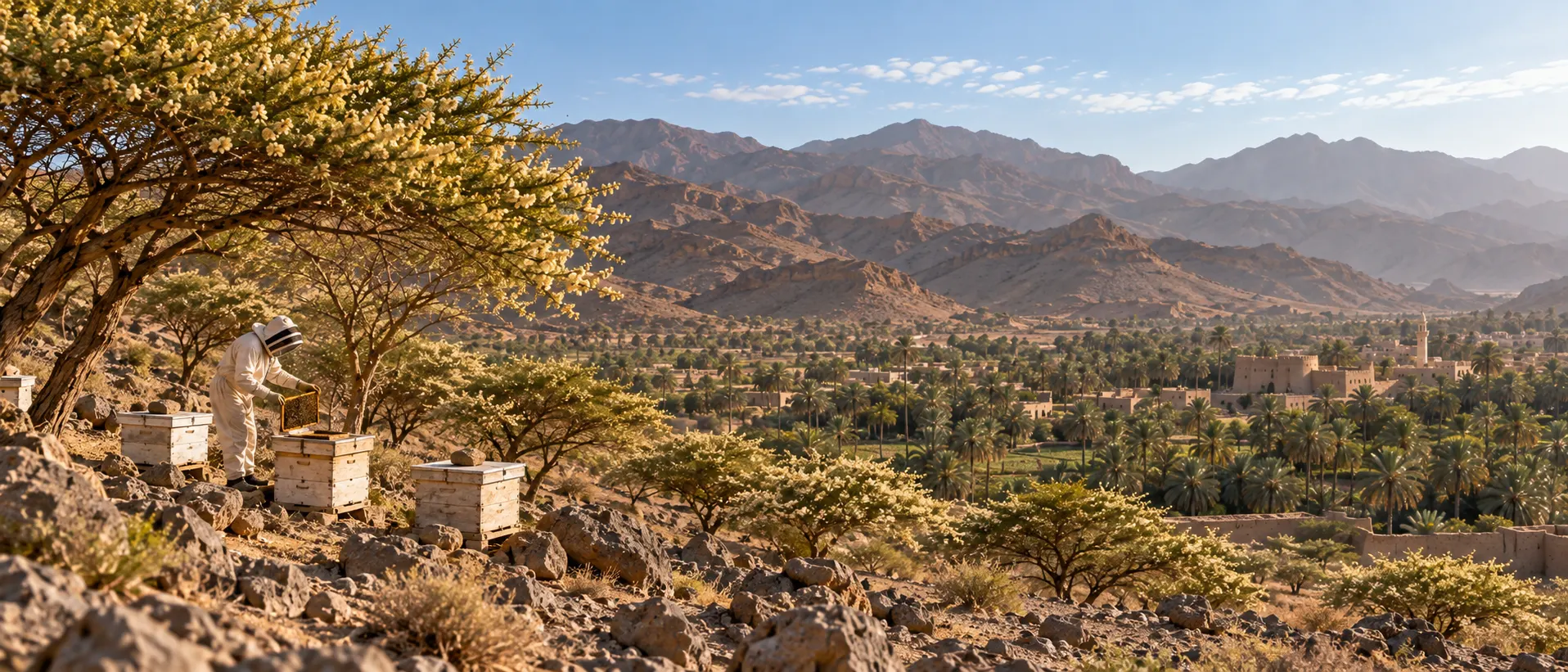
Samar is an acacia associated with arid Gulf landscapes. Around Nizwa and the Al Hajar terrain, it survives in hard, rocky ground beyond the greener oasis zones.
When the tree flowers in spring, bees work a nectar source completely different from Sidr. MESKI’s Honey Atlas records the Nizwa Samar bloom as beginning around April, with harvest typically running through April and May. As with any floral season, rainfall and local weather influence the exact window and yield.
Our detailed Omani Samar Honey Atlas entry follows the terrain, harvest and sensory profile in more depth.
The important point for a buyer is simple: Samar is not a lower grade of Sidr. It is another honey from another tree and another season.
Why Nizwa Matters
Nizwa is often introduced to visitors through its fort, souq and oasis. For honey, the more useful geography sits around that oasis: mountains, dry slopes and terrain where different trees flower at different times.
MESKI’s stated origin for this Samar is Nizwa, Al Hajar Mountains, Oman. Our relationship is not based on buying an anonymous market lot after harvest. The same beekeeper who supplies our Omani Sidr leads us into the spring Samar season.
That continuity matters because origin becomes easier to trust when the person, place and calendar remain connected from one harvest to the next.
A label saying “Omani honey” tells you a country. A traceable Nizwa relationship tells you much more.
The Spring Season: A Second Face of the Same Mountain
This is one of my favourite things about the Nizwa story.
In autumn, the conversation is Sidr. Months later, the mountain changes. The Sidr season is over and the Samar bloom opens another working window for the beekeeper.
The same apiary relationship can therefore produce two honeys that almost oppose each other in character. That is far more interesting to me than pretending one is automatically better.
We explain the contrast directly in Sidr Honey vs Samar Honey: Two Gulf Honeys, Two Different Terroirs.
What Does Omani Samar Honey Taste Like?
MESKI’s current Nizwa Samar is deep dark amber, fluid and velvety, with a bold profile we describe as smoky caramel, followed by warm, almost resinous depth and a persistent finish.
This is not a shy breakfast honey.
Sidr can feel rounder and more immediately luxurious to many buyers. Samar often has more edge. It can stand beside dark chocolate, roasted nuts, coffee or savoury glazes without disappearing.
If your only reference point is supermarket blossom honey, Samar can be surprising. That is part of the pleasure.
Omani Samar vs Omani Sidr
Buyers searching Omani Samar honey in Dubai often reach the page while actually trying to decide between Samar and Sidr.
The easiest distinction is not price or prestige. It is taste and season.
Omani Sidr comes from the Sidr bloom and carries its own autumn harvest identity. Omani Samar comes from the spring Samar bloom. They share an Omani origin and, in our case, the same beekeeper relationship, but the aromatic expression changes significantly.
If you prefer a darker, more assertive honey, Samar may be the better fit. If you are looking specifically for Sidr, our Omani Sidr Honey remains a separate origin and product.
Do not buy Samar because somebody told you it is more powerful. Buy it because you understand what it is and like the profile.
Omani Samar vs Emirati Samar
The UAE also has Samar honey, which is one reason the search term needs a country attached.
Two jars can both say Samar and still come from different landscapes, rainfall patterns, harvest decisions and beekeeper practices. Floral source is only the beginning of provenance.
For Gulf buyers, this is where origin becomes useful rather than decorative. Omani Samar should be sold as Omani Samar, Emirati Samar as Emirati Samar. The goal is not to invent a winner.
You can compare the Omani origin through the Honey Atlas and continue through our wider Gulf honey guides.
How to Buy Omani Samar Honey in Dubai Without Buying Only a Story
Dubai has no shortage of premium honey. Beautiful jars, mountain photographs and words such as royal, rare and pure are easy to find.
Before buying Omani Samar, ask five questions: What country is it from? What region? Which floral source? What harvest period? What traceability connects the jar to the source?
If the seller cannot move beyond “Oman” or “premium acacia,” you do not have enough information yet.
For MESKI’s Samar, the stated chain is Nizwa, a known beekeeper relationship, spring harvest, identified lot and analysis linked to that lot. We also make an important distinction in the Atlas: laboratory analysis describes the sample received by the lab; traceability is what connects that sample to the jars actually sold.
That distinction is less glamorous than a gold label, but it is more useful.
Where to Buy MESKI Omani Samar Honey in Dubai & the UAE
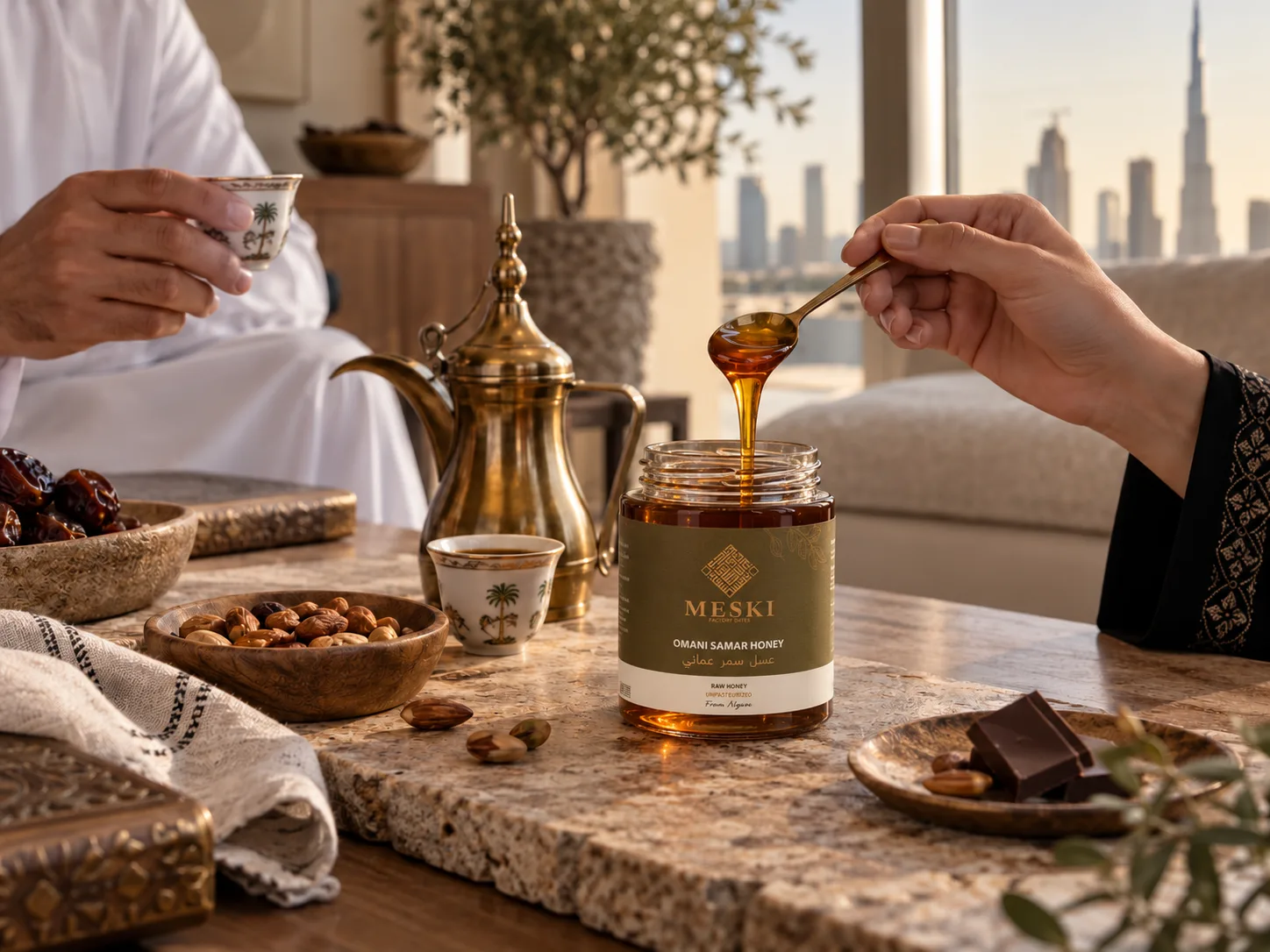
MESKI lists its Nizwa Omani Samar directly in the UAE store at Omani Samar Honey.
Our current UAE shipping policy accepts orders across the Emirates. At the time of writing, Dubai delivery is listed as free, while delivery charges vary for several other emirates. Standard online and phone orders are described as taking about two to three days.
Delivery policies can change, so the shipping page should always be checked at checkout rather than copied forever from an old article.
The point of this page is not to pretend MESKI has a honey shop on every Dubai street. We sell online and deliver. That is the honest local intent.
Dubai Buyer, UAE Seller, Omani Harvest: Three Places Can Exist in One Purchase
This is another detail search results often blur.
A jar can be harvested in Oman, sold by a UAE business and delivered to a customer in Dubai. Those are three different facts.
When somebody searches “Oman honey Dubai,” the search intent is commercial location. It does not mean the honey was harvested in Dubai. When somebody searches “Omani Samar honey,” the origin matters.
Keeping those two ideas separate protects both the buyer and the producer.
Is Omani Samar a Luxury Honey?
It can be presented as one, but I prefer to start somewhere else.
The rarity comes first from a seasonal floral source in hard terrain and a limited harvest window. Luxury packaging comes later.
You can eat Samar from a simple spoon beside coffee. You can also place it in a carefully prepared gift. Neither presentation changes the tree that flowered in spring.
At MESKI we enjoy beautiful packaging, but we try not to let the box become the provenance.
Omani Samar as a Gift in Dubai
Samar is a good gift for somebody who already knows Sidr and wants something different. It also works well for coffee lovers because the darker profile can sit naturally beside qahwa, espresso or roasted nuts.
For a host gift, client gift or private dinner, a single jar can be enough. A gift does not need gold to be meaningful.
For occasions that call for a larger presentation, a Sidr and Samar combination can create a much more interesting tasting story than repeating the same honey twice.
A good gift should still taste good after the ribbon is gone.
How I Would Taste It
First, alone.
One small spoon at room temperature, without bread, lemon, milk or supplements. Give the aroma a moment. Notice the dark caramel note, then the warmer finish.
After that, try it beside Omani coffee, dark chocolate, roasted nuts or plain yogurt. In savoury cooking, use it sparingly in a glaze where its intensity has something to push against.
If you taste Sidr and Samar side by side, use separate spoons and start with the lighter profile. The difference becomes obvious very quickly.
Raw Honey, Crystallisation and Storage
Raw honey is not a frozen product. Texture can evolve, and natural crystallisation does not automatically mean a honey is spoiled or fake.
Store the jar at normal room temperature, away from excessive heat and direct sunlight. There is no reason to cook it simply to make it look more liquid.
If texture changes, judge the honey by its actual condition and provenance rather than expecting every harvest to behave like an industrial syrup.
Living food is allowed to look alive.
A Note on Health Claims
Samar honey, like other honeys, contains sugars and naturally occurring compounds that vary by origin and harvest.
I would not buy it because a seller promises to cure a disease, repair an organ or replace medical treatment. Those claims go far beyond what a jar of honey should promise.
Buy it as food, as a traditional product, as a sensory experience and, if you value it, as part of a balanced diet.
Good provenance does not need miracle language.
Why This Long-Tail Search Matters
From an SEO point of view, “Omani Samar honey Dubai” is much smaller than “Sidr honey UAE.” That is precisely why it interests us.
A smaller search can carry a clearer buyer. Somebody typing Samar already knows more than somebody typing only honey. Somebody adding Oman knows the origin they want. Somebody adding Dubai tells us where they want to buy it.
Our job is not to repeat those words twenty times. It is to answer the intent better than a generic product page.
Origin, season, taste, comparison, traceability, delivery and gifting: that is the complete answer.
The Short Version
If you are in Dubai or elsewhere in the UAE and specifically want Omani Samar honey, look beyond the country name.
MESKI’s current Samar is stated as Nizwa, Al Hajar Mountains, spring harvest, sourced through the same beekeeper relationship as our Omani Sidr. Its character is dark, smoky-caramel, fluid and persistent.
Read the Atlas if you want the terroir. Use the product page if you are ready to buy.
And if you are still deciding between Sidr and Samar, taste both. The mountain will answer faster than the marketing.
Questions People Ask
It is honey produced from the spring bloom of the Samar acacia in Oman. MESKI’s stated origin is Nizwa in the Al Hajar Mountains.
MESKI’s Honey Atlas records the Samar bloom as beginning around April, with harvest typically in April and May, depending on rainfall and the season.
MESKI describes its current Nizwa Samar as deep dark amber with a fluid, velvety body, smoky caramel notes, warm depth and a long finish.
No. They come from different floral sources and different flowering seasons. MESKI’s Nizwa Sidr and Samar share a beekeeper relationship but are distinct honeys.
MESKI sells its Nizwa Omani Samar through its UAE online store and delivers in Dubai and across the UAE under its current shipping policy.
This article does not claim a Dubai storefront. MESKI sells online and delivers within the UAE.
Ask for the stated country, region, floral source, harvest period, lot information, analysis where available and a continuous traceability chain.
Yes. Its darker, more assertive profile can make an interesting gift, especially for someone who already knows Sidr. Choose the honey first and packaging level second.
Honey should not be sold as a substitute for medical diagnosis or treatment. Buy it as food and judge health claims cautiously.
Taste Oman’s Other Honey Season
Sidr may be the famous name, but Nizwa has another side in spring. Read the terroir, compare the two honeys, or continue through the MESKI Journal.