
Horses, dates, frankincense and pearls left Arabia here. Spices and ships arrived from India. Between mountain and sea, Qalhat became a medieval crossroads.
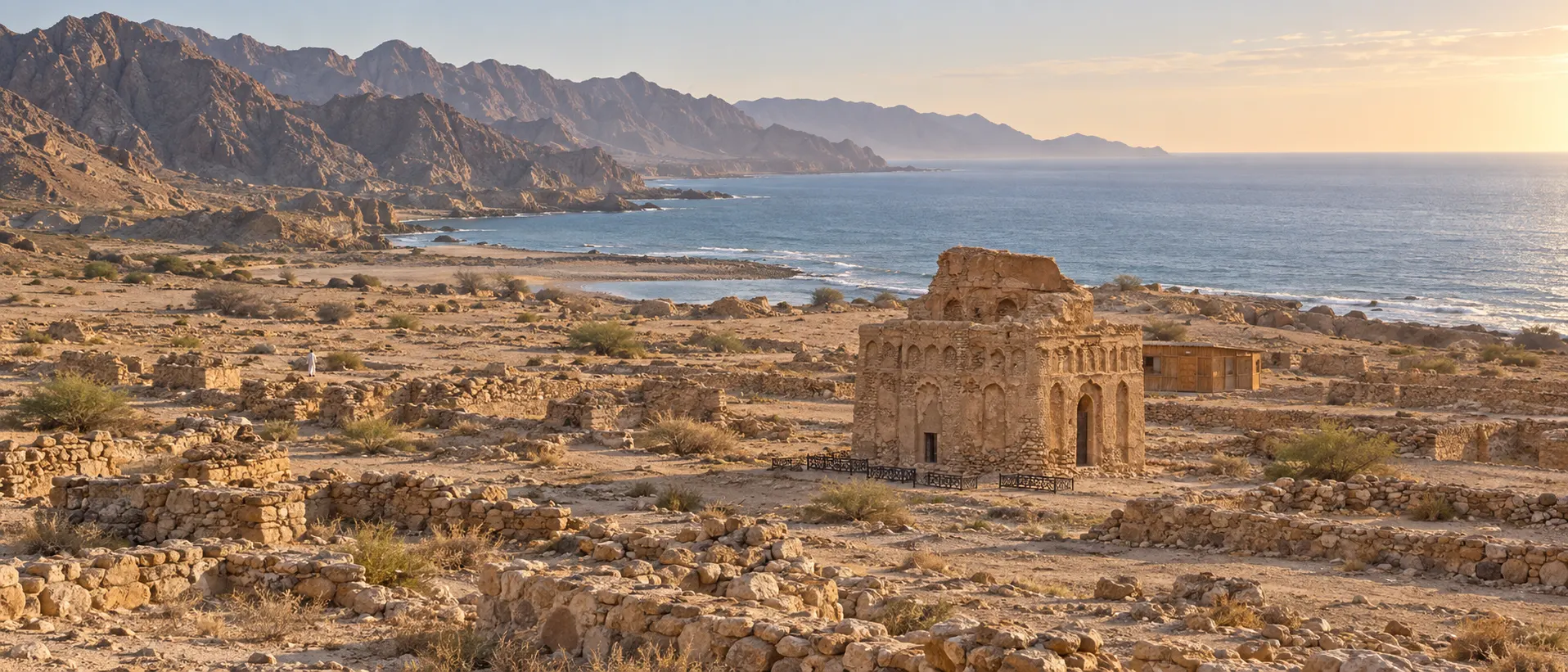
There was a time when a port on Oman’s eastern coast helped connect Arabian horses, dates, incense and pearls to an oceanic trade world reaching India and farther east. Qalhat is quiet now, but its ruins once stood inside one of the busiest commercial systems of the medieval Indian Ocean.
A Port Between Mountain and Sea
Qalhat does not need a fictional beginning. Its geography already feels written for a story.
The ancient city lies on Oman’s eastern coast, roughly twenty kilometres north of Sur, between the sea, mountains and deep valleys. UNESCO defines the archaeological city within inner and outer walls, with necropolises beyond them.
From roughly the eleventh to the sixteenth century, Qalhat prospered under the princes of Hormuz. Ships connected it to the Persian Gulf and Indian Ocean, while trade reached India and, through those networks, East and Southeast Asia. UNESCO’s broader description also places East Africa within its commercial world.
For several centuries, this was not the edge of Arabia. It was one of its doors.
The Port Where Arabia Met India
The title is deliberately simple because the connection was fundamental.
UNESCO describes Qalhat as a trade centre linking the Arabian Peninsula with India and, through India, farther east. Archaeological finds from China, India and Iran reinforce the picture of a cosmopolitan harbour rather than a local coastal market.
Medieval sailors experienced this network through monsoon winds, cargo, waiting, credit, languages and uncertainty. India was not an exotic idea beyond the horizon. It was part of Qalhat’s working commercial world.
Horses Went Out. Spices Came In.
One of the strongest ways to understand Qalhat is through cargo.
UNESCO lists vital exports coordinated under the Hormuz princes: Arabian horses, dates, incense and pearls. The port also received spices and other merchandise moving through Indian Ocean trade.
A horse begins inland. Dates begin in an oasis. Frankincense comes from trees farther south. Pearls come from the sea. Spices arrive from across the ocean.
Qalhat made them neighbours for a moment before they moved again.
Imagine the Horse Before the Ship
The export of Arabian horses sounds elegant when written in one line. In practice it meant an animal had to travel from an inland breeding world to the coast, be fed and watered, loaded safely and carried across the sea.
A horse is not a sack of spice.
That logistical difficulty tells us how valuable the trade must have been. When we say a port connected Arabia and India, we are talking about the organisation of hundreds of practical problems.
Dates: The Quiet Cargo Beside the Famous One
Dates rarely receive the drama given to horses, pearls or frankincense, but they belonged to Qalhat’s export economy too.
They are dense, durable and tied to oasis agriculture across Oman. They could feed households and travellers, travel better than many fresh foods and enter trade without a modern cold chain.
I like seeing dates on UNESCO’s export list because they keep the story grounded. A port moves luxury goods, but it also moves food.
Frankincense Reached the Port From Another Oman
Frankincense belongs most famously to southern Oman and Dhofar, far from Qalhat. Yet UNESCO includes incense among Qalhat’s major exports.
That means the port’s story cannot be understood only by looking at the coastline immediately around it. Goods travelled within Arabia before they travelled beyond Arabia.
We explored the living Omani side of this story in The Omani Honey I Discovered Through a Local Beekeeper, where frankincense appears first as a tree, resin and landscape before honey enters the picture.
At Qalhat, the resin was part of a much older movement: from tree, to inland route, to port, to another world.
Pearls Connected the Gulf to the Same Ocean
Pearls appear again here, just as they do in Al Zubarah centuries later.
That is why I like pairing Qalhat with Al Zubarah, Qatar’s lost pearl port. The cities belong to different centuries, but the sea links them conceptually.
The Gulf’s coast changed political rulers many times. The attraction of a small object pulled from the sea lasted far longer.
A City of Foreign Goods and Foreign Residents
UNESCO describes Qalhat as a medieval cosmopolitan city. Its houses and archaeological materials show influences connected to inhabitants and owners of different cultural backgrounds.
A port becomes cosmopolitan when people arrive because trade gives them a reason to stay. Languages mix. Building habits change. Imported ceramics enter local houses. Food changes.
Qalhat’s ruins preserve the material consequences of people meeting.
Marco Polo Saw a Port Dependent on Ships
Qalhat was important enough to appear in the accounts of major medieval travellers, including Marco Polo and Ibn Battuta.
The UNESCO nomination file preserves Marco Polo’s observation that Qalhat did not grow its own grain and relied on merchant vessels to bring it. He also described ships arriving from India and merchandise moving inland from the port.
That detail is extraordinarily useful. A prosperous port can be powerful and vulnerable at the same time. Stop the ships and the city does not merely lose luxury goods; it can lose food.
Ibn Battuta Looked at the Mosque
When Ibn Battuta visited in the fourteenth century, he did not describe only cargo.
The UNESCO nomination file preserves his praise of Qalhat’s “fine bazaars and one of the most beautiful mosques.” He wrote of Kashan tilework and a mosque overlooking the sea and port, associated with Bibi Maryam.
This is the moment the city stops being only an economic machine. Merchants need markets, residents need homes, and communities build religious spaces. Wealth becomes architecture.
Bibi Maryam and the Monument That Still Carries Her Name
Among Qalhat’s most recognisable surviving monuments is the mausoleum associated with Bibi Maryam.
Archaeological and nomination records connect her name to the city’s major religious architecture around the early fourteenth century. Where details of biography remain debated in historical traditions, the monument still gives Qalhat a human name inside a landscape of ruins.
It is easier to remember a city when one person’s name survives the erosion of almost everything around it.
Fish, Rice and the Everyday Port
The UNESCO nomination material preserves travellers’ observations about food. Marco Polo associated the local diet strongly with dates and salted fish, while Ibn Battuta wrote about fish served with rice.
A ship may carry horses worth fortunes, but somebody still has to eat dinner.
Fish comes from the sea beside the city. Dates connect to the oasis economy. Rice depends on trade. One meal can contain the port’s geography.
Water Again: The Problem Every Coastal City Must Solve
Qalhat’s location is dramatic, but it is not generous in every resource.
Archaeological work has identified cisterns and water-supply systems. A large population, visiting merchants, animals and ships all increase demand for fresh water.
Old ports force us to return to the same truth: trade looks glamorous from the cargo list, but infrastructure decides whether the port functions.
The Kingdom of Hormuz Needed More Than One Centre
Qalhat’s importance was political as well as commercial.
UNESCO describes it as a seasonal residence and refuge for the princes of Hormuz and gives it the status of a secondary capital within the kingdom.
The Kingdom of Hormuz controlled a maritime world where strategic ports were instruments of power. Qalhat’s fortifications, harbour and position gave rulers another secure centre on the Arabian side of that system.
Then Muscat Rose and the Portuguese Arrived
Ports do not stay central forever.
Qalhat’s decline accelerated in the early sixteenth century as Portuguese power entered the region and other ports, particularly Muscat, became more important. UNESCO states that following Portuguese attacks, Qalhat was abandoned in the sixteenth century.
I would resist turning that into one cinematic night when the city suddenly emptied. Ports lose importance through layers: warfare, shifting routes, political change and the growth of competitors.
Muscat Became the City That Continued
Our article Muscat: The City That Did Not Need to Shout begins much later, in a capital where the harbour, Muttrah and traditional urban scale still remain visible beside modern life.
Qalhat and Muscat are not interchangeable chapters. But placing them beside each other shows how commercial gravity moves.
One port falls silent. Another becomes the name the world knows.
Do Not Turn Qalhat Into a Fantasy Arabian Port
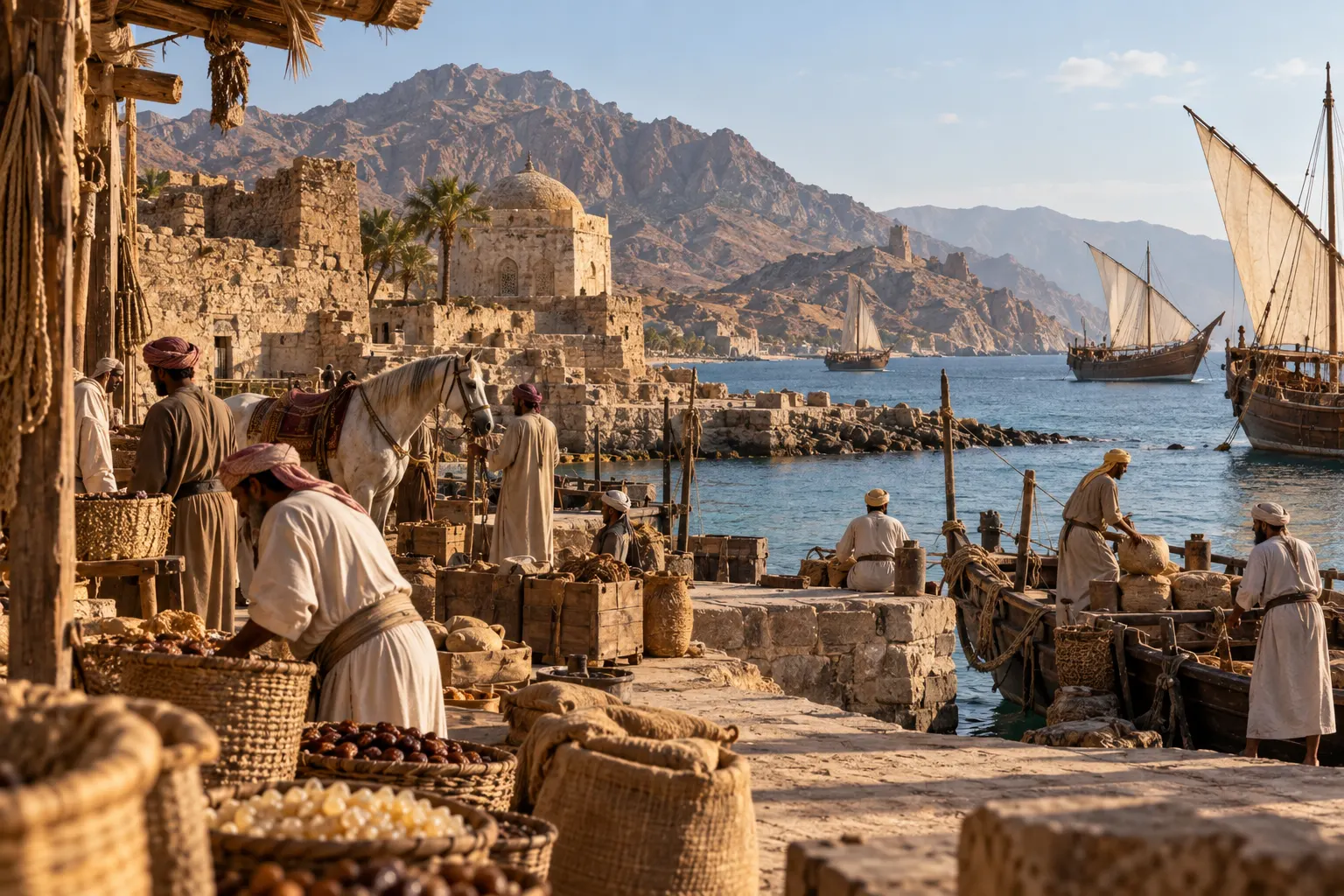
We do not know every colour of every awning, every face on the quay or every conversation in the market. Archaeology gives us plans, objects, buildings, systems and trade evidence. Travellers add observations.
I would rather describe the sound of a plausible working port and then tell the reader what is documented than pretend we have a perfect photograph from 1350.
The ruins are powerful enough without fantasy.
Sources & Further Reading
The factual backbone is the UNESCO World Heritage entry for the Ancient City of Qalhat, which documents the trading range, Hormuz role, exports and abandonment after Portuguese attacks.
Additional texture comes from the UNESCO nomination documentation, which preserves medieval travel accounts, food observations, water systems and archaeological evidence.
For the wider Omani continuum, see our own Muscat essay and the frankincense story.
Scenes of horses being prepared, sailors waiting or a harbour coming alive are editorial reconstruction anchored in documented trade, not invented quotations.
The Port Where Arabia Met India
Qalhat makes an old truth visible.
Arabia and India did not suddenly discover each other through airlines, container ports or modern migration. Horses went one way. Spices came another. Dates, pearls and frankincense entered the same system. Ships brought food as well as luxury. Travellers wrote about markets and mosques because the port was also a city.
Then the political map changed and the harbour fell quiet.
The sea kept moving.
Questions People Ask
On Oman’s eastern coast, about twenty kilometres north of Sur, between the sea and mountainous terrain.
UNESCO describes it as flourishing from roughly the eleventh to the sixteenth century under the princes of Hormuz.
Major exports included Arabian horses, dates, incense and pearls, while goods and spices arrived through Indian Ocean trade.
Yes. UNESCO identifies it as a trade centre linking Arabia with India and farther eastern networks.
Yes. UNESCO nomination records preserve his observations about Indian merchant ships and imported grain.
Yes. UNESCO documentation preserves his praise of its bazaars and mosque and his observations about food.
Her name is associated with major fourteenth-century religious architecture and the surviving mausoleum. Details of biography are treated cautiously.
UNESCO states that after Portuguese attacks the city was abandoned in the sixteenth century.
The Ancient City of Qalhat was inscribed in 2018.
Follow the Maritime Roads of Arabia
Qalhat opens one route toward India. Continue through Oman’s living harbour culture, frankincense, and Qatar’s lost pearl port.