
A strong little cup with South Asian roots became one of Qatar’s most ordinary and most revealing rituals.
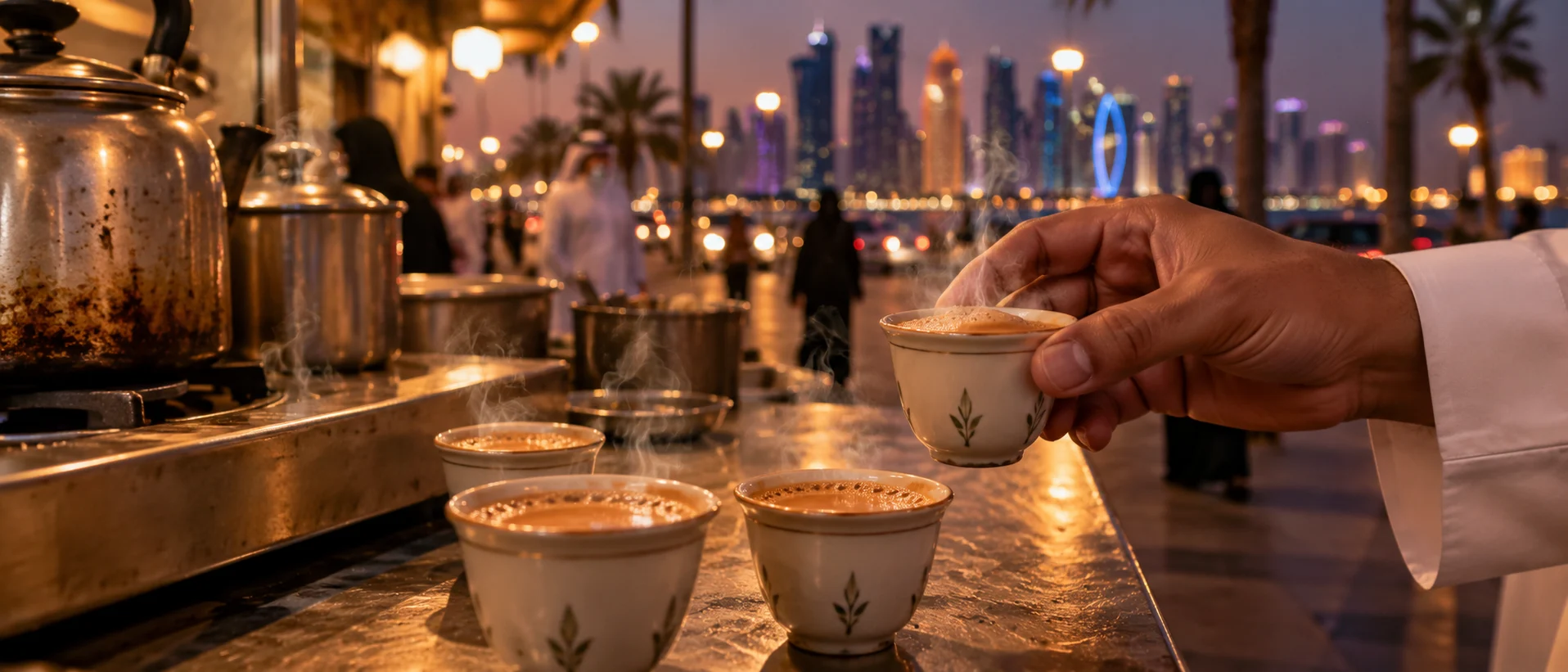
Arabic coffee may carry ceremony. Karak carries the pause between things. In Qatar, that small hot cup moves easily between work, driving, friendship, hospitality and late conversation. That may be why it tells us so much.
The cup that does not need an occasion
Arabic coffee carries ceremony. Karak often carries Tuesday afternoon. That difference is part of its charm. In Qatar, karak is everywhere from simple tea windows to polished cafés, and its strength is precisely that it can belong to almost any hour. It is social without requiring a formal invitation.
Visit Qatar traces the drink’s South Asian roots and notes how Qataris adopted and adapted it into everyday gatherings and hospitality. That history matters. Karak is a reminder that culture is not weakened by exchange. Sometimes a borrowed drink becomes so deeply woven into daily life that it begins to describe the place that adopted it.
Strong tea, milk, cardamom, sugar
The basic architecture is simple: strong black tea, milk, cardamom and sweetness, with variations that may include saffron, ginger, cinnamon or other touches. The pleasure comes from concentration. Karak should not taste like coloured milk. The tea needs enough character to survive the milk and sugar.
Recipes become personal quickly. Some people want it almost dessert-like. Others prefer more tea and less sweetness. Some chase saffron. Some want ginger. The cup is small enough that people can argue about it without consequences, which is one of the world’s better forms of disagreement.
A roadside karak can tell you more about everyday Qatar than a plate arranged to explain Qatar.
Meskaoui
Why Qatar feels particularly attached to karak
I would be careful with claims that Qatar drinks more karak than every neighbouring country. That is difficult to prove and unnecessary. The visible fact is already enough: karak has an unusually prominent place in Qatar’s public everyday life. It appears in quick stops, gatherings, drives, work breaks and late conversations.
Unlike a drink reserved for a particular ceremony, karak survives repetition. You can have one today and another tomorrow without pretending either cup is historic. That normality is exactly what makes it culturally interesting.
The two-finger cup
There is something perfect about the physical scale of karak. The cup is hot, often small, and usually held carefully near the rim. You do not settle into a three-course ritual. You pause. The tea is strong enough to mark the moment and small enough not to own the entire day.
A roadside karak can be more revealing than an expensive tasting menu because it shows what people choose when nobody is trying to represent the nation. This is not heritage staged behind glass. It is habit.
Karak and Arabic coffee are not enemies
It is tempting to write every culture article as a competition. Karak versus Arabic coffee. Modern versus traditional. Imported versus local. I do not think that helps. Arabic coffee has a deep language of generosity and hospitality across the Gulf, and Qatar is part of that story. Karak occupies another register.
One can appear in the majlis as a sign of reception and continuity. The other may arrive during a drive, a work break or a casual gathering. Sometimes both worlds overlap. Culture has enough room for more than one cup.
Reduce the sugar, add a little Sidr at the end, and let the honey bring the caramel note. That is my version, not a national decree haha.
Meskaoui
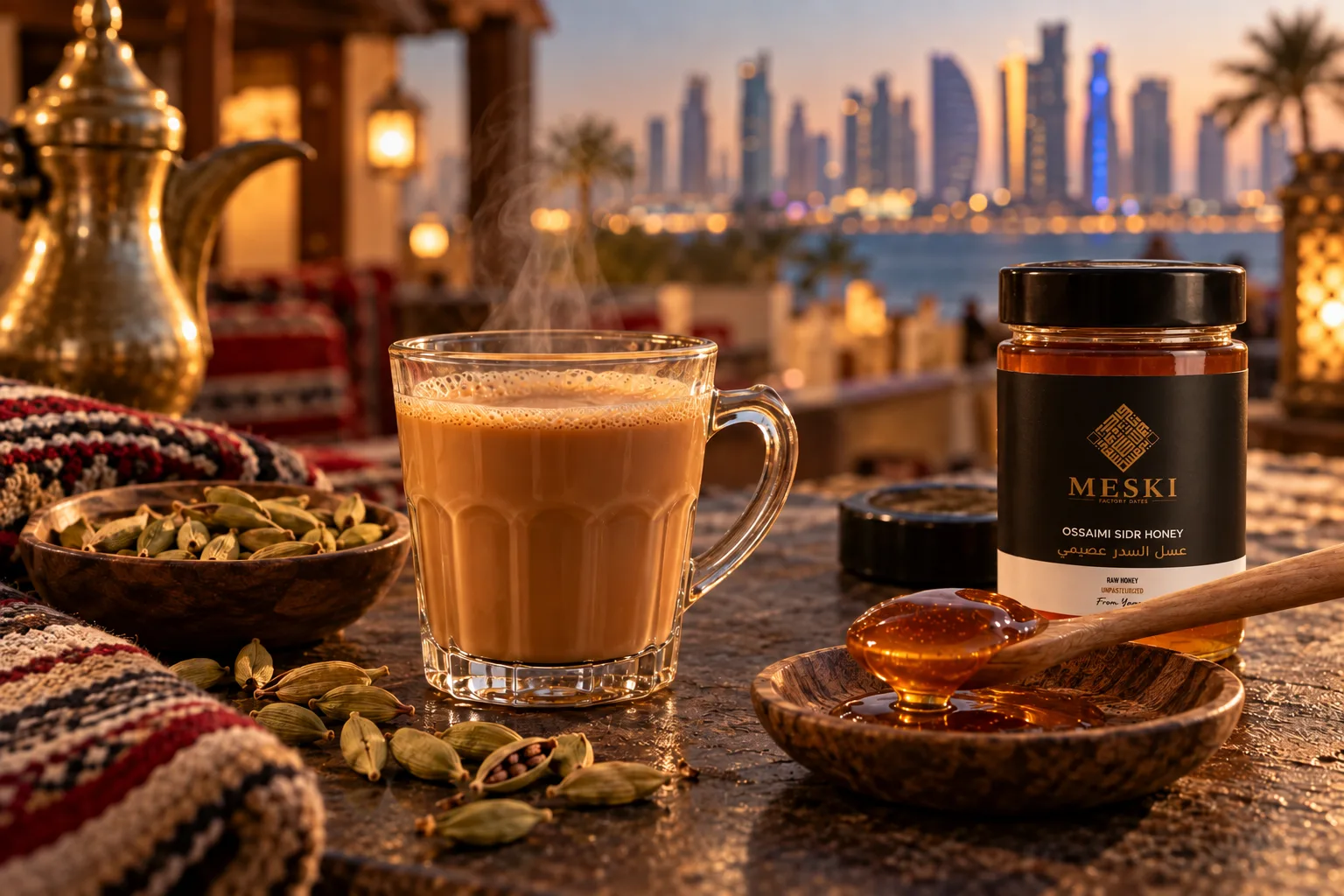
My small MESKI modification: less sugar, Sidr at the end
This is not a Qatari tradition. Let me say that first so nobody quotes us as the ministry of karak haha. It is simply how I like to modify the drink. Make the karak normally but reduce the sugar. Once the tea has finished boiling and is no longer aggressively hot, add a little Sidr honey to taste.
Sidr can bring a soft caramel, woody depth that suits cardamom beautifully. The key word is little. Honey should not turn the tea into syrup. And because honey aroma is part of the point, I prefer adding it after the hardest heat rather than boiling it for a long time.
Honey does not make karak a health drink
We should also resist another internet habit: adding honey and suddenly describing a drink as medicine. This is still sweet tea. Honey is food. Sidr is interesting here because of flavour and origin, not because it allows us to attach exaggerated health promises to a cup.
If you want to explore Sidr beyond tea, our Honey Atlas follows the tree and its honeys across different regions. If you want to understand the hospitality surrounding another Qatari drink, our article on dates, Arabic coffee and bukhoor continues the story.
From migration to belonging
Karak’s South Asian roots make the story more Qatari, not less. The Gulf has long been shaped by movement across the Indian Ocean. People, foods, textiles, spices, words and working lives crossed in both directions. A drink that arrived through these connections and then became locally normal belongs to that history of exchange.
Calling karak imported therefore tells only the first chapter. The next chapter is adoption. People changed proportions, attached the drink to local routines, built businesses around it and taught a new generation to recognise the smell before they knew the migration history behind it.
Why small rituals deserve serious articles
Big monuments are easy to research because institutions document them. Everyday habits are harder. They disappear into normal life. That is exactly why I think they deserve attention. A cup bought every week can reveal more about a city’s rhythm than a landmark visited once.
Karak is not Qatar’s oldest tradition, and it does not need to be. Age is not the only measure of cultural importance. Repetition can create belonging very quickly.
The best karak is sometimes the one you did not plan
Travel writing tends to hunt for the best cup. I understand why. Search engines like a winner. Real life is less obedient. The cup you remember might be from a famous shop, or it might be the one handed through a car window during a conversation that lasted five minutes longer than expected.
Karak’s power in Qatar is not exclusivity. It is availability. It belongs to ordinary time. And ordinary time, repeated often enough, is where a culture actually lives.
The drive-up ritual
One of karak’s modern strengths is that it works with the car. Doha life is spread across roads, neighbourhoods and destinations, and the quick tea stop fits that movement. A drink can be collected, passed through a window and consumed before the next part of the day begins.
There is nothing ancient about that scene, and that is exactly why it belongs in this article. Culture is not only what survives from grandparents. It is also what a city repeats now.
Sweetness is part of the argument
Karak is often sweet. For some people that is the pleasure; for others it is the reason to order less sugar. The important thing is not to declare one correct ratio. A cup is built around balance, and balance is personal.
My honey suggestion comes from that. I would rather reduce refined sugar and use a small spoon of Sidr for flavour than add honey on top of an already very sweet cup. The point is taste, not virtue.
A cup shared without ceremony
Not every social act needs a formal ritual. Karak can accompany a conversation that was never planned, a colleague’s break, a family drive or a late stop after dinner. That informality makes it democratic in a way luxury drinks rarely are.
You do not need to know a vocabulary of service to participate. You take the cup, protect your fingers from the heat, and drink.
Doha through smell and steam
Cities are often described through skylines, but daily memory is smaller. Steam on a car window, cardamom in the air, the first sip being hotter than expected, the sound of cups being placed on a counter. These details do not photograph as easily as towers, but they are often what remains.
This is where the story becomes interesting for MESKI. We can write about a city without pretending every important thing is monumental.
A MESKI note on certainty 1
There is a temptation in cultural writing to turn every repeated habit into a rule. Real places are less obedient. Families differ, generations differ, occasions differ, and a practice that feels obvious in one house may be less important in another.
For MESKI, the useful discipline is to separate three things: what a reliable source documents, what can reasonably be observed, and what is personal interpretation. Keeping those layers visible makes the article less perfect and more trustworthy.
I would rather preserve one honest uncertainty than replace it with a beautiful sentence that nobody can prove. The archive tells us this. It does not tell us that.
A MESKI note on certainty 2
There is a temptation in cultural writing to turn every repeated habit into a rule. Real places are less obedient. Families differ, generations differ, occasions differ, and a practice that feels obvious in one house may be less important in another.
For MESKI, the useful discipline is to separate three things: what a reliable source documents, what can reasonably be observed, and what is personal interpretation. Keeping those layers visible makes the article less perfect and more trustworthy.
I would rather preserve one honest uncertainty than replace it with a beautiful sentence that nobody can prove. The archive tells us this. It does not tell us that.
Questions People Ask
Karak is a strong milk tea usually made with black tea, milk, cardamom and sugar, with optional spices such as saffron or ginger.
Its roots are South Asian. Over time it was adopted and adapted across the Gulf, including Qatar, where it became deeply embedded in daily life.
It is affordable, widely available, social and easy to fit into everyday routines, from work breaks to gatherings and drives.
They are related traditions, but recipes and local preferences vary. Qatari karak often emphasises strong tea, milk, cardamom and sweetness.
Yes. Our MESKI suggestion is to reduce the sugar and add a small amount of Sidr honey near the end for a caramel and woody note.
For flavour, we prefer adding it after the strongest boiling stage so more of its aroma remains noticeable.
No. It is a MESKI serving suggestion, not a claim about traditional Qatari preparation.
It remains a sweet beverage. We use honey here for flavour and provenance, not as a medical claim.
Karak is widely available in tea stalls, cafés, restaurants and drive-up locations across Doha and the wider country.
One cup leads to another story
Read Qatar through its everyday rituals, then follow Sidr from the tea cup back to the tree and the hive.