
The right honey gift is not the jar with the loudest prestige claim. It is the one whose origin, taste and meaning fit the person receiving it.
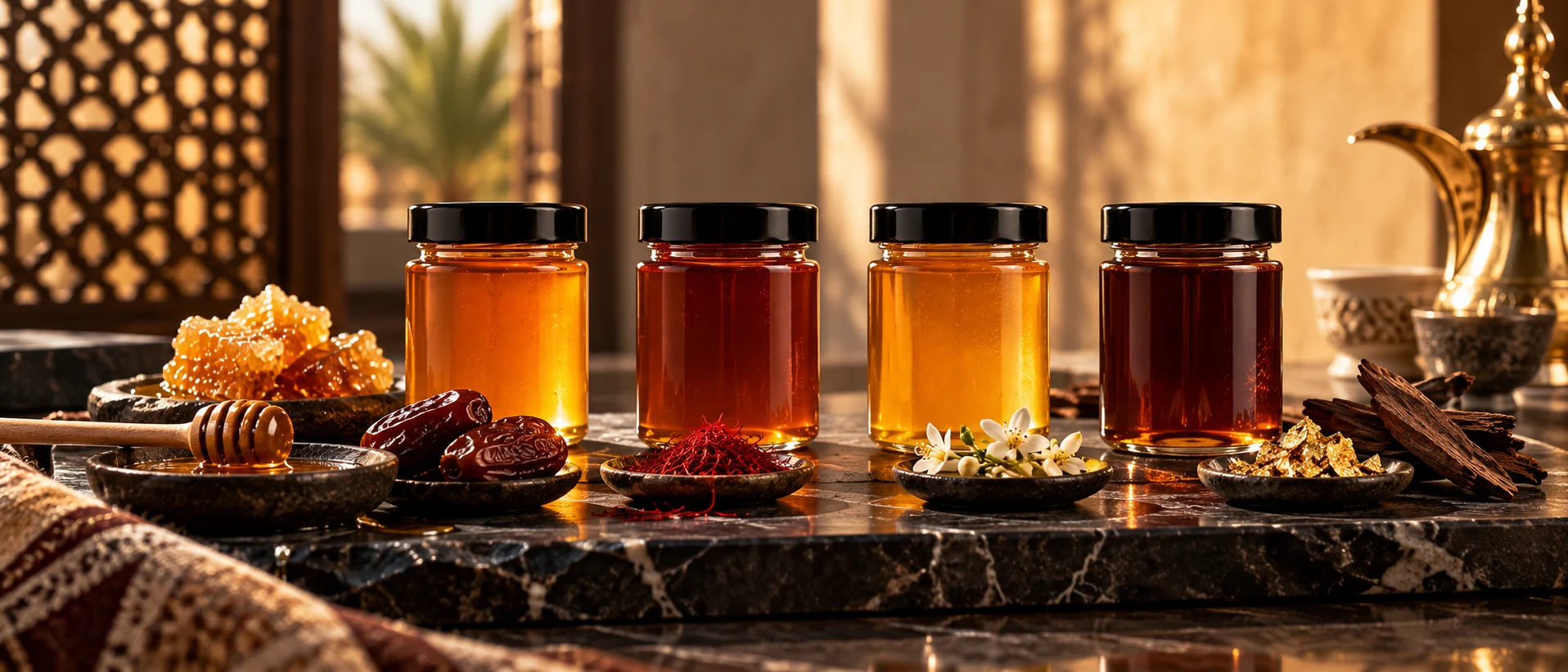
Choosing honey for a gift becomes easier when we stop asking which honey is “best” and start asking what the gift is meant to say. Local origin? Arabian heritage? A new tasting experience? Ceremony? Analytical grading? Sidr, Samar, Ghaf, gold, saffron and Manuka belong to different stories, and they should not be collapsed into one luxury ranking.
The best gift honey depends on who will open the jar
“What is the best honey to gift?” sounds like a ranking question, but gifting is more personal than that. A jar for someone who already knows Yemeni Sidr should not be chosen in the same way as a first honey for a colleague, a local UAE gift for a visitor, or a wellness-oriented present for someone who specifically asks for Manuka. The right jar is the one whose origin, taste and meaning fit the recipient.
This is also why price is a poor starting point. The most expensive honey can be the wrong gift if the recipient dislikes its intensity or does not understand why it costs more. Begin with the person, then decide whether you want heritage, local origin, sensory character, precious presentation or a recognised analytical grading system.
Sidr is the safest Arabian reference when provenance is strong
Sidr has the broadest premium recognition across the Arabian honey market. Yemeni Do’ani Sidr, Omani Sidr from areas such as Nizwa, Emirati Sidr from Hatta and Saudi Sidr can all make excellent gifts, but they are not interchangeable. A strong Sidr gift names the country and region before it leans on the fame of the tree.
For someone new to Arabian honey, Sidr is often the easiest story to understand. For a connoisseur, the interest comes from comparing origins. MESKI’s Sidr by Country guide is useful precisely because it keeps the flower constant while letting geography change. The gift then becomes a tasting question rather than a status symbol.
Samar suits someone who likes a darker, more assertive profile
Samar honey is familiar across Oman, the UAE and Saudi Arabia, but it is less internationally famous than Sidr. That can make it a particularly good gift for someone who already has several Sidr jars. It opens a different botanical conversation and often carries a stronger, deeper sensory identity, although individual harvests vary.
The important point is to avoid using Samar as a generic “dark honey” category. A good jar should still explain origin and harvest. If the recipient enjoys tasting differences rather than collecting famous names, Samar can feel more personal than choosing Sidr automatically.
Ghaf makes sense when the UAE connection matters
Ghaf honey is interesting because the tree itself has exceptional cultural and ecological significance in the UAE. For a visitor, a resident celebrating the Emirates, or a gift designed around local landscape, a documented Ghaf harvest can communicate something that imported honey cannot. It says: this jar begins with a tree deeply associated with this country.
But symbolism must not outrun evidence. Our Ghaf honey guide makes this distinction carefully. The national tree is real. Commercial Ghaf honey is real. Yet every jar still needs normal traceability, and taste or colour alone cannot prove that bees foraged predominantly on Ghaf.
Gold changes the ceremony, not the botanical origin
Edible gold can transform the visual experience of a gift. It catches light, creates movement in the jar and clearly signals ceremony. But gold is not a floral source. A gold Sidr jar remains Sidr honey with an added edible ingredient. The honey should already deserve attention before the gold enters the story.
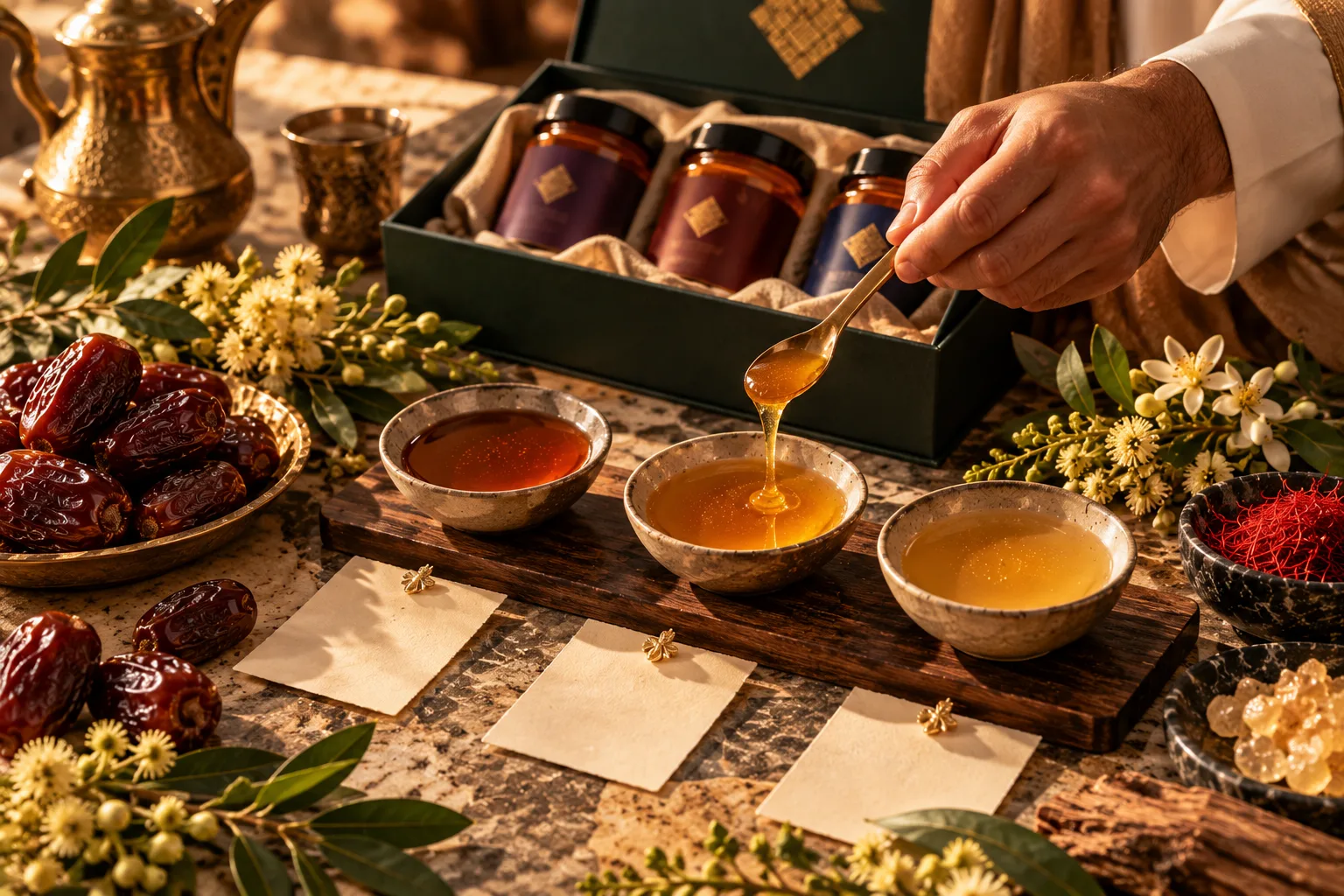
This distinction matters because luxury can easily reverse the order of importance. If the decoration becomes more important than provenance, the gift becomes theatre. In MESKI’s Royal Sidr Honey Collection, the intention is the opposite: three distinct Arabian Sidr origins first, then gold, silver and saffron as part of the presentation.
Saffron adds aroma and ritual, but it is still an addition
Saffron can be a beautiful pairing with honey because the threads contribute colour, aroma and a familiar luxury language across the Gulf. Yet, like gold, it does not define where the bees foraged. “Saffron honey” can mean honey infused or combined with saffron, not honey gathered from saffron flowers unless that very specific botanical claim is supported.
For gifting, saffron works best when the recipient enjoys aromatic foods or when the box is meant to feel ceremonial. The underlying honey should remain named. Yemeni Sidr with saffron tells a clearer story than a vague jar labelled only “royal saffron honey”.
Manuka belongs to a different buying system
Manuka is not an Arabian honey. Genuine New Zealand Manuka is produced from nectar of Leptospermum scoparium, and New Zealand’s Ministry for Primary Industries uses a scientific export definition based on chemical and DNA markers. Consumers also encounter commercial grading systems such as UMF and MGO. This makes Manuka a different kind of gift decision.
If the recipient already buys Manuka and understands the grading, a clearly authenticated jar can be appropriate. If the goal is to represent the Gulf, however, Sidr, Samar or Ghaf make more cultural sense. Manuka should not be placed above Arabian honeys as if one analytical number automatically made it the more luxurious gift. It is simply a different product with a different authentication framework.
Choose by occasion, not by a universal hierarchy
For Ramadan or Eid, shareable formats and elegant presentation often matter. For a corporate gift, consistency, traceability and delivery reliability become important. For a host gift, a single excellent jar may feel more sincere than a large box. For a collector, comparative origins can be exciting. For someone who cooks, a honey they can actually use may be better than a precious jar they are afraid to open.
The occasion should narrow the choice. It should not force a cliché. Gold does not automatically mean VIP. Sidr does not automatically mean connoisseur. Manuka does not automatically mean health. A thoughtful giver asks what the recipient values and then chooses the honey that best expresses it.
Taste still matters more than prestige
Honey is food before it is a symbol. That means sweetness, aroma, acidity, texture and aftertaste deserve attention. Some people love the deep caramel character associated with certain Omani Sidr harvests. Others prefer a brighter, more floral profile. Some enjoy the intensity of Samar. A beautiful jar that the recipient does not enjoy eating has failed one of the simplest tests of gifting.
When possible, taste before buying. When that is not possible, choose a seller who describes the jar in sensory terms without pretending every batch is identical. Natural variation is not an inconvenience to hide. It is part of why one harvest can feel personal.
A gift becomes stronger when the origin can survive a question
Imagine the recipient asks one thing after opening the box: “Where is this honey from?” A strong gift should have a clear answer. Hatta. Nizwa. Wadi Do’an. Aseer. New Zealand. The answer can then lead to the tree, season, beekeeper and harvest. If the seller cannot move beyond “premium”, “royal” or “best”, the gift has decoration but very little depth.
That is the final rule. Choose the honey whose story remains coherent after the ribbon is removed. Our Gulf Honey Charade puts it simply: origin first, decoration afterward.
A simple decision path is more useful than a ranking
If the gift must feel unmistakably Arabian, begin with Sidr, Samar or Ghaf. If it should feel specifically Emirati, a documented Hatta Sidr or Ghaf harvest makes more sense than an imported jar. If the recipient already collects Arabian honey, Samar or a comparative Sidr set can offer something less predictable. If the recipient explicitly values New Zealand Manuka, use an authenticated product and let its own system speak for itself.
Then decide whether the occasion needs ceremony. Gold or saffron can add visual and aromatic theatre, but they should never be used to rescue a weak base honey. Finally, choose size. A 250 g jar can be appropriate for discovery and formal gifting. A larger jar may be better for a family that will actually use it at breakfast.
This path is intentionally practical. It keeps the recipient, origin and use ahead of prestige vocabulary.
Health claims should not decide a gift purchase
Honey is often sold through wellness language, especially Manuka and some premium Sidr categories. A gift guide should not turn those commercial claims into medical advice. If the recipient is interested in a regulated grading system or a specific product tradition, explain that system accurately. Do not imply that one honey treats disease or that a higher price guarantees a health outcome.
This keeps the gift in a safer and more honest place: food, provenance, taste and presentation. Those qualities are already enough to make a jar meaningful.
The jar size changes the way a gift is experienced
A discovery gift does not always need a large quantity. A smaller jar invites tasting and comparison, especially when the honey is rare or part of a multi-origin set. A family gift can justify a larger format because the honey is more likely to be opened repeatedly at breakfast or with guests. The best size is the one that encourages use rather than turning the product into a display object.
Frequently Asked Questions
There is no universal winner. A traceable Sidr, Samar, Ghaf or authenticated Manuka can all be premium. Match the honey to the recipient, occasion and story you want the gift to carry.
Yes. Sidr is widely recognised across Arabia and works especially well when the country, region and harvest are clear. Yemeni, Omani, Emirati and Saudi Sidr should retain their distinct origins.
Samar suits recipients who enjoy deeper, more assertive Arabian honey or who already know Sidr and want to discover another important regional floral tradition.
A well-documented Ghaf honey can be especially meaningful as a UAE gift because Ghaf is the national tree. The botanical claim should still be supported by normal traceability.
No. Edible gold changes presentation, not the botanical quality of the underlying honey. The honey should be selected for origin and quality before gold is added.
The term often refers to honey combined or infused with saffron. It should not be confused automatically with monofloral honey from saffron blossoms.
They are different products. New Zealand Manuka has its own regulatory authentication and grading context, while Sidr is an Arabian floral and geographical tradition. “Better” depends on purpose and preference.
Choose a shareable, traceable honey that suits the recipient. Sidr is a familiar premium choice, while comparative collections or regional varieties can make the gift more distinctive.
Check harvest origin, floral source, producer, batch or traceability information, storage, ingredient additions and whether the presentation accurately describes what is inside.
Choose provenance before prestige
Use the Honey Atlas and MESKI gift guides to compare origins, flavours and presentation before deciding which jar belongs in the box.