
Before oil redrew the Gulf economy, natural pearls connected divers, captains, merchants, creditors and ports across one maritime system.
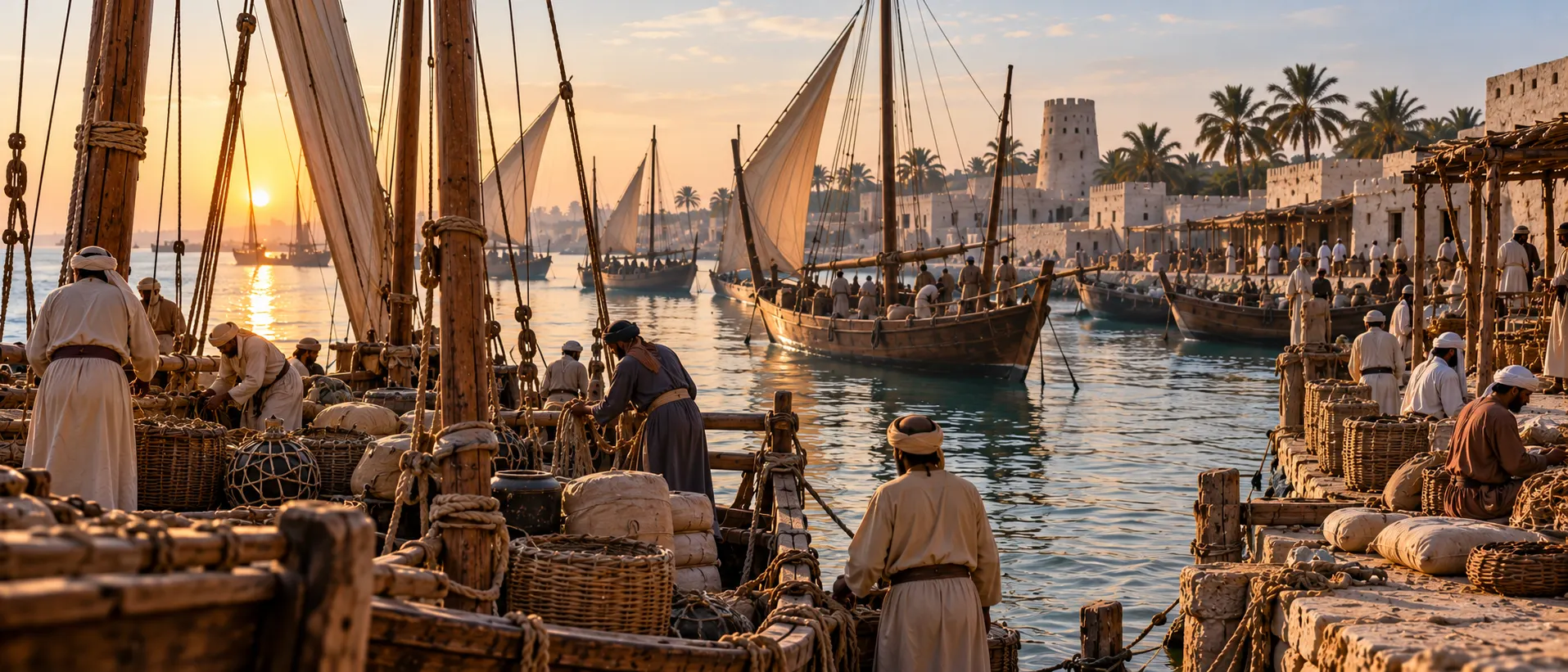
Before oil, the Gulf did not consist of isolated coastal towns each living from its own small sea. During the great age of natural pearling, Bahrain, Qatar and the Trucial Coast were connected by the same oyster banks, seasonal rhythms, credit systems, merchant networks and export routes. A pearl lifted from the seabed off Qatar might be purchased by a regional merchant, graded in Bahrain, financed through advances that began months before the dive and eventually travel to Bombay, Paris, London or New York. The people who made that journey possible were not only wealthy pearl merchants. They included divers, haulers, captains, boys, boat builders, sailmakers, food suppliers, water carriers, creditors and families waiting onshore. To call this merely a pearl industry is to miss the scale of the network. It was an economic system that made distant Gulf communities depend on one another long before oil transformed the region.
The sea connected places that modern maps separate
Today’s borders make Bahrain, Qatar and the United Arab Emirates easy to imagine as separate economic spaces. Pearling worked differently. Boats moved toward productive banks rather than toward national lines that did not yet function as they do today. Crews, merchants and supplies circulated through ports whose fortunes were tied to the same season and to the same international demand for natural pearls.
This does not mean the Gulf had no political territories or local rulers. Bahrain, Qatar and the sheikhdoms of the Trucial Coast had distinct authorities, rivalries and claims. But the pearling economy crossed those political spaces. The same wind, diving season and market price could affect households from Muharraq to Doha, Dubai and Abu Dhabi. That shared exposure is what makes pearling useful for understanding the Gulf as a region rather than as a collection of later states.
Bahrain became the great commercial centre of the network
Bahrain’s oyster beds had supported pearl fishing for centuries, but the nineteenth and early twentieth centuries produced extraordinary concentration. The official Pearling Path describes Muharraq as the Gulf’s principal pearling city, with a large fleet, many divers and an urban economy deeply organized around the trade. By 1904 to 1905, its historical account estimates that 97.3 percent of Gulf pearl turnover passed through Bahrain.
That figure should not be read as proof that every pearl was Bahraini. It shows the opposite: Bahrain’s importance came partly from acting as a hub for a wider Gulf economy. Pearls and merchants arrived from elsewhere. Indian, Persian, Arab and later European commercial connections converged there. Warehouses, merchant houses, boat supplies and finance turned Muharraq and Manama into places where production from across the Gulf could be valued, sold and redirected toward global markets.
Qatar’s coast belonged to the same seasonal world
Qatar’s pre-oil prosperity was closely tied to maritime trade and pearling. Settlements along the peninsula participated in the same annual cycle of preparation, departure, diving and return. The sea offered opportunity, but it also made household income dependent on a dangerous harvest whose result could not be known in advance.
The political history of Qatar is often told through Al Zubarah, Mohammed bin Thani, Jassim bin Mohammed and the formation of modern authority. Pearling belongs inside that story because wealth, migration and port life shaped the communities over which rulers governed. Our article on Doha and Qatar’s cultural landscape looks at the city from another angle, while the broader history of Qatar’s ruling family begins with movements from Najd toward prosperous coastal settlements. The coast mattered because it connected Qatar to an economy larger than the peninsula itself.
The Trucial Coast depended heavily on pearl income
Dubai, Abu Dhabi, Sharjah and other settlements of the Trucial Coast were also bound to pearling. Before oil revenues, the industry supported merchants, rulers and large numbers of working families. Dubai’s Creek, for example, became a commercial space where maritime exchange and pearling interacted with imported goods and regional trade.
This is why the history of the Trucial States cannot be understood only through treaties with Britain. Treaties shaped maritime politics, but daily economic life depended on boats, markets, debt, fishing, trade and pearls. Likewise, the story of Bani Yas movements between Liwa, Abu Dhabi and Dubai gains another dimension when the coast is seen not as an empty edge of the desert but as an economic frontier linked to international luxury markets.
A pearling boat was a hierarchy of specialised work
The romantic image of one diver entering clear blue water hides a complex crew. Historical descriptions distinguish the diver, or ghaws, the hauler who pulled him back to the surface, young assistants, the captain or nakhuda, and other men responsible for sails, rowing and the daily functioning of the vessel. Large boats could carry dozens of men. Work was repetitive, exhausting and organized by rank.
The diver descended with simple equipment, collected oysters quickly and relied on the hauler for his return. Heat, dehydration, pressure, injuries and the sheer repetition of dives made the season physically punishing. Songs and collective routines helped regulate life aboard, but hardship should not be turned into picturesque nostalgia. The beauty of a natural pearl was produced by labour that was uncertain and dangerous.
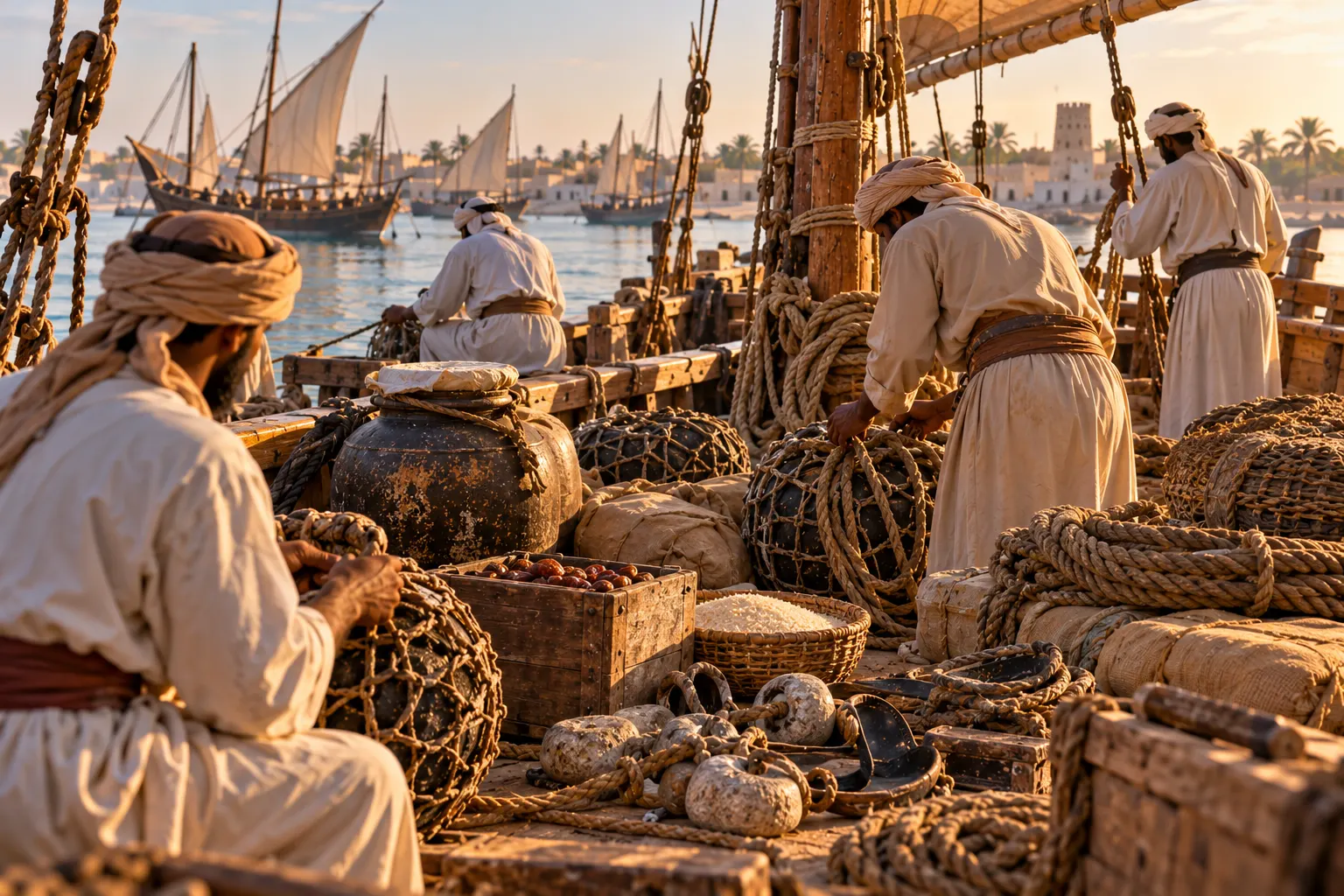
The season began on land long before the first dive
A dhow could not leave with courage alone. It needed timber repairs, rope, sails, water, rice, dates, coffee and equipment. Families also needed money while working men were away. Merchants and captains therefore arranged advances before departure. The Pearling Path records several categories of loans used to maintain crews and households during the off-season and the main dive.
This financing system made the economy possible, but it also created dependency. If a season was poor, debt could carry forward. Before reforms, unpaid obligations could burden families across years and even generations. That is a crucial part of the pearl story. Credit spread risk, but power between creditor and diver was not equal. A spectacular necklace in a distant market could begin with a household already owing money before a single oyster had been opened.
Women kept the shore economy functioning
When fleets left, coastal towns changed. The Pearling Path’s history of Muharraq describes neighbourhoods where large numbers of men were absent during the main season and women managed households, budgets and local work. Some baked bread, fished or found other ways to stretch the advances left for families. Wealth changed the experience: elite households had more protection from uncertainty than families living close to debt.
This perspective matters because pearling histories often follow men to sea and leave women outside the frame. In reality, the season reorganized whole communities. Food, childcare, household credit and social support continued on land. The network therefore had two connected workplaces: the visible boat and the less celebrated town that had to function until the fleet returned. Bahrain preserves unusually rich evidence for this social world, but similar pressures existed across Gulf pearling communities.
Bombay was part of the Gulf pearl economy
Natural pearls did not become globally valuable only when they reached Europe. For much of the trade, Bombay was a major commercial destination where pearls could be sorted, drilled, matched, financed and resold. Indian merchants and financial connections were therefore central to the Gulf economy. Later, European and American jewellery houses increasingly purchased closer to source, but Indian networks remained fundamental to the circulation of goods, credit and expertise.
This wider geography resembles older Gulf commercial patterns explored in our article on Qalhat, the port where Arabia met India. The centuries are different, but the underlying lesson is similar: Gulf ports gained power by linking local products and political communities to long-distance markets. A pearl bank under shallow water could influence a merchant house thousands of kilometres away, while Indian textiles and food returned through the same maritime circuits.
The system included coercion as well as opportunity
Pearling created fortunes and supported towns, but the labour system was not simply a free partnership among equal participants. Debt could restrict divers’ choices. British records also document enslaved people within Gulf maritime labour, including pearling. Any serious account has to acknowledge this without making every worker’s experience identical.
The archival problem is difficult because many surviving written records were produced by British officials, merchants or political agents rather than by divers themselves. Their categories reflected colonial interests and could misunderstand local relationships. Yet the documents are still valuable when read critically and alongside Gulf heritage sources and oral memory. The archive can show us debt disputes, working conditions and regulation, but it cannot speak for every person who worked at sea.
Why the pearl economy collapsed so quickly
The Gulf pearling economy reached extraordinary value in the early twentieth century, then faced several shocks. War disrupted markets. Global luxury demand weakened. Cultured pearls created a cheaper and increasingly accepted alternative to natural pearls. The Wall Street crash and depression damaged wealthy consumer markets. In Bahrain, the Pearling Path describes a decline through the 1930s and the effective collapse of the old industry by around 1950.
Oil did not single-handedly kill pearling, but it changed the choices available to Gulf societies at the moment the older economy was already under severe pressure. Wage work, government revenue and new infrastructure gradually offered alternatives to seasonal debt and dangerous diving. The transition was uneven, and memory of pearling remained powerful even after it ceased to organize everyday economic life.
One Gulf economy, many local experiences
It would be a mistake to flatten Bahrain, Qatar and the Trucial Coast into one identical pearling society. Bahrain had an unusually concentrated commercial hub. Qatar’s settlements had their own political and demographic histories. Abu Dhabi, Dubai, Sharjah and neighbouring ports occupied different positions in the Trucial Coast economy. The shared network did not erase these differences.
What it did was connect them. A bad season, changing credit, a shift in Bombay demand or the arrival of cultured pearls could travel through the network. This is the historical value of looking beyond a single port. Before oil, the Gulf already had a regional economy. The modern states inherited coastlines and cities whose people had spent generations working across a sea that functioned less as a barrier than as the main road between them.
Frequently Asked Questions
No. Bahrain became the leading commercial hub, especially through Muharraq and Manama, but Qatar, the Trucial Coast, Kuwait and other Gulf communities also depended on pearling. Bahrain’s strength was partly its role as a market for pearls produced across the wider region.
Muharraq combined a large pearling fleet, divers, merchants, supply industries and access to Bahrain’s productive oyster beds. Its commercial institutions helped make it a regional centre where pearls and finance from across the Gulf could meet international buyers.
The main diving season occupied the hottest months and lasted roughly four months, although preparation, shorter dives, financing and household adjustments extended the economic cycle far beyond the time crews were physically at sea.
Arrangements varied, but advances and shares of the seasonal catch were central. Captains often borrowed from merchants and advanced money to crews and their families. A poor season could leave workers carrying debt into the following year.
Yes, even when they did not dive. Women managed households during long male absences, stretched seasonal advances and sometimes undertook paid work. Pearling changed the social and economic life of whole coastal communities, not just the men aboard boats.
Bombay was a major centre for grading, drilling, matching and resale. Pearls also moved to Persia, Ottoman markets and later directly to European and American jewellers. The trade connected Gulf ports to a much larger luxury economy.
No. The industry included free workers, indebted workers and, in documented cases, enslaved labour. Debt itself could also be highly restrictive. Sources must be read carefully because many surviving records come from colonial administrations rather than the workers themselves.
There was no single cause. Cultured pearls, falling luxury demand, war, the global depression and structural economic change all weakened the trade. Oil revenues then expanded alternative employment and accelerated the move away from the older seasonal economy.
Family memories, songs, boat traditions, urban architecture, merchant houses and the cultural prestige of natural pearls remained. Bahrain’s UNESCO-listed Pearling Path preserves unusually extensive evidence, while pearling heritage remains important across Qatar and the UAE as well.
Continue exploring the Gulf
Follow the routes from Muharraq and Doha to the Trucial Coast, Qalhat and the older ports that made the Gulf a connected commercial sea.