
A cultural route through markets, heritage houses, Islamic art, the desert-rose museum, public sculpture and the question of how a fast-changing country protects memory.
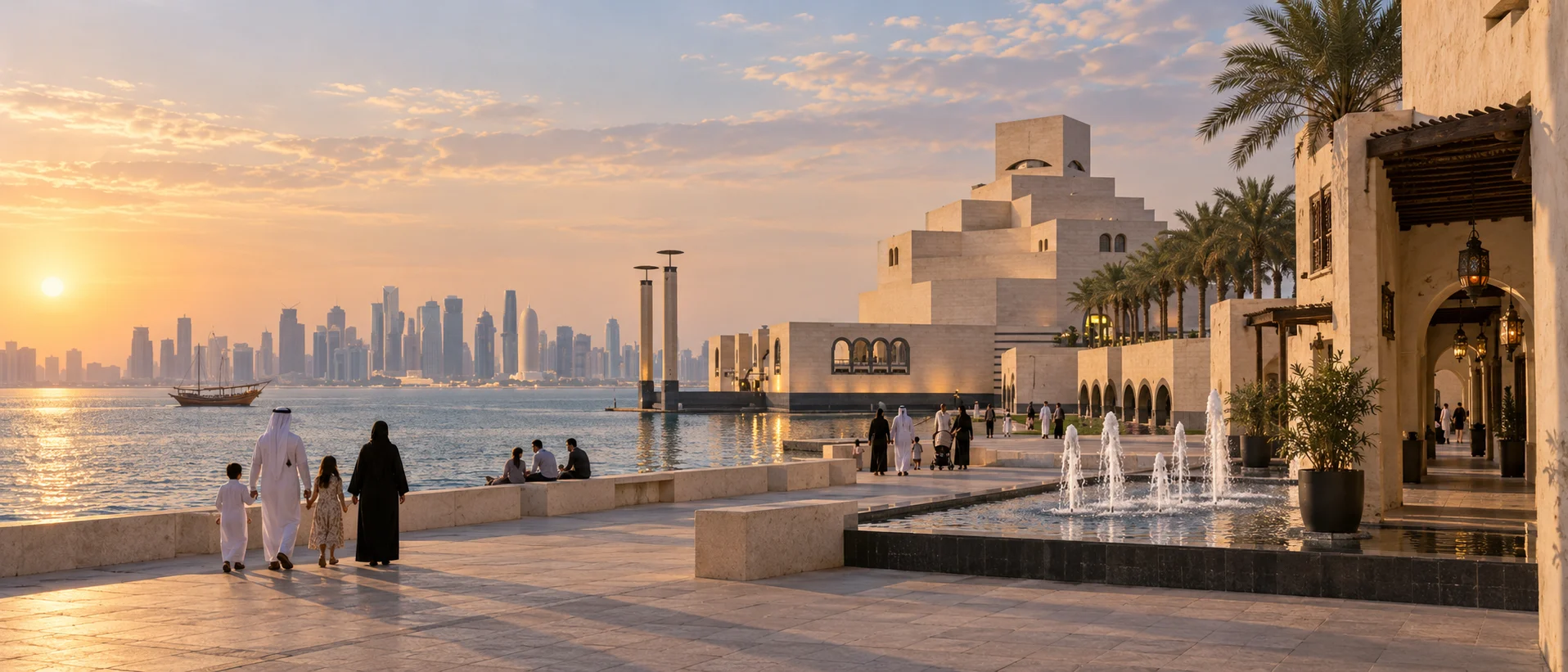
Qatar is small enough that its cultural layers sit unusually close together. You can leave a traditional market, enter restored heritage houses, stand inside one of the world’s major Islamic-art museums and finish the day among contemporary galleries and public sculpture. The distance is short. The conversation between old and new is not.
Doha Does Not Hide Its Ambition
Some cities keep art inside museums. Doha seems to prefer letting it escape into the street.
You notice it in the shape of the National Museum before you enter, in sculptures along public spaces, in the geometry of the Museum of Islamic Art, in restored houses at Msheireb and in the way Katara places galleries, performance and architecture beside restaurants and the sea.
That does not mean every cultural project feels ancient or organic. Much of Doha’s cultural landscape is deliberately built, curated and funded. I do not see that as a weakness. It makes the city’s question more interesting: how does a young state preserve memory while also deciding what image of itself it wants to leave for the future?
I Would Start at Souq Waqif, but I Would Not Stay There
Souq Waqif is an obvious cultural starting point because it gives the senses something immediate: oud, spices, coffee, falcons, textiles, restaurants, voices and narrow lanes.
We already have a full Souq Waqif visitor guide, so I do not want to repeat it here. For this journey, the souq is simply the first layer.
Stand there long enough and you see one Qatar: trade, hospitality, memory, everyday social life and a market that still attracts both residents and visitors.
Then walk or drive a short distance toward the museums and you meet another Qatar, one that has decided culture also deserves monumental architecture.
The Museum of Islamic Art: Before the Collection, the Building Speaks
The Museum of Islamic Art sits beside the Corniche on its own edge of the water, and the building does something useful before you see a single object: it slows the eye down.
Designed by I.M. Pei, MIA was conceived through a search for the essence of Islamic architecture rather than as a copy of one historic building. Qatar Museums describes its collection as spanning Islamic art from across three continents and more than 1,400 years.
That breadth matters. Islamic art is too often reduced to one region or one decorative style. Inside MIA, the story becomes wider: ceramics, manuscripts, metalwork, textiles, jewellery and objects that travelled across dynasties and trading worlds.
For a MESKI reader, this is where I would make a small connection to trade. Objects move because people move. So do spices, incense, dates and honey. Culture travels through things long before it is written into a museum label.
The Corniche Is Part of the Museum Day
I would not rush from MIA directly into another building.
Walk the Corniche for a while. Doha’s skyline sits across the water and gives you the contrast that makes this city interesting: old market behind you, museum beside you, modern towers in front of you.
Architecture becomes easier to understand when you see what surrounds it.
This is one of the reasons Doha works well for a cultural day. The distance between heritage, waterfront, museums and contemporary city is small enough that the contrasts remain visible.
The National Museum of Qatar: The Desert Rose and the Story of the Country
The National Museum of Qatar is almost impossible to separate from its architecture.
Jean Nouvel designed the building around the form of the desert rose, the crystalline formation found in desert regions. The interlocking discs make the museum look less like a conventional building and more like something that has emerged from the landscape.
But the most important element may be the old palace preserved at its heart. The palace of Sheikh Abdullah bin Jassim Al Thani served as a residence and seat of government before later becoming part of Qatar’s museum history. Today it sits inside the new museum complex.
That physical relationship says almost everything about the article I wanted to write: old Qatar is not placed in one corner while modern Qatar lives somewhere else. The two are deliberately built into each other.
A Museum About Qatar Cannot Be Only About Wealth
The most useful national museum is not the one that tells visitors how successful a country has become. It is the one that explains what existed before the success.
For Qatar that means the sea, pearling, desert life, family, migration, trade, oil and gas, political change and rapid urban transformation.
The museum gives those themes room to sit beside one another. That matters in a city where the visible present can easily overpower the past.
If you only know Doha through West Bay, luxury hotels and recent development, the National Museum changes the scale of the story.
Msheireb: When Restoration Becomes a Cultural Argument
From the monumental museums, I would go back toward smaller buildings.
The Msheireb Museums occupy four restored heritage houses in the oldest part of central Doha: Bin Jelmood House, Company House, Mohammed Bin Jassim House and Radwani House. Each explores a different part of Qatar’s social and economic history.
What I like about Msheireb is the scale. A palace or national museum tells history with national confidence. A house tells it through rooms, courtyards, work, family and ordinary life.
The museums sit within a regenerated downtown district, only a short walk from Souq Waqif. That proximity makes the city’s cultural strategy visible: restore selected pieces of the old city, then place them inside a new urban fabric rather than leaving them isolated.
Not Every Memory Is Comfortable
Culture becomes serious when it does not choose only the flattering parts of memory.
One of the Msheireb Museums, Bin Jelmood House, addresses histories of slavery and human exploitation. Company House examines the people who built the early oil industry. These are not decorative subjects.
That gives the cultural landscape more credibility. A country can celebrate craft, architecture and hospitality while still making space for difficult social history.
Museums become more useful when they allow pride and discomfort to exist in the same visit.
Katara: Culture Becomes Social Again
Katara Cultural Village changes the rhythm.
Here, galleries, performance spaces, an amphitheatre, mosques, restaurants, beach and public activity sit together. Qatar Museums also operates gallery spaces at Katara, while the wider village hosts exhibitions and cultural events.
This is less about a single museum narrative and more about culture as an evening out.
You can see an exhibition, hear music, walk, eat and talk. For families, that matters. Cultural life survives more easily when it does not always require silence and perfect behaviour.
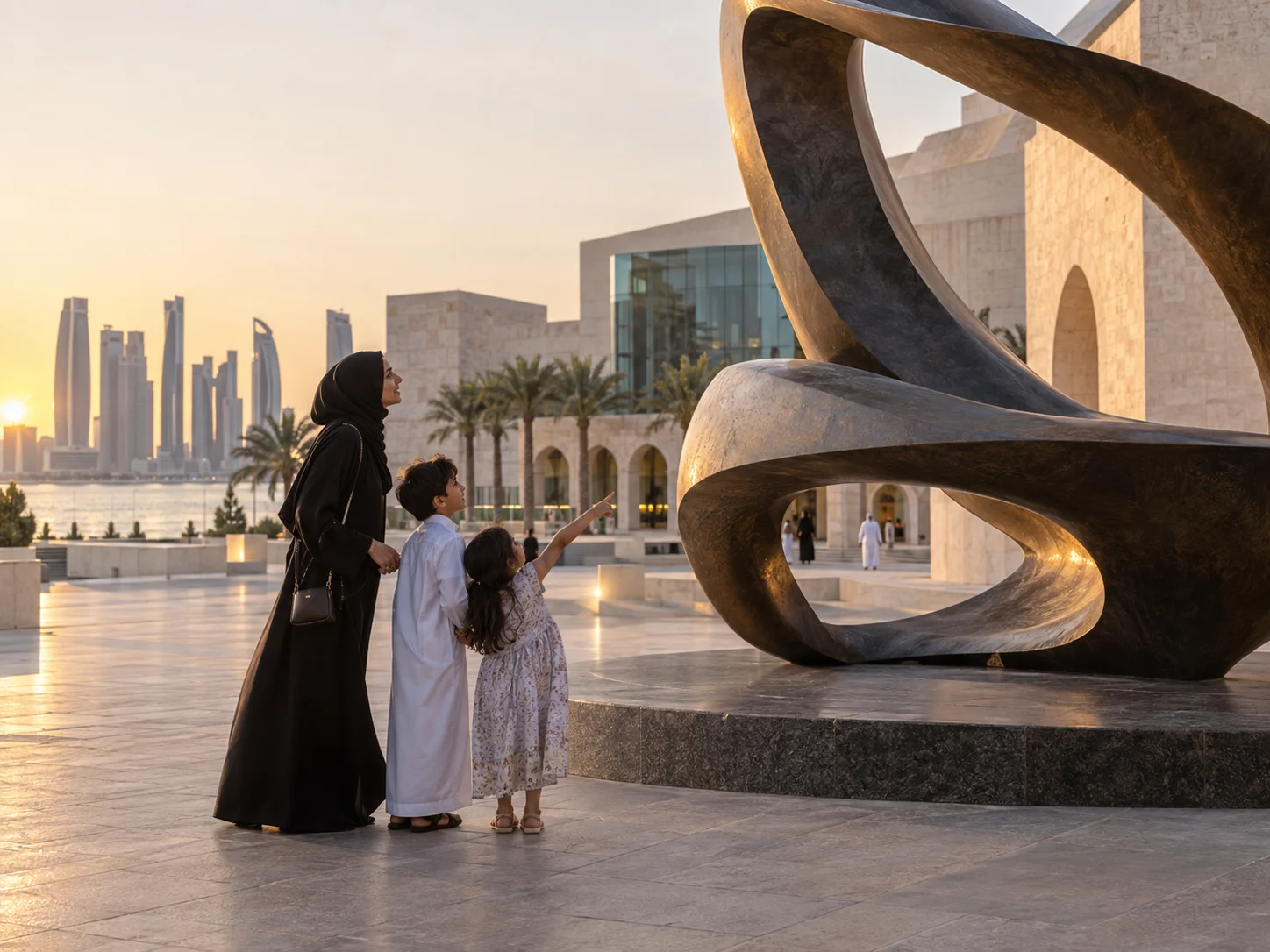
Public Art: Doha Wants You to Meet Art Before You Buy a Ticket
Qatar Museums maintains a growing public-art programme across the country, with works placed in parks, museums, transport spaces and public areas.
I like the principle because it removes one barrier. You do not have to decide that you are ‘an art person’ before encountering art.
A sculpture can interrupt an ordinary walk. A child can ask what something means before knowing the artist’s name. A visitor can dislike a work and still begin a conversation.
Public art is successful when it creates attention, not when everybody agrees.
Fire Station: A Building That Changed Jobs
The Fire Station is another good Doha story because the building itself has lived more than one life.
Built in 1982, it served as Qatar’s Civil Defence headquarters for decades before being transformed into a contemporary arts space and artist-residency centre.
That kind of adaptive reuse is culturally interesting. Instead of demolishing a familiar civic building and replacing it with a new museum, the city gave the old structure another role.
The architecture keeps a memory of public service while the rooms now support artists. Continuity does not always require keeping the original function.
Mathaf: Arab Modern Art Changes the Conversation Again
If you still have energy, Mathaf: Arab Museum of Modern Art takes the conversation away from heritage and into modern and contemporary art from Qatar, the Middle East and the wider Arab diaspora.
This is important because Arab culture cannot be presented only as old markets, calligraphy, forts and traditional dress.
Artists are also people responding to modern cities, politics, migration, identity, memory and experimentation.
A cultural country needs room for the artist who respects tradition and the artist who argues with it.
What Is Qatar Trying to Say Through All This?
After Souq Waqif, MIA, the National Museum, Msheireb, Katara, public art and contemporary galleries, a pattern appears.
Qatar seems determined to make culture visible at multiple scales: the market, the house, the monumental museum, the public sculpture, the reused civic building and the contemporary gallery.
That is not accidental.
For a small country undergoing rapid development, culture becomes one way of saying that growth should not erase memory.
Luxury Is Present, but It Is Not the Whole Story
Qatar is often marketed through luxury, and Doha certainly has it: hotels, high-end restaurants, malls, architecture and major events.
But a cultural day makes that image less complete.
The most memorable object may be an old domestic room at Msheireb. The strongest moment may be a manuscript at MIA, a story about pearling, a public sculpture or a conversation at Souq Waqif.
The expensive and the ordinary can sit close together here, which is one of the things I find most interesting about the Gulf.
Gifts, Souqs and Why We Carry Culture Home
Eventually most travellers buy something.
At Souq Waqif that may be oud, dates, spices, textiles or honey. We already wrote a separate guide to meaningful purchases at Souq Waqif, so I will keep this simple.
A good cultural gift should not pretend to contain Qatar. It should carry one honest piece of it.
If it is a dallah, know why coffee matters. If it is perfume, understand the scent. If it is honey, ask the origin rather than assuming everything sold in Doha was harvested in Qatar.
The story is what turns an object into a gift.
One Day Is Enough to Begin, Not Enough to Finish
Could you visit Souq Waqif, MIA, the National Museum, Msheireb and Katara in one day? Technically, perhaps, if you move quickly.
I would not.
Choose fewer places and allow them to connect. Souq Waqif and Msheireb work naturally together. MIA and the Corniche belong together. The National Museum deserves time. Katara is better when the day begins to cool.
Culture is not a checklist, and Doha is compact enough that you do not need to treat it like one.
My Qatar Art & Culture Route
If I had to make a simple route for someone with limited time, I would begin in Souq Waqif in the morning, walk into Msheireb, then move toward MIA and the Corniche.
I would give the National Museum its own long stop rather than squeezing it between lunch and another attraction.
Later in the day, I would head north to Katara and let the visit become less formal: galleries if something interests you, architecture, walking, food and the sea.
Public art will appear along the way whether you plan for it or not.
And if contemporary Arab art is a priority, give Mathaf another half-day rather than treating it as an afterthought.
Doha’s Strongest Cultural Quality May Be Proximity
In larger capitals, old market, national museum, modern-art institution and waterfront can feel like separate trips.
Doha compresses them.
That compression can be superficial if you only collect photos. But if you slow down, it becomes a strength. You can compare architecture, hospitality, memory and modernity while the previous place is still fresh in your mind.
The city becomes a conversation between buildings.
The Question I Would Take Home
I would not leave Doha asking which museum was best.
I would leave asking something more interesting: what should a fast-changing country preserve, and what is it allowed to reinvent?
Qatar does not provide one answer. Souq Waqif, Msheireb, MIA, the National Museum, Katara and the public-art programme all answer differently.
That is exactly why they are worth seeing together.
Questions About Art and Culture in Qatar
A strong cultural route can include Souq Waqif, Msheireb Museums, the Museum of Islamic Art, the National Museum of Qatar, Katara Cultural Village, public art, Fire Station and Mathaf.
The Museum of Islamic Art was designed by Pritzker Prize-winning architect I.M. Pei.
Architect Jean Nouvel designed the museum around the form of the desert rose, a natural crystalline formation found in desert regions.
They are four restored heritage houses in central Doha that explore different parts of Qatar’s social and economic history.
No. Katara combines galleries, performance spaces, an amphitheatre, restaurants, architecture, public events and a beach setting.
Yes. Qatar Museums maintains an extensive and continually updated public-art programme across museums, parks and public spaces.
You can see several because Doha is compact, but a slower route over two days gives the museums and neighbourhoods much more meaning.
No. It is a valuable starting point, but museums, heritage houses, public art and contemporary spaces reveal different parts of Qatar’s story.
Continue Through Qatar
Doha becomes more interesting when the souq, museum, street and gift are read as parts of the same cultural story.