
Dates, Honey, Oud, Spices & Meaningful Gifts
A cultural buyer’s guide to Doha’s most famous market:
not simply what to buy, but what to ask,
how to choose and what each object carries with it.
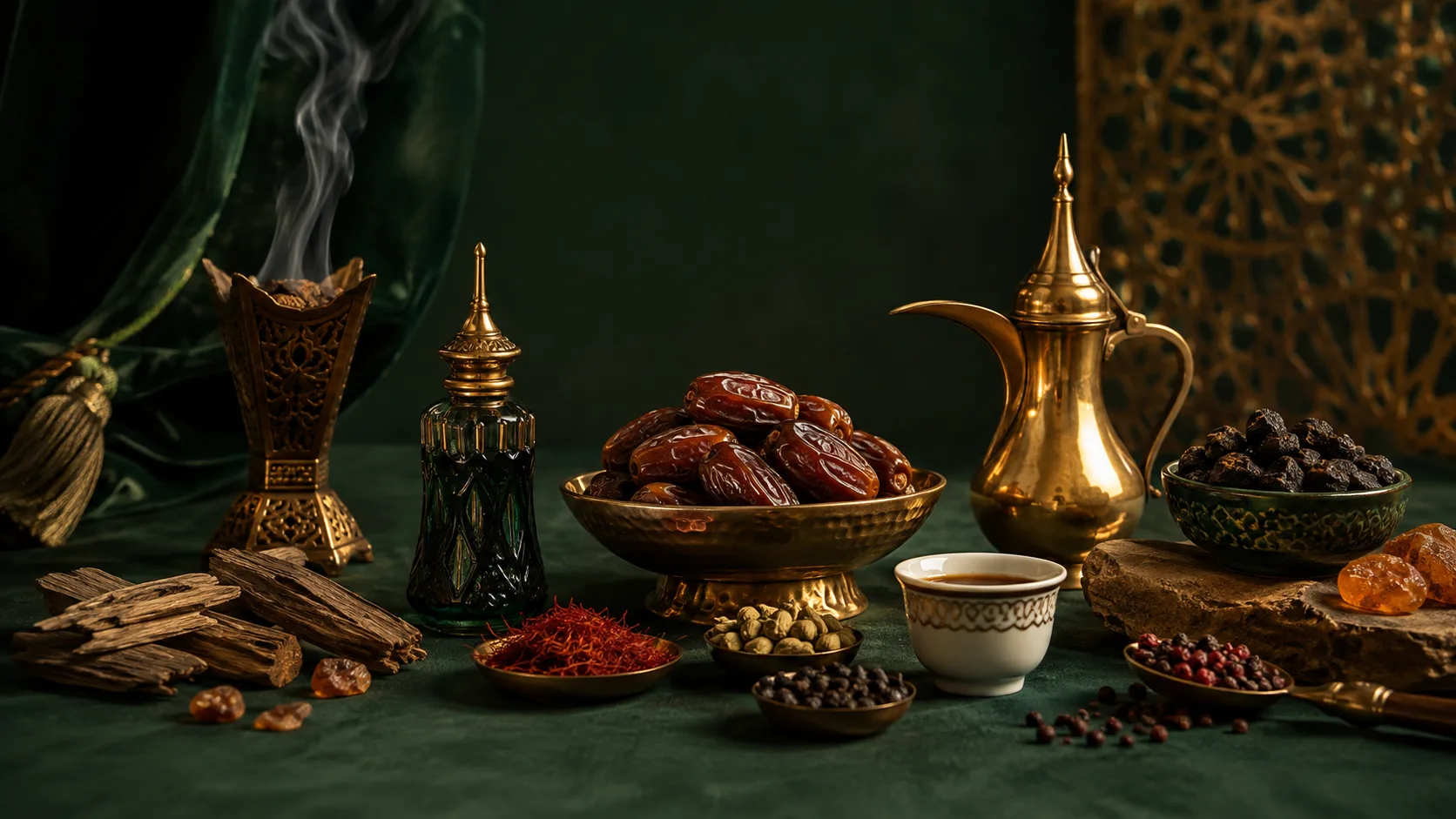
Visitors arrive at Souq Waqif with lists.
Dates. Oud. Spices. Perfume. Something for the family.
Something that feels unmistakably connected to Qatar.
But a market like this becomes much more interesting when
you stop asking only “What should I buy?”
and begin asking:
Where did it come from?
Who made it?
How is it used?
And why does it matter here?
That is the purpose of this guide.
Visiting Souq Waqif for the first time?
Read our separate
Souq Waqif Visitor Guide
for history, opening times, photography, food and what to see.
This guide focuses specifically on what is worth buying.
A Market That Has Always Been About More Than Shopping
Souq Waqif stands on the site of Doha’s old trading market
beside Wadi Musheireb.
Long before the modern skyline,
this was a place where people met to trade livestock,
food, household goods and materials arriving from the desert,
the coast and wider Gulf trading routes.
That history still matters when you shop here today.
Not everything sold at Souq Waqif is made in Qatar,
nor should it be.
Gulf markets have always connected different regions.
The interesting part is understanding the journey of the object
before deciding whether it deserves a place in your luggage.
1. Dates — Start with the Fruit of the Gulf
Dates are one of the easiest gifts to bring home from Doha
and one of the most closely connected to food traditions
across Qatar and the wider Arabian Peninsula.
At Souq Waqif you will find varieties from Qatar,
Saudi Arabia, the UAE and other producing countries,
displayed loose, boxed or prepared as gifts.
Ajwa
Ajwa is associated particularly with Madinah in Saudi Arabia.
The dates are usually relatively small, dark and dense,
with a flavour quite different from softer caramel-like varieties.
Medjool
Medjool dates are large, soft and fleshy.
Their historical origins are associated with Morocco,
although the variety is now cultivated in several countries.
Khalas
Khalas is especially popular across the Gulf.
Its amber colour, soft texture and caramel-like character
make it a natural companion to Arabic coffee.
Sukkari
Sukkari is strongly associated with Saudi Arabia
and is known for pronounced sweetness and a soft,
sometimes lightly crisp texture depending on ripeness and storage.
How to Choose Dates at Souq Waqif
Ask the country of origin and the variety.
Taste before buying when the vendor offers.
Compare texture as well as sweetness.
Check how the dates are packed if you plan to fly with them.
A simple box of good dates with a clearly identified origin
is often a better gift than elaborate packaging around
an ordinary product.
Best for:
family gifts, Arabic coffee service, Ramadan,
easy transport and visitors buying food souvenirs for the first time.
2. Honey — Buy the Origin, Not Just the Name
Honey deserves more attention than simply choosing
the darkest jar or the most expensive label.
At Souq Waqif and during its specialist honey events,
visitors can encounter honey from Qatar,
Yemen, Oman and many other producing regions.
Sidr, Samar, mountain honeys and imported varieties can look
remarkably different from one another.
Colour alone does not tell you which is better.
The Souq Waqif International Honey Exhibition
Souq Waqif has developed a significant annual honey event.
The seventh International Honey Exhibition,
held from 22 to 31 January 2026,
brought together around 100 participating companies
representing approximately twenty countries.
The event also included honey testing
and bee-related products such as propolis,
beeswax, pollen and royal jelly.
For a curious buyer, this is precisely what makes a honey market valuable:
the opportunity to compare different origins,
aromas and textures side by side.
Questions Worth Asking Before Buying Honey
Start with:
Where was the honey actually harvested?
Not where was it bottled.
Not where is the company registered.
Where were the hives?
Then ask:
What is the floral source?
What region?
Which harvest?
Is it single-origin or blended?
Is there batch information?
Can the seller explain the difference between this jar and the one beside it?
A high price does not prove authenticity.
A dark colour does not prove quality.
And the word Sidr by itself tells you much less
than many labels would have you believe.
If you want to understand Sidr origins before shopping,
explore the
MESKI Honey Atlas
.
Best for:
travellers who enjoy provenance,
food culture and gifts that can be tasted rather than displayed.
3. Oud — Perhaps the Most Gulf Gift of All
In Qatar, fragrance belongs to hospitality.
Oud, incense and perfume are encountered in homes,
majlis settings, shops, clothing and celebrations.
Souq Waqif is therefore a particularly natural place
to discover oud for the first time.
Oud Chips
Agarwood chips are burned so that their aromatic smoke
perfumes a room, clothing or textiles.
Prepared bukhoor may combine wood with perfumes,
resins or other fragrant materials,
so do not assume every incense chip is pure agarwood.
Oud Oil
Oud oil is distilled from resin-rich agarwood.
The aroma can vary dramatically according to wood origin,
age, distillation and quality.
If you are new to oud,
do not begin by asking for “the strongest”.
Smell several.
Wait.
Return to the one that stays interesting after a few minutes.
Oud-Based Perfume
For many visitors, a perfume built around oud,
amber, rose, musk or woods is easier to wear
than pure oud oil.
Souq Waqif gives you the opportunity to compare
traditional oils with more contemporary Gulf perfumery
in the same visit.
What to Ask
Ask whether you are smelling pure oud oil,
a perfume blend or a synthetic interpretation.
If buying wood,
ask its stated origin.
If buying oil,
ask whether it is pure or blended.
A serious perfume seller should be comfortable
explaining what is in front of you.
Best for:
someone who wants a small,
highly personal gift that immediately recalls the Gulf.
4. Spices — The Souvenirs You Will Actually Use
The spice lanes are among the most rewarding places
to shop without spending very much.
Spices travel easily, last well
and can recreate a memory of the Gulf months after
the trip has ended.
Loomi — Dried Black Lime
Loomi is one of the most characteristic flavours
of Gulf cooking.
Whole dried limes add acidity,
bitterness and a deep fermented citrus character
to rice, fish, meat dishes and stews.
Saffron
Buy saffron threads rather than an anonymous powder
and ask the seller about origin and grade.
The Gulf is a major market for saffron,
but the spice itself may come from Iran,
Afghanistan or elsewhere.
Cardamom
Whole green cardamom is one of the defining aromas
of Arabic coffee.
A bag of good cardamom paired with dates
is one of the simplest ways to bring
a small part of Gulf hospitality home.
Baharat
There is no single universal baharat recipe.
Blends differ between regions,
families and merchants.
That is precisely why buying it from a spice seller
can be more interesting than picking a generic packet
from a supermarket.
Dried Rose and Hibiscus
Dried flowers are commonly displayed alongside spices
and can be used for infusions, desserts
and aromatic preparations.
5. Objects That Carry Memory
Some of the best purchases from Souq Waqif
are not things you consume.
They are objects whose meaning becomes clearer
once someone explains how they are used.
The Dallah
The long-spouted dallah is inseparable
from the visual language of Arabic coffee and hospitality.
You will find practical coffee pots
as well as decorative pieces in brass,
copper and other finishes.
Look closely at construction and engraving.
Decide whether you want an object to use
or an object primarily intended for display.
Al Sadu Weaving
Al Sadu is a Bedouin weaving tradition
associated especially with women
and the textile culture of desert communities.
Qatar joined Saudi Arabia and Kuwait
in the UNESCO Representative List inscription
for traditional Al Sadu weaving in 2025.
In the souq,
you may see bags, cushions,
wall pieces and accessories using Sadu patterns.
Ask whether an item is actually handwoven
or simply uses a printed pattern inspired by Sadu.
Both can be attractive,
but they are not the same thing.
Pearls
Pearling belongs deeply to the maritime history
of Qatar and the Gulf.
If you are considering pearl jewellery,
ask clearly whether the pearl is natural or cultured,
what documentation accompanies it
and what exactly the seller is claiming about its origin.
The words “Gulf pearl” should mean something precise,
not simply provide atmosphere to a sales pitch.
What Is Genuinely Qatari — and What Is Not?
This may be the most useful question in the entire guide.
Souq Waqif is a Qatari market.
That does not mean every product inside it was produced in Qatar.
Dates may come from Saudi Arabia or elsewhere.
Saffron may come from Iran or Afghanistan.
Agarwood may originate in South or Southeast Asia.
Yemeni Sidr is, by definition, Yemeni.
Imported perfumes and manufactured souvenirs also form part
of the market.
None of this makes the souq less authentic.
Trade itself is part of the Gulf story.
What matters is whether the origin is represented honestly.
Five Questions to Ask Before You Buy
Country first, then region if relevant.
“From the Gulf” is not very precise.
For crafts, honey, perfume and specialist foods,
the producer can matter as much as the category.
A traditional appearance does not automatically
mean traditional production.
With dates, honey, spices and perfume,
your senses are often more useful than the packaging.
Knowledge does not guarantee quality,
but a seller who understands origin,
materials and use gives you much more to work with.
What I Would Avoid
Not because these things are necessarily bad,
but because they carry little of what makes
Souq Waqif interesting.
Avoid buying something simply because
“Qatar” has been printed on it.
Be cautious with dramatic authenticity claims
that the seller cannot explain.
Do not assume the most expensive jar,
perfume or craft is automatically the best.
And do not rush.
A market rewards the person who compares.
A Quiet Note Before You Buy
The most memorable purchases from Souq Waqif
are rarely memorable because of their price.
They are memorable because someone explained them to you.
A jar of honey chosen after asking where the bees forage.
Loomi bought after learning how it enters a family recipe.
A vial of oud selected only after smelling several others.
A dallah whose meaning you understood before placing it in your bag.
Objects purchased this way arrive home differently.
They carry a conversation inside them.
That is what a market like Souq Waqif,
at its best, has always offered:
not only goods,
but knowledge shared across a counter.
نسأل الله أن يبارك لكم فيما رزقكم
Buying Souvenirs at Souq Waqif
There is no single best souvenir.
For food, dates and spices are easy to transport.
Honey offers more depth for buyers interested in provenance.
Oud is highly personal.
A dallah or genuine handwoven textile carries stronger
cultural meaning as an object.
Some are, while many others come from across the Gulf,
Middle East, South Asia and elsewhere.
Souq Waqif has always been a trading place.
Ask the origin of an individual product
rather than assuming everything sold in Qatar was produced there.
It can be, particularly if the seller can identify
the country, region and harvest.
“Sidr honey” alone is not enough information.
Compare aroma, texture, origin and traceability
rather than relying only on price or colour.
Dates, dry spices, small textile items
and properly packed perfume are generally convenient choices.
Honey and other liquids require more attention to baggage rules,
packaging and the import rules of your destination country.
Understand Before You Buy
Souq Waqif is more rewarding when shopping becomes part of discovering
the culture rather than the purpose of the entire visit.