
Sidr Honey: The Liquid Gold of Arabia’s Ancient Valleys
A deep journey into the centuries-old heritage of Sidr honey — its origins in the storied valleys of Yemen, Oman, and the UAE, what makes it the most prized raw honey in the Arab world, and how to recognise its uncompromising authenticity.
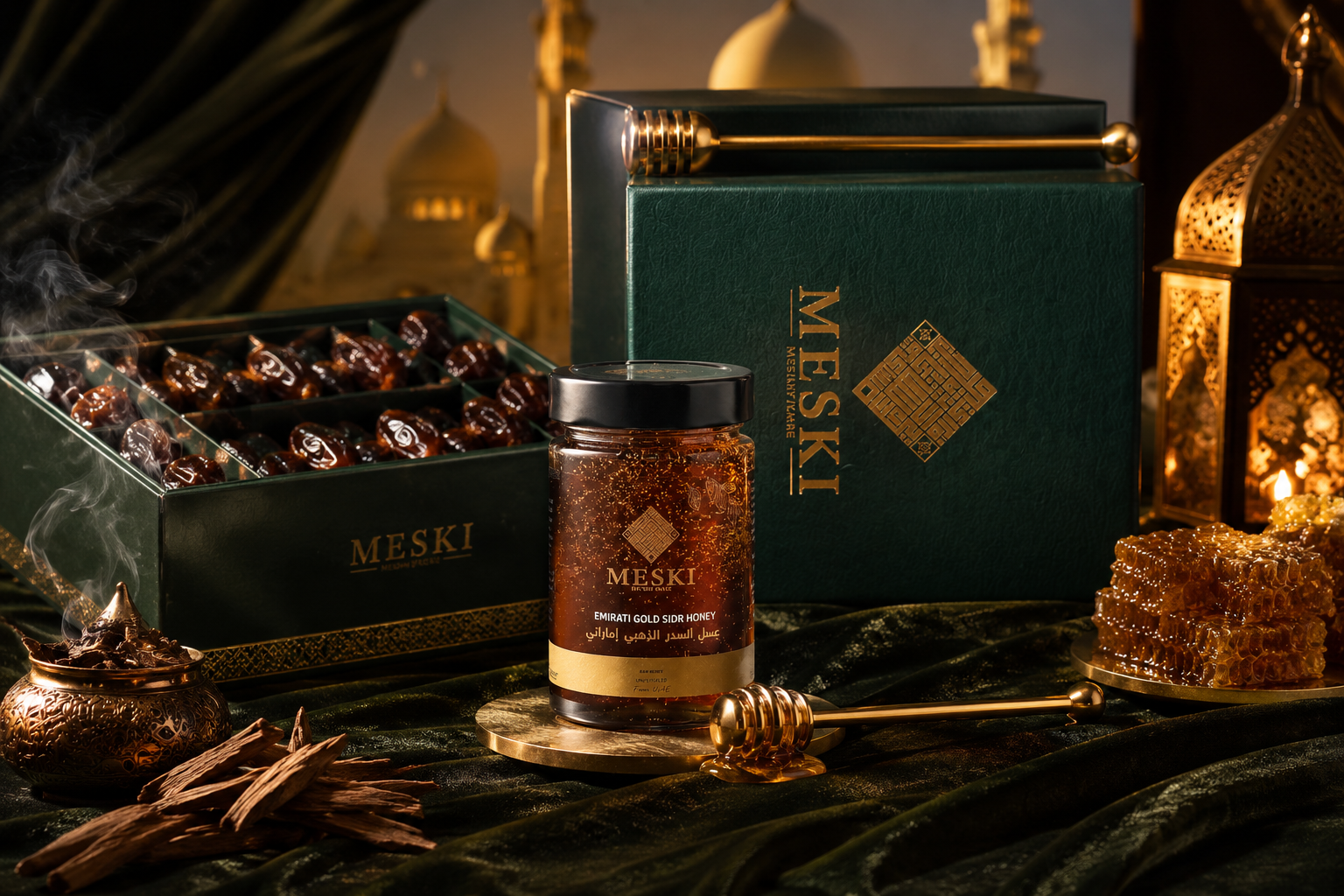
There are substances that carry within them an entire civilisation. Sidr honey is one of them. Long before the modern language of luxury existed, the tribes of southern Arabia were already trading this amber nectar as a currency of prestige, offering it to rulers and reserving it for the most solemn occasions of hospitality. Today, as the world rediscovers the virtues of raw, unprocessed foods and the heritage embedded in provenance, Sidr honey has reclaimed its place at the very summit of the global honey hierarchy — sought by connoisseurs from Dubai to Geneva, from Riyadh to Singapore.
At Meski Dates Factory, based in Sharjah in the heart of the Emirates, we have built our entire philosophy around this truth: that the finest honey is inseparable from the land, the season, and the hands that harvest it. This is the story of Sidr — told not as a product description, but as the living heritage it truly is.
The Sidr Tree: A Living Testament to Arabian Antiquity
The Sidr tree (Ziziphus spina-christi and its close relative Ziziphus jujuba) has grown across the Arabian Peninsula, the Levant, and the Horn of Africa for thousands of years. It is among the most ancient trees mentioned in sacred texts across the Abrahamic traditions — the Quran references it with reverence, and across Islamic scholarship, the Sidr occupies a place of symbolic nobility rarely accorded to any plant. Its shade was prized by desert travellers; its leaves have been used in ritual washing; its small, round fruits provided sustenance during long journeys across the Empty Quarter.
Yet it is the nectar of the Sidr blossom that holds the deepest culinary and cultural significance. When bees gather exclusively from these blossoms — a feat that depends entirely on the precise timing of the flowering season and the vigilance of the beekeeper — the result is a monofloral honey of extraordinary character: dense, richly amber, with a complexity of flavour that skilled tasters describe as warm caramel layered with a faint floral dryness, and an unusually slow, measured sweetness.
Hadramout’s Legendary Valley Honey
The most celebrated Sidr honey in the Arab world. Deep, sheltered valleys create a microclimate of near-perfect monofloral isolation. Beehives perched on cliff faces — a practice unchanged for centuries — yield a honey of extraordinary density and complexity.
Frankincense Plateaux & Khareef Mist
Sidr grows alongside frankincense trees on limestone plateaux swept by the Khareef monsoon mist. The resulting honey carries a subtly greener, more herbaceous register. Oman’s beekeeping traditions are recognised as intangible cultural heritage.
The Emirates’ Quiet Noble Tradition
In Ras Al Khaimah, Fujairah, and the Hajar highlands, native Sidr trees bloom each autumn. Emirati Sidr honey tends to be lighter in colour and more delicate in texture — the most intimate expression of local Emirati provenance.
Why Sidr Honey Stands Apart: Rarity, Season, and Craft
Understanding why authentic Sidr honey commands prices far beyond those of mass-produced honey requires understanding what it demands of everyone involved in its creation.
A Single Annual Harvest: The Logic of Scarcity
Sidr trees bloom once a year, for a narrow window of approximately three to six weeks depending on the region and the year’s climatic conditions. This is not a forgiving industry of continuous production: the beekeeper must position the hives at precisely the right moment, monitor the bloom’s progression, and extract the honey at peak maturity — typically between autumn and early winter. A late extraction, a premature harvest, or an unexpected weather event can alter the honey’s profile irreversibly or reduce the yield to almost nothing.
This annual singularity means that each jar of authenticated Sidr honey is, in the most literal sense, a one-year harvest. There is no second chance, no parallel batch. The quantity is determined entirely by the tree, the bee, and the season — three factors that no commercial logic can override. This is the bedrock of Sidr’s rarity, and therefore of its value.
Colour, Texture, and Aroma — The Sensory Signature of Authentic Sidr
Authentic raw Sidr honey occupies a specific sensory territory that experienced buyers learn to recognise immediately. The colour ranges from a deep, burnished amber to a warm golden brown, depending on the region of origin and the precise moment of harvest. The texture is characteristically thick and viscous, with a slow, deliberate pour that signals the high density of natural sugars and the minimal moisture content that defines well-extracted raw honey.
On the palate, Sidr offers a layered experience: an initial sweetness that is rich but not cloying, followed by a characteristic warmth — some describe it as almost buttery — and a long, clean finish that lingers without becoming sticky or sharp. Experienced tasters can often distinguish a Yemeni Sidr from an Omani or Emirati one by precisely these finishing notes, much as a sommelier distinguishes terroir in a fine wine.
The aroma, particularly in freshly harvested, unfiltered Sidr honey, carries the unmistakable signature of the Sidr blossom: a warm, slightly woody sweetness with faint herbaceous undertones that recalls the valleys and mountains from which it came.
| Attribute | Yemeni Sidr (Do’an) | Omani Sidr | Emirati Sidr |
|---|---|---|---|
| Colour | Deep burnished amber | Warm golden brown | Light golden |
| Texture | Very thick, slow pour | Thick, smooth | Smooth, lighter body |
| Flavour profile | Rich caramel, complex | Herbaceous, rounded | Delicate, floral |
| Aroma | Woody sweetness | Faint frankincense | Clean, mountain floral |
| Harvest season | Autumn–early winter | Autumn–early winter | Autumn |
How to Spot Inauthentic Sidr
Be wary of honey labelled “Sidr” with no stated region of origin, unusually low prices, or a thin, watery consistency. Genuine monofloral Sidr honey from documented sources is inherently limited in supply — prices reflect this reality. Always ask for provenance documentation from your supplier.
Sidr Honey in Arab Culture: More Than a Sweetener
To reduce Sidr honey to a premium food product would be to misunderstand its place in Arab and Gulf culture entirely. Across Yemen, Oman, Saudi Arabia, and the Emirates, the finest Sidr honey has always occupied a position closer to that of a luxury textile or a precious stone: it is stored carefully, offered ceremonially, and discussed with the kind of informed appreciation usually reserved for aged oud or fine pearl jewellery.
In classical Arabic poetry, honey frequently appears as a metaphor for eloquence and generosity — and Sidr honey, as the finest of its kind, carried the fullest weight of these associations. Medieval Islamic scholars, including Ibn Sina (Avicenna), wrote extensively on honey’s nutritional and compositional properties, distinguishing carefully between varieties and origins in ways that anticipate modern food science by centuries. These writings were not incidental: they reflected a society in which the quality of one’s honey was a mark of connoisseurship and of one’s relationship to the natural world.
The Art of the Honey Gift in Gulf Hospitality
In the Gulf today, the tradition of offering premium honey as a gift is very much alive — and has, if anything, been elevated by the globalisation of luxury gifting culture. A jar of authenticated Wadi Do’an Sidr honey, presented in a handcrafted wooden box alongside a premium cold-pressed olive oil, is no longer simply a domestic gift: it is a statement of refinement, cultural rootedness, and genuine generosity.
This is the spirit that animates Meski’s luxury gift collections. Each curated box is designed not merely to be beautiful, but to communicate a depth of meaning — the knowledge that what is being offered is irreplaceable, seasonal, and the product of an unbroken human tradition stretching back across centuries. In a world saturated with generic luxury goods, this authenticity is itself a form of rarity.
Meski’s Sidr Selection: Where Provenance Is Everything
At Meski Dates Factory, each Sidr honey we source is selected on the basis of a single, non-negotiable criterion: documented, verifiable provenance. We work directly with beekeepers and trusted intermediaries in the Hadramout valley regions of Yemen, in the highland zones of Oman, and within the UAE’s own beekeeping communities, ensuring that what arrives in Sharjah is exactly what was described at source.
Source Verification
Every batch is traced to a named beekeeper or cooperative in a documented region — Wadi Do’an, Dhofar, or the Hajar highlands.
Raw Extraction Only
No heating, no filtration, no blending. The honey leaves the hive and arrives in your hands with its natural enzymes, pollen traces, and aromatic compounds fully intact.
Seasonal Batches
Because Sidr blooms once a year, each batch is by definition a limited edition. We never supplement supply with off-season or substitute material.
Curated Gifting
From the Wadi Do’an lineage to our 23-karat gold-infused signature collections, every presentation is designed to honour the heritage of what it contains.
Heritage
Every origin we source carries centuries of unbroken beekeeping tradition — Yemeni, Omani, and Emirati alike.
Craft
Raw, unfiltered, unheated — preserving the full sensory and compositional integrity of each harvest.
Provenance
Documented, verifiable sourcing — not a marketing claim, but a supply-chain commitment at Meski.
Gifting Excellence
Curated collections designed to communicate cultural depth, seasonal rarity, and genuine generosity.
Explore Meski’s Sidr Honey Collection
From Yemen’s Wadi Do’an to Oman’s frankincense plateaux and the UAE’s Hajar highlands — discover raw, authenticated Sidr honey sourced with complete provenance transparency.
Choosing Sidr Is Choosing a Story
In the end, choosing Sidr honey — truly authentic Sidr honey, from a source you can trust — is an act that goes beyond taste. It is a decision to participate in a tradition older than most nations, to support the beekeepers and landscapes that make this honey possible, and to carry into your home or your gift box a substance that holds the memory of an entire civilisation within its amber depth.
At Meski, we consider it our privilege to be the custodians of that story — and to offer it, jar by jar, to those who understand its worth.
Sidr Honey: Your Questions Answered
Sidr honey is a monofloral honey produced exclusively from the nectar of the Sidr tree (Ziziphus spina-christi), which blooms just once a year for three to six weeks. This extreme seasonality, combined with the remote, often inaccessible terrain where Sidr trees thrive, makes authentic Sidr honey genuinely scarce. Unlike mass-produced honey, it is raw, unheated, and unfiltered — preserving its full natural composition of enzymes, pollen, and aromatic compounds. Its flavour profile — rich, layered, with a slow caramel warmth — is unlike any multifloral or commercially processed variety.
Authentic Sidr honey should have a clearly stated region of origin (e.g. Wadi Do’an, Dhofar, Hajar highlands). Its texture should be thick and viscous, with a slow pour — a thin, watery consistency is a strong indicator of adulteration or dilution. The colour should range from deep amber to warm golden brown. A reputable supplier will always be able to provide provenance documentation or trace the batch to a named beekeeper or cooperative. If the price seems surprisingly low for “Sidr” honey, treat it with scepticism: genuine monofloral Sidr is inherently limited in supply.
All three originate from the same Sidr tree family but express distinct terroir characteristics. Yemeni Sidr — particularly from Wadi Do’an in Hadramout — is generally the most intensely flavoured: deeply amber, very thick, with a complex caramel warmth. Omani Sidr, sourced from Dhofar and Al Dakhiliyah, tends to carry a subtly greener, more herbaceous register, reflecting the frankincense-rich landscape and Khareef monsoon influence. Emirati Sidr, from the Hajar mountain foothills, is typically lighter in colour and more delicate in texture — a quieter, equally noble expression of the same ancient tradition.
Absolutely. In Gulf culture, premium Sidr honey — particularly from authenticated origins like Wadi Do’an — has long been considered one of the most meaningful gifts one can offer. It communicates refined taste, cultural knowledge, and genuine generosity. At Meski, our curated gift boxes combine authenticated Sidr honey with complementary premium products (such as cold-pressed olive oil or saffron-infused varieties) in presentation-ready packaging, making them appropriate for corporate gifting, Ramadan, Eid, weddings, and high-value personal occasions.