
Gold made Sijilmassa famous. Water, palms, agriculture and generations of diverse families made life possible.
The river before the gold
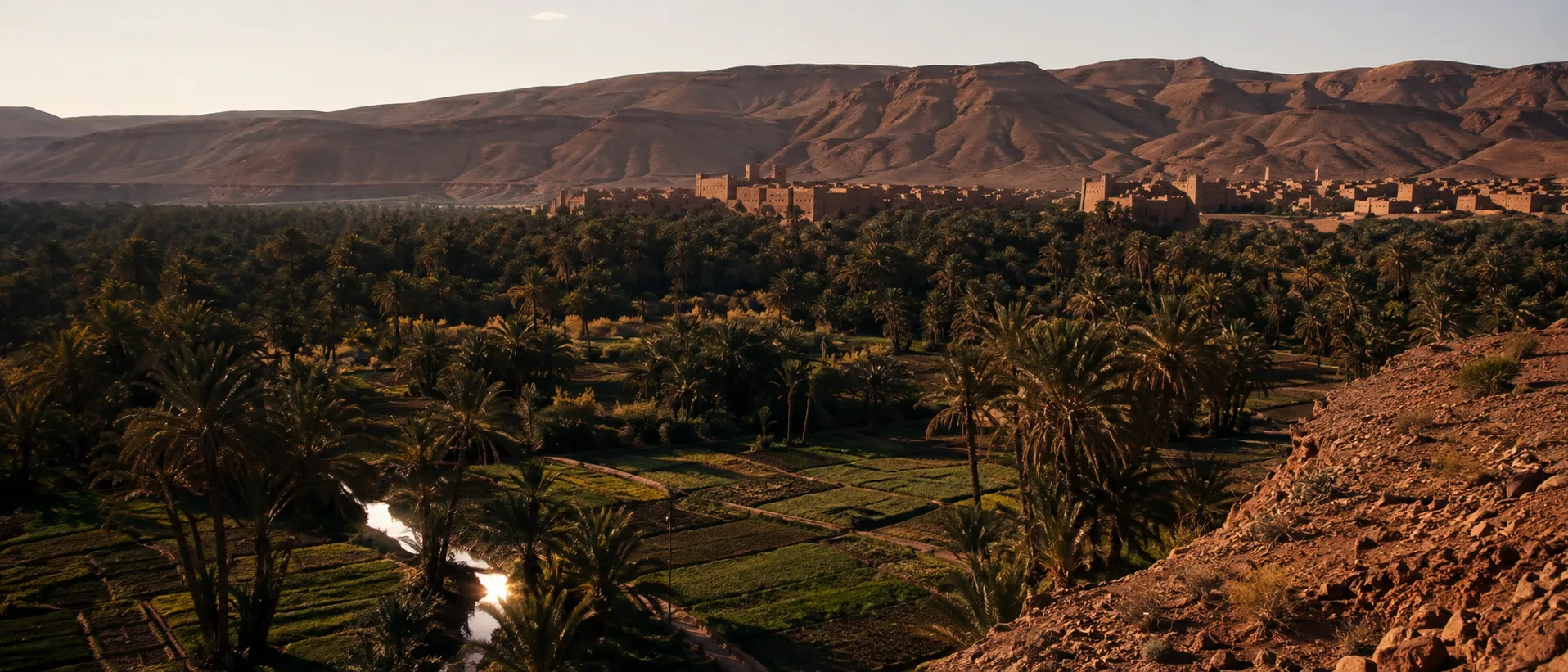
People remember Sijilmassa for gold. I understand why. Gold crossed the Sahara, entered its markets and helped make the city famous far beyond the Tafilalt. But when I think of this land, gold is not the first thing I see. I see water, palms and gardens. I see families learning how to live in a dry country without treating a drop of water as ordinary.
A river inside my own memory
The Ziz is not an abstract line on a historical map for me. It belongs to the landscape of my childhood and passes through the country of my native Ksar Meski. Long before I learned the names of dynasties or caravan routes, I knew the simple architecture of oasis life: earth, water, palms, gardens, animals, family and work.
Sijilmassa before the legend
Sijilmassa was founded in the eighth century in the Tafilalt near present-day Rissani. Its early history is strongly associated with Miknasa Amazigh communities and the Midrarids. The city was not born as an Arab city dropped into an empty desert. It grew in an inhabited pre-Saharan world and later became a meeting place for people arriving from many directions.
The oasis made the city possible
Recent archaeology has brought attention back to a truth anyone raised around an oasis understands: Sijilmassa did not stand in lifeless sand. It belonged to a fertile oasis system connected to the Ziz. Date palms, gardens and agriculture formed the living base beneath the commercial city. The caravan carried gold, but somebody still had to feed the camel driver.
Three floors of life
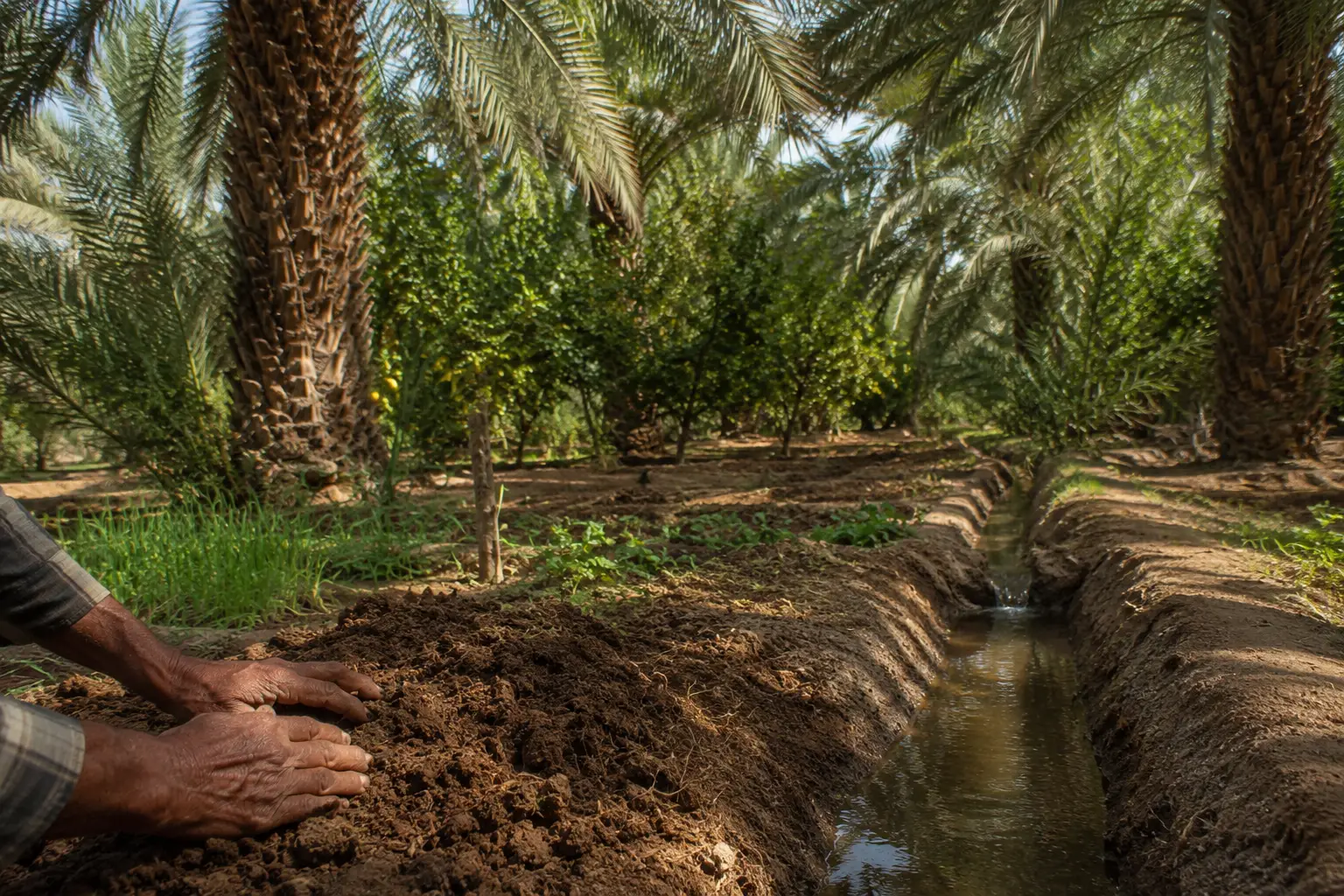
An oasis is architecture made with plants. Date palms form the high canopy. Fruit trees can grow beneath them. Lower still, fields and garden crops benefit from shade and moisture. Crops varied by place and period, but the principle remained intelligent: make several forms of life share the same precious water and protected ground.
The palm was infrastructure
A visitor may photograph a palm because it is beautiful. For a family living beneath it, beauty was only one gift. Dates fed people and could be stored. Palm materials had practical uses. Shade protected lower cultivation. A palm grove was not scenery. It was infrastructure.
Gold travels, water makes people stay
Sijilmassa became a great northern terminal of trans-Saharan trade. Gold from West Africa moved through these routes, with salt and many other goods. Yet commerce alone cannot explain sustained settlement. Water could. It converted an arid environment into a place where urban and rural life supported each other.
Meskaoui
“People called Sijilmassa a city of gold. As a child of the Ziz, I learned another kind of wealth. Gold can cross the desert. Water makes people stay.” — Meskaoui
A city emerging again
Excavations reported in 2026 are changing the image of Sijilmassa. Wider excavation strategies and LiDAR are helping archaeologists recognise streets, houses, a mosque and a madrasa instead of isolated walls. The medieval city is becoming spatially legible again.
A mosque beneath later centuries
Researchers have identified an early mosque nucleus dating to the eighth century beneath later construction phases. Sculpted plaster, wall painting and geometric and vegetal decoration are opening another window onto early Islamic artistic life. Sijilmassa was never only a market.
The dead return ordinary people to history
A cemetery behind the qibla wall preserves burials across centuries. Some remains show evidence of violent conflict. Domestic objects, glass and beads found nearby return families and ordinary inhabitants to a story too easily dominated by merchants, rulers and gold.
One river, many peoples
The Ziz cannot honestly be reduced to one ethnicity. Amazigh communities were fundamental to the early history of Sijilmassa and the Tafilalt. Jewish communities and Saharan and sub-Saharan connections also belong to the region’s history. Over later centuries Arab tribes, families and sharifian lineages arrived and became rooted in different places.
Arab settlement was a process
Arabisation did not happen in one day and did not erase everyone who was already there. It unfolded over centuries through migration, tribal movement, religion, scholarship, commerce, political alliances, marriage and settlement. Different Arab groups reached the Maghrib at different periods, and parts of southern Morocco developed strong Arab identities.
Not every ksar tells the same story
Travel a short distance along an oasis and the history of one settlement may differ from the next. Some communities preserve strong Amazigh identities, others strong Arab identities, and others mixed histories. The Ziz did not make every village identical.
My own Ksar Meski
My native Ksar Meski belongs to this mosaic with an Arab identity carried by its families. I can say that from lived family and local identity without pretending that every neighbouring ksar shares the same ancestry. Difference is part of the valley’s richness.
Sharifian Tafilalt
The Tafilalt also became deeply associated with sharifian lineages. In later centuries Sijilmassa and its surrounding region became an environment of zawiyas, saints, scholars and sharifian families. The Alaouite dynasty itself emerged from the Tafilalt, placing southeastern Morocco at the centre of later Moroccan political history.
Do not make every sharif an Idrisid
Sharifian does not automatically mean Idrisid, and an Arab family in the Ziz does not automatically descend from one famous tribe or dynasty. Oral memory deserves respect, but genealogy requires evidence. A beautiful family legend should not be promoted into documented history without proof.
Arabic travelled too
Languages travel with people. Arabic spread through religion, scholarship, administration, trade, tribal migration and daily life. Amazigh languages remained deeply rooted. The linguistic map of southeastern Morocco therefore records movement and coexistence, not a simple replacement.
The ksar as a social machine
A ksar is often photographed as architecture, but its walls only make sense when we imagine the community inside: families, storage, water, paths to gardens, worship, animals, work and protection. The wall guarded a system of life.
Water requires neighbours
Irrigation depends on channels, maintenance, timing and agreements. Systems varied across the oasis, but the social principle is recognisable: water forces neighbours to negotiate because the garden downstream also needs to live.
The family garden
As a child, a garden does not feel like economic history. It is simply where adults work and children learn without knowing they are learning. Years later, you understand that knowing shade, soil, seasons and water is accumulated knowledge.
The well and generosity
In my family memories, water is also attached to generosity. A well is never only a hole in the ground when other people may need it. In a difficult environment, sharing water, shade and food can become part of survival.
The caravan does not eat gold
Imagine hundreds of kilometres of desert travel. Gold has value at the destination, but on the road you need water, dates, grain, animals and places able to receive travellers. The quiet oasis economy supported the glamorous gold economy.
Sijilmassa looked south
The city connected North Africa to West African kingdoms and markets. Gold from south of the Sahara became central to its fame. This makes Sijilmassa African history as much as Moroccan history. The Sahara was difficult, but it was crossed.
Sijilmassa looked north
Goods and money also moved toward Fez, Aghmat, Ifriqiya and Mediterranean networks. Accounts of Midrarid revenues mention caravan taxes, livestock, merchandise and minting. Tafilalt could be far from northern capitals while remaining connected to a vast economy.
The city of coin
Under the Almoravids, Sijilmassa became a major centre for striking gold dinars. Control of the oasis and its monetary power helped sustain political expansion. Sometimes history did not travel from the imperial city toward the oasis; wealth from the oasis helped make imperial history possible.
Decline is not disappearance
As trans-Saharan routes shifted, Sijilmassa declined. The old urban centre fragmented and oasis settlement increasingly organised itself through fortified villages, the ksour. The city faded, but oasis life continued.
The ksour inherit the landscape
This is where ruins and childhood begin to speak to each other. A great medieval city disappears, yet water, palm groves, gardens and fortified settlements continue across the region. History changes scale, but the oasis remains the stage.
The Ziz passes Meski
Follow the Ziz and it links landscapes that modern administration divides into different names. One of those places is Meski. The river does not announce that it has entered someone’s birthplace. It simply continues, feeding palms and memory.
Fortress of memories
In my own memories of Ksar Meski I return to doors, wells, family rooms, the spring, gardens and grandparents because that is how a child records a place. The historian later adds centuries. The adult adds archaeology. The child remembers where the water came from.
Different origins, shared shade
One family may tell an Arab genealogy. Another may speak an Amazigh language and carry another tribal history. Another may remember migration, scholarship or trade. Yet agricultural life can place them under the same climate and beside the same river.
Meskaoui
“Our histories were not always the same, but the palms gave us the same shade and the Ziz carried the same water to our land.” — Meskaoui
The Jewish chapter
The history of southern Moroccan oases also includes Jewish communities and commercial networks. Their presence reminds us that the human map of Tafilalt cannot be reduced to an Arab-Amazigh binary.
Pilgrims, merchants and scholars
Sijilmassa also stood on routes used by pilgrims travelling east. Commerce and faith could share the same road. Merchants, scholars, travellers and pilgrims passed through for different reasons, adding new connections to the oasis.
Natural wealth before financial wealth
Money is easy to count. Oasis wealth is harder. What is shade worth at forty degrees? What is an irrigation channel worth to a family whose crop depends on it? What is fertile soil worth where surrounding land is dry? These questions change the meaning of wealth.
A date can be worth more than a coin
Not in a market, perhaps. But imagine hunger or a long road. The value of an object changes with the question. Sijilmassa’s gold made history books. The date palm made breakfast.
Bees belong quietly
Bees need no advertising role here. They belong naturally in a landscape of gardens, flowering plants and wild vegetation. Around the wider Errachidia region, memories of wild nbeg or local jujube also belong to the intimate botanical map of the oasis.
Honey before branding
Before honey became a luxury gift, it was food, sweetness and part of household traditions and hospitality. The connection here is continuity, not commerce: plants, seasons, bees, family and landscape.
The old lesson in a changing climate
Water pressure, drought, heat and agricultural transformation make the old oasis relationship with limited resources newly urgent. We should not romanticise the past, which was hard, but neither should we ignore knowledge created by generations who understood scarcity.
Heritage is more than ruins
Preserving Sijilmassa should not mean preserving excavated walls alone. Palm groves, irrigation knowledge, ksour, oral histories, agriculture and family memory belong to the same landscape. A ruin without its environment loses part of its explanation.
Heritage is not a museum of poverty
Families deserve modern comfort, education, healthcare, infrastructure and opportunity. Heritage should never demand that people remain poor so visitors can admire an ‘authentic’ oasis. The challenge is to modernise without forgetting why settlement was possible.
Why I refuse one origin story
It would be easy to say one people lived here, another arrived, and the story changed completely. Human history is not that neat. Communities persist, mix, move, change language, marry and remember different genealogies.
Ksar Meski in the mosaic
So when I say Meski carries an Arab identity, I am speaking about my own ksar, not assigning that identity to the entire Ziz. Errachidia and the Tafilalt have known many Arab and sharifian families alongside deeply rooted Amazigh communities and other historical populations.
History without competition
Sijilmassa’s Amazigh foundations do not erase later Arab settlement. Arab settlement does not erase earlier populations. Sharifian history does not make every family sharifian. Accuracy gives every history more room.
A river does not need a flag
Dynasties change names and capitals. The Ziz flowed under Midrarids, Almoravids and those who came later. Families arrived, others moved, children were born. The river outlived every political slogan.
The wealth that stayed
Much of the gold that passed through Sijilmassa continued elsewhere. Coins were spent, melted, lost or collected. The oasis remained. Palms continued producing. Gardens continued needing water. Families continued teaching children how to live there.
From Sijilmassa to home
I do not need to claim that my ancestors lived in Sijilmassa in 757. I do not know that and will not invent it. The connection is already real: the same greater Tafilalt-Ziz world, the same oasis logic and a river passing through the landscape of my beginnings.
The last image
If I had to choose one image for this story, I would not choose a gold dinar. I would choose a palm casting shade over cultivated earth beside water. Somewhere beyond it, the ruins of a famous city sleep. Somewhere along the same river, another ksar raises another generation.
The river continues
Sijilmassa fell. Caravan routes changed. Empires disappeared. The Ziz continued through palms and gardens, through a region where Amazigh and Arab histories, sharifian lineages, Jewish memories, Saharan connections and family stories accumulated. It passes the country of my Ksar Meski. The river never told us about gold. It simply kept giving life.
Continue the Journey
If this story brought you here, continue the journey through related stories from The House of Meski.