
History · Yemen · The Sea
The Ancient Ports
That Connected Yemen to the World
Look at Yemen only on a modern news map and it can appear isolated. Look at the sea routes of history and the picture changes completely.
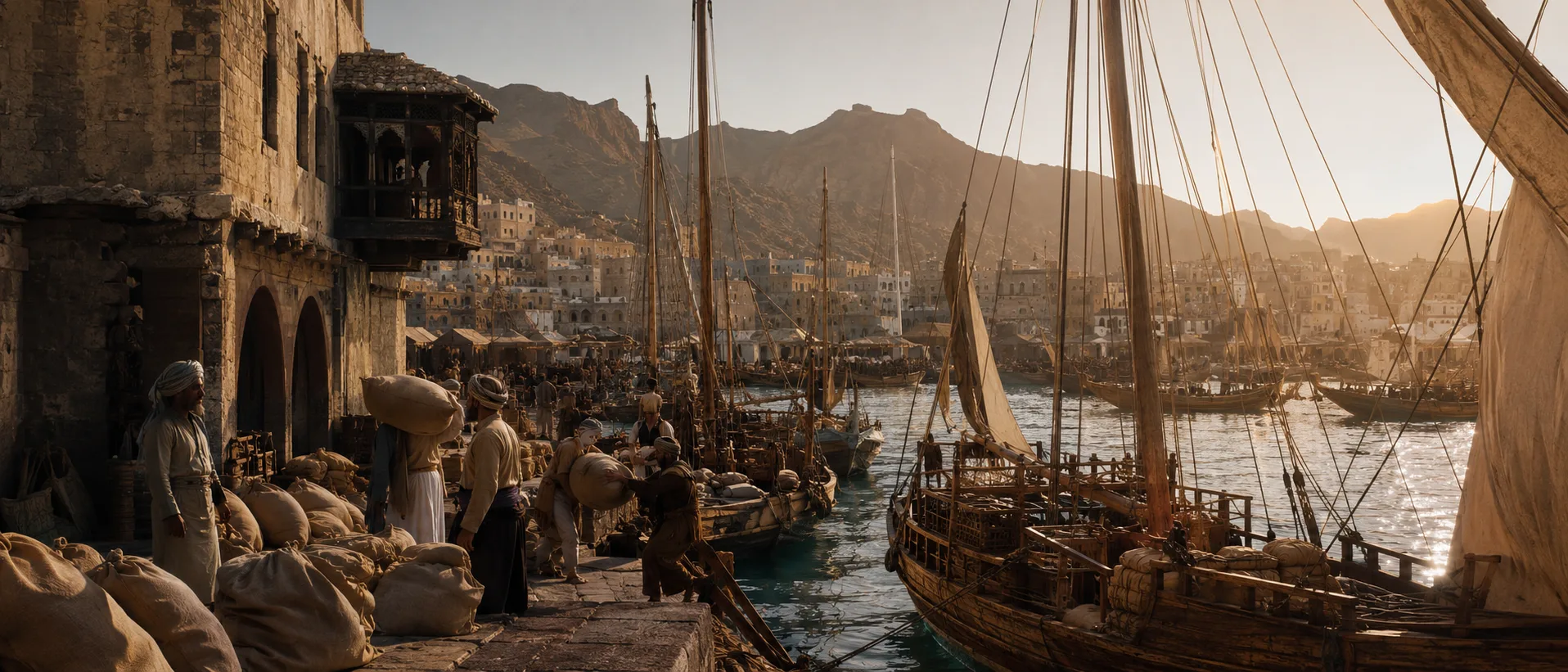
Yemen sits at the southern edge of the Arabian Peninsula.
But “edge” is a dangerous word.
From one map, an edge looks remote.
From another, the same coast becomes a gateway.
For centuries, Yemen faced the Red Sea, the Gulf of Aden and the Indian Ocean. Ships moved toward East Africa, India and the Persian Gulf. Caravans connected coastal exchange with inland kingdoms and cities.
Yemen was not waiting for the modern world to discover it. It was already part of older worlds of movement.
“A coast can look like the end of a country on a map. For the people who sail from it, it can be the beginning of the world.”
Meskaoui
Two Thousand Kilometres of Coastline Change the Story
France’s Ministry of Culture archaeological project on Yemen describes roughly two thousand kilometres of coastline along the Red Sea and Gulf of Aden.
It also notes that mastery of marine currents helped Yemen become part of shipping routes linking India, the Persian Gulf and the Mediterranean around the turn of the Christian era.
That matters because the usual image of ancient Arabia is dominated by caravans.
The camel is important.
So is the boat.
Aden: A Port Inside a Volcano’s Geography
Aden’s geography is difficult to separate from its history.
The historic city sits within the crater of an extinct volcano, opening toward the sea. Yemen submitted the Historic City of Aden to UNESCO’s Tentative List in 2025, describing the port as a long-standing crossroads of international maritime routes and a place of exchange between East and West.
By the Middle Ages, archaeological scholarship describes Aden as the most important port of southern Arabia and a major connection between Red Sea and Indian Ocean commerce.
Merchants did not arrive only with goods.
They arrived with languages, beliefs, tastes, techniques and news.
A Port Creates a Different Kind of City
A trading port has to learn to receive strangers.
That does not mean every encounter is peaceful or equal. Trade has always existed beside competition, taxation, war, empire and exploitation.
But repeated contact leaves marks.
UNESCO’s description of Aden emphasises cultural plurality and the historic presence of different religious communities. Architecture, food and vocabulary in port cities often remember journeys long after the ships themselves disappear.
Mocha: A City Whose Name Travelled Farther Than Most People Realise
Then there is Al Mokha, better known internationally as Mocha.
Today millions of people recognise the word “mocha” through coffee, often without thinking about the Yemeni port behind the name.
UNESCO’s 2025 Tentative List entry for Al Mokha describes its strategic position on maritime routes linking India and the Mediterranean and its historic links with ports on the Yemeni and Abyssinian coasts.
The port became especially important as an export point for Yemeni coffee.
A city became a flavour word.
Coffee Was Not Just a Drink Leaving Port
When coffee travelled, habits travelled with it.
Beans moved into commercial systems, then cafés, social rituals, taxation, fashion and global agriculture.
The point is not that Yemen “invented every coffee culture”.
It did not.
The point is that Yemeni cultivation and the port of Mocha held a central place in the early global movement of coffee.
That history is much larger than a menu word.
The Inland and Maritime Worlds Met
Yemen’s ports did not float separately from the interior.
Caravan routes moved frankincense, myrrh and other goods toward larger networks. Agricultural products came from highlands and valleys. Inland centres linked to coastal trade according to political power, safety, taxation and changing demand.
The country’s geography forced people to understand both mountain and sea.
Why This Changes How I See Yemen
Balqees opened one door into Yemen for me.
Honey opened another.
Mangoes opened another.
And the ports change the scale again.
They remind me that Yemen belongs not only to the history of Arabia, but to the history of the Indian Ocean and Red Sea worlds.
It received influences and sent influences outward.
The Modern Headlines Are Not the Whole Country
None of this is an argument for ignoring Yemen’s present suffering.
History should not be used to romanticise a difficult present.
But the present should not erase the depth that came before it either.
A country can be in crisis and still deserve to be understood as more than its crisis.
For me, that is one reason to keep writing these pieces.
Yemen’s Historic Ports
Aden sits at a strategic maritime position near the entrance to the Red Sea. It became a major commercial port linking Red Sea and Indian Ocean networks, especially in the medieval period.
Yes. Mocha derives from Al Mokha, the Yemeni port that became a major export centre for Yemeni coffee.
Yes. Yemen’s position on Red Sea and Indian Ocean routes connected its ports with East Africa, India, the Persian Gulf and Mediterranean-linked networks over long periods of history.