
Two kinds of richness: the architecture and luxury of Dubai and Doha, and the quieter wealth of coffee, conversation, desert and majlis.
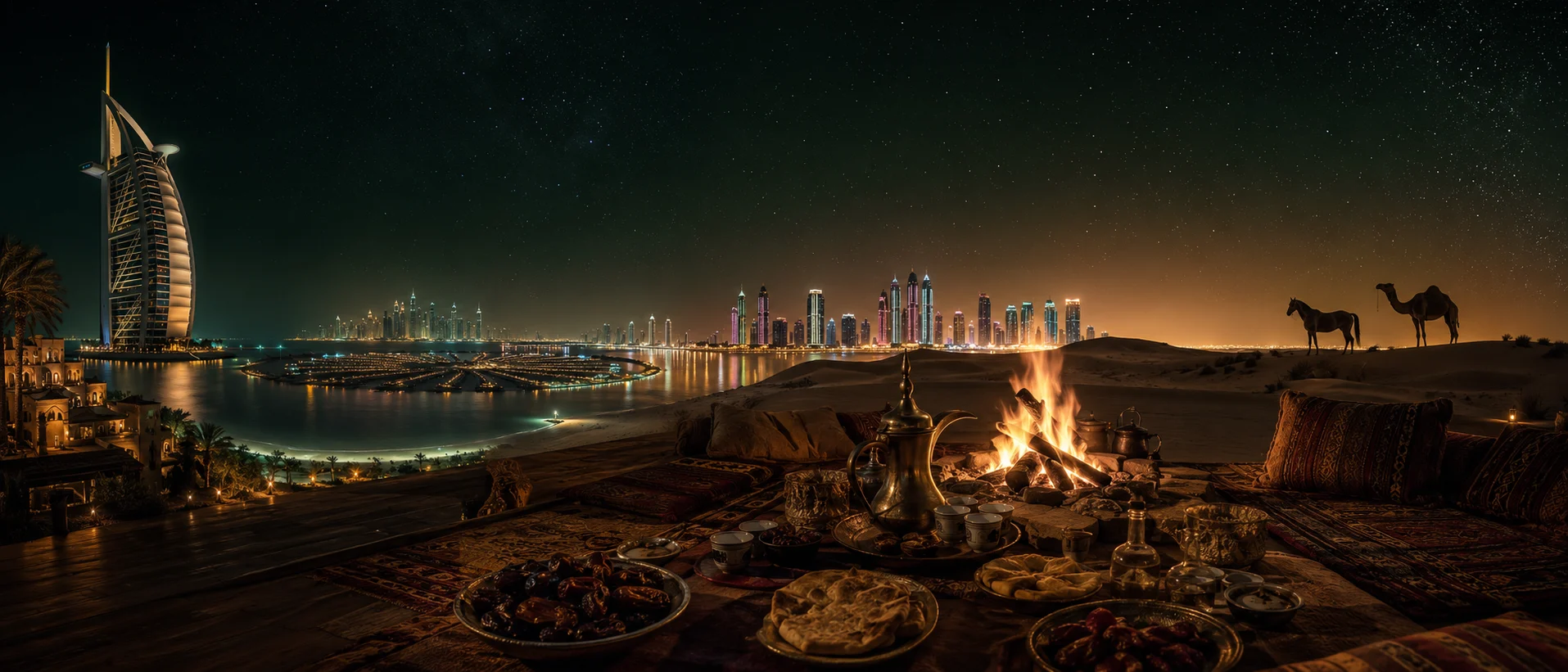
Two luxuries, and I refuse to make them enemies
I like beautiful things. There, I said it before anyone imagines this is going to be one of those stories where a man goes to the desert and suddenly decides that marble, architecture, good restaurants and comfortable hotels are meaningless. They are not meaningless to me. I can walk through Downtown Dubai at night, look upward and enjoy what human beings have managed to build. I can cross Jumeirah, see Palm Jumeirah opening into the sea, enter a hotel where every detail has been designed, and simply enjoy it.
Doha can do the same to me. A skyline reflected in the water, a hotel lobby that feels almost theatrical, a beautiful plate arriving at the table, a perfume in the air, polished stone, soft light. Sometimes I want that. Sometimes it is a pleasure to let a city impress me.
But there is another richness that works differently on me. It does not try to impress me. It removes things instead. The building disappears. The traffic disappears. The menu disappears. Eventually even the fork can disappear. Hahaha. There is sand, a majlis, coffee, bread, olive oil, honey, perhaps horses or camels somewhere beyond the light, and later a sky that nobody designed.
This is not an article about choosing the correct luxury. It is about discovering that the word can contain two opposite experiences. One can excite me. The other can calm me. And neither gives me the right to decide what should make you happy.
Dubai knows how to make the eyes happy
Start in Downtown Dubai and it is difficult to pretend the city lacks ambition. The Burj Khalifa changes the scale of the street before you even enter anything. Around it, hotels, restaurants, shops and public spaces have been composed to create an experience. At night, glass, water and light do part of the storytelling.
Then move toward Jumeirah. The mood changes. The coast becomes part of the luxury. Continue to Palm Jumeirah and the city does something that still feels improbable even when you have seen it many times: it pushes a palm-shaped island into the Gulf and fills it with resorts, residences, restaurants and beach clubs. Visit Dubai itself describes Palm Jumeirah as synonymous with luxury. That is not an exaggeration.
And yes, Atlantis belongs in this story. You do not have to sleep there to understand why it became an image recognised far beyond Dubai. The scale, the position at the Palm, the idea of a destination inside a destination: this is luxury as spectacle, engineering and entertainment.
I enjoy walking through these places because curiosity should not become snobbery in reverse. It would be ridiculous for me to praise a handmade coffee pot and then pretend I cannot admire an architect, a chef, a designer or the thousands of people required to make a major hotel work.
Jumeirah, the Palm and the pleasure of being looked after
There is another part of hotel luxury that photographs cannot explain: for a while, somebody else has thought about almost everything. The room is ready. The table is set. Someone carries the bag, remembers the reservation, brings the coffee, cleans what you leave behind and answers when you need something.
That service has value. Hospitality as an industry employs skill, training and enormous coordination. A beautiful hotel is not beautiful because marble was ordered. It becomes an experience because people maintain thousands of details that the guest is not supposed to notice.
So when I say that my heart often prefers the desert majlis, I am not insulting the person who has spent a career learning how to welcome guests in a hotel. In fact, the interesting question is almost the opposite: how did an old regional instinct for receiving people enter a modern hospitality industry and take new forms?
Dubai Marina: luxury can also be movement
Dubai Marina gives me another version. Here luxury is less about one monumental object and more about movement: towers, yachts, terraces, restaurants, people walking late, languages arriving from everywhere. You can eat one cuisine tonight and another tomorrow without leaving a small area.
I like that too. Discovery does not have to happen on a mountain trail. Sometimes discovery is ordering something whose name you cannot pronounce and trusting the kitchen.
People constantly search for the best restaurant in Dubai, the best restaurant in Dubai Marina, the best restaurant in Jumeirah. I understand the search. We all want to avoid disappointment. But I have a problem with the word best. Best according to whom, on which night, with which chef, with what mood, and sitting with which person?
My best restaurant may fail tomorrow
A famous restaurant can give you a disappointing plate. A tiny place you entered because you were hungry can give you a meal you remember ten years later. Price can buy ingredients, location, design, staff and technique. It cannot mathematically guarantee emotion.
Today I can eat rice. Tomorrow noodles. The next day meat. Why should I eat rice every day only because somebody told me that this is the number-one rice in the city? Hahaha. I have favourite restaurants, of course. But if I return only to what I already know, I stop discovering.
For me, discovery itself is a kind of wealth. Not money. Wealth. I would rather have a life containing one hundred tastes, streets, conversations and mistakes than spend every evening proving that my favourite place is still my favourite.
Doha: another city, another way of shining
Doha offers a different rhythm. West Bay rises beside the water, newer districts stretch the city outward, and luxury hotels have become part of the contemporary image of Qatar. Yet the older cultural vocabulary never entirely disappears behind the glass.
This is what interests me most in Gulf cities. You can leave a modern restaurant, cross a few kilometres, and encounter a social ritual whose meaning is much older than the building you just left.
Doha is especially useful for understanding the majlis because the majlis remains a central feature of Qatari social life. Visit Qatar describes it as one of the most important spaces in Qatari homes, historically connected with Bedouin life, conversation, storytelling, etiquette and the receiving of guests.
So the contrast between a Doha luxury hotel and a majlis is not really a battle between modern Qatar and old Qatar. Both exist in contemporary Qatar. People move between worlds.
Before the five stars, there was the guest
Long before anyone searched for luxury hotels in Dubai or Doha, hospitality had another measurement. A traveller arrived. A guest entered. Space was made. Food and drink were offered according to what the household had and according to local custom.
We should be careful here. There was never one frozen form of Arabian hospitality practised identically for two thousand years. Arabia is enormous. Coastal towns, oases, mountains, desert communities and cities developed different habits. Wealth also mattered. A rich household and a modest household did not receive in exactly the same surroundings.
But some social ideas became remarkably durable: honouring the guest, making room, sharing conversation, serving coffee, dates or food, and treating reception as something larger than a commercial transaction.
The majlis gives that idea an architectural and social space.
Majlis means a place to sit, but it became much more
The Arabic word majlis is beautifully simple: a place of sitting. Yet a place to sit can become a place to listen, negotiate, tell stories, welcome relatives, receive strangers, discuss community matters and teach younger people how adults behave with guests.
The majlis is recognised by UNESCO as intangible cultural heritage in the United Arab Emirates, Saudi Arabia, Oman and Qatar. That recognition matters because the heritage is not simply a room with cushions. It is the social practice around the room.
In Qatari descriptions of traditional majalis, guests receive dates and Arabic coffee from a dallah. Older forms could be Bedouin tents. Wealthier homes might decorate the majlis more richly, while simpler homes used more modest decoration. Even historically, then, hospitality did not require everybody to pretend material differences did not exist.
What mattered was what happened once you sat down.
The first luxury is being given a place
Think about the simplest gesture: move, make space, sit here. It costs almost nothing and can mean everything.
A hotel reservation gives me a room because I have entered a commercial agreement. There is nothing wrong with that. A private majlis gives me a place because somebody has admitted me into a social space. These are different relationships.
Sometimes the most precious thing the host gives is not coffee, dates, meat or honey. It is attention. Time. The willingness to remain in the room and listen.
Modern life has made time strangely expensive. We can order almost anything to the door in minutes, yet finding two uninterrupted hours with people we love can feel difficult. Perhaps that is why the old idea of sitting together can feel luxurious again.
Arabic coffee: a small cup carrying a large meaning
Then comes the coffee. Not the enormous cup designed to accompany a laptop for three hours. A small finjan. The dallah. The hand. The sequence of serving.
UNESCO describes Arabic coffee as a symbol of generosity and notes that the associated etiquette is passed between generations. Guests and elders are served first; the coffee is poured with the right hand; the guest can signal that enough has been served by gently shaking the cup. Practices vary between communities and families, but the social grammar is recognisable across several Gulf and Arab societies.
Cardamom is central in many preparations, while saffron, cloves, rose water or other additions may appear according to local and family preferences. Visit Qatar is careful about something I like: ratios vary from family to family. There is no single magical recipe owned by the internet.
That is how living heritage should be. Similar enough to recognise, personal enough to belong to a house.
Coffee, dates, conversation, then another cup
The cup is tiny partly because serving is a conversation. You can receive another. And another. The host remains involved. The guest responds. Even the little movement of the cup when you are finished is communication.
UNESCO also notes that coffee gatherings can accompany poetry, discussion and the exchange of memories. That is important. Coffee is not heritage because the liquid itself is ancient and exotic. It is heritage because people built behaviour around it.
Dates naturally enter the scene as well. In Qatar they remain closely associated with hospitality and are commonly served with coffee. Across the Gulf, the combination is so familiar that it can appear almost ordinary. But ordinary practices are often the ones that carry culture most quietly.
Meskaoui
“I will not pretend I don’t enjoy luxury. Beautiful architecture, a beautiful hotel, a beautiful table… of course I enjoy it. Why should I lie? Hahaha. But sometimes what makes my eyes happy is not what makes my heart quiet.”
— Meskaoui
Now leave the city with me
Enough marble for a moment.
Drive outward. Let the towers shrink in the mirror. Let the traffic thin. The road becomes darker. The horizon becomes wider. What looked empty begins to acquire detail once your eyes stop expecting buildings.
This transition is one of my favourite feelings in the Gulf. Dubai and Doha can make human achievement feel enormous. The desert can make the human being feel small again.
I need both sensations.
The desert is not empty
People who do not know deserts sometimes call them empty. Empty of what? Shopping centres, perhaps. But the land has tracks, plants, insects, birds, grazing routes, weather, wind, stars and knowledge accumulated by people who learned to read signs that a visitor does not even notice.
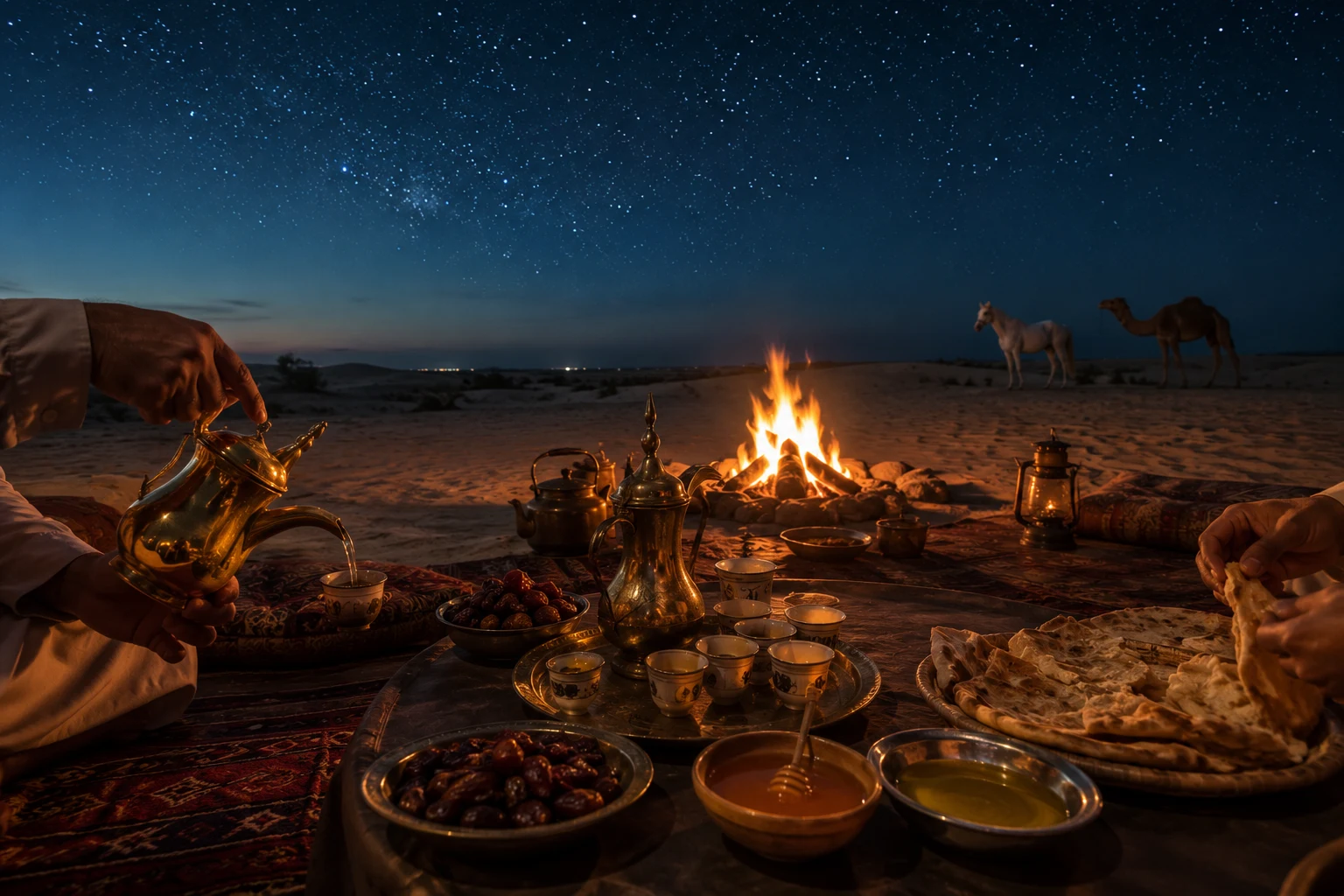
A camel on the horizon changes the scale. Horses change the mood again. The fire creates a small centre in an enormous dark space. Suddenly a few cushions and a pot of coffee are enough to define a room without walls.
This is where my definition of luxury begins to become personal.
A majlis without marble
I do not need the desert majlis to be poor or rough in order to find it authentic. That would be another romantic invention. Majalis can be simple, richly furnished, permanent, temporary, indoor or under a tent. Families express hospitality according to their means and taste.
What I love is the reduction. Fewer barriers between me and the landscape. Less architecture competing with the sky. A fire instead of a chandelier. Sand a few steps away. The possibility of hearing a horse before seeing it.
And silence. Real silence is becoming expensive without anybody selling it.
Leave the fork for one evening
Now give me bread.
Good olive oil.
A little honey.
I tear the bread with my fingers. Dip it. Taste it. Perhaps somebody tells me I should use a plate properly. Tonight I refuse. Hahaha.
This is not a claim that eating with your fingers is morally superior to a beautifully set table. Tomorrow I may be back in a restaurant admiring the cutlery. The pleasure comes from changing rhythm. One evening the chef builds the plate for me with tweezers. Another evening I build my dinner with a piece of bread.
Both can be delicious.
Why honey belongs here without needing an advertisement
Honey fits naturally into hospitality because sweetness travels easily through memory. In the Arabian Peninsula, Sidr honey, Samar honey and other regional honeys carry associations with origin, harvest, family preference and gifting. In modern Dubai and Doha, honey can also become a luxury gift: beautiful jars, boxes, gold details, corporate gifts, Ramadan gifts and VIP presentations.
I know this world well, and I love beautiful presentation when it respects what is inside. But the box did not invent the emotion of offering food.
A spoon of honey shared at home and a luxury honey gift in Jumeirah can belong to the same broad human instinct while expressing it very differently: I thought of you. I wanted to offer you something good.
That sentence is older than luxury packaging.
From Sidr honey to gold honey
Dubai has a particular talent for transforming products into experiences. Honey is no exception. Search for Sidr honey in Dubai, luxury honey in Dubai, gold honey gifts or VIP gifts in Jumeirah and you enter a market where origin and presentation meet.
Some buyers want Yemeni Sidr. Others look for Emirati honey, Omani Sidr, a Ramadan gift, a corporate box or something visually spectacular enough for a special occasion. There is room for all of these desires.
But I hope we never reach the point where we think adding gold automatically creates value. Gold can make an object beautiful. It cannot manufacture a story, a harvest or generosity.
Luxury presentation is at its best when it carries meaning rather than replacing it.
Ramadan makes the distinction even clearer
During Ramadan, Gulf hospitality becomes especially visible. Families gather, invitations multiply, restaurants create iftar and suhoor experiences, hotels build elaborate Ramadan settings, companies prepare gifts, and majalis remain places of meeting.
A five-star iftar can be wonderful. A family table can be wonderful. A simple coffee after prayer can remain in memory longer than both. Again, I refuse the ranking.
The meaning comes from the people, the intention and the moment. Price participates in an experience; it does not own the experience.
Luxury restaurants and the danger of eating the city as a checklist
Dubai and Doha contain enough restaurants to turn a holiday into a spreadsheet. Breakfast here, lunch there, sunset there, reservation at 8:30, another famous chef tomorrow. I understand the temptation.
But I do not want to consume a city only through recommendations. Sometimes I want to walk until I am hungry.
I want to enter a place because the smell convinced me. Ask the waiter what he eats. Try the dish I did not plan. Maybe it will be bad. Fine. Discovery includes disappointment.
If every meal must be the best restaurant in Dubai or the best restaurant in Doha, we have made eating strangely stressful.
Human-made beauty deserves respect
There is a lazy way to praise nature: insult everything humans build. I reject it.
The Burj Khalifa is an extraordinary human project whether or not skyscrapers are your preferred landscape. Palm Jumeirah is an extraordinary engineering idea whether you would rather camp in the desert. A beautifully designed Doha hotel can involve architects, craftspeople, cooks, gardeners, engineers, cleaners and thousands of workers.
Human creativity deserves wonder too.
My desert preference is not a verdict against cities. It is simply where my nervous system seems to say: yes, stay here a little longer.
Then night arrives
Daylight makes the desert wide. Night makes it infinite.
The fire becomes smaller. The conversation becomes softer. Coffee tastes different when there is nowhere else you need to be. If horses are nearby, you hear them. If camels move farther out, their shapes disappear before the sound does.
Then look upward.
No architect is competing anymore.
The ceiling nobody built
I have stood under impressive ceilings. Domes, chandeliers, carved wood, enormous hotel atriums. I still admire them.
But the desert sky plays an unfair game. It has scale without construction. Darkness gives the stars space. You look for a minute, then another, and eventually the instinct to photograph everything becomes almost embarrassing.
Sometimes the correct camera is your memory.
Meskaoui
“For me, this is richness: silence, a desert sky, horses somewhere in the distance, Arabic coffee, bread, olive oil and honey shared with people I love. But this is my richness, not a rule for yours.”
— Meskaoui
Two kinds of richness
Now we can return to the question that started the journey.
One richness is built. Architecture, engineering, design, service, restaurants, beautiful objects, pools, views, suites and extraordinary human effort. I visit it to enjoy what people can create.
The other richness is partly what remains when construction stops. Landscape, silence, time, company, fire, stars. I go there to breathe.
Why should one destroy the other?
Maybe your desert is a swimming pool
Perhaps you have read all these words thinking: Meskaoui, thank you very much, but you can keep the sand. Give me a swimming pool overlooking Palm Jumeirah, cold water, a towel, breakfast brought to my chair and absolutely no camel near me. Hahaha.
And you know what? You may be right for yourself.
If that is the place where your shoulders finally relax, where you stop checking the time and where you feel grateful to be alive, then I have no desire to take it away from you.
My peace does not need to become your homework.
Luxury may be the place where you stop wanting another place
Maybe that is the definition I can live with.
Luxury is not necessarily what costs the most. It may be the place, moment or company in which, for a little while, you stop wishing you were somewhere else.
For one person that is a suite in Atlantis with the Palm outside the window. For another it is a tent beyond the city. For somebody else it is the family home, a grandmother’s kitchen, a fishing boat, a mountain, a cheap café or simply a day without a telephone.
Money can open doors to certain forms of luxury. It cannot decide which door leads to peace.
Hospitality survives because it can change clothes
Arabian hospitality did not disappear when hotels arrived. It changed clothes.
The dallah can stand in a family majlis, a government reception, a cultural event or a luxury hotel lobby. Dates can be served on a simple plate or arranged like jewellery. A desert camp can be genuinely familial or carefully designed for visitors. A Ramadan table can be private or commercial.
Living traditions survive precisely because people continue to use them rather than locking them behind glass.
The challenge is to preserve meaning while allowing form to evolve.
What I hope Dubai and Doha never lose
I hope both cities continue building. I want architects to surprise us. I want chefs to experiment. I want hotels to become more beautiful, more thoughtful and more connected to place rather than simply more expensive.
But I also hope a child continues watching how an elder pours coffee. I hope families continue making room in the majlis. I hope the little rules of welcome are transmitted not because UNESCO listed them, but because somebody practises them at home.
A skyline can become iconic in a decade. A gesture may need generations.
The last cup
So I will take both.
Give me Downtown Dubai when I want lights. Give me Jumeirah when I want the sea. Let me walk the Marina and discover another restaurant. Let me look at Palm Jumeirah and admire the audacity of building it. Let Doha show me what contemporary Gulf architecture wants to become.
Then, another day, take me away from all of it.
Put the coffee on. Bring bread. Olive oil. Honey if we have it. Leave the fork there; I may or may not use it. Hahaha.
Let the conversation take as long as it takes.
And when night comes, let me look up.
And you?
I know my answer, at least today. Nature usually needs very little help to make me feel rich.
But this entire article would betray its own meaning if I ended by telling you that my answer should be yours.
Maybe your happiest evening is under the stars. Maybe it is beside a pool overlooking the Palm. Maybe it is a table in Doha surrounded by people you love. Maybe luxury for you is finally being alone.
Choose your richness. Enjoy it without needing everybody else to agree.
My place may be under the stars. Yours may be beside the pool. Both of us can be rich.
Questions about Arabian hospitality
Arabian hospitality refers to a broad family of customs around receiving and honouring guests across Arab societies. Practices differ by country, community and family, but coffee, dates, food, conversation and the majlis are important traditions in several Gulf societies.
Majlis literally means a place of sitting. In the Gulf it is an important social space for receiving guests, conversation, family and community life. The majlis is recognised by UNESCO as intangible cultural heritage in the UAE, Saudi Arabia, Oman and Qatar.
Arabic coffee, or qahwa, carries strong associations with generosity, welcome and social etiquette. UNESCO recognises Arabic coffee as intangible cultural heritage shared by several Arab countries.
Not necessarily. Modern hotels, restaurants and traditional social practices coexist. The forms change, while practices such as serving Arabic coffee, dates and welcoming guests remain visible in contemporary Gulf life.
Presentation can add beauty and ceremony, but meaning usually comes from intention, relationship, origin and the experience of giving. A costly object is not automatically a meaningful gift.
Continue the Journey
If this story brought you here, continue the journey through related stories from The House of Meski.