
A cultural and practical guide to the most important date varieties available in Dubai — from the caramel notes of Khalas to the sacred weight of Ajwa.
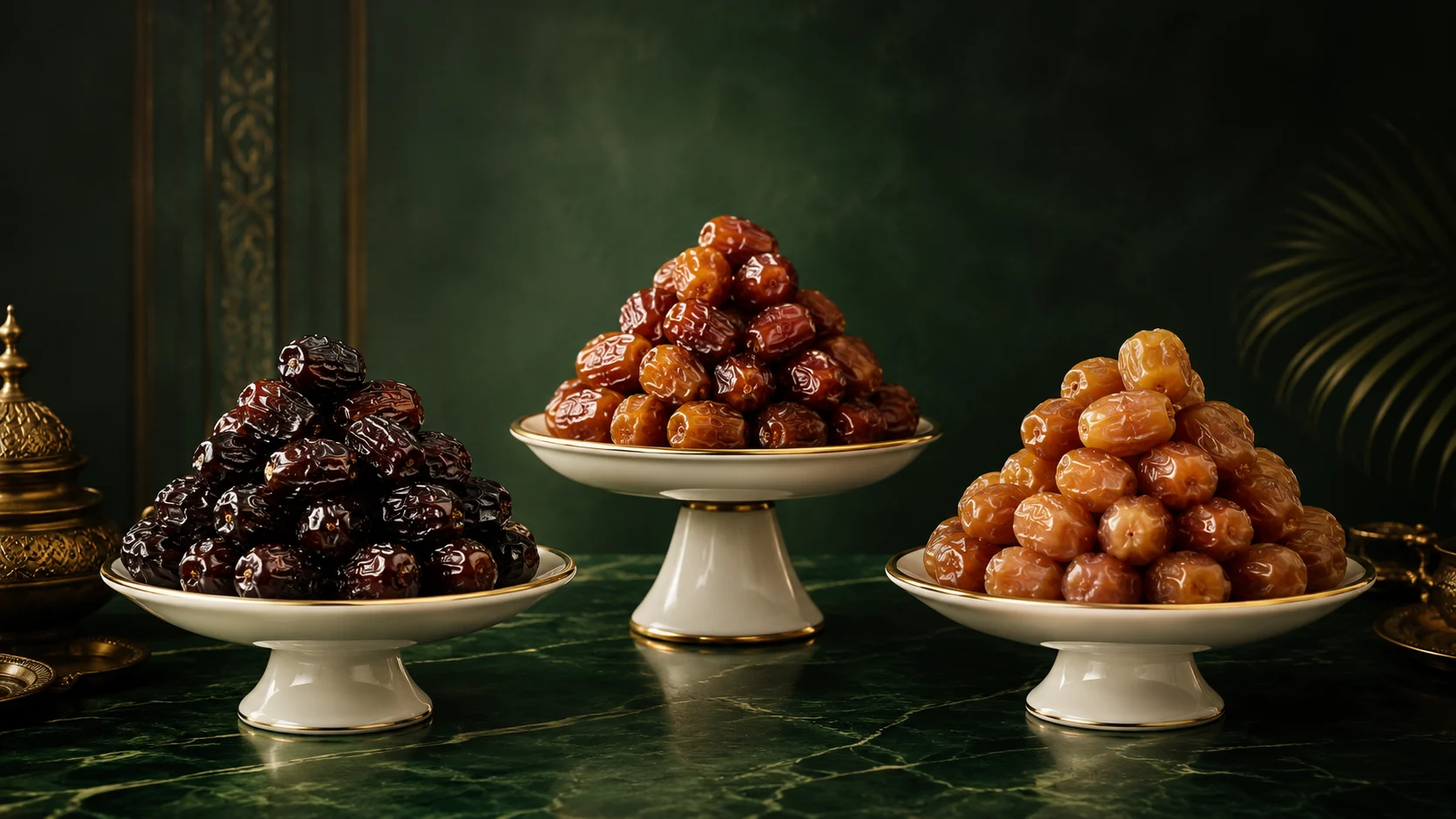
In almost every home across the UAE, a guest is offered dates before anything else. Before the meal. Before the conversation has properly settled. Often before a name is exchanged. The gesture is so habitual that many people no longer notice it. But for someone arriving in Dubai for the first time, or standing in front of a market stall piled with a dozen varieties they cannot name, the question becomes immediate: which ones are actually good? And what does “good” mean when it comes to dates in Dubai?
This guide is an attempt to answer that honestly. Not as a sales argument, but as a piece of genuine knowledge — the kind you might receive from someone who has spent years around date palms, farmers and the tables where these fruits are served.
The UAE is home to approximately 40 to 42 million date palms and cultivates somewhere between 120 and 160 recognised varieties. The country is among the world’s top date-producing nations, and the date palm itself was inscribed on UNESCO’s Representative List of the Intangible Cultural Heritage of Humanity in 2019, shared across fourteen countries including the UAE, Saudi Arabia, Morocco, Iraq and others. That inscription was not about tourism. It was an acknowledgement that the date palm is inseparable from how people in this region build homes, share food, mark time and welcome strangers.
What follows is a guide to six varieties you are most likely to encounter in Dubai — and to the knowledge that makes choosing between them meaningful rather than arbitrary.
Before You Choose: Understanding the Date
Dates are not a single thing. They are a fruit that passes through several very distinct stages before reaching a table, and the stage at which a date is harvested or sold changes everything — its sweetness, its moisture, its texture, its shelf life and its most natural use.
The Four Stages of Ripeness
The date palm produces fruit that ripens progressively. Understanding even a simplified version of this sequence helps explain why the same variety can taste completely different depending on when and how it was harvested.
Khalal
The earliest stage at which dates are sometimes eaten. The fruit is still firm, often green or yellow, with a crunch closer to an apple than a date. Some older Emiratis eat Khalal dates with salt or fresh. Most visitors find them unexpected.
Bisr
Sits between Khalal and Rutab — partially ripened, changing colour, still firm but beginning to sweeten. It appears occasionally in local markets but is rarely encountered in gift boxes or retail packaging.
Rutab
The stage most prized for fresh eating. The date has softened, its sugars have peaked, and its skin begins to loosen. Rutab dates are juicy, fragile and highly perishable — they must be consumed quickly. In the UAE, Rutab season runs roughly from mid-June through early August, and it is eagerly anticipated each year. Khalas at the Rutab stage is considered by many to be one of the finest things you can eat in this country.
Tamr
The dried or semi-dried stage that most people encounter outside the Gulf. The date has lost moisture, its sweetness has concentrated, and it will keep for months if stored well. Most packaged dates sold in supermarkets are at the Tamr stage — which is not lesser, simply different.
The Six Varieties Worth Knowing
Every date variety has an origin, a geography, a season and a character. The six described here are not the only ones worth knowing — but they are the ones most frequently encountered in Dubai, and the ones that best illustrate the range available in this city.
Khalas: The Taste of the Gulf
If you spend any time in the UAE, Khalas will find you. It is the most widely produced and most widely loved date variety in the country, and for many Emiratis it is simply the reference point against which everything else is measured. The name is sometimes said to derive from the Arabic word for “relief” or “salvation” — a hint at how significant this fruit was to communities who depended on it during long desert journeys and through lean seasons. Al Ahsa in Saudi Arabia’s Eastern Province and Al Ain in Abu Dhabi are two of its most celebrated growing regions. At the Rutab stage, Khalas is extraordinary: soft, slightly sticky, with a flavour that moves through caramel and into something almost honey-like. At the Tamr stage, it becomes denser and sweeter still. Khalas is harvested in July in Al Ain — a short window that requires immediate handling.
Sukkari: Sugar in Its Purest Form
The name says it directly. Sukkari comes from the Arabic word sukkar — sugar — and that is precisely what this variety delivers. Grown primarily in the Al Qassim region of Saudi Arabia, Sukkari is one of the most intensely sweet dates you will encounter, with a flavour profile that is golden, buttery and almost crystalline on the palate. At peak quality, it is extraordinarily tender, nearly melting. The skin is thin and dry, sometimes slightly powdery at the Tamr stage, which creates a contrast with the soft interior that many people find addictive. One caution: because Sukkari is associated with sweetness and value, it is sometimes mislabelled in lower-quality markets. Authentic Sukkari from Al Qassim has a specific appearance and fragility that distinguishes it from cheaper imitations.
Ajwa: A Date Carried by History
Among all the varieties discussed here, Ajwa occupies a different kind of place. It is not simply a premium date. It is a date that carries centuries of religious significance, cultural memory and a specific geographic identity that cannot be separated from what it is. Ajwa is grown in and around Medina in Saudi Arabia. Its association with the Islamic tradition is well documented: the date is mentioned in classical hadith literature in connection with the Prophet Muhammad (peace be upon him), and it has been consumed as part of religious practice — particularly at dawn during Ramadan, and when visiting the holy city — for generations. The date itself is small, dark — nearly black — and oval in shape. Its skin is fine and slightly wrinkled. The flavour is deep rather than sweet: there are notes of dried fruit, something close to prune or dark fig, with a subtle earthiness underneath. The sweetness is present but restrained. Ajwa is not the most approachable date for someone unfamiliar with the variety — it asks for attention rather than delivering immediate pleasure.
Medjool: A Moroccan Traveller in a Global Market
Medjool is the date most likely to be recognised by someone who has never been to the Gulf. Its reputation as the “king of dates” is rooted in size, texture and a sweetness that is immediate and generous. The origin of Medjool is Moroccan, specifically the Tafilalt region in the southeast of the country. Historical records suggest the variety was reserved for Moroccan royalty and traded across routes reaching European markets. When disease threatened Moroccan date palm crops in 1927, a small number of offshoots were saved and eventually planted in the Jordan Valley, the United States and other regions. Nearly all Medjool palms grown commercially today descend from that handful of rescued plants. In Dubai, Medjool is widely available and represents excellent quality at a moderate price point. It is large — noticeably larger than most other varieties — with a deep reddish-brown skin that wrinkles slightly when ripe. Medjool has a shorter shelf life than drier varieties, which is part of why quality varies between suppliers.
Khenaizi: The Local Treasure Few Visitors Discover
Khenaizi (also written Khnaizi or Khunaizi) is a date that many visitors to Dubai never discover, which is perhaps part of its appeal. It is a genuinely local UAE variety — dark brown to nearly black in colour, medium in size, with a wrinkled skin and a texture that is softer and juicier than its appearance might suggest. Grown across the UAE, Khenaizi tends toward mild sweetness rather than intensity. This makes it an approachable everyday date — something you can eat several of without fatigue, which is why it appears frequently on family tables and in homes rather than only in gift boxes. Because this variety does not always receive the marketing attention given to Khalas or Medjool, it tends to be reasonably priced.
Lulu: Simple, Honest and Deeply Emirati
Lulu (sometimes spelled Loulou or Lou Lou) is perhaps the least celebrated of the six varieties described here in terms of international exposure. It is a small, sweet, firm date — typically pale golden to amber in colour — that is well known to Emiratis and almost unknown to most visitors. Its sweetness is clean and uncomplicated. Lulu simply tastes like a good date: sweet, honest, with a texture that is firmer than Sukkari or Medjool and therefore slightly more satisfying for someone who prefers dates with a little more structure. For a tourist, Lulu offers a different kind of value: it is what Emiratis have eaten at home for generations, without ceremony or branding. Finding it at a local farm market or a traditional souk is its own small discovery.
Dates and Arabic Coffee: A Pairing That Precedes Taste
In the Gulf, the combination of dates and Arabic coffee — qahwa — is not a pairing invented by a chef. It is a social ritual that has existed for centuries and continues to define the first minutes of every formal and informal meeting in the region. When a guest enters a majlis, the traditional sitting room of an Emirati home, they are offered both simultaneously. To decline is understood as unusual. To accept is to confirm the relationship between host and guest.
The pairing makes practical sense: Arabic coffee is brewed with cardamom, and sometimes with saffron, cloves or rose water. It is lightly roasted, rarely bitter, and carries a gentle spiced warmth that calls for something sweet alongside it. Dates complete the balance. Their natural sugar softens the cardamom and allows the coffee’s floral notes to linger.
| Variety | Pairing with Qahwa | Notes |
|---|---|---|
| Khalas | Excellent | Most traditional choice. Caramel-honey flavour complements cardamom without competing. |
| Sukkari | Very good | Creates an almost confectionary effect alongside spiced coffee. |
| Ajwa | Good | Reflective pairing — depth and mild earthiness contrast with the lightness of qahwa. |
| Lulu | Good | Gentle enough not to overwhelm; clean sweetness suits lighter brews. |
| Medjool | Moderate | Rich enough to stand alone; can occasionally overwhelm a delicate qahwa. |
| Khenaizi | Good | Pairs naturally and honestly — the equivalent of a good conversation that does not dominate the room. |
The serving vessel matters too. Qahwa is poured into a small handleless cup — a finjan — from a long-spouted brass or copper pot called a dallah. The cup is never filled to the brim: leaving space signals that more is expected. A slight shake of the cup when you are satisfied tells the host, wordlessly, that you have had enough. These gestures are worth learning before arriving in the Gulf, not because they are tested, but because noticing them is its own form of respect.
Choosing Dates as a Gift in Dubai
Dates are one of the most culturally appropriate gifts you can give in the UAE — for Ramadan, for Eid, for a corporate occasion, for a dinner invitation, or simply as something meaningful to bring home. But choosing well requires thinking about the recipient rather than the packaging.
A note on prices
All price ranges mentioned in this article are indicative market estimates and may vary significantly depending on the seller, the season and the source. They are not prices from any single retailer. Always verify current pricing directly with your supplier.
For Ramadan gifting, Ajwa holds particular significance because of its religious and cultural associations — which are traditional and spiritual in nature. A box of Ajwa, or a mixed selection that includes Ajwa alongside Khalas and Sukkari, is received with genuine appreciation in Muslim households.
For corporate gifting, Medjool and Sukkari are the most universally appealing choices — impressive in size or colour, easy to appreciate without prior knowledge. A well-packaged box of mixed varieties, with the varieties clearly labelled, adds an educational dimension that reflects well on the giver.
For travellers taking dates home, Tamr-stage dates are the safest choice: they are more stable, travel better, and hold their quality for longer. Soft, fresh Rutab dates are more perishable and should only be purchased close to the point of travel.
For a personal gift with a story to tell, a single-origin box — Khalas from Al Ain, or Ajwa from Medina — with a note explaining the origin is more thoughtful than a generic assortment in expensive packaging. Knowledge is always the better luxury.
In Dubai, gift boxes range considerably in price and quality. A decent assortment of 500 grams begins at roughly AED 80 to 120 (indicative estimate). Premium single-variety or artisanal boxes may reach AED 200 to 400 or more. The packaging is often beautiful — lacquered wood, woven fabric, embossed boxes — but the quality of the dates inside is always more important than the container.
Where to Find Good Dates in Dubai
Dubai offers several distinct contexts for buying dates, each with its own character.
Traditional markets and souks — particularly the covered markets in Deira — remain the most atmospheric place to buy dates. Vendors display varieties in open trays, often encourage tasting, and are usually willing to explain what they have. Prices are negotiable. Quality varies significantly between stalls, so tasting before buying is important.
Specialised date shops have grown considerably in recent years. These stores offer curated selections, often with clear labelling of variety, origin and harvest date. Many carry local UAE varieties alongside Saudi and Moroccan imports. Staff in the better shops are knowledgeable and can guide a first-time buyer through the differences.
Premium retail and department store food halls — including those in Dubai Mall, Mall of the Emirates and similar destinations — carry well-packaged dates from established regional brands. The convenience is high; the discovery is lower.
Farm markets and seasonal stands during the Rutab season (summer months) offer something rarer: fresh, locally harvested dates sold by or near the farms that grew them. This is the best opportunity to taste varieties that rarely make it into retail packaging.
How to Store Dates at Home
Dates are more resilient than most people assume, but they are not impervious to their environment. Two things harm dates most reliably: excessive humidity and sustained heat. In a city like Dubai, where both are present for much of the year, storage deserves some attention.
At room temperature: Tamr-stage dates stored in a sealed, airtight container in a cool, dark place will keep for six weeks to three months, depending on the variety and its moisture content. Softer varieties like Medjool last closer to six weeks; drier varieties can extend further.
In the refrigerator: This is the most reliable option for Dubai’s climate. An airtight container prevents the dates from absorbing other food odours — dates are sensitive to neighbouring smells.
In the freezer: Dates freeze exceptionally well, particularly Khalas and Medjool. Allow them to return to room temperature for twenty minutes before eating. The texture after thawing softens slightly but the flavour holds.
Fresh Rutab dates, if you are fortunate enough to buy them during the summer season, should be consumed within a few days or refrigerated immediately. They are perishable in a way that dried dates are not — their moisture makes them fragile and beautiful at the same time.
How to Know You Are Buying Well
A final word for anyone standing in front of a display of dates, uncertain how to distinguish quality from presentation.
Quality dates, regardless of variety, share certain characteristics. The skin should be intact, without cracks, mould or fermented smell. The flesh should be consistent in colour — patches of extreme dryness or unusual discolouration can indicate poor storage or age. The texture, when pressed gently, should yield appropriately for the variety: Medjool and Sukkari should feel soft; Khenaizi and Lulu may be slightly firmer.
Price alone is not a reliable indicator. The most expensive box is not always the best date. The most beautiful packaging does not guarantee the most careful harvest. What matters is origin, handling, storage and — above all — the honesty of the seller.
If you can taste before you buy, taste. A good date does not need explanation. It simply stays with you a little longer than you expected, and you find yourself reaching for another before you have quite decided to.
That is, perhaps, the most honest measure of quality there is.
Frequently Asked Questions About Dates in Dubai
The best variety depends on your purpose. Khalas is the most celebrated local variety and the most traditional choice for everyday enjoyment and Arabic coffee pairing. Sukkari appeals to those who prefer intense sweetness. Ajwa carries deep cultural and religious significance and is particularly meaningful for Ramadan gifting. Medjool is the most universally accessible choice for first-time buyers and corporate gifts.
Khalas is a UAE and Gulf variety with a caramel-honey flavour, soft to semi-soft texture and a strong cultural identity in the Emirates. Medjool originates from Morocco and is larger, moister and more widely known internationally. Both are considered premium varieties, but they differ significantly in flavour depth, texture and cultural context. Khalas is the traditional local choice; Medjool is the global ambassador of premium dates.
For atmosphere and discovery, the traditional covered markets in Deira remain excellent, with vendors who often allow tasting. Specialised date shops offer curated selections with clear labelling. Premium food halls in major malls carry well-packaged options for convenience. During summer, farm markets and seasonal stands offer fresh Rutab-stage dates that are rarely found in retail packaging.
Khalas is the most traditional and widely recommended variety to serve alongside Arabic coffee (qahwa). Its caramel-honey notes complement cardamom naturally. Sukkari works well for those who prefer a sweeter pairing. Ajwa offers a more reflective, slower pairing suited to contemplative moments. Khenaizi and Lulu are also pleasant, gentle companions to lighter qahwa brews.
Given Dubai’s heat and humidity, refrigeration in an airtight container is the most reliable storage method. Tamr-stage dates keep well for six to twelve months when refrigerated. Dates can also be frozen for twelve months or more without significant flavour loss. Room temperature storage is possible for shorter periods (six weeks to three months) if the container is sealed and placed in a cool, dark location. Fresh Rutab dates should be refrigerated immediately and consumed within a few days.
Ajwa is a dark, small date grown in and around Medina in Saudi Arabia. It holds deep cultural and religious significance in the Islamic tradition, as it is mentioned in classical hadith literature and has been traditionally consumed during Ramadan and visits to the holy city. Ajwa is appreciated for its depth of flavour — notes of dried fruit, prune and mild earthiness — rather than sweetness. It is a meaningful gift in any context where the recipient understands its cultural and spiritual weight. Its traditional associations should not be confused with scientifically established medical claims.
Rutab is the fresh, juicy stage of date ripening that occurs in the UAE roughly between mid-June and early August. During this season, dates are at peak moisture and sweetness and must be consumed quickly because of their high perishability. Khalas at the Rutab stage is widely considered one of the finest seasonal foods in the country. Outside this window, most dates available for sale are at the Tamr (dried or semi-dried) stage, which has a much longer shelf life.
The date palm stands in UAE law as a protected tree. It appears on currency, on official crests and in the stories that families tell about their origins. To eat a date in the Gulf is never merely to eat fruit — it is to participate, however briefly, in something that has been offered and shared for a very long time.
May every date you discover bring with it a little of the generosity in which it was grown.
The Gulf at Its Finest
Dates and honey are the two pillars of Gulf hospitality. While you explore the world of dates, discover the raw honeys of the Emirates and Oman — gathered from Sidr and Samar trees in some of the most remote landscapes of the Arabian Peninsula.