
Ancient History — The Meski Journal
Honey and the Pharaohs:
What 3,000 Years in a Tomb Tells Us
They built the pyramids. They invented embalming. They put honey in the pharaoh’s tomb — and it lasted three millennia. Maybe they knew something we are still learning.
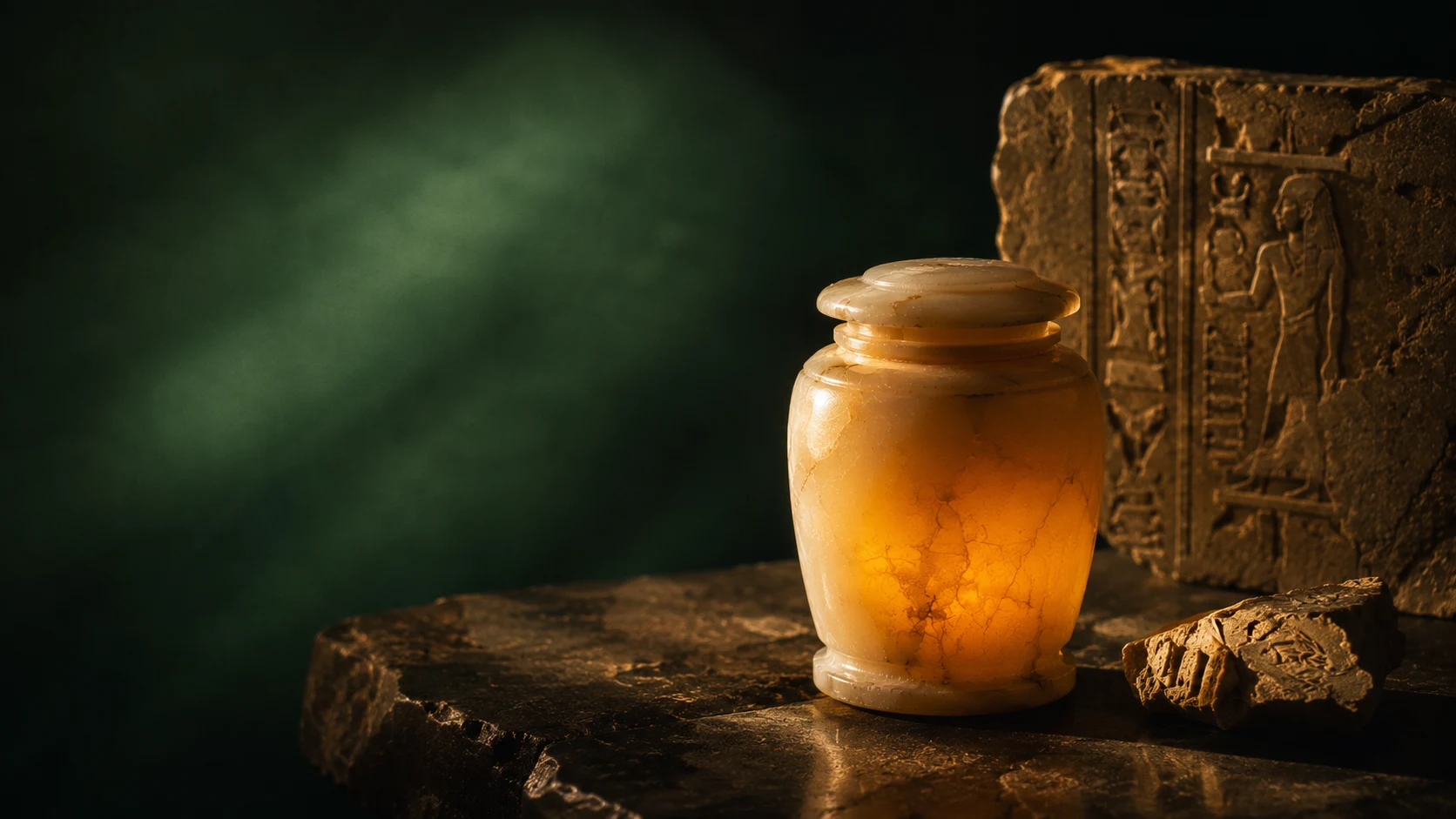
When Howard Carter’s team opened Tutankhamun’s tomb in 1922, they found more than golden masks and carved furniture. Among the provisions left for the pharaoh’s journey to the afterlife — food offerings sealed in alabaster jars — was honey. The tomb had been sealed around 1323 BCE. That is approximately 3,300 years before Carter’s team entered it. The honey was still honey. Chemically intact. Chemically identifiable. Preserved by nothing more elaborate than the sealed jar and the extraordinary properties of the substance itself. This is not legend. The chemistry behind it is real, well-studied, and — the more you understand it — genuinely remarkable. What the Egyptians understood about honey, without a laboratory, without the vocabulary of microbiology or food science, raises a question worth sitting with: what else did they know that we have taken centuries to rediscover?
I — What Was Found in the Tomb
The popular telling of the Tutankhamun honey story includes a detail that deserves honest treatment: the story that archaeologists opened the jar and tasted the honey — and found it sweet — is widely repeated but lacks a verifiable primary source. Carter’s excavation records, held in the Griffith Institute archive at Oxford, document thousands of objects and food offerings. That organic material including honey survived in the sealed tomb: confirmed. That a specific tasting event occurred and was documented in an official excavation report: not confirmed.
The honest version, however, is not less remarkable than the myth. What chemical analysis of honey from sealed Egyptian contexts has confirmed is this: the honey was intact. Its structure was preserved. Its composition was recognisable. The same substance that the bees produced, the same substance that the Egyptians sealed in that jar, had not fundamentally changed across three thousand years of darkness. No other food on earth does this. Not bread, not wine, not meat, not fruit. Honey, alone among the foods of the ancient world, can outlast the civilisation that made it.
And the Egyptians knew. They did not need a chemistry laboratory to observe that honey kept indefinitely while everything else rotted. They observed it. They drew the logical conclusion — that honey was in some sense eternal — and they placed it in the tombs of their pharaohs accordingly, as the most appropriate provision for a journey that was also, in their understanding, eternal.
II — Why Honey Never Expires
The science behind honey’s extraordinary preservation is elegant in its simplicity. Three overlapping properties create an environment so hostile to microbial life that bacteria and fungi cannot establish themselves — and without microbial activity, there is no spoilage.
Water activity. Ripe honey contains approximately 17–20% water — but the number that matters to a microbe is not total water, but available water, measured as water activity. In honey, this sits around 0.5 to 0.6. Most bacteria need a water activity above 0.91 to grow. Most moulds need above 0.7. Honey provides neither. The bees, by fanning nectar until it reaches the right concentration and then sealing the comb with wax, are engineering a preservation environment — without knowing the vocabulary for what they are doing.
Acidity. Honey’s pH ranges from approximately 3.2 to 4.5 — significantly acidic. This acidity alone would inhibit most bacterial growth. Combined with the low water activity, the environment is doubly hostile.
Hydrogen peroxide. Bees add an enzyme called glucose oxidase to the nectar as they process it. When honey is diluted — when it encounters moisture — this enzyme produces hydrogen peroxide. The same compound used in wound treatment and antiseptics. The Egyptians who applied honey to battle wounds did not know why it worked. The why is the hydrogen peroxide. They observed the outcome — wounds that healed faster, wounds that did not fester — and incorporated it into their medical practice as an empirical fact, centuries before the concept of antisepsis existed.
3,300
Years that honey from Tutankhamun’s tomb remained chemically intact in its sealed jar
3,500
BCE — the date of the oldest known bee hieroglyph in Egyptian records
2,400
BCE — when organised, state-managed beekeeping is first documented in Egypt
III — The Bee Was the Pharaoh
In ancient Egyptian writing, the bee hieroglyph — bjt — appears from approximately 3500 BCE. It is among the oldest symbols in the Egyptian writing system. But more than a word, it was a title.
Before Egypt was unified, the country was divided into two kingdoms. Upper Egypt was represented by the sedge plant. Lower Egypt — the Nile Delta, the most fertile and productive region — was represented by the bee. When Upper and Lower Egypt were united under a single ruler, the pharaoh took the combined title: nsw-bjt — “he who unites the sedge and the bee.” The title persisted for three thousand years of Egyptian history, from the first dynasty to the Roman period.
This was not decoration. In Egyptian royal ideology, the bee was the symbol of the sovereign. The pharaoh did not merely rule over a territory that produced honey — he was identified with the creature that produced it. And an Egyptian papyrus from around 300 BCE records the mythological origin of bees: “The god Ra wept, and the tears from his eyes fell on the ground and turned into a bee.” The bee, in Egyptian cosmology, was a tear of the sun god. The honey it produced was, by extension, something sacred — a substance that came from the divine and carried something of the divine’s permanence.
Honey appeared in religious ceremonies as an offering to the gods. It was included in tribute paid by conquered territories and subject provinces — the tomb of the official Rekhmire shows paintings of honey being presented as tribute to the pharaoh. It was used as a form of currency. In a civilization that managed to engineer the pyramids, build lasting cities, and develop one of the world’s first writing systems, honey was not an afterthought. It was woven into the administrative, religious, and medical fabric of the state.
IV — The Ebers Papyrus and the Medicine They Already Knew
The Ebers Papyrus, dating to approximately 1550 BCE and now held in Leipzig, Germany, is one of the oldest and most significant medical texts ever discovered. It is approximately 20 metres long and contains hundreds of medical formulations — remedies for wounds, skin conditions, digestive ailments, eye diseases, respiratory conditions, and dozens of other complaints.
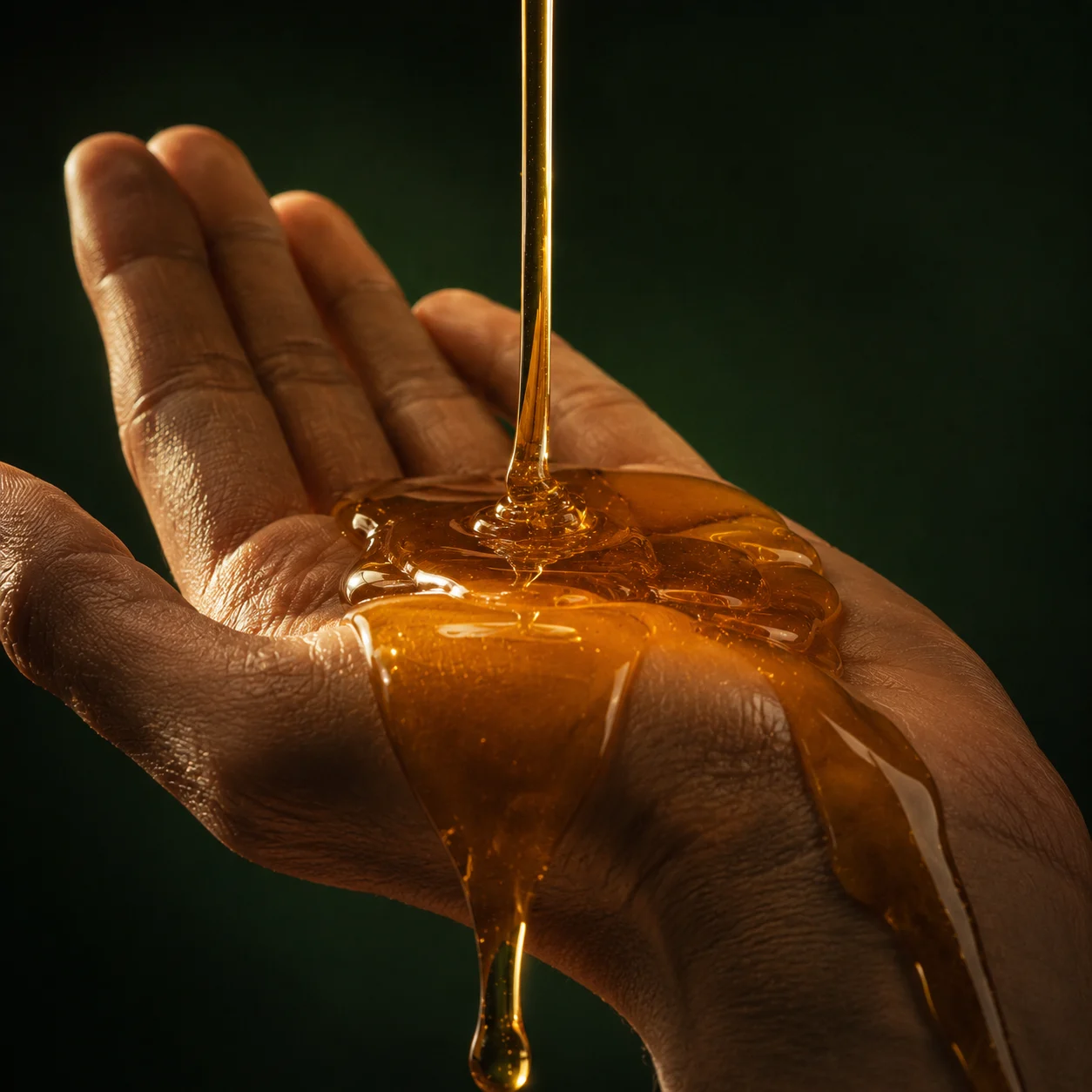
Honey appears in the Ebers Papyrus as a therapeutic agent in numerous preparations — as a carrier for other medicinal ingredients, as a topical treatment for wounds and burns, as a remedy for skin conditions and infections. The Egyptian physicians who compiled these remedies did not know about hydrogen peroxide or water activity or microbial growth. They knew that honey healed wounds faster than leaving them untreated. They knew that wounds dressed with honey did not putrefy the way wounds left uncovered did. They observed outcomes and recorded them with the discipline of empiricists — which is exactly what they were.
And honey and beeswax were used in embalming — the process of preserving human bodies that the Egyptians developed to a sophistication that modern science still finds remarkable. In 2026, a team analyzing nine mummies at the Egyptian Museum in Cairo found that the scent compounds in the embalming materials were still measurable using mass spectrometry — aromatic signatures preserved for over two thousand years. The Egyptians understood preservation. And honey was part of their toolkit for it.
V — Maybe We Are the Ones Who Are Behind
The question is worth asking seriously, without romanticising the answer.
A civilisation that aligned the Great Pyramid of Giza to true north with an accuracy that our best modern surveying instruments would struggle to improve upon. A civilisation whose architects designed structures that have withstood four thousand years of earthquakes, floods, and human intervention — while most modern buildings are designed for a lifespan of fifty years. A civilisation that developed one of the world’s first writing systems, one of the world’s first organised medical traditions, and one of the world’s first managed agricultural systems.
And this same civilisation — without a single concept from modern biochemistry — understood that honey healed wounds, that honey could be placed in a sealed container and retrieved thousands of years later unchanged, that the bee was something sacred and the honey it produced was something that defied the ordinary logic of organic matter.
They were not guessing. They were observing, over centuries, what worked. And honey worked. It worked so consistently, so reliably, so inexplicably by the standards of everything else they knew, that they elevated it to the sacred and placed it in the tombs of their gods-on-earth as the most fitting provision for eternity.
We have since explained the hydrogen peroxide and the water activity and the pH. We have given names to what they observed. But the honey in the jar — the actual substance, the actual product of bees and flowers and the brief flowering of a tree that returns year after year — is the same as it was when Tutankhamun’s embalmers sealed those alabaster jars three thousand years ago.
We did not improve it. We have not improved it. We have explained it. But the explanation is not the honey. The honey was already there. And it was already perfect.
The Egyptian Observation — Still True
Apply honey to a wound. Seal honey in a dry jar. Use honey instead of sugar in a recipe that needs to keep. These are not ancient superstitions. They are empirical observations that the Egyptians made before we had the science to explain them — and that the science has since confirmed entirely.
VI — The Same Honey, Three Thousand Years Later
The Sidr tree — شجرة السدر, Ziziphus spina-christi — grows in Egypt. It grows along the Nile Valley and in the arid zones of the eastern Egyptian desert. It grew there in 1323 BCE, when Tutankhamun’s tomb was being sealed. The honey that was placed in that tomb may well have included Sidr honey — the same species, the same tree, the same brief annual bloom that produces something extraordinary from something brief.
The honey in the Ebers Papyrus remedies came from Egyptian bees foraging on Egyptian flowers. Some of those flowers grew on the Sidr trees that lined the Nile’s edge. The connection is not a marketing claim. It is botanical continuity across three thousand years of human history.
The jar of Sidr honey on a table in Dubai or Abu Dhabi today — sealed, raw, unheated — will keep indefinitely for exactly the same reasons as the honey in Tutankhamun’s tomb. Not because we have engineered it better. Because the bees have always known how to do this. And the tree has always given them what they needed.
Questions About Honey and Ancient Egypt
Honey — and other organic provisions — was placed in Tutankhamun’s tomb as part of the Egyptian funerary tradition of providing for the deceased in the afterlife. Chemical analysis of organic material from sealed Egyptian tomb contexts has confirmed that honey can remain intact for thousands of years. The specific detail that archaeologists tasted the honey and found it perfect is widely repeated but lacks a verified primary source in Carter’s excavation records. What is confirmed: sealed honey was present, and the chemistry that preserves honey indefinitely is real and well-documented.
Three overlapping properties make honey almost impossible for bacteria and fungi to colonise. First, extremely low water activity (around 0.5–0.6) — most bacteria need above 0.91 to grow. Second, significant acidity (pH 3.2–4.5) — hostile to most microbial life. Third, glucose oxidase added by bees produces hydrogen peroxide when honey encounters moisture — a natural antiseptic. Together, these three defenses create an environment that prevents spoilage indefinitely, as long as the honey is sealed and kept dry. This is why ancient sealed honey remains intact.
The Ebers Papyrus — one of the oldest medical texts known, dating to approximately 1550 BCE — lists honey in numerous therapeutic preparations. Egyptian physicians applied it topically to wounds and burns (exploiting its antimicrobial properties empirically, without knowing the chemistry behind them), used it as a carrier medium for other medicinal ingredients, and prescribed it for digestive and skin conditions. Honey and beeswax were also used in embalming. Egyptian medical practice around honey was empirically based — they observed outcomes and recorded them — and modern science has confirmed the basis of what they observed.
The bee (bjt in Egyptian hieroglyphs) was the symbol of Lower Egypt from at least 3500 BCE. When Upper and Lower Egypt were unified, the pharaoh took the title nsw-bjt — “he who unites the sedge and the bee” — which persisted for three thousand years of Egyptian history. The association went deeper than geography: Egyptian mythology described bees as the tears of the sun god Ra, giving the bee and its honey a sacred origin. Honey appeared as tribute to the pharaoh, as offering to the gods, and as provision in royal tombs. The bee was not merely an economic symbol but part of the divine identity of Egyptian kingship.
The oldest documented honey is from the Borjomi region of Georgia (the country), where honey approximately 5,500 years old was discovered. Egyptian tomb honey from various sites dates to approximately 3,000–3,300 years ago. The oldest evidence of humans collecting honey — from cave paintings in Valencia, Spain — dates to approximately 8,000 years ago. Organised, state-managed beekeeping first appears in ancient Egypt around 2,400 BCE. Fossil records show honeybees themselves have existed for over 150 million years.
Yes. Honey and beeswax were components of Egyptian embalming practice. The same preservation properties that keep honey intact in a sealed jar — antimicrobial activity, low moisture, acidity — also contribute to the preservation of organic tissue. Egyptian embalmers used honey and wax alongside other resins and oils in their preparations. In 2026, chemical analysis of nine mummies at the Egyptian Museum in Cairo found that aromatic scent compounds in the embalming materials were still measurable after more than two thousand years — a testament to the sophistication of Egyptian preservation knowledge.
The Sidr tree — Ziziphus spina-christi — grows in Egypt and has for millennia. It grows along the Nile Valley and in arid zones of the eastern Egyptian desert. Egyptian bees foraging during the ancient period would have found Sidr blossoms among the nectar sources available to them. Whether the specific honey in Tutankhamun’s tomb was Sidr honey cannot be confirmed without detailed pollen analysis of whatever organic residue survives. What can be said is that the tree existed in Egypt, the bees existed in Egypt, and the Sidr honey tradition in the Arabian Peninsula and North Africa predates any written record we have access to.
It means that genuine raw honey — unheated, unsealed from excessive moisture — does not expire. Not practically. The jar of raw Sidr honey from Hatta or Hadhramaut on your shelf in Dubai will keep indefinitely under the same conditions that kept Egyptian tomb honey intact for three millennia: sealed, dry, room temperature. It may crystallise over time — that is a natural process, not spoilage — and the crystals can be returned to liquid by gentle warming below 40°C. The product itself does not require a best-before date. The Egyptians who put it in Tutankhamun’s tomb were right about that.
Honey That Has Not Changed in 3,000 Years
The chemistry that kept honey intact in Egyptian tombs is the same chemistry in every jar of genuine raw Sidr honey from Hatta or Hadhramaut today. No additive, no preservative, no technology. Just what bees have always produced, from a tree that has always bloomed, in the same mountains of the Arabian Peninsula that fed the caravans of the ancient world.
Explore the range