
Heritage Series — The Meski Journal
Ibn Battuta:
The Explorer Who Tasted This Honey
Born in Tangier, Morocco. Crossed Yemen, Oman, and Arabia on foot and by sea. Walked the same roads as بلقيس — the Queen of Sheba — seven centuries later. And almost certainly tasted the same عسل السدر that exists today.
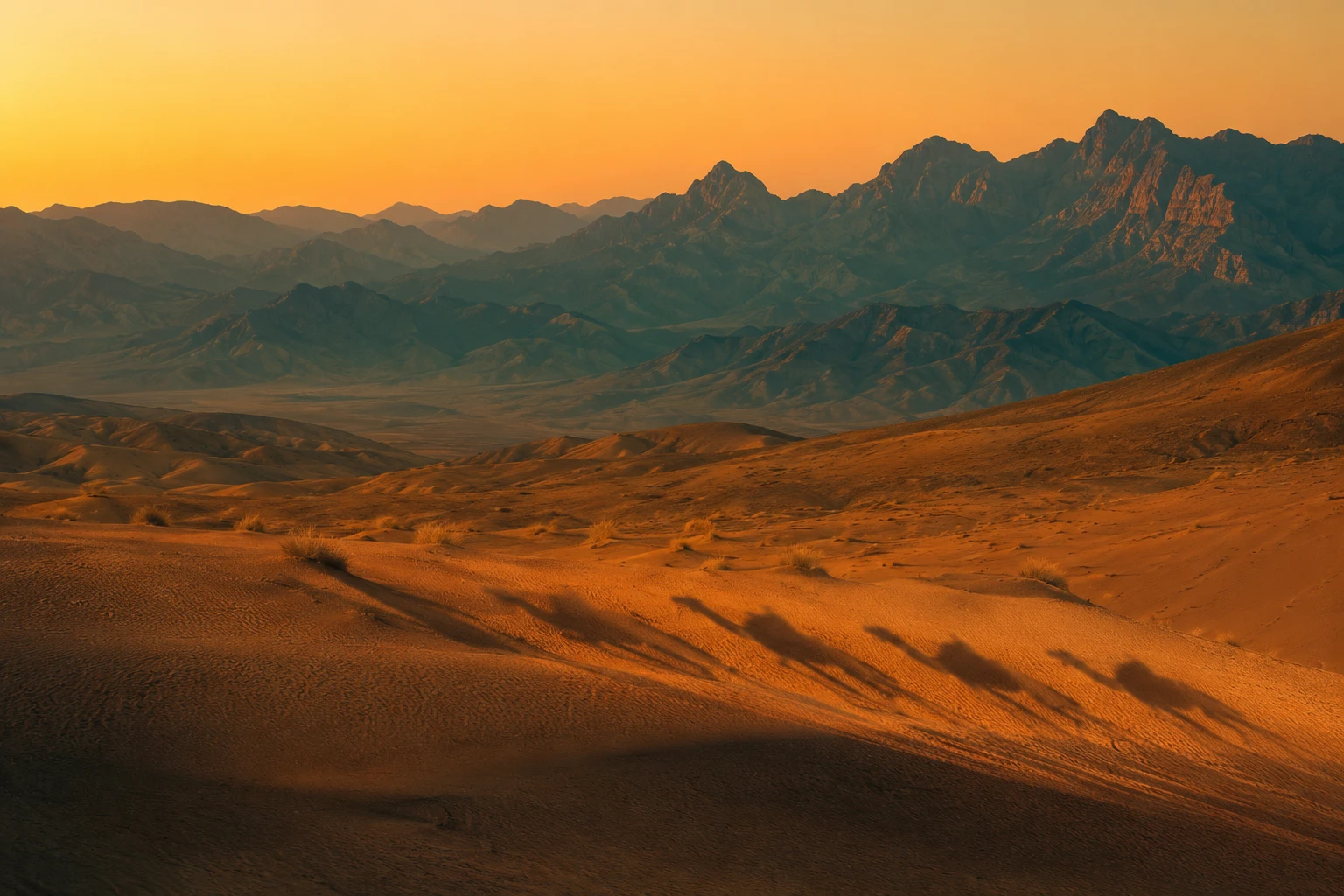
In Dubai, there is a shopping mall named after him. Most people who walk through its doors have a vague sense that Ibn Battuta was a famous traveller from somewhere in the past — someone important enough to have his name on a building in one of the world’s most modern cities. Very few know his full story. Very few know that this Moroccan scholar, who set out from Tangier in 1325 at the age of twenty-one and did not return home for almost thirty years, walked through the same mountain valleys of Yemen and Oman where the finest Sidr honey — عسل السدر — has been produced for three thousand years. He did not write about the honey. But he could not have passed through those valleys without encountering it — any more than a traveller through Burgundy in the fourteenth century could pass through without encountering wine.
I — A Man Who Could Not Stay Home
Abu Abdullah Muhammad ibn Battuta was born on 24 February 1304 in Tangier, Morocco — then part of the Marinid Sultanate. His family were scholars of Islamic law. He was educated as a jurist. He had, by any reasonable expectation, the kind of future that unfolds in libraries and courtrooms, not on the open sea.
He left Tangier at twenty-one to perform the Hajj. He intended to be gone for months. He was gone for twenty-nine years. By the time he returned to Morocco in 1354, he had covered approximately 120,000 kilometres — more than Marco Polo, more than any other traveller of the medieval world. He had visited the equivalent of 44 modern countries. He had served as a judge in Delhi, as a diplomatic envoy to China, as a guest of the Khan of the Golden Horde in the steppes north of the Caucasus. He had been shipwrecked, robbed, threatened by pirates, caught in the Black Death in Damascus where he witnessed 2,400 deaths in a single day, and had married — and left — multiple wives in multiple countries.
When he finally returned to Morocco, the Sultan ordered him to dictate his travels to a young scholar named Ibn Juzayy. The result was the Rihla — تحفة النظّار في غرائب الأمصار وعجائب الأسفار — formally titled “A Gift to Those Who Contemplate the Wonders of Cities and the Marvels of Travelling.” It is one of the most important documents of medieval world history. It is also one of the most vivid. Ibn Battuta wrote the way a curious man observes: with attention to food, to markets, to local customs, to the specific texture of places — not just their political or religious significance.
120,000
Kilometres travelled — more than any other medieval explorer, three times the circumference of the Earth
29
Years away from home — setting out at 21, returning at 50
44
Modern countries visited, including Yemen, Oman, and the Arabian Peninsula repeatedly
II — The Roads He Walked
Ibn Battuta crossed the Arabian Peninsula multiple times. His routes through Yemen and Oman are documented in the Rihla with the specificity of a man who was there — not a man summarising reports from others.
In 1328, he sailed from Jeddah down the Red Sea coast to Yemen, crossed the country by land, and set sail from Aden toward East Africa. His return journey — in 1332 — took him back through southern Arabia and Oman, through Dhofar, through Hormuz, and across the Persian Gulf to Mecca.
In 1347, returning from China via the Indian Ocean, he arrived at Dhofar after twenty-eight days at sea — the same Dhofar that Ibn Battuta himself described in the Rihla as a place where “the people are traders, and when a ship arrives, everyone on board is granted hospitality for three days.”
These are not abstract geography. Dhofar sits at the southern edge of Oman, on the border with Yemen. The mountain range that forms its backdrop — the Dhofar mountains — is part of the same geological system that extends westward into Hadhramaut, where the Wadi Do’an produces the world’s most celebrated Sidr honey. The Sidr tree grows in both territories. The beekeeping traditions in both territories trace back further than any written record can follow.
Ibn Battuta walked and sailed through this entire arc of territory — from Aden to Dhofar, from the mountains of Yemen to the coast of Oman. The same routes that caravans had used for a thousand years before him. The same routes that continued to be used for centuries after.
III — The Same Roads as Bilqis
There is a detail in the Quran that connects Ibn Battuta’s journey to a story that predates him by two thousand years.
In Surah An-Naml — the Chapter of the Ant — it is a hoopoe bird, الهدهد, that brings the Prophet Solomon news of the Queen of Sheba and her kingdom. The hoopoe is a real bird, native to the Arabian Peninsula and Yemen. It is a bird that Ibn Battuta would have seen — and did see — in his travels through the same territories.
The connection is not mystical. It is geographical. Ibn Battuta walked through the same mountain terrain that the caravans of Bilqis — بلقيس, the Queen of Sheba — had crossed going in the opposite direction two thousand years before him. She went north, toward Jerusalem, carrying gold and frankincense and the honey of the Sidr tree as tribute to Solomon. He went south and east, following the routes of trade and faith that had remained largely unchanged for millennia.
The Sidr trees that produced honey for the Queen of Sheba’s caravans still grew in those valleys in the fourteenth century when Ibn Battuta passed through. The beekeeping families of Hadhramaut were already, in 1328, doing what their predecessors had done for generations. The honey existed. The routes existed. The tradition existed. Ibn Battuta passed through it all — a Moroccan scholar with an insatiable curiosity, following the same roads that a Yemeni queen’s caravans had carved into the desert centuries before his birth.
She went north with her caravans. He went south with his curiosity. The roads were the same. The honey was the same. Only the direction and the century had changed.
IV — What He Actually Tasted Along the Way
Ibn Battuta was a man who paid attention to food. The Rihla is full of descriptions of what he ate, what he was served by his hosts, what impressed him and what did not. He tried mango in the Indian subcontinent and compared it to an apple. He described sun-dried fish in Oman. He noted the hospitality customs of Dhofar, where arriving travellers were fed for three days without being asked.
In the markets of Aden and Hadhramaut and along the Arabian coastal trade routes, honey was not an exotic or rare commodity. It was a staple of hospitality, medicine, and commerce. Arab hosts served honey to guests as a matter of course — as naturally as bread was served in other cultures. A scholar who spent three days as a guest of local rulers in the cities of southern Arabia would have been offered honey. It is not speculation — it is what the hospitality culture of the region demanded, and what the Rihla’s own descriptions of Arab hospitality confirm.
What honey would he have been served? In Yemen and Oman in the fourteenth century, in the mountain valleys of Hadhramaut and the markets of Dhofar, the honey of prestige and of hospitality was Sidr honey — عسل السدر. The same honey that the markets of Dubai and Sharjah today sell as a luxury product was, in the world Ibn Battuta travelled through, simply what fine honey meant.
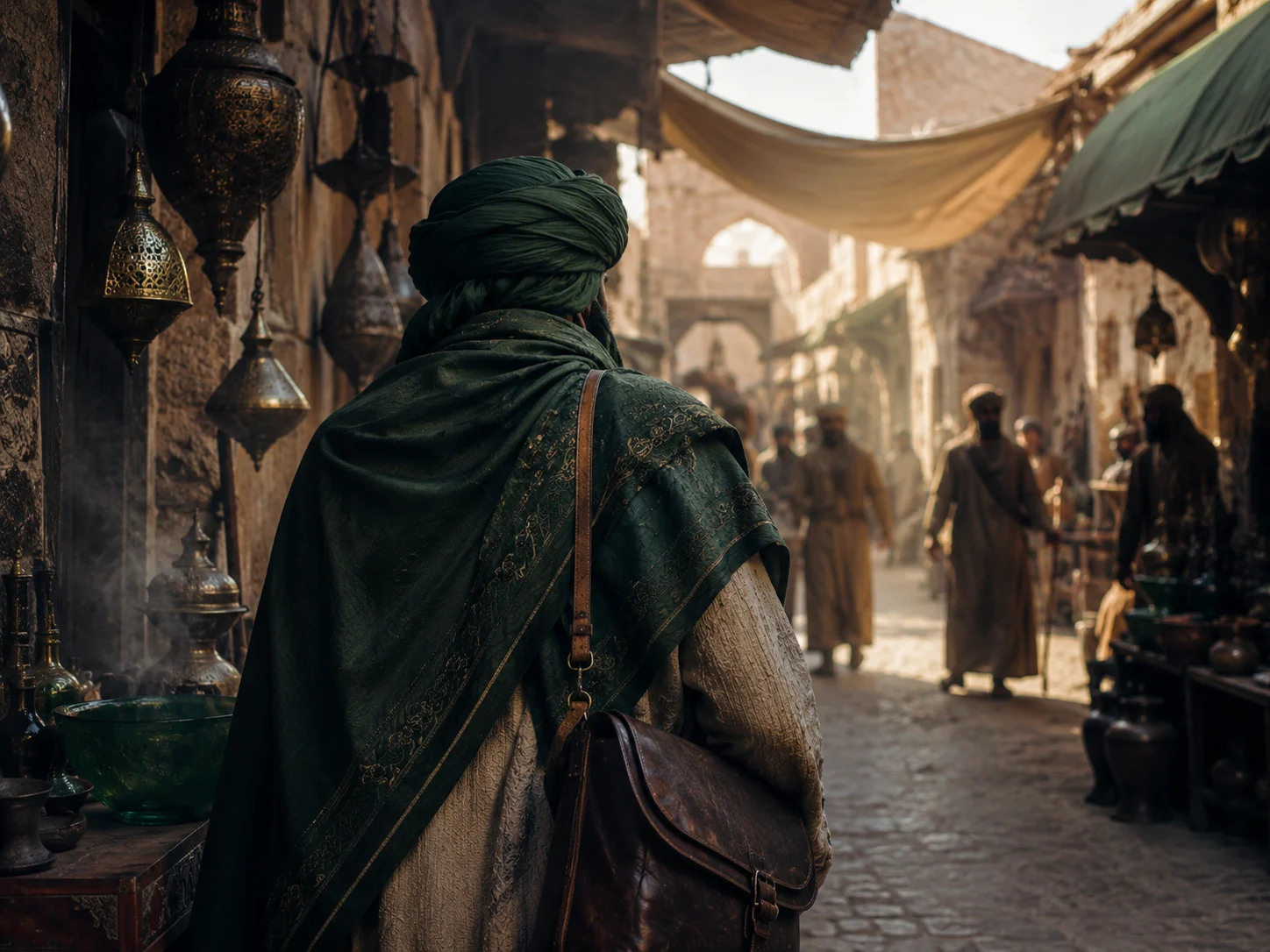
V — From Tangier to Sharjah: The Circle That Closes
Ibn Battuta died in Morocco — in Marrakesh, around 1368 or 1369 — without having written his Rihla himself. He dictated it to Ibn Juzayy from memory, a man recounting twenty-nine years of travel without a single journal to consult. That the result is as detailed and vivid as it is says something about the quality of his attention. He did not just pass through places. He absorbed them.
He was Moroccan. Born in Tangier, in the far northwest of the Arab world. He came from the same tradition — the Arabic language, Islamic scholarship, the intellectual culture of the Maghreb — that shaped the Ksar Meski in Morocco’s Tafilalet, the village whose name and heritage live in the Meski brand today.
And here, in Sharjah in the Emirates, a honey company carries a name from a Moroccan ksar — مسكي — and sources honey from Yemen, Oman, the Hatta mountains of the UAE: the same arc of territory that Ibn Battuta travelled through seven centuries ago, describing the hospitality, the markets, the trading culture of the Arabian Peninsula with the eye of a man who noticed everything.
He would have recognized the honey. He would have recognized the routes. He might even have recognized the tree — the Sidr, شجرة السدر, whose thorned branches appear in the Quran, whose flowers produce a honey that has not changed in three thousand years, whose name is as old as the civilization that gave him his language and his faith.
The world Ibn Battuta travelled through is gone. The roads have changed. The kingdoms he visited have dissolved and reformed and dissolved again. But the tree flowers every year. And the honey it gives is the same honey.
Ibn Battuta in Dubai
The Ibn Battuta Mall in Dubai — opened in 2005 — is divided into six courts, each representing a region he visited: Tunisia, Andalusia, Egypt, Persia, India, and China. The Arabian Peninsula — Yemen, Oman, the Gulf — is not a separate court, perhaps because it is not a foreign destination. It is the home ground of the tradition he travelled within. The honey of these territories was not something he discovered. It was something he already knew, from a culture that had known it for a thousand years before he was born.
Questions About Ibn Battuta
Ibn Battuta (1304–1368/69) was a Moroccan scholar and explorer who travelled approximately 120,000 kilometres over twenty-nine years — more than any other medieval traveller. Born in Tangier, he set out initially to perform the Hajj and never stopped travelling. He visited the equivalent of 44 modern countries, served as a judge in Delhi, and was sent as a diplomatic envoy to China. His Rihla — dictated from memory after his return to Morocco — is one of the most important documents of fourteenth-century world history, providing first-hand accounts of societies, markets, food, customs, and political conditions across the Islamic world and beyond.
Yes, multiple times. In 1328, he sailed from Jeddah to Yemen, crossed the country by land, and departed from Aden. His return journey in 1332 took him through southern Arabia and Oman, including Dhofar — which he describes in the Rihla with characteristic detail. In 1347, returning from China via the Indian Ocean, he arrived at Dhofar again after twenty-eight days at sea. He described the markets, the trading culture, and the hospitality of these territories with the attention of someone who was genuinely present and genuinely curious.
Both travelled the same mountain routes of Yemen and southern Arabia — separated by approximately two thousand years. The Queen of Sheba (Bilqis — بلقيس) travelled north with her caravans, carrying the products of her kingdom — including Sidr honey — toward Jerusalem and Solomon. Ibn Battuta travelled south and east through the same territory, following the trade and pilgrimage routes of the medieval Islamic world. The Sidr trees that produced honey for the Sabaean caravans still grew in Hadhramaut and Dhofar when Ibn Battuta passed through in the fourteenth century.
The Ibn Battuta Mall, opened in Dubai in 2005, celebrates the explorer’s journeys through its six themed courts: Tunisia, Andalusia, Egypt, Persia, India, and China. The mall’s name reflects Dubai’s position as a modern intersection of the trade routes that Ibn Battuta travelled — the same routes that have connected Morocco, the Arabian Peninsula, Persia, India, and beyond for over a thousand years. Ibn Battuta himself never visited what is now the UAE, but the trading culture of the Gulf region was deeply familiar to him from his repeated journeys through Yemen and Oman.
The Rihla — formally titled “A Gift to Those Who Contemplate the Wonders of Cities and the Marvels of Travelling” — is the travel account that Ibn Battuta dictated from memory after returning to Morocco in 1354. He dictated it to the scholar Ibn Juzayy under the patronage of the Marinid Sultan. It chronicles his journeys from 1325 to 1354 across approximately 120,000 kilometres of the known world. The Rihla provides first-hand descriptions of markets, food, politics, religion, hospitality customs, and geography across four continents — including vivid accounts of the Arabian Peninsula, Yemen, and Oman that remain historically invaluable.
Ibn Battuta passed through the same mountain territories of Yemen and Oman where Sidr honey has been produced for three thousand years. In the fourteenth century, as today, the honey of these regions — particularly Hadhramaut and Dhofar — was the honey of hospitality and prestige. Arab hosts in the territories he visited served honey to guests as a matter of cultural protocol. The Rihla confirms the hospitality customs of Dhofar, where visitors were fed for three days upon arrival. What they were served included, almost certainly, the Sidr honey that those mountain valleys have always produced. The same tree. The same tradition. Seven hundred years later.
The Same Honey. Seven Hundred Years Later.
The Sidr honey from the Hatta mountains — 105 kilometres from the Dubai mall that bears Ibn Battuta’s name — comes from the same tree species that grew in the territories he crossed. The Sidr honey from Yemen that we source at Meski comes from the same Hadhramaut valleys he passed through on his way to and from Aden. Nothing about the tree has changed. Nothing about the honey has changed. Only the world around them.
Explore the range