
The Meski Reference — Honey Academy
The World of Sidr Honey
One tree. Dozens of countries. Thousands of years of history. The most complete guide to عسل السدر ever written — from the mountains of Yemen to the wadis of Hatta, from the bees that make it to the hands that harvest it.
There is a honey that has been traded across the Arabian Peninsula for three thousand years. A honey mentioned — its source tree, at least — in the Quran, in ancient Egyptian medical texts, in the travel journals of Ibn Battuta. A honey that commands prices between $250 and $500 per kilogram in its finest form, and that has been counterfeited so extensively that an entire science of authentication has grown up around it. This is Sidr honey — عسل السدر. And most of what is written about it, even by people who sell it, barely scratches the surface of what it actually is. This guide goes further.
Chapter I — The Tree That Started Everything
Before there is honey, there is a tree. And before you can understand why Sidr honey is different from every other honey, you need to understand why the Sidr tree is different from every other tree.
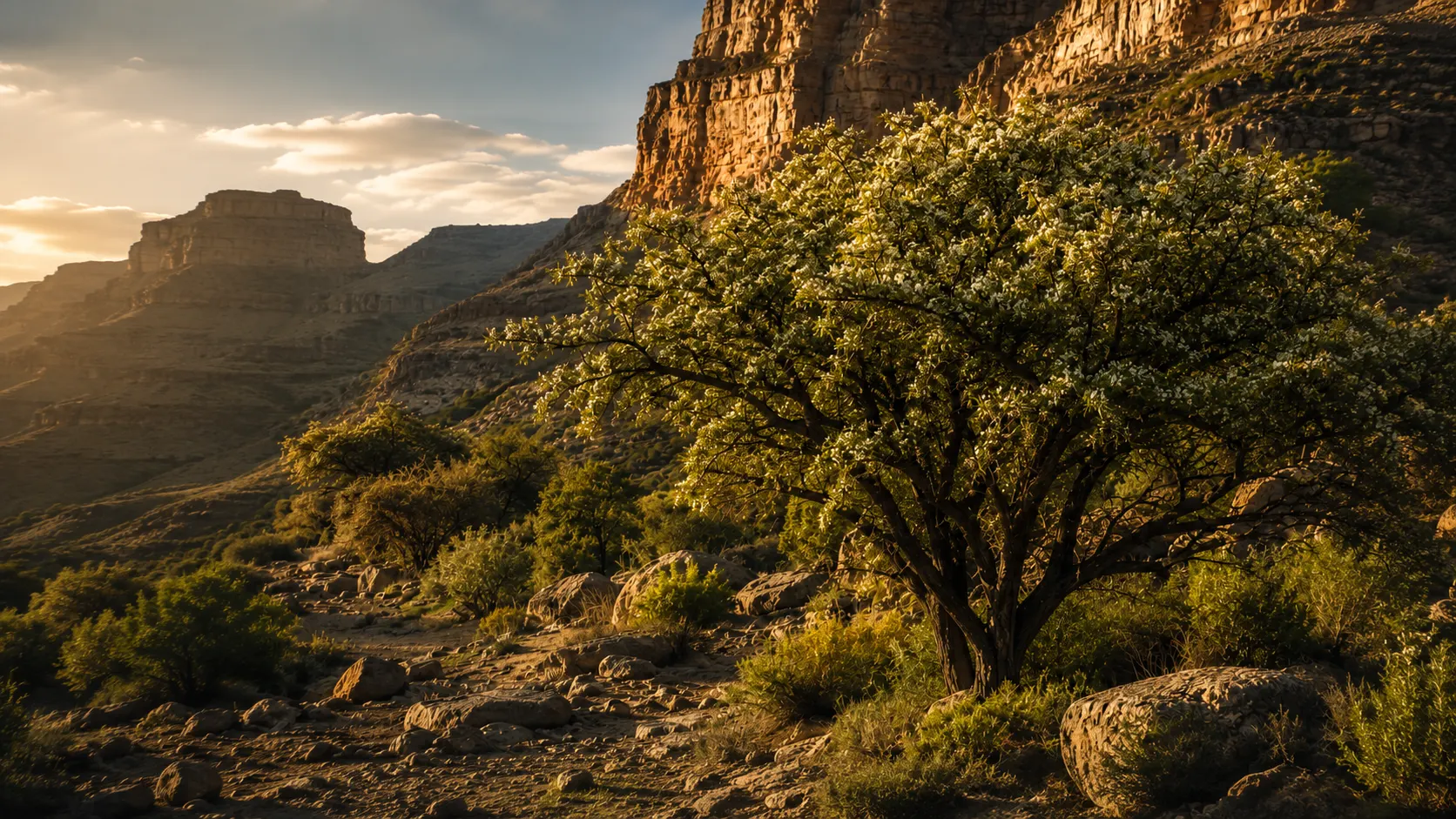
Ziziphus spina-christi — known in Arabic as شجرة السدر, the Sidr tree — belongs to the Rhamnaceae family. It is thorned, ancient, drought-resistant to a degree that defies easy explanation. In the mountains of Yemen it grows at altitudes between 1,500 and 2,800 metres above sea level, in soil that is almost pure limestone — calcareous, arid, inhospitable to almost everything else. In the wadis of the UAE, it grows on rocky slopes in temperatures that exceed 45°C in summer. In the Tafilalet of Morocco, it survives in the pre-Saharan zone where rainfall is almost a theoretical concept.
In every one of these environments, the tree does the same remarkable thing: it flowers. Briefly, once or sometimes twice a year, for a period of four to six weeks — and in that brief window, the Sidr produces small white flowers with a nectar so concentrated, so aromatic, so chemically distinct that the bees that find it produce something that has no industrial substitute and no authentic imitation.
The tree is mentioned in the Quran in several contexts — most memorably in Surah Al-Waqi’a, where Sidr trees with thornless branches (سِدْرٍ مَّخْضُودٍ) are described among the gifts of paradise. This is not incidental. The tree was so deeply woven into the fabric of Arabian culture, medicine, and daily life that it entered sacred text naturally — the way wheat or water enters sacred text in other traditions.
The Sidr Tree — Fast Facts
Family: Rhamnaceae · Latin name: Ziziphus spina-christi · Arabic: شجرة السدر · Flowering season: 4–6 weeks, once or twice yearly · Range: Arabian Peninsula, North Africa, South Asia · Altitude in Yemen: 1,500–2,800 metres · Also known as: Jujube tree, Lote tree
Chapter II — Three Thousand Years of History
Sidr honey is not a recent discovery with clever marketing. It is among the most continuously documented foods in human history.
The Ebers Papyrus — the ancient Egyptian medical text dating to approximately 1550 BCE — lists remedies using honey from the Sidr tree for wound treatment and digestive ailments. Egyptian physicians understood, without the vocabulary of modern biochemistry, that this honey behaved differently from other honeys. They were right.
The Kingdom of Saba — the ancient Yemeni civilisation that controlled the frankincense and myrrh trade routes across the Arabian Peninsula — produced Sidr honey in the same mountain valleys where it is still harvested today. The caravans of the Queen of Sheba, Bilqis — بلقيس — carried it alongside gold and spices on their routes toward Jerusalem and beyond. It was not cargo. It was tribute. The kind of thing you bring to a king to show him the best your kingdom produces.
Ibn Battuta — the fourteenth-century Moroccan explorer who travelled 120,000 kilometres across the known world — crossed the same mountain routes of Yemen and Oman where Sidr honey has always been harvested. He visited Aden and Dhofar, described the markets of Hadhramaut, encountered the trading routes that had carried Sidr honey for a millennium before his arrival. He did not write about the honey specifically — but he could not have passed through those valleys without encountering it, any more than a traveller through Burgundy in the fourteenth century could pass through without encountering wine.
The tradition that Ibn Battuta encountered in those mountain valleys continues today, largely unchanged. Families in Wadi Do’an have been keeping bees in the same locations, using similar traditional methods, for generations that reach back further than anyone can accurately count.
3,500+
Years of documented Sidr honey use — from Egyptian papyri to today
40,000
Rural Yemeni households whose livelihoods depend on Sidr honey production
$500
Maximum price per kilogram for authenticated Do’ani Sidr from Hadhramaut
Chapter III — Terroir: Why the Same Tree Produces Different Honey
The word terroir comes from the world of wine. It simply means: the way a place — its soil, its altitude, its climate, its surrounding flora — changes what grows there. The same grape variety planted in Bordeaux and in Napa Valley produces fundamentally different wines. Not better or worse. Different. The place writes itself into the product.
The same principle applies to Sidr honey with striking clarity. The Ziziphus spina-christi tree growing in Wadi Do’an in Yemen produces a honey that is demonstrably different from the Ziziphus spina-christi growing in the Hatta mountains of the UAE — same species, same flower, profoundly different result. Understanding why is the beginning of understanding Sidr honey properly.
What Changes the Honey
Altitude. The Sidr trees of Hadhramaut in Yemen grow between 1,500 and 2,800 metres above sea level in calcareous mountain terrain. At this altitude, the air is cooler, the seasons more defined, and the soil’s mineral composition — dominated by calcium-rich limestone — produces a nectar that is exceptionally concentrated. The resulting honey has a moisture content that frequently falls below 17%, compared to the 18–20% typical of most commercial honeys. Lower moisture means more intense flavour, greater density, and a shelf life that approaches the indefinite.
Soil composition. Calcareous soil — high in calcium carbonate — affects the mineral content of the nectar the tree produces. This is not visible to the eye but measurable in the laboratory, and perceptible to a trained palate. Yemeni Sidr from limestone mountain terrain has a mineral depth — a slight earthiness beneath the sweetness — that lowland or sandy-soil Sidr does not replicate.
Surrounding flora. In the remote valleys of Hadhramaut, the Sidr trees grow largely in isolation from other flowering plants during the brief bloom season — which is why Yemeni Sidr can genuinely claim monofloral status. In regions where the Sidr blooms alongside acacia, thyme, or other desert flowers, the bees inevitably visit multiple sources, creating a honey that is more complex but less purely Sidr in character.
Harvest season. The Sidr tree flowers once or twice yearly depending on the region. In Yemen, the primary harvest is in autumn. In the UAE’s Hatta mountains, the harvest runs from October to November. In Morocco’s Tafilalet, the cycle is different again. Honey harvested at the beginning of the flowering season differs from honey harvested at its peak — the early harvest is often lighter in colour and more floral; the peak harvest darker, denser, more intensely aromatic.
Chapter IV — Country by Country: The Sidr World Map
Sidr honey is produced across an arc of territory stretching from Morocco in the west to Pakistan in the east. Each producing region has its own character — its own version of the same story, told in a different accent.
Yemen is the undisputed reference point for Sidr honey worldwide. Within Yemen, Wadi Do’an in the Hadhramaut Governorate produces what is considered the world’s finest Sidr — the Do’ani honey, harvested at altitudes between 1,500 and 2,800 metres from trees growing in pure calcareous soil, by bees that forage on almost nothing else during the bloom season. The flavour profile is distinctive: caramel and butterscotch are the notes most commonly used, with a warm, woody depth and a finish that lingers for minutes on the palate. A second major production region is Al-Ussaimat in Amran Governorate north of Sanaa — different altitude, different microclimate, a honey that is slightly more floral and complex. Both are genuinely extraordinary. Both command prices that reflect genuine rarity.
The Hatta mountains — a UAE enclave on the border with Oman, 105 kilometres from Dubai — produce the only Sidr honey with fully verified Emirati provenance. The harvest runs from October to November. The flavour is rich and buttery, sweeter and lighter than Yemeni Sidr, with a golden colour that darkens gradually over time and an aroma described as reminiscent of the Sidr flower itself — pungent, warm, distinct. Hatta Sidr honey bees forage on Sidr trees alongside wild acacia and desert thyme, giving the honey a slightly more complex multi-floral character than pure Do’ani. London Honey Awards 2022 recognised Emirati Sidr — an external validation from an institution that evaluates blind, without knowledge of the story behind each jar.
Oman produces Sidr honey in its Hajar mountain range — the same geological formation that extends into the UAE’s Hatta region — and in the southern Dhofar region, which Ibn Battuta visited in the fourteenth century and described as rich in frankincense and natural abundance. Omani Sidr sits between Yemeni and Emirati honey in character: deeper and more aromatic than Hatta, somewhat lighter than Hadhramaut’s most intense expressions. Less internationally known than Yemeni Sidr but respected by serious honey buyers in Gulf markets.
Saudi Sidr production is geographically diverse — from the Hijaz mountain region in the west (higher mineral content, robust character) to the northern regions (lighter consistency, milder flavour). The most prestigious Saudi Sidr comes from Taif and the Asir region in the southwest, where traditional apiaries — some maintained by the same families for over 500 years — produce honey in log hives that command significantly higher prices than modern Langstroth-hive production from the same trees. The old apiaries in Taif represent one of the most continuous traditions of formal beekeeping documented in Arabic literature.
The Sidr tree grows wild in Morocco’s Tafilalet region — the valley of the Ziz river in the pre-Saharan south — and in parts of the Atlas foothills. Moroccan Sidr honey is lighter and more floral than its Yemeni counterpart, with a sweetness that is less intense and a profile that reflects the Atlantic-influenced climate and the soil composition of North African semi-arid terrain. It is not trying to be Yemeni Sidr. It is a different expression of the same source — a different poem in the same language. Wild, unmanaged, gathered by hand from hives positioned in the same valleys where Arab families from Yemen settled a thousand years ago and found, to their surprise, a tree they already knew.
Pakistani Sidr honey — particularly from Kashmir and the northern mountain regions — has gained recognition in Arab markets as a credible alternative to Yemeni Sidr at a significantly lower price point. Its consistency is thick, its flavour distinctly floral in a way that Yemeni Sidr is not — more perfumed, less earthy. It does not replicate the character of Do’ani Sidr, and serious buyers are not confused between the two. But for those seeking the Sidr flavour experience at an accessible price, Pakistani production offers a genuine product with honest characteristics.
Chapter V — The Bees: Why They Matter More Than Most People Know
Most honey buyers think about the flower. Very few think about the bee. This is a significant gap in understanding, because the bee species — and subspecies — making the honey changes what ends up in the jar in ways that are real, measurable, and important.
The native bee of the Arabian Peninsula and Yemen is Apis mellifera jemenitica — sometimes called the Arabian or Nubian honey bee. It is classified as a tropical African bee group. It is smaller than European commercial bee subspecies. It produces less honey per colony per season. And it is extraordinarily well adapted to the extreme climatic conditions of its native environment — surviving and foraging in temperatures that would shut down European bee activity entirely.
The difference in honey yield is real: scientific comparison studies have shown that imported Carniolan bee colonies (the standard European commercial bee) produce approximately 27% more honey than native Yemeni bee colonies when placed in the same environment. From a commercial perspective, this makes the imported bee economically attractive. From a quality and cultural perspective, this is precisely the problem.
Traditional apiaries in Taif — some maintained by the same family for over five centuries — exclusively use Apis mellifera jemenitica. The honey from these apiaries commands significantly higher prices than honey from the same region produced using imported bees in modern hives. The beekeepers who maintain these traditions understand something that laboratory comparisons confirm: the native bee, producing less, produces something that the imported bee does not. The concentrating effect is different. The foraging pattern is different. The result is different.
The Native Bee — Apis mellifera jemenitica
Native to the southern Arabian Peninsula, Sudan, Somalia, and parts of East Africa. Smaller than European commercial subspecies. Produces approximately 27% less honey per colony. Better adapted to extreme heat — continues foraging in temperatures above 40°C where European bees cease activity. Has been kept in traditional log and clay-pot hives in the same Arabian mountain locations for documented generations exceeding 500 years. The honey it produces is more concentrated, denser, and — according to buyers who have compared both — noticeably different in character from the same flower’s honey made by imported bee subspecies.
Chapter VI — The Harvest: How It Actually Happens
Sidr honey does not arrive in a warehouse on a pallet. In its traditional form, it begins with a beekeeper who has been watching the mountains for signs of the Sidr bloom — a change in the air, a particular quality of light in the afternoon, the first small white flowers on the branches — and who moves his hives accordingly.
In Wadi Do’an and the surrounding Hadhramaut valleys, the beekeepers lead a semi-nomadic existence during the bloom season, moving hives across mountain terrain that road vehicles often cannot access. Transport is on foot or with pack animals. The isolation that makes the honey pure — no pesticides, no industrial agriculture, no competing floral sources — is the same isolation that makes the logistics difficult and the final product genuinely rare.
The Sidr flowers for four to six weeks. During this window, the bees collect nectar that is unusually concentrated — the dry, arid conditions of the mountain terrain mean the nectar evaporates quickly and the bees cap it at a lower moisture content than most other honeys. When the beekeeper judges the combs sealed, he harvests. In traditional practice, the honey is extracted without heat — centrifuged cold — and stored in clay pots that regulate temperature naturally.
This process, in its traditional form, is only possible once per season. The yield per hive is low. The labour is high. The honey that results is, by any honest accounting, worth what serious buyers pay for it.
Chapter VII — How to Taste Sidr Honey Properly
Sidr honey deserves the same attention that wine or single-malt whisky receives — not because tasting it requires expertise, but because approaching it with attention reveals things that casual consumption misses entirely.
Colour — The First Signal
Sidr honey ranges from deep amber to dark mahogany depending on its origin and age. Fresh Yemeni Sidr from Hadhramaut is typically a deep, warm amber — dark but not opaque. Hatta Sidr is often lighter and more golden when fresh, darkening over time. Colour is an indicator of terroir and concentration, not of quality per se. Very dark honey from pure limestone mountain terrain is not better than lighter honey from the same tree growing in coastal terrain — it is different.
Viscosity — What the Spoon Tells You
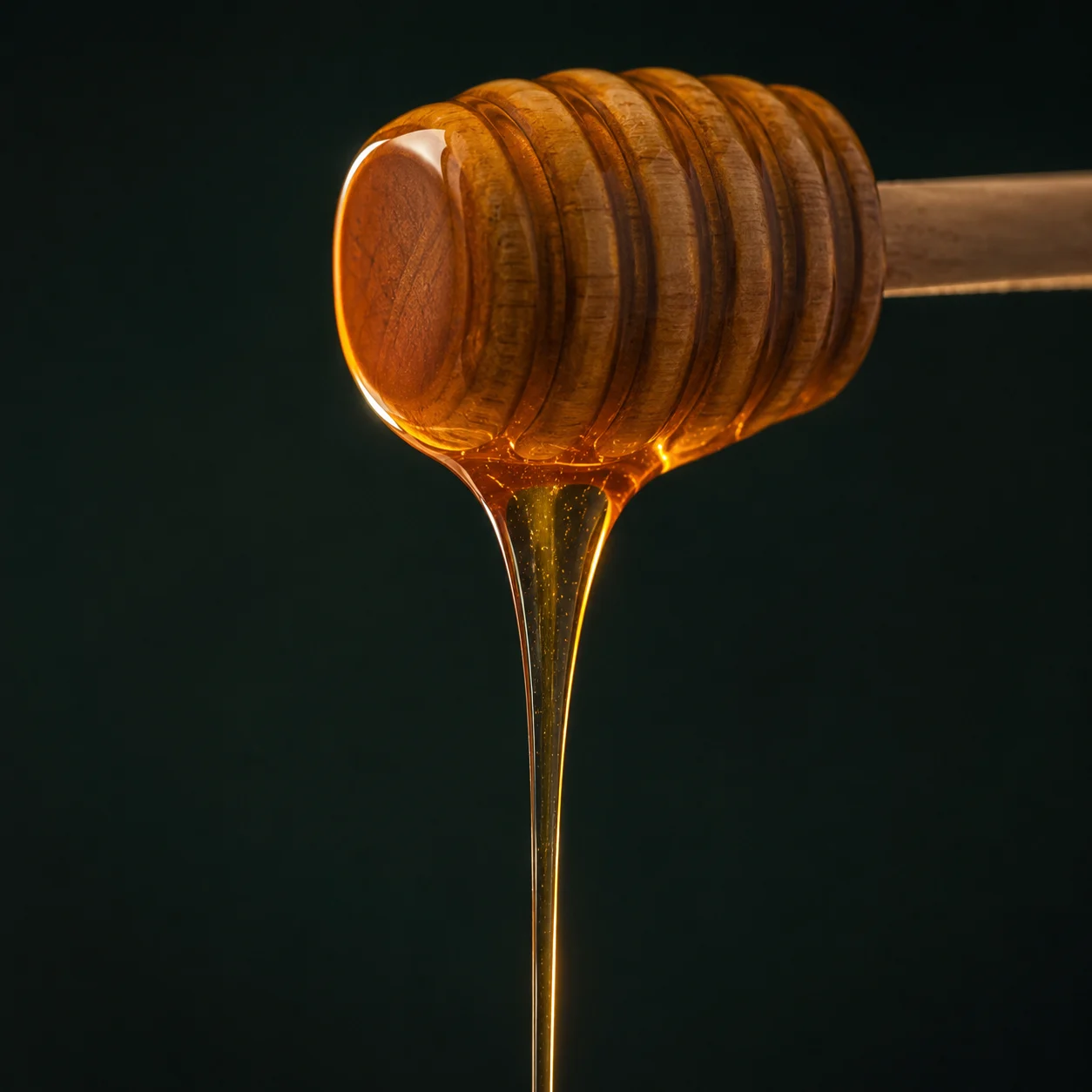
Authentic Sidr honey is dense. When you lift a spoon from the jar, the honey should fall in a slow, continuous rope — not a stream, not a trickle, a rope. If it pours quickly, either the moisture content is too high (suggesting dilution, improper harvest, or poor storage) or it is not genuine Sidr from a premium origin. The low moisture content of authentic mountain Sidr — often below 17% — produces a viscosity that is almost architectural.
Aroma — Before You Taste
Open a jar of genuine Sidr and the scent should reach you immediately. Warm. Slightly woody. A floral sweetness that is distinct from generic floral honey — more complex, more resinous, with something almost animal underneath. If you smell nothing, or if you smell generic sweetness, the honey is either not genuine Sidr or has been heated in processing, which destroys the volatile aromatic compounds.
The Palate — What to Expect
The first impression is sweetness — but not simple sweetness. Almost immediately, a warmth develops on the palate that is characteristic of Sidr: not spicy, not bitter, but warm in the way that good cognac is warm. The caramel-butterscotch notes often described are real and pronounced in good Hadhramaut Sidr. The finish is long — genuinely long. In the finest expressions, the flavour remains on the palate for three to five minutes after swallowing. No other honey does this consistently.
Moroccan and Emirati Sidr will be lighter on the palate — more approachable, less intense, with the floral notes more forward and the woody depth less pronounced. Neither is a lesser honey. They are different honeys from the same tree — and the difference is the whole point of terroir.
Chapter VIII — How to Recognise Genuine Sidr Honey
The premium reputation of Sidr honey has made it one of the most counterfeited foods in the world. In 2023, the UAE Ministry of Climate Change and Environment flagged over 27% of locally marketed Sidr honey samples as mislabelled, diluted, or adulterated. The fraud ranges from simple dilution with cheaper honeys or sugar syrups, to blending small amounts of genuine Sidr with large quantities of other honey, to complete fabrication.
What a serious buyer can verify without a laboratory:
The Spoon Test
Lift a spoon slowly from the jar. Genuine Sidr honey forms a continuous rope that falls in one thread, not multiple drips. Turn the spoon upside down — the honey should hold for several seconds before sliding. A honey that flows quickly or drips immediately has moisture content that suggests dilution or that it is not mountain Sidr.
The Aroma Test
Open the jar and smell before tasting. Genuine Sidr has an immediate, distinctive aroma — warm, slightly woody, with a floral sweetness that is complex rather than simple. No aroma, or generic floral sweetness without depth, suggests the honey has been heated (destroying volatile compounds) or is not genuine Sidr.
Source Documentation
A genuine premium Sidr should be able to tell you exactly where it comes from — not just “Yemen” or “UAE,” but which valley, which governorate, which beekeeping family or cooperative. The absence of specific geographic information is itself a signal. Authentic Do’ani Sidr from Wadi Do’an in Hadhramaut has a precise origin. “Yemen Sidr honey” without further specification is a category, not a product.
Price as a Signal
Authentic Do’ani Sidr costs between $250 and $500 per kilogram when sold at source. Any product claiming to be genuine Wadi Do’an Sidr at a price significantly below this range merits serious scrutiny. The cost of genuine mountain harvesting, traditional methods, and the rarity of the bloom season are not compatible with bargain pricing.
The Crystallisation Test (Over Time)
Genuine raw Sidr honey will crystallise over time — slowly, because of its low moisture and specific glucose-fructose ratio. The crystals in authentic Sidr are fine and smooth, not coarse or grainy. Honey that never crystallises after extended storage may have been ultra-filtered (removing pollen and the particles that seed crystallisation) or may be a blend with high-fructose honey designed to resist crystallisation indefinitely.
Chapter IX — What Makes It Genuinely Unique
A serious buyer — one who has tasted many honeys, who approaches the subject with critical attention — will eventually ask: is the reputation of Sidr honey justified, or is it marketing built on a ancient name?
The honest answer is: the reputation is justified, but not for the reasons most marketing presents. The extraordinary flavour of authentic mountain Sidr honey — its depth, its viscosity, its long finish, its warming complexity — is the result of a specific and unusual combination of factors that cannot be engineered: a brief annual bloom, at altitude, in calcareous soil, in a region with almost no competing floral sources, harvested by native bees adapted to extreme conditions over thousands of years of co-evolution with the tree, processed without heat, stored at natural temperature.
Remove any one of these factors — introduce a more productive imported bee subspecies, lower the altitude, add a competing floral source, apply heat in extraction — and the result is still honey. It may even be good honey. But it is not what the best Sidr honey is. It is not what three thousand years of documentation describe. The gap between the two is not small.
Questions About Sidr Honey
Sidr honey — عسل السدر — is a monofloral honey produced from the nectar of the Ziziphus spina-christi tree, which blooms for only four to six weeks per year in specific mountain terrain. The finest variety, from Wadi Do’an in Yemen’s Hadhramaut Governorate, is harvested by semi-nomadic beekeepers at altitudes between 1,500 and 2,800 metres in calcareous soil, using native bee subspecies adapted to extreme conditions. The yield per hive is low, the logistics are demanding, and the result cannot be industrialised without fundamentally changing the product. These factors — rarity, labour intensity, and the genuine quality of the result — explain a price range of $250 to $500 per kilogram for authenticated Do’ani Sidr.
Authentic Yemeni Sidr honey from Hadhramaut has a distinctive profile that experienced tasters describe as caramel and butterscotch with a warm, woody depth and a finish that lingers for three to five minutes after swallowing. It is sweet but not simply sweet — there is warmth, complexity, and a slight mineral depth from the limestone soil. Emirati Sidr from Hatta is lighter and more floral, sweeter on the palate, with the woody depth less pronounced. Moroccan Sidr is lighter still — more floral, more accessible, a different poem in the same language.
Yemeni Sidr — particularly Do’ani Sidr from Wadi Do’an — is the reference point for the category and commands the highest prices globally. But “better” depends on what you are looking for. For maximum intensity, depth, and the classic Sidr character at its most pronounced, Hadhramaut Sidr is the answer. For a more approachable daily honey with genuine local provenance and Emirati cultural heritage, Hatta Sidr is the more honest choice for buyers in Dubai and Abu Dhabi. For wild, unmanaged honey with its own terroir story, Moroccan Sidr has qualities the Yemeni does not. The right Sidr is the one that fits what you are actually looking for.
Five checks a buyer can do without a laboratory: the spoon test (honey should form a slow, continuous rope); the aroma test (immediate warm, woody, complex scent on opening); source documentation (specific valley and region, not just country); price (below $150/kg for claimed Do’ani Sidr warrants serious scrutiny); and crystallisation over time (fine, smooth crystals — not grainy). Over 27% of honey marketed as Sidr in the UAE was found mislabelled or adulterated in a 2023 government assessment. A specific, verifiable source with pollen analysis documentation is the strongest guarantee available.
Both are genuinely monofloral honeys with documented properties that distinguish them from generic commercial honey. Manuka — عسل المانوكا — from New Zealand is defined by its methylglyoxal (MGO) content, which is independently certified and graded. Sidr is defined by its terroir, its cultural history, and a phenolic profile that is genuinely complex but less precisely quantified than Manuka’s MGO system. Manuka has the more rigorous certification infrastructure. Sidr has the deeper history and — in the opinion of many serious honey buyers — the more interesting flavour profile. They are not rivals. They are different honeys from opposite ends of the world, each genuinely worth knowing.
The same tree — Ziziphus spina-christi — produces fundamentally different honey depending on where it grows because of terroir: the soil composition, altitude, surrounding flora, climate, and bee species all write themselves into the final product. Yemeni Sidr from calcareous mountain soil at 2,000 metres, harvested by native Apis mellifera jemenitica bees, produces a concentrated, intensely flavoured honey with moisture below 17%. Moroccan Sidr from pre-Saharan lowland terrain, with Atlantic climate influence and different surrounding flora, produces a lighter, more floral honey. Both come from the same tree. The place makes them different.
Three things to look for regardless of where you buy in Dubai or Abu Dhabi: the seller names a specific geographic origin (valley, governorate, not just country); the price reflects genuine rarity for the claimed origin; and the seller can provide pollen analysis or harvest documentation on request. Our Emirati Sidr honey from Hatta comes with full traceability documentation and reflects the London Honey Awards 2022 recognition. Our Yemeni and Omani sourcing follows the same traceability standards. You can verify before you buy.
Do’ani Sidr — عسل السدر الدوعاني — comes from Wadi Do’an, a remote valley in Yemen’s Hadhramaut Governorate. It is harvested at altitude in calcareous soil, by native bees foraging on Sidr trees that grow with almost no competing floral sources during the bloom season. The result is a honey of exceptional concentration, depth, and flavour complexity — and extraordinary rarity. The combination of geographic isolation, traditional harvesting methods, native bee subspecies, and a brief annual bloom season that cannot be extended or replicated produces the world’s most expensive authenticated honey. Prices between $250 and $500 per kilogram reflect a genuine scarcity, not marketing.
Store Sidr honey at room temperature, away from direct light, in a sealed jar. Do not refrigerate — cold temperatures accelerate crystallisation. Do not heat — temperatures above 40°C begin to degrade the natural enzymes and volatile aromatic compounds that make Sidr honey what it is. Use clean, dry utensils only; introducing moisture into the jar is the one thing that can compromise a honey that would otherwise keep indefinitely. Authentic mountain Sidr with moisture below 17% will not ferment or degrade in any other way — the same principle that kept Sidr honey intact in Egyptian tombs for three thousand years applies to the jar on your shelf.
The Sidr tree — شجرة السدر — is mentioned several times in the Quran. In Surah An-Najm (verse 14–16), the Sidr al-Muntaha — the Lote tree at the boundary — marks the furthest limit of the universe. In Surah Al-Waqi’a (verse 28), the thornless Sidr — سِدْرٍ مَّخْضُودٍ — is listed among the gifts of paradise. The tree’s presence in sacred text is not coincidental: it was so deeply woven into Arabian daily life, medicine, and culture that its appearance in the Quran reflects the centrality it held in the civilization that received it. The honey produced from this tree carries that cultural and spiritual weight — not as a religious claim, but as a historical fact about the significance of this plant across centuries of Arab and Islamic civilisation.
Sidr Honey from Identified Sources
Every Sidr honey we carry at Meski comes with traceable origin documentation — specific valley, harvest season, beekeeper or cooperative. Not “Yemen Sidr.” Not “UAE Sidr.” A specific product from a specific place, verified before it reaches your hands. This is what the guide above describes. This is what we sell.
Explore the range