
Nature · Yemen · A Discovery Through Honey
The Dragon’s Blood Tree:
Why Socotra Looks Like Another World
Strangely, I did not discover Socotra through its famous tree. I discovered the island through honey.
The world still has mysteries left.
That is something I love.
A few years ago, I barely knew Socotra existed.
And the person who opened that door for me was not a documentary presenter or a botanist.
It was a Yemeni producer I met in the Emirates.
We were talking about honey.
“Sometimes a natural product is not the end of a journey. It is the door that makes you want to discover the land behind it.”
Meskaoui
I Told Him I Liked Strong Honey
I explained that I enjoy honeys with a pronounced character.
Chestnut honey from Corsica is one example. I like bitterness, depth, something that does not disappear immediately into sweetness.
The Yemeni producer understood what I meant and gave me a Socotra honey to taste.
My reaction was immediate.
Waaaaw.
I have tasted other Socotra-labelled honeys since then, but that particular one stayed at the top for me. I still think about it. In fact, I need to find that producer again.
Then I Started Looking Up the Island
That tasting led me to Socotra.
Then Socotra led me to the dragon’s blood tree.
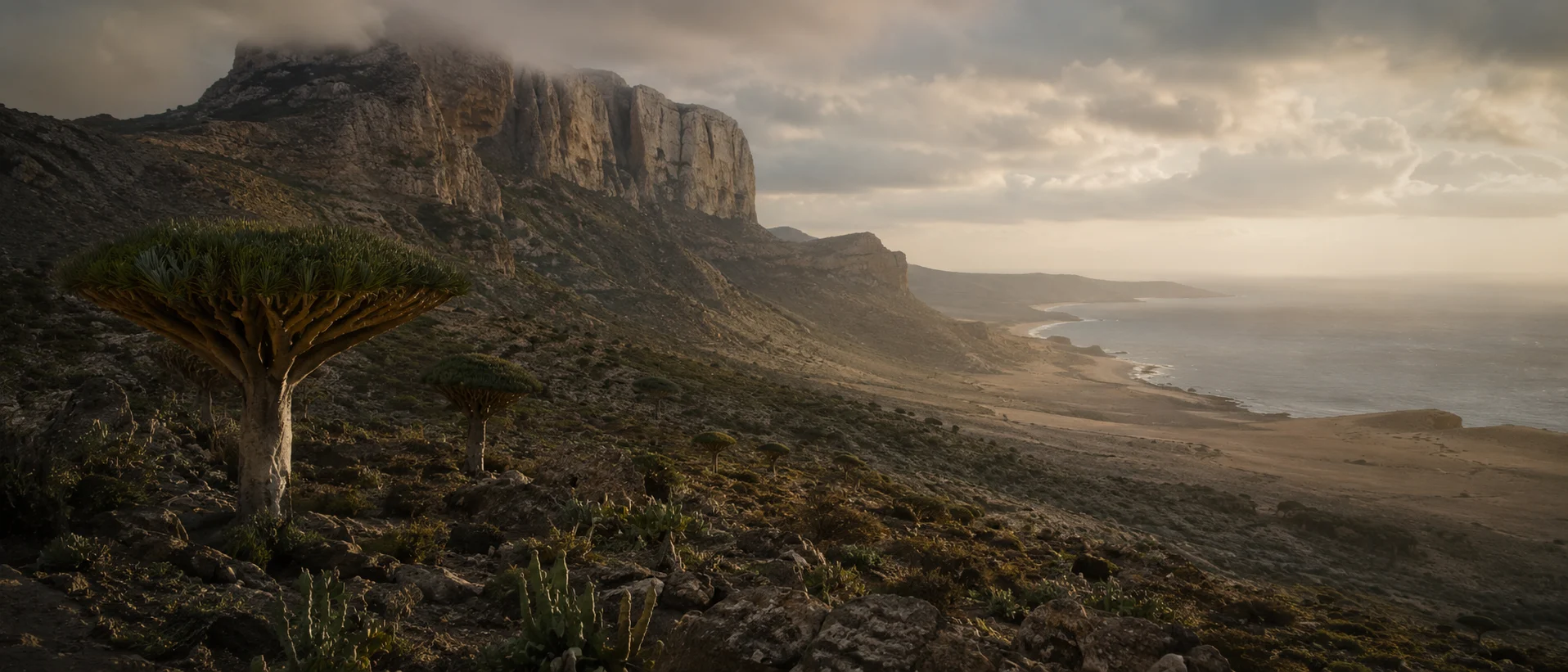
And the first time you really look at a mature Dracaena cinnabari, it is difficult not to stare.
The trunk rises into branches that divide again and again, carrying a dense crown shaped almost like an umbrella turned toward the sky.
A forest of them does not look like the tree landscapes most of us know.
It looks designed.
Dracaena cinnabari Exists Naturally in Socotra
Royal Botanic Gardens, Kew accepts Dracaena cinnabari as a distinct species whose native range is Socotra.
Its common names include Socotra dragon’s blood and dragon’s blood tree. Kew also records the tree’s famous red resin in its economic botany collections.
The name feels mythical, but the tree is not mythology.
It is biology adapted to an unusual island environment.
The Umbrella Shape Is More Than Decoration
Its architecture is one reason the tree became an icon of Socotra.
The dense crown can intercept moisture and create shade beneath it. Research in Biological Conservation found that plant richness and abundance were higher beneath Dracaena cinnabari canopies than in open sites in the studied areas, suggesting the tree helps shape the microhabitats around it.
That means losing the tree would not only remove a famous silhouette from photographs.
It could alter the plant communities associated with it.
A Famous Tree That Is Also Vulnerable
Kew records the species as Vulnerable under the IUCN Red List category.
Scientists have studied poor natural regeneration, grazing pressure and the difficulty of seedlings surviving outside protected conditions. UNESCO conservation reporting has also highlighted Firmihin, where the highest concentration of dragon’s blood trees occurs, as a key conservation area.
This matters because iconic species are easy to admire and easy to misunderstand.
Fame does not guarantee security.
The Resin Behind the Name
The tree produces a red resin historically called dragon’s blood.
Kew’s Economic Botany Collection preserves Socotra material collected in the nineteenth century and records traditional medicinal use associated with the resin.
That history is another reason the tree sits between nature and culture.
It is not simply something people looked at.
It entered human use, naming and imagination.
But Socotra Is Bigger Than One Tree
The dragon’s blood tree is so visually powerful that it risks becoming a logo for the whole island.
Socotra deserves more than that.
UNESCO records hundreds of plant species, extraordinary reptile and land-snail endemism, rich marine life and globally important bird populations across the archipelago.
And beyond biodiversity is the Socotri language, pastoral knowledge, fishing, villages and everyday lives that photographs of trees rarely explain.
An icon should be an entrance, not a replacement for everything behind it.
Why the Tree Still Feels Mysterious to Me
I know much more about it now than when I first saw an image.
I know the scientific name.
I know its conservation status.
I know the red resin is real.
I know the tree influences the vegetation beneath its crown.
And yet knowledge has not removed the mystery.
It has made me want to see the tree even more.
From a Spoon of Honey to an Island
This is why I remember the producer in the UAE so clearly.
He did not give me a geography lesson.
He gave me a spoon.
I tasted something I had never tasted before, asked where it came from, and a country opened a little wider.
For me, that is one of the greatest values of food.
It can make curiosity physical.
The Dragon’s Blood Tree
It is Dracaena cinnabari, a tree native to Socotra and famous for its umbrella-like crown and red resin known as dragon’s blood.
Kew lists Socotra as the species’ native range.
This article does not make that claim. “Socotra honey” can refer to honeys from different floral sources on the island. Botanical origin requires evidence about the actual nectar sources of a specific harvest.