
Hospitality, respect, generosity and strong family ties — the living heart of one of the world’s most distinctive cultures.
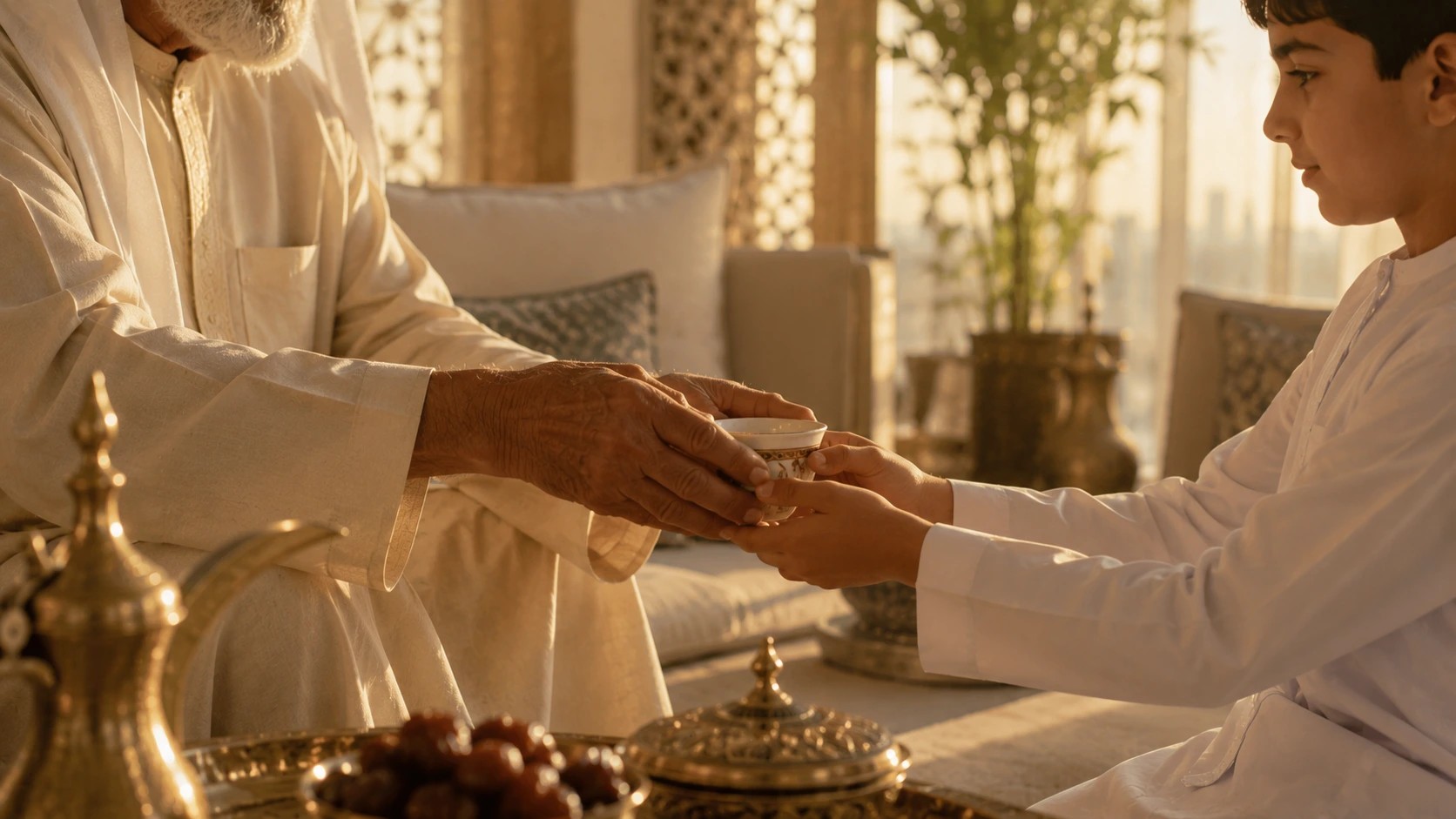
Some truths are not written in books. They are passed from hand to hand — in a warm cup of coffee, in the silence of a respected elder, in a table set for guests who arrived unannounced. Across the Gulf, family values are not simply a social framework. They are the first language everyone learns — and the deepest expression of Arab hospitality, karam, and cultural identity.
Why Family Is Central to Gulf Society
In the six nations that form the Gulf Cooperation Council — the UAE, Saudi Arabia, Oman, Qatar, Kuwait, and Bahrain — the family is not a background institution. It is the foreground of daily life. Every decision of consequence — where one lives, how one works, whom one marries, how one raises children — is filtered through the prism of family. This is not a constraint; for most people across the region, it is a source of profound strength and identity.
Scholars and sociologists who have studied Arab society consistently identify the family as its foundational building block. Religion, morality, a culture of honor, and the deep ethic of generosity all converge within the family unit. In a landscape that stretches from the pearl-diving shores of Bahrain to the mountain villages of Oman, from the ancient trade corridors of Jeddah to the modern boulevards of Dubai, this centrality of family remains the common thread.
The Extended Family as a Living Institution
Unlike the nuclear model that dominates much of the contemporary Western world, the Gulf family is typically extended — grandparents, parents, children, aunts, uncles, and cousins forming a living constellation that shares not just blood but responsibility. Decisions are rarely solitary. Celebrations are rarely small. Grief is never carried alone.
Even as urbanization and globalization reshape Gulf cities at breathtaking speed, the gravitational pull of the extended family has proven remarkably resilient. Younger generations may live in separate apartments, study abroad, or build careers across time zones — but the Friday gathering, the call to check on a grandmother, the instinct to bring something sweet when visiting, endures.
Respect Across Generations
If one were to identify a single principle that governs the internal life of the Gulf family, it would be respect — and specifically, the veneration of elders. This is not mere politeness. It is a moral architecture, quietly present in every exchange.
Younger family members typically rise when an elder enters the room. They do not contradict in public. They seek counsel before making significant decisions. In the majlis — the traditional gathering space of Gulf homes — one never calls an elder by their first name. Instead, the title Abu (father of) or Umm (mother of), followed by the name of the eldest child, is used — a linguistic gesture that acknowledges a person’s role, not merely their identity.
The Unspoken Language of Honor
Respect in the Gulf is rarely declarative. It lives in gesture, in posture, in timing. It is the younger sibling who pours the tea. The son who walks slightly behind his father when entering a formal gathering. The daughter who asks before she acts, not because she must, but because she understands that consultation is itself a form of love.
This culture of honor — sharaf in Arabic — is not merely about reputation in the social sense. It is about being someone your family can stand behind, someone who carries the name forward with integrity. Accomplishments, in this context, are never purely personal. They belong to the family, and they reinforce its collective dignity.
Hospitality as a Core Value
To understand Gulf culture and traditions, one must understand that hospitality — al-diyafa — is not a social nicety. It is a sacred obligation, historically rooted in the survival imperatives of desert life and spiritually reinforced by Islamic tradition. A guest, in this culture, is not simply welcomed. A guest is honored.
The best food is brought out. The finest coffee is brewed. The guest’s comfort is placed ahead of the host’s own convenience — unhesitatingly, and often elaborately. This generosity toward guests is not performed for admiration. It springs from a genuinely held belief: that how you treat a visitor reflects the depth of your character.
The Majlis: Where Culture Lives
At the heart of Arab hospitality sits the majlis — a word that translates simply as “a place of sitting,” but whose meaning extends far beyond furniture. Recognized by UNESCO as an element of Intangible Cultural Heritage of Humanity since 2015, the majlis is the social and intellectual heart of Gulf life. It is where families gather, disputes are resolved, news is shared, and wisdom is transmitted.
In a royal palace and in a modest home alike, the majlis follows the same essential logic: the space is open, the coffee pot is ready, and no one is turned away. Cushions line the walls. Guests sit according to an unspoken hierarchy that everyone understands. Children watch quietly and learn — the majlis is, among other things, the Gulf’s oldest classroom.
The Ritual of Qahwa
Arabic coffee — qahwa — served alongside dates, is the universal gesture of welcome across all six Gulf states. The ritual is precise: the host pours with the right hand, begins with the most senior guest, and refills without being asked. A guest signals satisfaction by gently tilting the cup — a small motion freighted with generations of meaning.
Generosity and Community Spirit
Beyond the household, Gulf values extend outward into the community through a powerful cultural ethic of generosity: karam. The Arabic word carries more weight than any English translation can fully render. Karam is not merely giving. It is giving abundantly, giving before being asked, giving in a way that preserves the dignity of the recipient.
Karam — A Word That Carries a World
A Gulf Arab will often feel quiet pride in the act of offering: food, gifts, help, time, shelter. The guest who visits a home will rarely leave without a gift pressed into their hands. The neighbor who has suffered a loss will find food appearing at their door. The colleague who is struggling will be supported without fanfare.
This community spirit is woven into the social fabric through institutions old and new — from the traditional practice of zakat (obligatory charitable giving in Islam) to the modern philanthropic foundations that carry the names of Gulf ruling families. Generosity, in this worldview, is not exceptional. It is expected — of the wealthy and the modest alike, each according to their capacity.
It is no coincidence that in Gulf culture, gifts carry exceptional significance. The choice of what to offer a guest, a host, or a loved one is considered carefully. A gift must reflect both the giver’s discernment and their regard for the recipient. This is why the finest products — premium honey infused with 23-carat gold, rare ingredients, objects of beauty — have always found their natural home in Gulf gift-giving traditions. At Meski Dates Factory, this understanding is woven into every curated gift box we craft: each one a small act of karam, made tangible.
Emirati Values
Hospitality and pearl-diving heritage shape a culture where family councils guide major decisions and the majlis remains the center of social life.
Omani Traditions
Mountain and coastal communities preserved ancient codes of generosity, where frankincense and honey have symbolized welcome for centuries.
Arabian Hospitality
From the trade corridors of Jeddah to the highlands of Asir, family loyalty and generosity define the social contract across every generation.
Teaching Values to Future Generations
One of the most remarkable aspects of Gulf family life is how effectively it transmits itself. Values are not typically taught through formal instruction. They are absorbed — through proximity, through observation, through the texture of daily life.
A child who attends the majlis learns, without being lectured, how to listen before speaking, how to defer to age, and how to make a guest feel seen. A teenager who watches their mother prepare a meal for unexpected visitors absorbs, wordlessly, that hospitality is not conditional on convenience. A young adult who sees their father support a struggling relative understands that family loyalty is not situational.
Observation
Children attend the majlis and absorb the unspoken rules of respect, hierarchy and welcome before they can articulate them.
Participation
Adolescents take on roles — pouring coffee, greeting guests — that embed the ethic of karam through lived practice.
Transmission
Adults model the full range of values — generosity, honor, care for elders — that the next generation will, in turn, pass on.
Preserving Cultural Identity in a Changing World
The Gulf of the twenty-first century is among the most rapidly transforming regions on earth. Cities that were modest trading posts within living memory are now global hubs of finance, architecture, and culture. Millions of expatriates live alongside Emirati, Saudi, Omani, Qatari, Kuwaiti, and Bahraini nationals, creating societies of extraordinary cosmopolitan complexity.
In this context, the preservation of cultural identity in UAE, Saudi Arabia and Oman has become a conscious and deliberate project. Gulf governments have invested significantly in heritage institutions, national museums, cultural festivals, and educational programs designed to ensure that younger generations remain anchored to their roots even as they reach outward toward the world.
But institutions can only do so much. The deepest preservation of cultural identity happens, as it always has, within the family — in the language spoken at the dinner table, in the stories told by grandparents, in the rituals of welcome maintained even when life grows busy. The family, here as ever, is the custodian of what matters most.
Final Thoughts
The values that shape life across the Gulf — hospitality, respect for elders, karam, the centrality of family, the transmission of identity through lived ritual — are not relics of a past era. They are daily realities, refreshed in every generation, adapting in form while remaining constant in spirit.
In a world that increasingly prizes individual achievement and private ambition, there is something quietly radical about a culture that insists the highest honor is to be someone your family, your guests, and your community can count on. Across the Gulf, this is not an aspiration. It is simply how life is lived.
At Meski Dates Factory, we are grateful to operate within this tradition — and to offer products that are themselves expressions of it: gifts chosen with care, ingredients sourced with integrity, and every box assembled with the understanding that what passes between hands matters deeply.
Rooted in Heritage
Every Meski product is selected with an understanding of the cultural weight that gifts carry in Gulf tradition — from sourcing to presentation.
Crafted for Karam
Our curated gift collections are designed to honor the Gulf ethic of giving abundantly and giving with discernment.
Provenance You Can Trust
From Omani Sidr to Emirati Samar, our honeys are sourced directly from the same lands where these values were forged.
Gift the Spirit of Karam
Express Gulf generosity with a luxury honey gift box — curated to honor the tradition of giving your finest to those you cherish.
Frequently Asked Questions
The core values most consistently identified across the Gulf are hospitality (al-diyafa), generosity (karam), respect for elders, loyalty to the extended family, and the preservation of cultural and religious identity through daily life and ritual.
The majlis is a dedicated gathering space — in homes, palaces, or community settings — where family members, neighbors, and guests come together. It functions as a social, cultural, and sometimes political space. In 2015, UNESCO inscribed the majlis on its Representative List of Intangible Cultural Heritage of Humanity, recognizing its role in transmitting values across generations.
Karam is the Arabic concept of generosity — but it extends well beyond material giving. It encompasses the spirit of giving freely, preserving the dignity of the recipient, and offering one’s best without hesitation. It is one of the most admired qualities in Gulf society.
Gift-giving in the Gulf is an expression of karam and of the regard one holds for another. The thoughtfulness of a gift — its quality, its rarity, its presentation — communicates respect and affection. This is why premium, carefully curated gifts carry particular cultural resonance across the region.