
Arabian Lifestyle · Food & Terroir
Why Gulf Food Tastes Familiar
but Never Quite the Same
Rice. Meat. Cardamom. Saffron. Dried lime. Familiar ingredients travel across the Gulf, but the plate still tells you where you are.
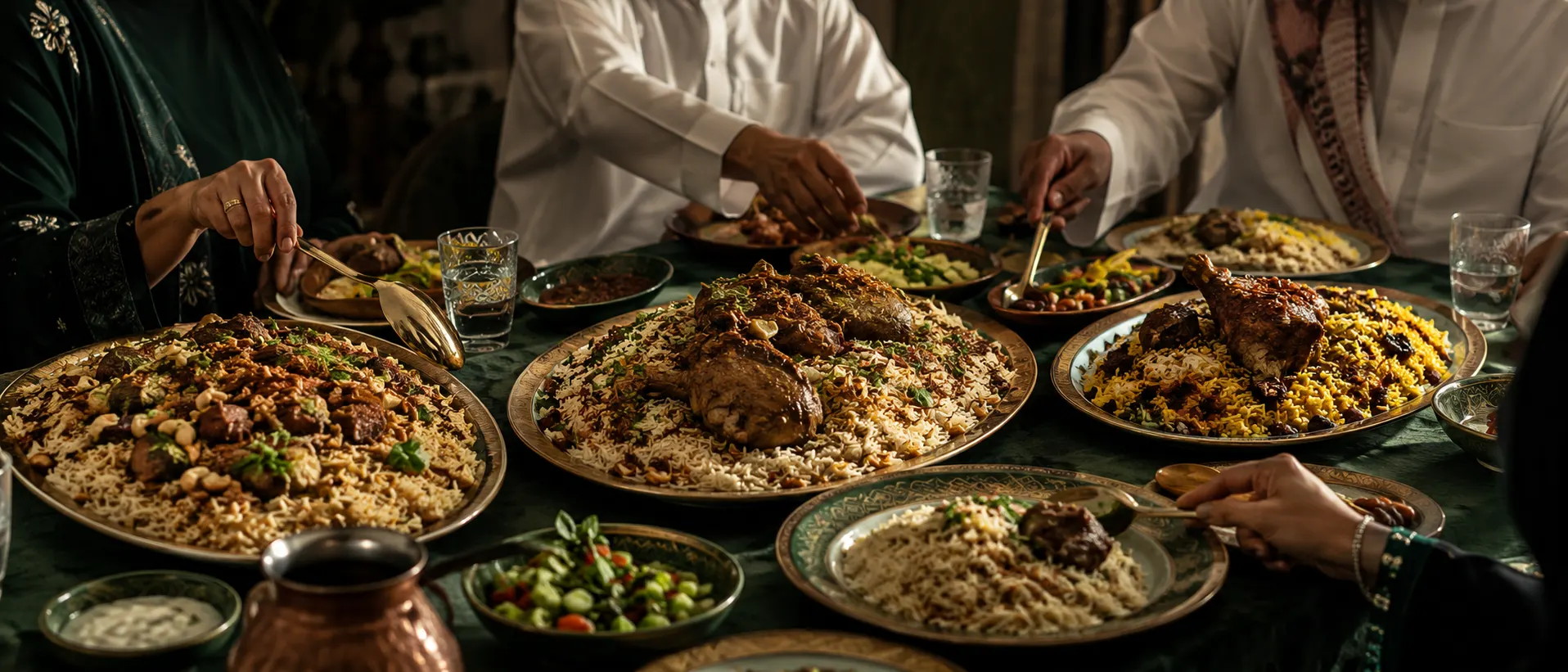
The first time you move between traditional restaurants in the Gulf, you can think the menus look similar.
Rice.
Lamb.
Chicken.
Camel.
Grilled meat.
Stews.
Bread.
Coffee.
Dates.
Then you start eating.
And the similarities become less important than the details.
“A cuisine can share its ingredients with its neighbours and still keep its own accent.”
Meskaoui
This Is Not a Competition
I do not want to rank Emirati, Qatari, Omani and Saudi food.
That would miss the point.
What interests me is how a region can share so much and still produce different sensations at the table.
The observations below are partly documented and partly personal. When I describe Oman as feeling a little more spice-forward to my palate, or Qatar as more balanced, I am describing what I have repeatedly experienced, not issuing a national rule.
Every home and every cook can prove a generalisation wrong.
Qatar: Balance Before Noise
Qatari food often gives me a feeling of balance.
Not blandness. Balance.
Visit Qatar describes a cuisine shaped by old trade routes and influences from India, Persia, the Levant and North Africa. Machboos, considered a national dish, brings rice, meat and spices together slowly. Saloona layers tomato with cardamom, clove, ginger and black loomi. Harees turns wheat and meat into something much softer and quieter.
When I eat Qatari rice, I like to eat it with my fingers.
I know I could use a spoon. I simply do not want to.
For me, the gesture is part of the immersion. I feel the texture, I control the amount, and the meal becomes less distant.
Oman: A Wider Ocean on the Plate
Oman often feels different to me.
Sometimes the spices seem more forward, and in some meals I notice a slightly hotter edge. That is my palate speaking, not a rule for every Omani dish.
But the broader history helps explain why Omani cuisine can feel so layered.
Experience Oman describes it as a meeting of Arabian, Indian and African flavours. Qabooli combines rice with meat, nuts and raisins. Shuwa takes marinated meat and cooks it slowly, traditionally underground. Mishkak brings a more direct grilled character.
Oman’s old maritime connections are visible even when nobody at the table mentions history.
The UAE: Roundness, Warmth and the Sweet-Savoury Edge
Traditional Emirati food often feels rounder to me.
I notice warm spices and, in some dishes, a gentle sweet-savoury relationship that I associate strongly with my experiences in the UAE.
That does not mean Emirati food is “sweet”. It means sweetness can appear as one voice among salt, fat, spice and meat.
One meal made that very clear to me. I found a traditional Emirati restaurant serving lamb, and small bowls of honey were placed with the meat. I poured the honey over it.
I was not prepared for how much I would enjoy it.
The richness of lamb, the seasoning and the sweetness changed one another.
I still think about that plate.
Saudi Arabia: Too Large for One Flavour
Saudi cuisine is the hardest of the four to summarise because Saudi Arabia is enormous.
Najd, Hijaz, the Eastern Province, the south and the north do not offer one identical food culture.
My own restaurant experiences sometimes place Saudi flavours somewhere between the warmth I associate with Emirati food and the more assertive spice notes I sometimes find in Oman.
Again, that is only my palate.
The better lesson is that “Saudi food” should lead to another question: which Saudi food, and from where?
Rice Is a Map
Rice may be the best place to understand the region.
It appears everywhere, but it refuses to become identical.
The spice mix changes.
The fat changes.
The meat changes.
The cooking liquid changes.
Some versions lean toward loomi. Others toward saffron or cardamom. Nuts or raisins may appear. A tomato base may be more or less important.
Then the rice absorbs the meat above it and becomes the part I usually want most.
Camel Meat Changed My Expectations
I also look for camel when I can find it.
It has a more pronounced character than many people expect. Yet when it is cooked properly, I have eaten camel meat so tender that the texture surprised me completely.
This is one reason I search for traditional restaurants when I travel.
If I eat only international food, I may enjoy myself, but I lose one of the easiest ways to understand how a place tastes.
Trade Routes Still Sit at the Table
The shared ingredients of Gulf cooking are not an accident.
For centuries, Arabia participated in land and maritime trade networks. Spices from India and Southeast Asia moved through ports. Persian, Indian, African and Levantine influences met local ingredients and techniques.
That does not make Gulf cuisines less authentic.
Quite the opposite.
A living cuisine is rarely a sealed box. It takes what arrives, adapts it, repeats it, gives it to children and eventually makes it feel inseparable from home.
Why I Keep Looking for the Traditional Restaurant
There are excellent restaurants across Dubai, Doha, Muscat and Saudi cities serving every cuisine imaginable.
I enjoy that too.
But when I travel, I keep returning to one question:
What does this place taste like when it is cooking for itself?
Sometimes the answer is a famous national dish.
Sometimes it is a restaurant nobody put on a top-ten list.
Sometimes it is a bowl of honey next to lamb that I did not expect at all.
Those are the meals I remember.
Gulf Food and Regional Differences
No. The cuisines share ingredients, cooking methods and historical influences, but national and regional dishes, spice profiles and techniques vary. Saudi Arabia itself contains major regional differences.
Machboos, also spelled majboos or machbous in different contexts, is widely presented as Qatar’s national dish and combines spiced rice with meat or chicken.
Shuwa, qabooli, harees and mishkak are useful starting points. Omani cuisine reflects Arabian traditions alongside long-standing Indian and African connections.