
Turquoise waters, ancient Hajar peaks, and the art of slow living — a complete guide to Dubai’s most quietly spectacular mountain escape.
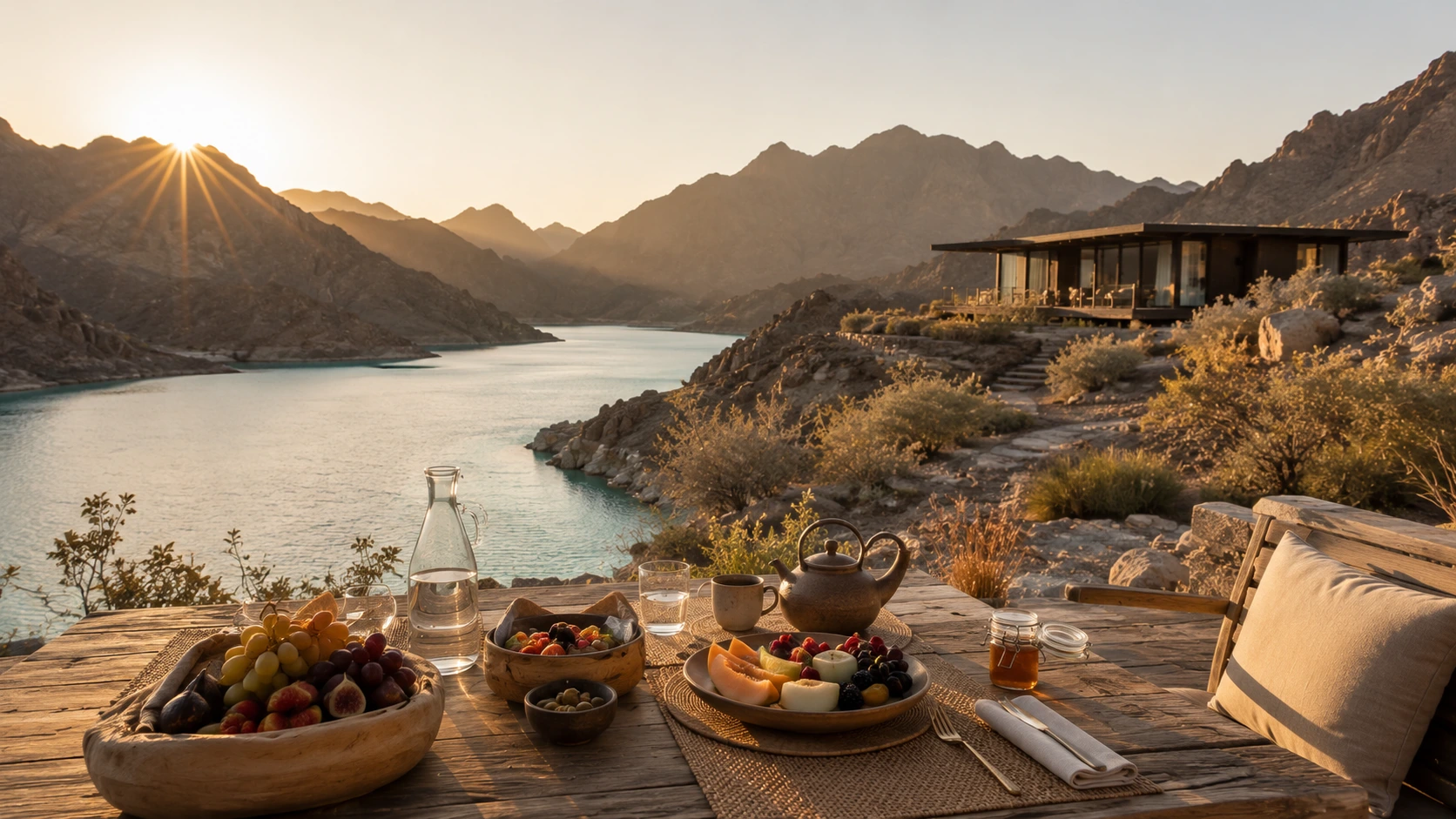
Hatta is a mountain exclave of Dubai tucked within the western Hajar range — a place of turquoise reservoir waters, 3,000-year-old heritage villages, and cool mountain air that feels wholly removed from the coastal city just 90 minutes away. This guide covers everything the discerning traveller needs to know before making the journey.
A Place the Desert Keeps Secret
Most visitors to the UAE never leave the gleaming corridors of Dubai Mall or the polished shores of Abu Dhabi’s Corniche. And yet, tucked away at the edge of the emirate, where the flat golden desert folds suddenly into ancient stone ridges, lies one of the most quietly spectacular destinations in the entire Arabian Peninsula. Hatta is not loud about what it offers. It does not need to be. Its turquoise waters, its centuries-old watchtowers, its cool mountain air — they speak with the kind of authority that only genuine beauty commands.
This is a guide for those who travel not to be seen, but to truly arrive somewhere.
Where Is Hatta?
Hatta is a mountain exclave of the Emirate of Dubai, located approximately 130 kilometres east of Dubai city, nestled within the western reaches of the Hajar Mountain range, sharing a border with the Sultanate of Oman. Despite belonging to Dubai, Hatta is entirely surrounded by Omani territory — a geographical curiosity that lends the town a sense of sovereign quietude, as if the modern world has politely stepped aside.
The drive from Dubai takes roughly 90 minutes along Sheikh Mohammed bin Zayed Road, passing through Oman’s Hatta Crossing border zone — a seamless transition for UAE residents and GCC nationals, and a straightforward process for visitors with the appropriate documentation. From Sharjah, the journey is comparably smooth, making Hatta an ideal weekend escape for residents across the Northern Emirates as well.
Why Hatta Is One of the UAE’s Hidden Treasures
In a region often defined by superlatives — the tallest towers, the largest malls, the most ambitious engineering — Hatta offers something far rarer: restraint. The town’s appeal lies precisely in what it does not try to be. There are no neon lights here, no theme parks, no manufactured spectacle. Instead, there is the sound of wind threading through ancient rock formations, the shimmer of a dam reservoir at dawn, and the scent of frankincense drifting from a heritage village that has stood for centuries.
Hatta was recognised as a key destination within the Dubai Tourism Strategy 2033, and significant investment has been directed toward developing its eco-tourism infrastructure while preserving the integrity of its natural and cultural landscape. The result is a rare equilibrium: a place that welcomes the discerning traveller without surrendering its soul.
The Stunning Hatta Mountains
The Hajar Mountains — hajar meaning “stone” in Arabic — are among the oldest geological formations in the Arabian Peninsula, their craggy ridgelines composed primarily of ophiolite, a rare rock sequence that originated on the ancient ocean floor and was thrust upward over millennia. In Hatta, these mountains take on a particularly dramatic character: deeply striated, rust-red and grey, rising sharply from narrow wadis that bloom with acacia and wild desert flora after seasonal rains.
The elevation in Hatta reaches up to approximately 1,000 metres in parts of the surrounding range, creating a microclimate that is measurably cooler than the coastal cities. For those who know the Gulf’s relationship with the mountains — the Omani tradition of honey harvest in high-altitude apiaries, the ancient caravan routes that threaded these same ridges carrying frankincense and dates — the Hajar peaks feel less like scenery and more like living history.
Hatta Dam: A Must-See Natural Wonder
If there is a single image that defines modern Hatta in the collective imagination, it is the dam: an expanse of improbably turquoise water cradled between two mountain walls, its surface so still in the early morning that it mirrors the surrounding rock face with near-perfect fidelity. The Hatta Dam was constructed in the late 1990s to serve as a water reserve for the region, and its reservoir stretches across roughly 1.47 square kilometres — a modest figure that belies the grandeur of the experience.
Visitors can kayak or pedal across the reservoir’s surface, hire small motor boats, or simply stand at the water’s edge and absorb a landscape that feels entirely incongruous with the desert emirate just 90 minutes away. The interplay of light on the water changes hour by hour — copper-tinted at sunset, silver-blue at midday — and rewards those who linger.
Luxury Stays and Boutique Resorts
Hatta’s accommodation landscape has evolved considerably in recent seasons, moving well beyond the utilitarian and into something genuinely inspired. At the top of the hierarchy stands the JA Hatta Fort Hotel, the emirate’s oldest mountain resort, set against the Al Hajar range in manicured grounds that feel like a colonial botanical garden transported to the Arabian mountains. Its spa, restaurants, and private pool villas make it the default choice for those seeking uncompromised comfort alongside the scenery.
For a more immersive experience, Hatta Resorts — operated by Dubai’s Department of Economy and Tourism — offers glamping accommodations of quietly exceptional quality: the Damani Lodges, elevated timber structures with private BBQ stations and panoramic mountain views; transparent Dome tents with plunge pools for stargazing in uncluttered night skies; and restored vintage caravans that manage to be both nostalgic and elegant. Each option comes with complimentary firewood, a detail that speaks to the considered hospitality characteristic of the Gulf.
Seasonal note
Hatta Resorts follows a seasonal calendar and typically operates from October through May. Book at least two to three weeks in advance during peak winter weekends.
Outdoor Adventures and Hiking Trails
Hatta has developed into one of the UAE’s most serious destinations for outdoor pursuits, and the infrastructure to support this has been built with care. The Hatta Wadi Hub serves as the central activity hub, offering mountain biking, zip-lining, kayaking, archery, axe throwing, and supervised hiking — all within a short drive of the dam. The mountain bike trails in particular have garnered a dedicated following among UAE cycling communities, with tracks graded from beginner-friendly to genuinely technical.
The hiking trail network spans over 32 kilometres of well-marked paths across the Hatta mountain terrain. The City Hiking trail, at 9 kilometres, winds through the valley and offers a meditative rhythm suited to those who prefer to walk in contemplative quiet. More challenging ascents reward the effort with vistas over the reservoir and deep into Omani territory.
The wadis themselves are worth exploring on foot during the cooler months, when seasonal pools collect in natural rock basins and the desert flora is at its most vivid — landscapes that have been walked for thousands of years by traders, herders, and the beekeepers who maintained hives in the mountain clefts, collecting wild honey from floral sources found nowhere else on the peninsula.
Local Heritage and Emirati Culture
No visit to Hatta is complete without time spent at the Hatta Heritage Village, a meticulously restored settlement that occupies the site of one of the oldest communities in the Dubai emirate, with evidence of habitation stretching back more than 3,000 years. The village preserves a collection of traditional mudbrick homes, watchtowers, a fortress, a mosque, and communal gathering spaces — all presented not as museum pieces under glass, but as living structures one can enter, touch, and inhabit imaginatively.
The watchtowers that crown the surrounding hillsides were built not merely for defence but as expressions of territorial identity and communal pride. Falconry demonstrations, traditional crafts, and live cultural performances are offered throughout the season.
There is a particular quality to Emirati hospitality in mountain communities that differs subtly from its coastal counterpart — more grounded, rooted in a tradition of self-sufficiency and pride in the land. A cup of qahwa offered in the shade of a mudbrick wall, sweetened with a spoonful of raw mountain honey, carries in it the full weight of that history.
Emirati Mountain Heritage
Hatta’s mountain communities have maintained distinct traditions of beekeeping, falconry, and fortified architecture for over three millennia — a living culture embedded in the Hajar landscape.
Shared Mountain Tradition
The Hajar range straddles the UAE-Oman border. The same geological formation that frames Hatta’s wadis extends deep into Oman, where mountain apiculture has produced celebrated raw honeys for generations.
Best Cafés and Restaurants in Hatta
The dining scene in Hatta is intimate by design, and all the better for it. Within the JA Hatta Fort Hotel, Gazebo Restaurant offers a relaxed lunch experience with views of the resort gardens, while Jeema provides refined evening dining in a setting that strikes the balance between rustic warmth and polished service.
Beyond the resort, the Tanoor Restaurant serves traditional bread baked fresh in a clay oven — the kind of simple, honest cooking that reminds you why the region’s culinary heritage has endured for millennia. For heartier fare after a day on the trails, several local establishments serve slow-cooked lamb and rice dishes that are deeply satisfying in the cool mountain air.
The Best Time to Visit Hatta
Hatta rewards its visitors most generously between October and March, when daytime temperatures in the mountains settle into the low-to-mid twenties Celsius and evenings carry a coolness that makes the lit firepit at a Damani Lodge feel genuinely earned. This is the season when the hiking trails are at their best, the dam’s waters reflect the clearest winter light, and the Heritage Village’s cultural programming is in full swing.
April and early May offer a transitional window — warm but manageable, and notably quieter than the peak winter months. From June through September, Hatta shares the Gulf’s summer intensity; outdoor activities are not advisable during midday hours, and the glamping resorts typically close for the season.
| Season | Temperature | Outdoor Activities | Glamping |
|---|---|---|---|
| Oct – Mar | 20–25°C | Excellent | Open |
| Apr – May | 28–35°C | Morning only | Limited |
| Jun – Sep | 38–44°C | Not advised | Closed |
A Perfect Weekend Itinerary
Friday Afternoon — Arrival
Depart Dubai or Sharjah after the midday prayer. Arrive in Hatta by late afternoon, check in to your chosen lodge or resort. Take a slow walk to the dam’s edge as the light turns amber. Watch the mountains change colour at dusk.
Friday Evening — Under Open Skies
Dinner at Jeema or a self-prepared meal at your lodge’s BBQ station. The stars above Hatta on a clear winter night require no filter and no commentary.
Saturday Morning — The Quiet Hour
Rise early. The hour before sunrise belongs entirely to those willing to claim it — mist in the wadis, birdsong from the ridge, the dam surface completely undisturbed. A morning hike on the City Hiking trail, followed by qahwa and fresh bread.
Saturday Afternoon — Heritage and Water
The Hatta Heritage Village, unhurried. Speak to the guides. Look at the watchtowers. Return to the Wadi Hub for kayaking on the reservoir as the afternoon softens.
Sunday Morning — The Return
A final breakfast. Pack deliberately. Drive home slowly, via the mountain road rather than the highway, and carry with you something less tangible than a souvenir — the particular stillness of a place that has not yet learned to perform itself.
Travel Tips Before You Go
Border Crossing
The route to Hatta passes through Omani territory. UAE residents and GCC nationals do not require a visa for this transit, but must carry valid identification. Non-GCC nationals should verify current requirements before travelling.
Fuel Up in Dubai
Petrol stations are sparse once you leave the main highway. Fill your tank before departing the city.
Vehicle Choice
The main road to Hatta is well-maintained, but some wadi tracks require a 4×4. If you plan to explore beyond the main areas, a suitable vehicle is strongly recommended.
Book Ahead
JA Hatta Fort Hotel and Hatta Resorts accommodation fills quickly during October–March weekends. Book at least two to three weeks in advance.
Dress in Layers
Mountain evenings in winter can be surprisingly cool by Gulf standards. A light jacket and a second layer for evening are not excessive.
Respect the Landscape
Hatta’s natural environment is part of its value. Leave the wadis and mountain trails as you found them.
Final Thoughts — The Value of Genuine Places
Hatta is not trying to compete with Dubai, and therein lies its singular appeal. In a landscape defined by ambition and velocity, this small mountain exclave holds its ground with quiet confidence — offering not the newest or the grandest, but something more enduring: a genuine connection to the land, to Emirati heritage, and to the slower rhythms that the Gulf’s oldest communities have always known how to honour.
The most valuable things in this region rarely announce themselves. The finest Sidr honey does not come from the loudest market stall. The most beautiful landscape in the UAE does not have a ticket booth. And the most meaningful journeys are often those taken not toward spectacle, but toward substance.
Hatta will be waiting — in its own time, on its own terms.
Taste the Mountains You Just Discovered
The Hajar range has sustained mountain beekeepers for millennia. Bring a piece of that heritage home — raw Emirati and Omani honeys harvested from the same landscape you just explored.
Frequently Asked Questions About Hatta
Hatta is approximately 130 kilometres from Dubai city centre, a journey of roughly 90 minutes by car via Sheikh Mohammed bin Zayed Road (E44). From Sharjah, the drive is comparable in duration.
The road to Hatta passes through Omani territory. UAE residents and GCC nationals do not require a visa for this transit, but must carry valid identification (Emirates ID or GCC national ID). Non-GCC nationals should verify current requirements with UAE immigration authorities before travelling.
October through March offers the most pleasant conditions for outdoor activities, with cooler temperatures and clearer skies. April and May are transitional but manageable. Summer months (June–September) bring significant heat; outdoor activities are best avoided during peak daytime hours and most glamping resorts close for the season.
JA Hatta Fort Hotel is the region’s most established luxury property. Hatta Resorts (Damani Lodges, Dome tents with plunge pools, and vintage caravans) offers a glamping experience of genuine quality during the October–May season. A growing selection of private villas and chalets provides further options for independent travellers.