
Sidr Honey:
10 Questions Every Buyer Asks
The answers most sellers avoid giving. Straight from a UAE-based team that sources, curates and lives this product daily.
Every week, customers walk into conversations about Sidr honey carrying the same questions — and walking away with answers that are either incomplete, exaggerated, or lifted from a competitor’s website. The market is full of beautiful jars and confident claims. What it is short on is honest information.
These are the ten questions we hear most, answered the way we would answer them face to face: directly, without selling harder than the product deserves.
What exactly is Sidr honey, and why does everyone say it’s special?
Sidr honey is a monofloral honey — meaning bees produce it almost exclusively from the nectar of a single plant: the Sidr tree, botanically known as Ziziphus spina-christi. The tree is ancient, drought-resistant, and documented across the Middle East for thousands of years. It is mentioned in the Quran, referenced in Egyptian medical texts, and has held cultural significance in the Arabian Peninsula long before anyone thought to market it.
What makes the honey genuinely different is its composition. Because it draws from a single, botanically specific source, it carries a concentration of phenolic compounds, flavonoids, and natural enzymes that multi-flower honeys simply do not share. The result is a distinct flavour profile — thick, dark amber, with notes of caramel, warm wood, and wildflower — and a texture that is noticeably denser and slower to pour than most honey you have tasted.
The reputation is real. What often gets inflated is the scale of the claims attached to it.
Why is Sidr honey so expensive compared to regular honey?
Three things drive the price, and only one of them is marketing.
First, the Sidr tree blooms for a very short period each year — typically a few weeks. Outside that window, bees cannot collect Sidr nectar, which means each annual harvest is the only one. There is no accelerating the cycle. Second, quality Sidr comes from remote mountain terrain where neither large machinery nor industrial beekeeping is practical. The harvest is manual, labour-intensive, and dependent on experienced beekeepers who understand specific microclimates. Third — and this is the part worth being honest about — demand in the Gulf has grown enormously while genuine supply from the most prized regions has not grown to match it. That gap creates premium pricing that is partly justified by scarcity and partly inflated by brand mythology.
The honest answer is: when you are paying for verified origin, traceable sourcing, and genuine monofloral composition, the price reflects something real. When you are paying for a story and a label, you are paying for something else entirely.
How do I know if the Sidr honey I’m buying is real?
This is the question that matters most in the UAE market right now, because the gap between genuine and mislabelled product is wider here than almost anywhere. Think of it the way you would approach buying saffron or aged olive oil: the label is a starting point, not a guarantee.
- Ask for the specific region of origin. “Product of Yemen” is insufficient. A credible seller names the valley, province, or mountain region. “Hadhramaut,” “Wadi Do’an,” “Al-Hajar mountains” — that level of specificity signals actual knowledge of the supply chain.
- Check the texture before you taste. Authentic Sidr is dense and moves slowly. Honey that pours at room temperature like water is telling you something.
- Open it and smell it first. Real Sidr has an immediate, distinctive aroma — warm, slightly woody, unmistakably complex. No scent, or a generic sweet smell, is a sign worth paying attention to.
- Ask if lab analysis is available. Premium Sidr should come with pollen analysis confirming monofloral composition. If your seller has never heard this question, that is itself an answer.
- Verify ESMA compliance. The Emirates Authority for Standardisation and Metrology sets labelling standards for honey sold in the UAE. Products meeting these standards should have accurate origin declarations — though compliance does not automatically verify monofloral claims.
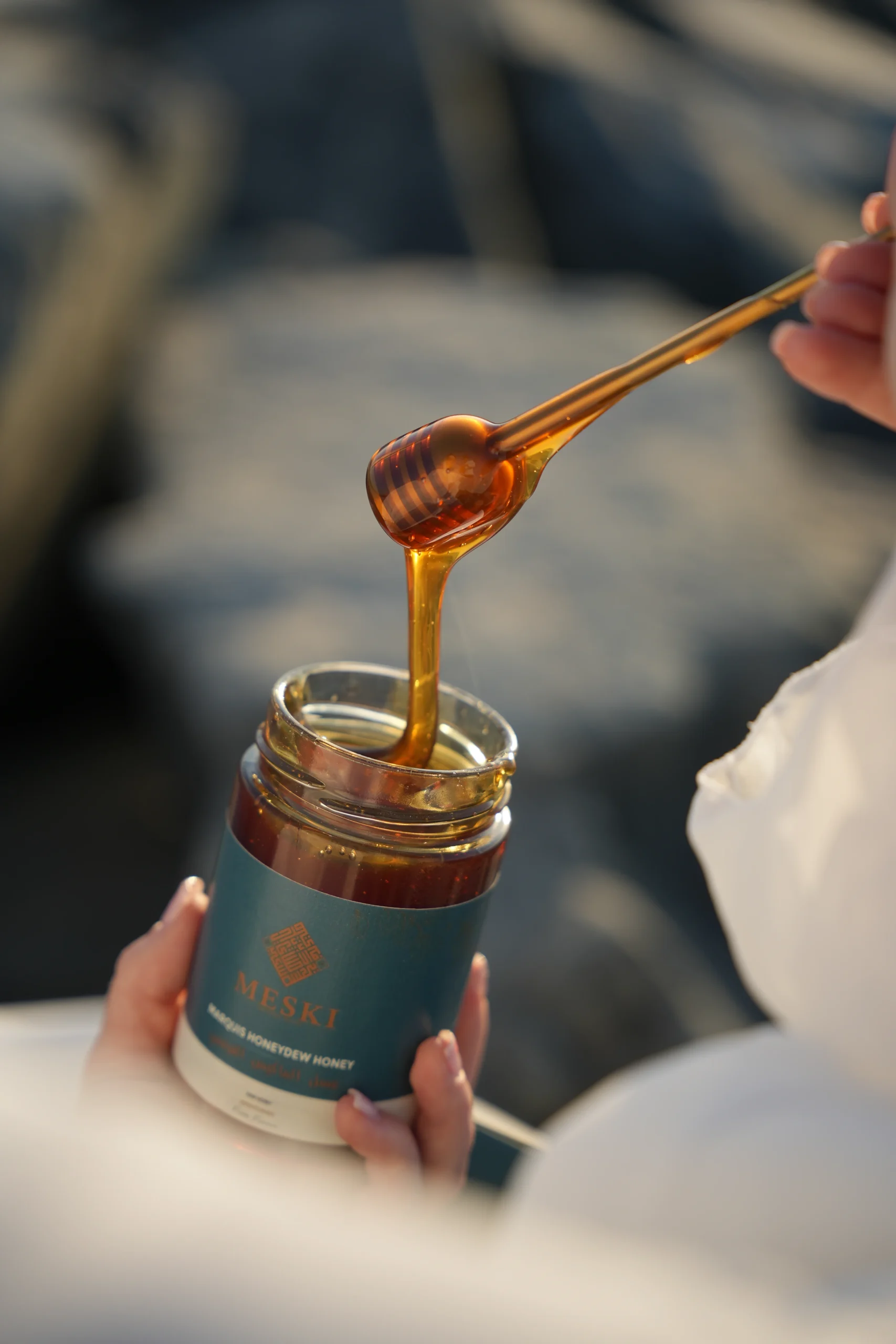
Meski Honey Raw
Is Yemeni Sidr honey really better than Omani or Emirati Sidr?
In terms of flavour complexity and historical reputation, authentic Yemeni Sidr from Hadhramaut — particularly the Wadi Do’an valley — is widely considered the reference point. The combination of altitude, ancient soil, and centuries of traditional beekeeping produces a depth of flavour that is genuinely distinct.
But “better” depends entirely on what you are actually buying. A verified Omani Sidr with state-backed certification and a confirmed supply chain is, in practical terms, a far safer purchase than an unverified jar labelled Yemen — regardless of what the label implies about prestige. Our full country comparison guide breaks this down in detail.
Our own Emirati Sidr from the Hatta mountains was recognised at the London Honey Awards 2022 — which tells you something about the quality ceiling of UAE-origin Sidr when sourced and handled with genuine care. It is rarer than Yemeni varieties, floral rather than woody in profile, and carries a provenance story that no competing origin can replicate.
My honey has crystallised. Is it ruined?
Not at all — and if anything, crystallisation is reassuring. Processed, heat-treated honey is specifically treated to prevent crystallisation by breaking down its natural sugar composition. Raw honey crystallises naturally over time because its glucose content solidifies at cool temperatures. This is chemistry, not spoilage.
Sidr honey is slower to crystallise than many raw varieties due to its higher fructose-to-glucose ratio — it typically stays liquid for six to twelve months. When it does crystallise, the fix is straightforward: place the jar in a bowl of warm (not boiling) water for fifteen to twenty minutes. The crystals dissolve, the honey returns to liquid, and none of its natural compounds are affected. What you want to avoid is microwaving it or using very hot water — that begins to degrade the enzymes and pollen that give raw honey its character.
How should I store Sidr honey to keep it at its best?
Three rules, and they are all simple.
- Room temperature, away from heat. A kitchen cupboard away from the stove is ideal. Heat above 40°C begins to degrade the enzymes and volatile compounds responsible for Sidr’s distinctive character.
- Away from direct light. UV exposure degrades honey’s natural antioxidants over time. A dark cupboard or a dark glass jar does the work here.
- Sealed, with a dry spoon. Moisture is honey’s main enemy. Introducing water into the jar through a wet spoon can trigger fermentation. Keep the lid sealed and always use a dry utensil.
Stored this way, raw Sidr honey is stable for years — not months. The famous archaeological finding of honey in ancient Egyptian tombs is an extreme example, but it illustrates something real: honey’s natural composition — low moisture, high sugar, naturally acidic — makes it one of the most shelf-stable foods that exists.
What’s the difference between raw honey and regular honey?
The difference is what happens between the hive and the jar. Raw honey is extracted, lightly strained to remove wax and debris, and bottled without heating. It retains its natural pollen, enzymes, and the full range of compounds bees deposited in it. Regular commercial honey is typically pasteurised — heated to around 60–70°C — which extends shelf life, prevents crystallisation, and makes it easier to filter to a perfectly smooth, uniform appearance. The trade-off is that pasteurisation denatures many of the naturally occurring enzymes and reduces pollen content significantly.
When you buy premium Sidr honey, you are specifically buying raw. That is the point. All of our raw honey range is unheated, unfiltered beyond basic wax removal, and handled to preserve its natural composition from hive to jar.
Can I use Sidr honey every day, or is it too strong?
Sidr honey is not a medicine and should not be treated as one — but daily enjoyment of a small amount is how most people in the Gulf and across the Middle East have actually used it for generations. A spoonful in warm water before breakfast, drizzled over labne or yoghurt, stirred into tea — these are habitual uses, not medicinal protocols.
“Too strong” is not really a concern. Sidr’s distinctive flavour is intense compared to generic honey, which can take some adjustment, but the body does not respond to raw honey as if it were a supplement with a dosage cap. The main consideration, as with any natural sugar, is simply that moderation is sensible for anyone managing blood glucose.
If you are new to Sidr, starting with a small amount and appreciating the flavour on its own terms — rather than using it as a generic sweetener — is the natural approach. It is more like tasting a fine vinegar than consuming a supplement.
Why does the colour and taste of Sidr honey vary between jars and batches?
Because it is a natural product from a living ecosystem, and no two harvests — even from the same beekeeper in the same valley — are identical. Sidr trees bloom at slightly different intensities from year to year depending on rainfall. The bee population’s access to other nearby plants shifts seasonally. Altitude, temperature during harvest, and even the beekeeper’s timing all leave small fingerprints in the final product.
This variability is a feature of quality raw honey, not a defect. It is the same reason a fine olive oil from the same estate tastes slightly different in a drought year versus a wet year. Honey that tastes exactly the same every batch, year after year, has almost certainly been standardised through blending and processing. Raw Sidr does not work that way — and that is precisely its value.
When you notice a batch of our Sidr is darker or lighter than the last, or that the flavour has a slightly different emphasis, that is the terroir speaking. It is worth paying attention to.
How do I choose between the different Sidr honeys available at Meski?
The choice depends on what you are looking for — and we find that most customers fall into one of three groups.
- If you want the rarest, most locally meaningful jar: our Emirati Sidr from Hatta. Award-winning, produced in extremely limited quantities, and the only Sidr you can source with UAE mountain provenance.
- If you want deep complexity and are confident in your sourcing: our verified Yemeni Sidr, when available. Stock is limited by genuine supply constraints, not marketing — when we have it, we are transparent about the origin and analysis.
- If you want a reliable, premium daily Sidr with full traceability: Omani Sidr. State-certified, consistently excellent, and a product that rewards daily use rather than special-occasion treatment.
If you are unsure, we always suggest starting with the Emirati or Omani variety. The Meski sourcing approach means every jar in our range has a story we can tell honestly — origin, beekeeper relationship, and what makes that specific batch worth opening.
This article is for informational purposes only. No health or medical claims are made or implied. Consult a qualified health professional for personal dietary guidance.