
A Practical Guide for Women
Streets, malls, mosques, beaches, desert safaris and evenings — everything you need to know before you pack, without confusion or contradiction.
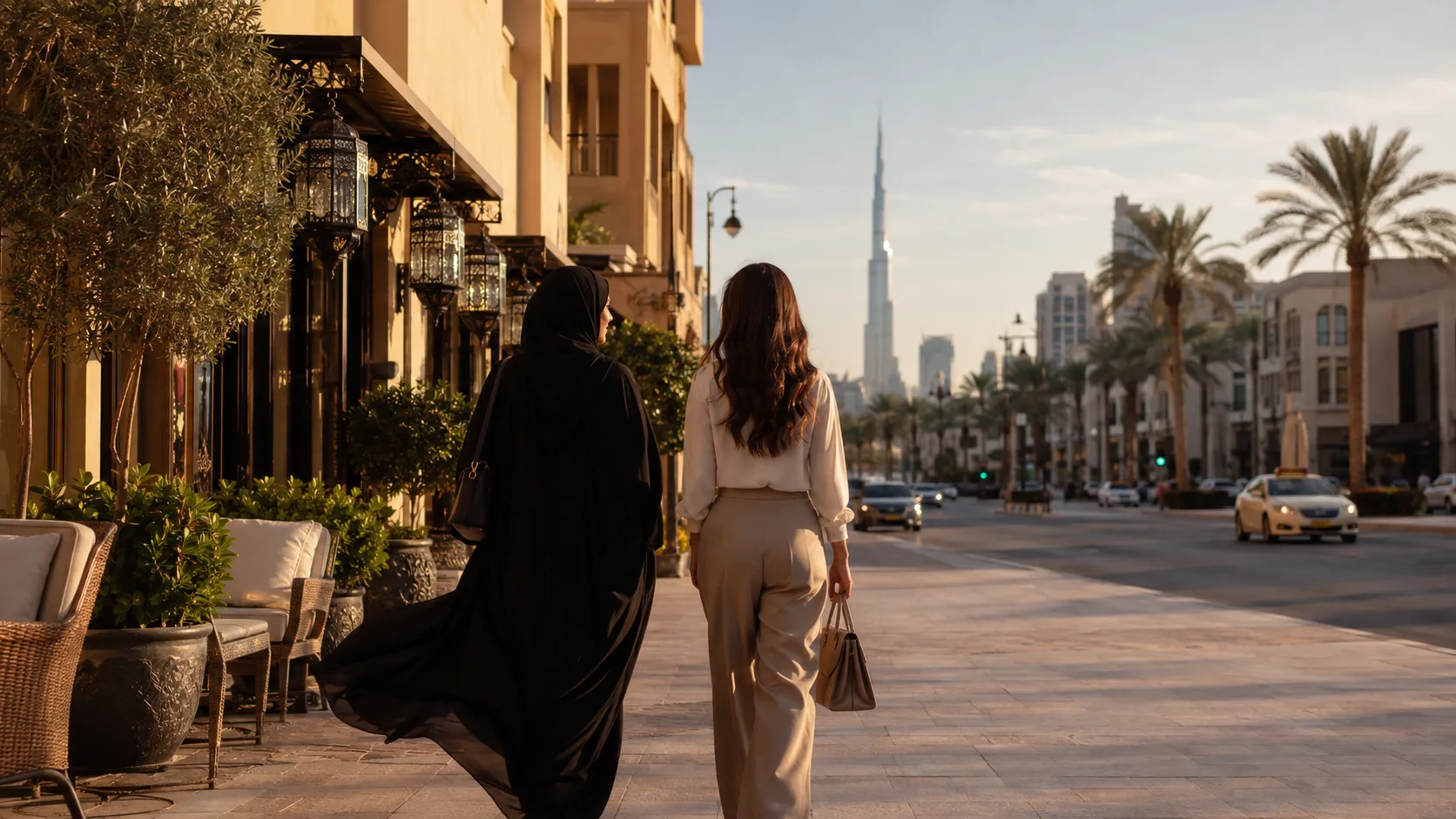
What to wear in Dubai for women is one of the most searched travel questions about the UAE — and one of the most inconsistently answered. This guide gives you a direct, accurate answer for every setting Dubai offers, based on official UAE guidance and the policies of specific sites including Jumeirah Mosque.
Direct answer
Women can wear ordinary summer clothing throughout most of Dubai. Standard dresses, trousers, jeans, skirts, T-shirts and light tops are appropriate in streets, shopping malls, hotels and restaurants. The adjustments are modest and specific: mosques require full coverage and a headscarf; traditional neighbourhoods invite slightly more conservative choices; swimwear stays at the beach or pool; and Dubai’s fierce summer heat, combined with equally fierce indoor air conditioning, makes fabric choice as important as anything else. No abaya is required in daily tourist life. Hair covering is only necessary when visiting a mosque.
Is There a Dress Code for Women in Dubai?
This question deserves a careful answer, because most online sources blur three very different things together: the law, cultural courtesy and venue-specific policies. They are not the same.
What the law says: The UAE government’s official guidance asks that clothing in public spaces not be transparent, not indecently expose the body and not display offensive images or slogans. Swimwear is restricted to beaches, water parks and swimming pools. Topless sunbathing is not permitted anywhere in the UAE. Beyond these points, there is no law requiring women to cover their shoulders, arms or knees in general public spaces, and women are explicitly not required to wear the hijab or an abaya in daily tourist life. This is confirmed by the official UAE government platform (u.ae).
What cultural courtesy means: Dubai is a Muslim city, and a proportion of its residents — including Emirati families, older residents and people visiting religious or traditional areas — dress conservatively. Choosing clothing that does not draw unnecessary attention in shared public spaces is considered respectful, not legally required. Covering shoulders and knees in malls, markets and streets is the most commonly cited guideline, and it is a reasonable one to follow in those contexts. It is a gesture of consideration, not a demand.
What venue rules mean: Hotels, restaurants, beach clubs, nightlife venues and tourist attractions each set their own dress expectations, which may be stricter or more relaxed than general public guidance. A rooftop restaurant might have a smart-casual policy. A beach club has its own dress code from poolside to lobby. Always check the venue’s website if you are unsure.
What mosque rules mean: Mosques are religious sites and carry their own clear requirements, which are entirely separate from what is appropriate in a shopping mall or on a hotel terrace. These are covered in detail below.
Understanding these four layers — law, courtesy, venue policy, mosque rules — makes navigating Dubai far simpler than most travel forums suggest.
What Can Women Wear in Dubai’s Streets and Shopping Malls?
The short answer is: most of your wardrobe. The slightly longer answer accounts for a few practical distinctions.
In Dubai’s streets and major shopping destinations — including Dubai Mall, Mall of the Emirates and City Walk — women regularly wear everything from sundresses to jeans, midi skirts to wide-leg trousers, fitted tops to flowing blouses. This reflects the reality of a city where residents come from over 200 nationalities. The visible range of dress is wide.
What works comfortably and courteously in these settings:
- Dresses and skirts: Midi and maxi lengths are ideal. Knee-length dresses are generally fine. Very short hemlines — well above mid-thigh — tend to draw more attention than necessary in shared public spaces.
- Trousers and jeans: Both are perfectly appropriate. Loose, wide-leg trousers in linen or cotton are particularly practical given the heat.
- T-shirts and regular tops: Entirely acceptable. Fitted tops without sheer fabric are fine.
- Sleeveless tops: Generally accepted in malls and tourist areas. In traditional markets and older neighbourhoods, a light layer over bare shoulders is a courteous addition.
- Shorts: Women can wear shorts in malls and main tourist areas. Knee-length or just-above-the-knee styles are the most comfortable choice. Very short shorts are better reserved for beach areas.
- Transparent or sheer clothing: Best avoided in public unless worn over a solid lining. The official guidance specifically mentions transparency as something to avoid.
- Footwear: Sandals are the most practical choice. Comfortable walking shoes or trainers are equally appropriate.
One detail that catches many visitors off guard: Dubai’s malls maintain their air conditioning at genuinely cold temperatures. A cardigan, a light jacket or a cotton scarf draped over the shoulders is not a cultural gesture inside a shopping mall — it is simply comfort.
What Should Women Wear During Dubai’s Summer?
Between May and September, Dubai operates under heat and humidity levels that reshape every clothing decision. Temperatures regularly exceed 40°C, and the humidity near the coast makes even a short walk outdoors feel immediately physical.
Fabrics: Natural fibres breathe. Linen, cotton and cotton-linen blends are the most reliable choices for outdoor movement. Rayon and viscose also handle heat reasonably well. Polyester, thick synthetics and heavy jersey fabrics trap warmth and become uncomfortable quickly.
Silhouettes: Loose and flowing works better than fitted in extreme heat. Wide-leg trousers, maxi dresses with movement, flowing midi skirts and relaxed shirts all allow air to circulate. A garment that covers more of the skin in loose, breathable fabric can actually feel cooler than bare skin under direct sun.
Colour: Light colours reflect heat. Darker fabrics absorb it. This matters when you spend even a few minutes outdoors between air-conditioned spaces.
Indoor air conditioning: Dubai’s cooling systems are powerful enough to make restaurants and malls feel genuinely cold. Packing a light cardigan, a cotton blazer or a large fine scarf that can double as a wrap is one of the more useful decisions any visitor makes. The shift from 42°C outside to 20°C inside happens every time you enter a building.
What to leave at home for summer: Denim jackets, heavy knitwear, thick cotton hoodies. None of these have a useful role in a Dubai summer wardrobe, even if evenings feel cooler than midday.
What Should Women Wear in Winter?
Dubai’s cooler months — roughly November through March — offer something quite different. Daytime temperatures typically sit between 20°C and 28°C, with evenings occasionally dropping below 18°C, particularly in January. It is not cold in any northern European sense, but it is pleasant enough to wear clothing that would be too heavy for summer.
Light jeans, cotton trousers, midi dresses worn with a light layer and smart casual outfits all work well. A thin jacket or structured cardigan is useful for evenings outdoors. The same general courtesy guidelines apply — this is still a Muslim city with a diverse population — but the range of comfortable options is wider when you are not fighting 40-degree heat. Indoor air conditioning is still present, though not as aggressively chilled as in summer months.
What Should Women Wear in a Mosque?
Mosque visits require the most specific clothing in any Dubai itinerary, and the expectations here are clear, consistent and non-negotiable — which actually makes them easier to prepare for than the more nuanced guidance that applies elsewhere.
For women visiting a mosque in Dubai:
- Arms must be covered — long sleeves to the wrist.
- Legs must be covered — full-length trousers or an ankle-length skirt or dress.
- Hair must be covered — a headscarf or hijab that covers the hair completely.
- Clothing should be opaque and loose — not form-fitting or see-through.
- Shoes are removed before entering the prayer area.
Jumeirah Mosque is one of the few mosques in Dubai that welcomes non-Muslim visitors and operates a formal guided tour programme under the Open Doors, Open Minds initiative, administered by the Sheikh Mohammed Centre for Cultural Understanding. Its official dress code confirms that women must cover arms, legs and hair. Abayas and headscarves are available for visitors who arrive without appropriate clothing. Guided visits run on Saturday through Thursday at 10:00 am and 2:00 pm, with a fee of AED 45 per person, which includes light Emirati refreshments.
Carrying a large lightweight scarf in your bag throughout your trip costs nothing and takes up almost no space — it resolves the problem in any unexpected situation involving a mosque or a traditional area.
The requirements at Jumeirah Mosque are genuine religious courtesies, not restrictions aimed at tourists. The gesture of dressing respectfully at a place of worship is one that most cultures around the world would recognise.
What Should Women Wear in Old Dubai and the Souqs?
Old Dubai — the neighbourhoods of Deira, Bur Dubai, Al Fahidi and the surrounding historic districts — has a different atmosphere from the newer parts of the city. These areas are home to established communities, traditional markets, working mosques, heritage sites and businesses that have operated for generations.
The clothing guidance here is not dramatically stricter than elsewhere, but it is worth being thoughtful:
- Loose trousers or a maxi skirt rather than shorts
- A top that covers the shoulders — or a light scarf or overshirt draped over bare shoulders
- Comfortable flat shoes, because the lanes of the Spice Souq and Gold Souq are narrow, occasionally uneven and definitely not designed for heels
Shorts and sleeveless tops are not forbidden here, but they attract more attention than in modern tourist areas. The practical reality is that covering up slightly makes you more comfortable for a different reason: when you are not thinking about what you are wearing, you can think about what you are seeing.
The Al Fahidi Historical Neighbourhood, which contains Dubai’s oldest surviving buildings, is particularly worth visiting at a calm pace. A long dress and sandals is perhaps the most practical outfit for exploring its narrow wind-tower lanes.
What Should Women Wear in Dubai Restaurants?
Dubai’s restaurant scene spans an enormous range, and so do its dress expectations. There is no single answer — which is precisely the point.
Casual restaurants and cafés: The same outfit you wore exploring the mall is entirely appropriate.
Hotel restaurants: Most apply a smart-casual expectation without stating it formally. Beachwear, pool cover-ups and flip-flops are best changed out of before arriving at a hotel restaurant, even if the hotel itself is casual.
Rooftop dining: Many of Dubai’s rooftop venues operate a smart-casual dress code. A simple dress, tailored trousers with a nice top, or similar. Some venues post their policy online — check before going if you want to be sure.
Fine-dining restaurants: Smart-casual to formal expectations apply. A midi dress, a silk blouse with trousers or a cocktail dress all work. Athletic wear, beach cover-ups or clothing with tears or slogans may result in being asked to change.
Beach restaurants: A sundress or resort wear over swimwear is typically fine. Stepping into a more formal part of the same restaurant may call for a cover-up or a light layer.
The most reliable habit: check the restaurant’s website or social media before going. Dubai’s top venues are clear about what they expect.
What Should Women Wear at the Beach or Pool?
Within beach and pool areas, women can wear standard swimwear — including bikinis — on both public beaches and at private resorts. This is accepted practice across Dubai’s coastline. Topless sunbathing is not permitted anywhere in the UAE. Thong-style bikinis are generally considered inappropriate on public beaches and tend to attract unwanted attention. On private resort beaches and pools, the atmosphere is more relaxed.
Public beaches — such as Jumeirah Beach, Kite Beach and JBR Beach — are enjoyed by a very mixed population, including families with children. Standard swimwear is normal here. A reasonable cover-up when leaving the water and moving through the surrounding area is both a cultural consideration and a practical one.
Private beach clubs and resort pools follow their own standards, which are typically fully comfortable with international swimwear norms. Their dress codes tend to specify smart wear in lounging areas and restaurants but leave the pool and beach itself entirely relaxed.
The one rule that applies everywhere: swimwear is for beach and pool settings only. Walking through a hotel lobby, a shopping mall or a restaurant in a bikini and nothing else is not appropriate anywhere in Dubai, regardless of how close those spaces are to the water.
What Should Women Wear on a Desert Safari?
The desert is one of Dubai’s most memorable experiences, and it has its own logic when it comes to clothing — driven by sand, heat, temperature shifts and physical movement rather than cultural formality.
Trousers: Loose, lightweight trousers — linen or cotton — are the best foundation for a desert safari. They protect against the sun during golden hour, keep sand from working its way into uncomfortable places during dune bashing, and provide warmth when the desert temperature drops sharply after sunset. Avoid tight jeans.
Tops: A breathable, light-coloured top with at least short sleeves. Sun exposure is considerable in the late afternoon, and sleeves provide practical protection. A loosely draped scarf is useful both as a sun shield and as an evening layer.
Footwear: Flat closed sandals or canvas shoes that can be removed easily. Sand gets into everything. Heels are impractical in soft sand.
Evening temperature: After dark in the desert, particularly between October and April, temperatures fall significantly — sometimes to 15°C or below. A lightweight jacket, a warm pashmina or a long cardigan in your bag is genuinely useful.
Jewellery and accessories: Keep them minimal. Sand is abrasive, heat is intense, and the combination of dune bashing and camel riding creates conditions where complex accessories or valuable jewellery can be damaged or lost.
What Should Women Wear in Dubai at Night?
Dubai evenings cover a very wide range of settings. There is no single dress code for night-time.
A quiet dinner at a neighbourhood restaurant requires nothing beyond whatever you wore during the day. An evening stroll along the Dubai Marina waterfront or Downtown Dubai near the Burj Khalifa is entirely casual. The same light dress that worked in the afternoon works at 9pm.
Rooftop lounges and cocktail venues typically expect something smarter — a simple dress, a nice blouse with tailored trousers — without reaching the level of formal dressing. The atmosphere at most of these venues is dressed-up but relaxed.
Licensed nightlife venues and hotel bars operate essentially without modesty restrictions. This is a distinct environment governed by its own norms, and the dress expectations are comparable to those of similar venues in any international city.
The single most useful item for Dubai evenings, regardless of where you are going: a light wrap or oversized scarf. Restaurants tend to run their air conditioning at full power well into the evening. And if your evening ends with a walk outdoors, the warm night air feels entirely different from the temperature inside.
Does the Dress Code Change During Ramadan?
During Ramadan, the atmosphere across Dubai shifts in ways that are meaningful rather than restrictive. The city slows during daylight hours, becomes quieter, and then comes to life after iftar in ways that are genuinely worth experiencing.
The clothing guidance changes only at the margins. The shoulder-and-knee baseline that already applies as a courtesy in shared public spaces — streets, markets, public transport — becomes slightly more important to observe consistently during daylight hours. This is a gesture of solidarity with the spirit of the month, not a legal change.
Beach and pool dress codes are unaffected. Hotel restaurants and private venues are unaffected. Evening settings — particularly the late-night iftar atmosphere at many hotels and restaurants — are often quite festive, and evening wear is entirely appropriate.
Non-Muslim visitors are not required to fast, but are asked not to eat, drink or smoke in public during daylight hours. Most restaurants and malls provide designated areas for non-fasting visitors. The practical adjustment to clothing is small; the adjustment in awareness and consideration is more significant.
If your visit coincides with Ramadan and includes a mosque visit or an invitation to an iftar gathering, dressing conservatively — long sleeves, full-length clothing, a scarf at hand — is both appropriate and appreciated.
What Should a Woman Pack for Seven Days in Dubai?
Seven days in Dubai typically involves a mix of outdoor exploration, shopping, dining, at least one beach day and possibly a desert excursion or a mosque visit. Below is a compact and adaptable packing framework.
Daytime (streets, malls, sightseeing):
- 2–3 loose linen or cotton trousers (one in a neutral tone, one in a lighter colour)
- 2 midi dresses or maxi dresses in breathable fabric
- 3–4 light tops: a mix of T-shirts and simple blouses, with and without sleeves
- 1 light overshirt or cotton shirt (doubles as a layer for souqs or a beach cover-up)
Evening:
- 1 smart-casual dress suitable for rooftop dining or a restaurant (midi length is versatile)
- 1 evening top that can be paired with trousers already packed
Beach and pool:
- 1–2 swimsuits or bikinis
- 1 lightweight kaftan or cover-up dress
- 1 pair of beach sandals
Cultural visits and mosques:
- 1 large lightweight scarf (can double as a beach wrap, a cardigan substitute and a hair covering)
- 1 long-sleeved top or thin cardigan
- Long trousers or a maxi skirt from the daytime selection
Desert safari:
- Loose linen trousers (one pair already in the daytime selection)
- A breathable long-sleeved or short-sleeved top
- A warm wrap or lightweight jacket for the evening drop in temperature
Practical accessories:
- Flat sandals with a secure strap (primary walking shoe)
- Comfortable trainers or canvas shoes (for uneven ground, markets, desert)
- One pair of small heels or dressy sandals for evenings
- Sunglasses
- A compact crossbody bag for daily use
Common Clothing Mistakes to Avoid
Packing only beachwear and resort wear
Dubai has an enormous amount to see beyond the beach. Without a couple of versatile daytime outfits, you will feel either overdressed or under-prepared depending on where the day takes you.
Forgetting a light layer for air conditioning
This is genuinely the most common practical mistake. Restaurants, malls and museums are cold. A thin cardigan or large scarf solves this completely.
Assuming every venue has the same expectations
A beach club, a fine-dining restaurant, a mosque and a souq have four entirely different contexts. A single outfit rarely crosses all of them comfortably.
Packing uncomfortable shoes
Dubai involves more walking than visitors expect — through malls that span hundreds of metres, across open plazas in heat, along market lanes. Painful footwear shortens the day.
Choosing heavy synthetic fabrics for summer
Polyester and thick jersey trap heat. Linen, cotton and natural blends are not just more pleasant — they are genuinely more practical in temperatures above 35°C.
Carrying no adaptable layer or scarf
Even on a day when you have no plans to visit a mosque or a souq, a large scarf has value. Situations change, invitations arrive, plans shift.
Overpacking formal clothing
Unless your trip is specifically oriented toward multiple fine-dining events, one or two smart-casual outfits are sufficient. Dubai’s evening culture is polished but rarely demands a full formal wardrobe.
Overthinking the whole thing
Dubai is an experienced international destination. Its residents and hospitality industry are accustomed to visitors from every background. A thoughtful approach to packing makes the trip easier; it does not require anxiety before you leave.
Dressing well in Dubai is ultimately about adaptability: knowing that your choices will vary by setting, and packing a wardrobe flexible enough to move with you through a city that shifts considerably across a single day. A morning at the mosque, an afternoon at a beach restaurant, an evening at a rooftop table overlooking the creek — each calls for a slightly different version of you, and none of them requires a dramatically different suitcase.
One final thought: leave a small corner of that suitcase free for the return journey. The best things to bring home from Dubai are rarely the largest. A small jar of Emirati Sidr Honey — the kind that still tells you where its bees spent the season — or a scent that reminds you of a specific market lane. Those things travel well, and they mean something a year later.
Frequently Asked Questions About Dress Code in Dubai for Women
Yes. Women can wear shorts in Dubai’s streets, malls and tourist areas. Knee-length or just-above-the-knee styles are the most comfortable choice in shared public spaces. Very short shorts are better reserved for beach and pool settings. In traditional areas such as old Dubai souqs, slightly longer clothing is more courteous.
Sleeveless tops are generally accepted in shopping malls and tourist areas. In traditional markets, older neighbourhoods and historical districts, adding a light layer or draping a scarf over the shoulders is a courteous gesture. In mosques, arms must be fully covered.
No. Women visiting Dubai as tourists are not required to wear an abaya in any public space, including streets, malls, restaurants, hotels or cultural sites. An abaya is the traditional garment worn by Emirati and some Muslim women. Non-Muslim tourists are not required to wear one. The only exception is visiting a mosque, where modest full-coverage clothing is required — and abayas are often provided at the entrance for those who arrive unprepared.
Hair covering is only required when visiting a mosque. In all other settings — streets, malls, restaurants, beaches, hotels, nightlife venues — there is no requirement for women to cover their hair. Non-Muslim women visiting a mosque should bring a headscarf or use one provided at the entrance.
Yes. Bikinis are accepted on both public beaches (such as Jumeirah Beach, Kite Beach and JBR Beach) and at private resort pools and beach clubs. Topless sunbathing is not permitted anywhere in the UAE. Swimwear should remain at beach and pool settings — walking through hotel lobbies or shopping malls in a bikini without a cover-up is not appropriate.
The change is modest. The general courtesy of covering shoulders and knees in shared public spaces — streets, markets, public transport — becomes slightly more important to observe consistently during daylight hours of Ramadan. Beach, pool, hotel restaurant and private venue dress codes are unaffected. Evening settings are often festive and evening wear is appropriate. Non-Muslim visitors are asked not to eat, drink or smoke in public during daylight hours.
Natural fibres breathe and are far more comfortable in Dubai’s summer temperatures, which regularly exceed 40°C. Linen, cotton and cotton-linen blends are the most reliable choices. Rayon and viscose also handle heat reasonably well. Polyester and thick synthetic fabrics trap warmth and become uncomfortable quickly. Loose, light-coloured garments are practical both outdoors and in heavily air-conditioned indoor spaces.
Jumeirah Mosque requires women to cover arms fully (long sleeves to the wrist), cover legs completely (full-length trousers or an ankle-length skirt), cover their hair with a headscarf, and wear opaque, non-form-fitting clothing. Shoes are removed before entering the prayer area. Abayas and headscarves are available for visitors who arrive without appropriate clothing. Guided tours run Saturday through Thursday at 10:00 am and 2:00 pm (AED 45 per person, including Emirati refreshments). Verify current schedules directly with the Sheikh Mohammed Centre for Cultural Understanding before visiting.
Discover the Flavours of the Emirates
When the suitcase is packed and the journey begins, some of the most memorable souvenirs from the Gulf are the ones that still carry meaning long after you return. Emirati Sidr honey — harvested from the wild sidr trees of the UAE — is one of them.