
Instead of Just a Store
Some places ask you to buy before they tell you their story. We wanted to create a place where the story comes first.
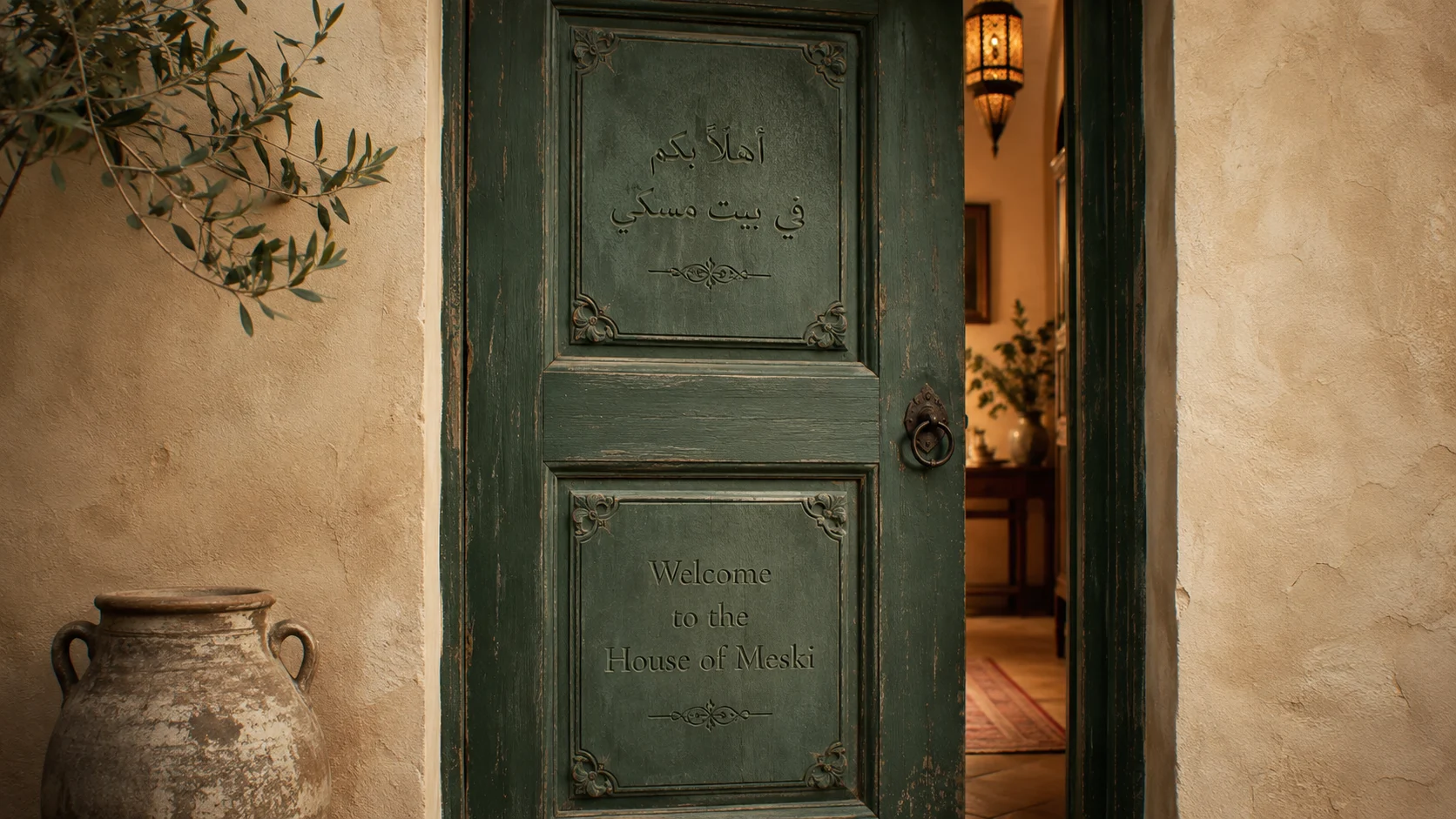
This sentence is not a marketing line. It is the reason The House of Meski exists. When we imagined what we wanted to build, we did not begin with products. We began with a question — the kind of question that tends to get pushed aside when business plans take over: What kind of place do we actually want this to be?
Some Places Ask You to Buy Before They Tell You Their Story
Most online shops are designed around a single moment: the transaction. Their architecture points toward one destination. Add to cart. Proceed to checkout. Thank you for your purchase.
There is nothing dishonest about that. But it is a narrow ambition.
We have all arrived at websites that felt like standing in a corridor rather than entering a home. Everything is designed to move you forward. Nothing invites you to sit down. The products are presented before you have been told why they matter, where they come from, or what stories surround them. You are expected to buy something you do not yet understand, from people whose values you cannot read, in a language that belongs more to advertising than to conversation.
We wanted something different.
Not better, necessarily. Different in purpose. Different in what it values. Different in what it asks of the people who arrive.
What It Means to Build a House
In the Arab world, a house is not merely an address. It is a statement of values.
The majlis — the traditional sitting room found across the Gulf, inscribed by UNESCO as Intangible Cultural Heritage shared by the UAE and Saudi Arabia in 2015 — was never designed for commerce. It was designed for conversation. For welcoming strangers. For sharing what you know and learning what others carry. Coffee was poured. Dates were placed on the table. Incense was lit. And then, before any business was discussed, before any transaction was considered, time was given. Time to sit. Time to ask. Time to listen.
The greatest discourtesy in that tradition is to rush a guest.
The House of Meski is modelled on that understanding. Not as an imitation of a physical space, but as an editorial commitment. Every reader who arrives here deserves the same welcome — whether they stay for five minutes or five hours, whether they buy something today, in two years, or never. The hospitality does not depend on the outcome.
A house welcomes you. A store qualifies you.
We chose the house.
The Philosophy in a Single Line
Knowledge before commerce. Story before sale. Understanding before choosing. This is what The House of Meski was built to protect.
Products as Gateways, Not Destinations
Someone may arrive here looking for honey.
They type a search into Google — Sidr honey heritage, or premium honey Middle East, or simply what makes Arabian honey different — and they land in our house. Perhaps they are looking for a gift. Perhaps they are curious about a jar they saw at a friend’s table. Perhaps they simply want to understand what makes one honey different from another.
We do not begin by telling them to buy.
We begin by telling them about the Sidr tree — Ziziphus spina-christi, ancient and hardy, growing across the wadis of Yemen and Oman and the fringes of the Arabian Peninsula. A tree so deeply woven into the region’s history that its name appears in Islamic tradition. The honey gathered by bees that visit its small pale flowers carries something of that history: a flavour that many apiculturists describe as complex and resinous, darker than clover, richer than acacia, with a texture that resists crystallisation and a scent that lingers in the memory.
Now the visitor knows something. They arrived looking for honey. They discovered a landscape.
Another visitor arrives looking for olive oil. They leave knowing something about Morocco — about the families who have pressed olives in the same valleys for generations, combining ancestral knowledge with careful craft, producing oils that carry the memory of the soil as clearly as any terroir wine.
Someone else comes curious about Arabic coffee traditions. They leave having thought about the dallah — the copper or brass coffee pot whose shape has barely changed for centuries — and about the act of pouring, and about the gentle shake of a cup that signals, across cultures and generations: I have had enough, thank you.
Products are not the destination. They are the beginning of a journey.
Learning Before Selling
There is a practical reason why so many brands sell before they teach. Teaching takes longer. It requires patience. It demands honesty — including the honesty of saying this is more expensive, and here is exactly why, or this tradition is debated among historians, or the science here is promising but not yet conclusive.
Selling is simpler. You find a want. You offer a product. You close.
But something is lost in that speed.
When a reader understands why Moroccan argan oil takes longer to press than industrial alternatives, they do not need to be persuaded of its value. When someone learns that dates were a primary sustaining food for travellers across the Arabian Peninsula for centuries — not merely sweet fruits but a concentrated, nourishing food carried across deserts and mountain passes — they understand why quality matters. When a visitor reads about the tradition of offering honey as a gift across parts of the Arab world — a gesture of prosperity and sweetness for a new household — they experience something that no product description can replace.
Knowledge does not slow down decisions. It improves them.
Readers who understand what they are choosing are better guests, and better ambassadors for the traditions they have discovered. They do not simply buy a jar of honey. They bring a story to the table.
That is what we are building here.
Knowledge First
We write to educate. Products appear naturally when the subject calls for them — never before.
Honesty Always
We say tradition suggests rather than making promises we cannot keep. We differentiate between documented history and popular belief.
Hospitality Without Condition
Every reader is welcome here, whether they buy something today, in two years, or never. The house is always open.
Why Every Question Matters
We will be honest about something that most brands prefer not to admit: we do not know everything.
A beekeeper in the Hadhramaut valley understands the Sidr flower in ways no article can fully capture. A Moroccan family preserves methods of preparing argan oil that no academic paper has thought to record. A traveller who has spent time in a Yemeni mountain village will notice things about local honey traditions that a merchant sitting in a warehouse cannot.
Every question a reader asks us is an invitation to keep learning.
We have built this Journal understanding that knowledge does not flow only from expert to reader. It flows in every direction. The questions people bring are often more valuable than the answers we already have. They reveal gaps. They point toward subjects we had not considered. They remind us, always, that the world is larger than any single editorial calendar.
We encourage questions. We value uncertainty. We find misconceptions interesting rather than embarrassing — because correcting them is one of the most useful things a journal can do.
The Journal of The House of Meski is not a repository of final answers. It is an ongoing conversation, offered in the spirit of the majlis: open, curious, and genuinely interested in what you bring with you when you arrive.
Conversations Build Trust — Slowly, and That Is Fine
Someone may read one of our articles today.
They may return in three months to read another. Six months later, they might recommend one of our pieces to a friend travelling to Oman who wants to understand the local honey traditions. That friend may arrive, read several articles, then eventually decide to buy a gift for someone they love. And through that gift — a jar of honey, a box of dates, a bottle of cold-pressed olive oil — they will carry a story into someone else’s home.
That journey may take two years. It may take five.
We are comfortable with that.
Trust is not built in an afternoon. It is not built through discounts or urgency or the artificial scarcity of a countdown timer. It is built through consistency. Through honesty. Through the accumulated weight of articles that were worth reading even when no purchase followed. Through a publication that behaves the same way whether you are a first-time visitor or a loyal reader of several years.
A product may be enjoyed for a few days. A story can remain with us for a lifetime.
We have always believed this. It is why we research before we publish. It is why we prefer to say tradition suggests or studies indicate rather than making promises we cannot keep. The reader’s time is the most valuable thing they can offer us. We do not take it lightly.
Culture Lives Through Sharing
There is something that troubles us about the way heritage is sometimes used in commerce.
Words like authentic and traditional and ancestral appear everywhere. They decorate packaging. They fill product descriptions. They are used as quality signals without explanation — as though the word itself does the work that understanding should do.
Culture cannot be packaged. It can only be transmitted.
Arabian hospitality is not a feature. It is a practice that takes years to understand and a lifetime to embody. Moroccan craftsmanship is not a label. It is the accumulated knowledge of families who learned from families before them, in workshops and souks and mountain homes, passing gestures and techniques and measurements that were never written down because they did not need to be — until now, perhaps, when so much is at risk of disappearing.
Gulf traditions around dates, coffee and honey are not aesthetic choices. They are a language of generosity that has been spoken for centuries across the Arabian Peninsula, from the tent of a Bedouin host to the majlis of a modern Emirati household, always carrying the same message: you are welcome here, and your presence matters.
Sharing this — carefully and honestly — is the work of The House of Meski.
Not to sell it. To transmit it. And perhaps, through transmission, to preserve something that would otherwise be lost to the speed of the world.
What We Hope You Take With You
We do not simply offer products.
We share the culture, stories and traditions that give them meaning.
When you leave our house, we hope you carry something you did not have when you arrived — a name you did not know before, a tradition that now makes sense, a question you want to pursue, an understanding that will make you pause the next time you open a jar of honey or pour coffee for a guest.
Our greatest hope is simple: that you leave our house knowing something you did not know when you arrived.
And if one day you remember The House of Meski, we hope it will not only be because of a jar of honey, but because of a story that stayed with you.
That, more than any sale, more than any search ranking, more than any number on an analytics dashboard, is what we are here to build.
بارك الله فيكم
Frequently Asked Questions
The House of Meski is a cultural house and editorial journal dedicated to honey, dates, olive oil, Arabic coffee, Moroccan heritage, Gulf traditions and the stories that connect people through food, craftsmanship and hospitality. It is also a curated shop offering premium products from the Arab world and Mediterranean traditions — but the Journal exists independently of the shop, because knowledge should never depend on a sale.
Because we believe that understanding comes before choosing. A reader who knows the story of the Sidr tree, the traditions of a Yemeni beekeeper, or the way honey has been offered as a gift across the Arab world for centuries will make a wiser and more meaningful decision than one who simply reads a product description. We write to educate first. Products appear naturally when the subject calls for them.
We curate premium honey from the Arabian Peninsula, dates from historic Gulf growing regions, Moroccan olive oil, Arabic coffee and traditional products rooted in the heritage of the Arab world and Mediterranean cultures. Every product in our collection is chosen because a story surrounds it — not simply because it is available.
Please visit our shop for current delivery information. Availability and shipping options may vary by region and season.
Meski is a term with roots in Moroccan and Andalusian tradition, connected to the fragrance of musk — one of the most prized and ancient scents of the Arab world. It evokes generosity, warmth and the kind of beauty that lingers long after the moment has passed. It felt like the right name for a house built around memory, culture and lasting impression.
Every question we receive is a potential future article. If you carry knowledge we do not yet have — a family tradition, a regional variation, a beekeeper’s practice, a recipe passed down without a recipe — we would be honoured to hear it. Reach out through our contact page. The house is always open.
Explore the World We Are Building
Every article in our Journal is written with the same care as this one. Stories about Sidr honey, Moroccan olive oil, Arabic coffee, Ramadan traditions and the cultures that gave them meaning.