
Before oil transformed Abu Dhabi, more than 400 pearling boats worked under Sheikh Zayed bin Khalifa — a ruler whose power joined the sea, the majlis and the oases.
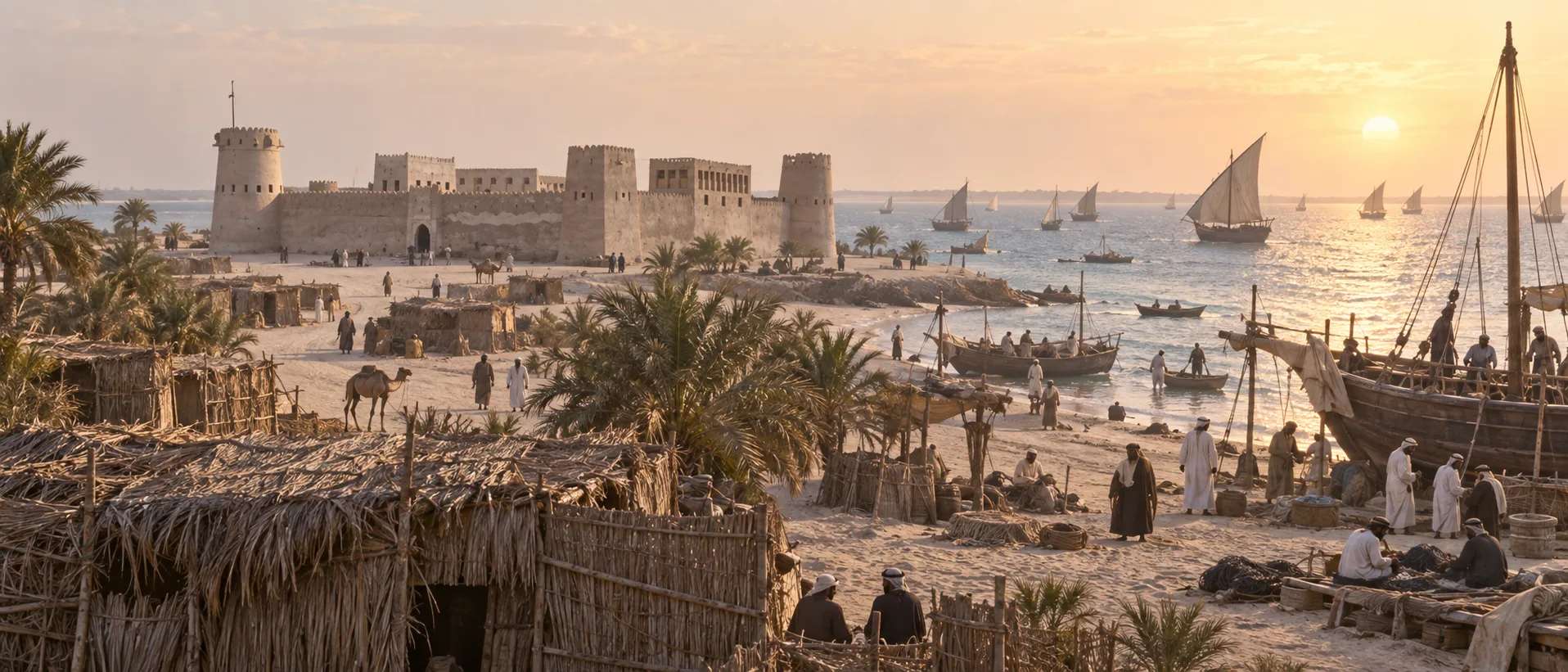
The Abu Dhabi we know grew rich from oil, but oil was not its first fortune. In the late nineteenth century, natural pearls connected the island to buyers across the Gulf and beyond. Under Sheikh Zayed bin Khalifa Al Nahyan, known as Zayed the Great, Abu Dhabi commanded more than four hundred pearling boats — a fleet large enough to shape the economy, the city and the ruler’s power.
Before Oil, Abu Dhabi Looked to the Sea
Abu Dhabi’s modern image makes oil almost impossible to ignore.
But the city is older than oil, and its first great economic horizon was not underground.
It was the sea.
Fishing fed households. Coastal trade connected settlements. Pearls connected Abu Dhabi to a market much larger than the island itself.
By the late nineteenth century, under Sheikh Zayed bin Khalifa Al Nahyan, the ruler remembered as Zayed the Great, Abu Dhabi commanded the largest pearling fleet in the Gulf.
Zayed the Great Was Not Sheikh Zayed bin Sultan
The name can confuse modern readers because Abu Dhabi has two famous rulers named Zayed.
Sheikh Zayed bin Khalifa Al Nahyan ruled Abu Dhabi from 1855 to 1909 and is known as Zayed the Great, or Zayed the First.
He was the grandfather of Sheikh Zayed bin Sultan Al Nahyan, the Founding Father of the United Arab Emirates.
Keeping those two men separate is important because their Abu Dhabis were separated by an extraordinary economic transformation.
A Reign Longer Than Half a Century
Qasr Al Hosn records Sheikh Zayed bin Khalifa’s rule as the longest in Abu Dhabi’s history.
Beginning in 1855, his reign brought a long period in which the city expanded, tribal relationships were strengthened and Abu Dhabi’s external diplomacy grew.
The official Qasr Al Hosn history describes him as a ruler determined to establish economic prosperity and strengthen diplomatic relations abroad.
That prosperity was not oil prosperity.
It was built from a desert-oasis-maritime economy in which pearls became exceptionally important.
Qasr Al Hosn Was the Political Heart
Today Qasr Al Hosn sits surrounded by a capital of towers, roads and institutions.
In Zayed the Great’s time it was far more than a heritage landmark.
It was home, seat of rule, meeting place and political centre.
Abu Dhabi Culture describes the fort as the oldest and most significant building in the city, a place that evolved with the settlement around it.
Our article I Went Looking for a Souk in Abu Dhabi begins at Qasr Al Hosn for exactly this reason: if you want to understand the modern capital, start where political Abu Dhabi once gathered around a fort.
The Majlis Was Government at Human Scale
One detail from the Qasr Al Hosn narrative is especially important.
Emirates News Agency records that Zayed the Great established a majlis where he met the community and personally attended to people’s wellbeing.
That is a very different image of government from a ministry tower.
The ruler sat where people could bring needs, disputes and requests.
Power was still personal, visible and tied to reputation.
Then There Were the Pearling Boats
Qasr Al Hosn gives the number that changes the scale of the story.
By the late 1800s, Abu Dhabi commanded more than 400 pearling boats, described by the heritage site as the largest number in the Gulf.
That fleet was not four hundred floating jewellery shops.
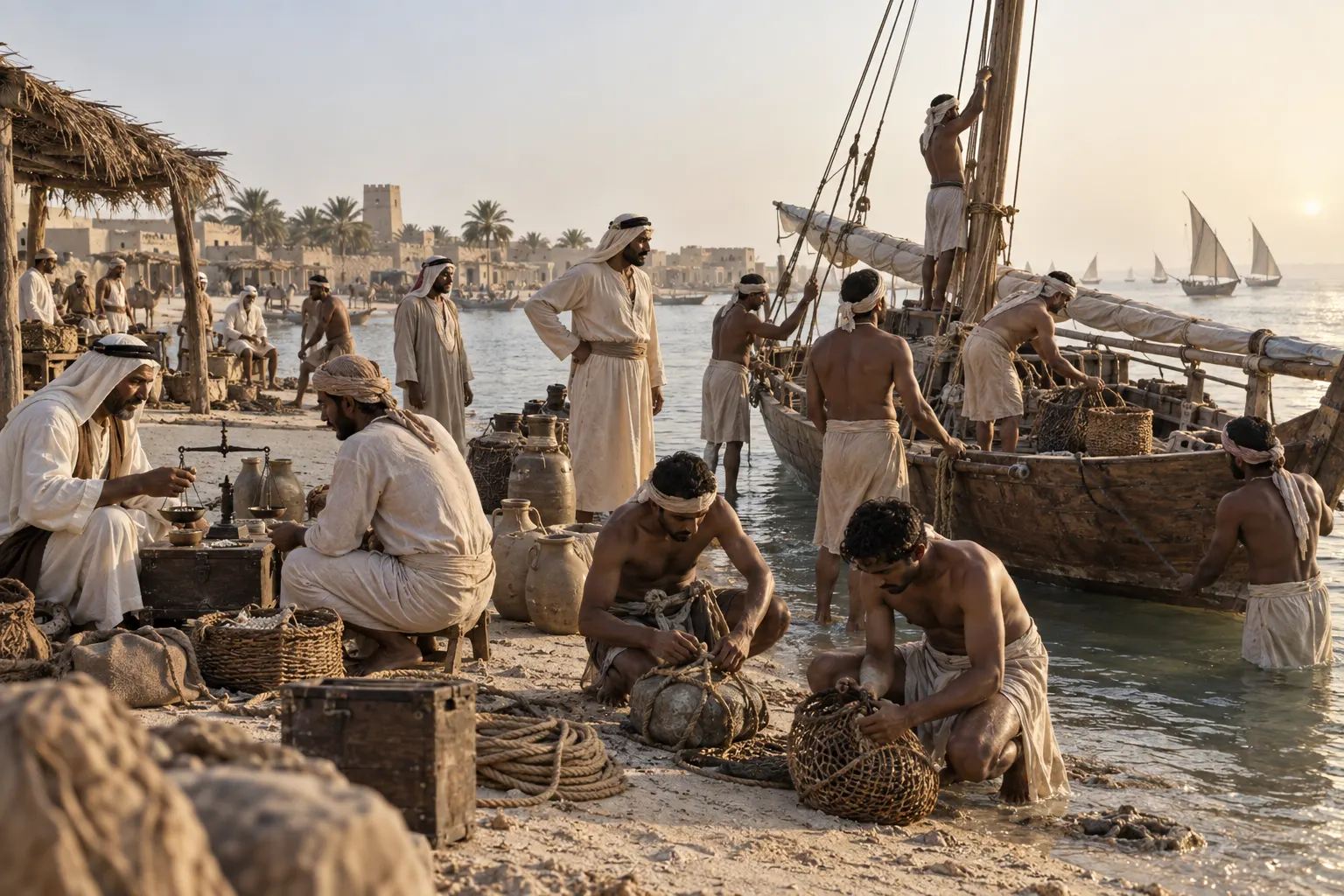
Each vessel meant a captain, divers, rope pullers, crew, suppliers, financiers, merchants, families and people waiting on shore.
Multiply one boat by hundreds and pearling becomes less like an exotic tradition and more like an entire economic system.
The Diver Was Only One Person in the Chain
Pearling history often focuses on the diver because the physical act is extraordinary.
He descended on one breath, collected oysters and relied on the crew above to pull him back.
But the pearl did not become wealth when the shell reached the deck.
Someone financed the season. Someone owned or captained the boat. Someone sorted and evaluated pearls. Merchants negotiated. Buyers connected the Gulf to India and international markets.
The diver was essential, but the economy was a chain.
Families Experienced the Sea From Shore
The pearling season also had a family geography.
Men could spend long periods away from home during the main diving season. The sea that promised income also created absence.
We should not romanticise that.
A prosperous fleet did not mean every household felt wealthy. Debt, dangerous work, uncertain harvests and dependence on market prices were part of the system.
Pearling could make fortunes, but it could also make families wait.
Dalma Was Part of the Pearl World
Abu Dhabi’s pearling story was larger than the city island.
Dalma and the surrounding pearl banks formed part of the seasonal geography of the industry. Boats, merchants and supplies moved across a maritime landscape that modern road maps can hide from us.
The emirate was not simply desert behind one coastal town.
It was islands, sea routes, oases and seasonal movement.
Pearls Connected Abu Dhabi to India and Beyond
A pearl from Gulf waters did not have to remain in the Gulf.
Regional merchants connected the harvest to Bombay, Persian Gulf trading centres and eventually European buyers.
That is why pearling belongs to the same history as the old ports we have been writing about in Qatar and Oman.
In Al Zubarah, pearls helped build a Qatari port. In Abu Dhabi, a later nineteenth-century pearl fleet helped strengthen a ruling city.
The object was tiny. The network was enormous.
What Wealth Looked Like Before Oil
Pearl wealth did not look like a modern sovereign wealth fund.
It moved through boats, trade, land, patronage, defence, alliances and the ruler’s ability to support people and extend authority.
The National notes that Zayed the Great used Abu Dhabi’s pearling wealth to acquire land and build forts in the oases of Al Ain, including sites such as Al Jahili.
The sea could therefore finance influence inland.
Pearls taken from salt water helped shape control around wells, farms and oasis routes.
Al Ain and Liwa Were Not Separate From the Coast
Abu Dhabi’s history makes more sense when coast and oasis are read together.
The Bani Yas moved seasonally between places according to pasture, water, dates, fishing and pearling. Qasr Al Hosn’s historical material describes the earlier migration from Liwa toward a permanent coastal settlement.
Under Zayed the Great, the emirate’s political strength depended on both worlds.
The coast produced maritime wealth. The oases produced dates, agriculture, water and strategic depth.
A ruler who controlled only one would have understood only half the country.
A European Visitor Left a Human Description
Historical rulers easily become statues in our minds.
One description quoted by The National helps reduce that distance.
An American missionary who met Sheikh Zayed bin Khalifa in 1901 described him as “genial, hospitable and very intelligent.”
It is only one visitor’s impression, not a complete character study.
But the words fit another documented image: a ruler conducting business in a majlis and dealing directly with people.
Hospitality Was Part of Rule
In a society where authority was personal, hospitality was not separate from politics.
To receive people, listen, pour coffee, hear disputes and maintain reputation was part of how leadership was experienced.
That connects naturally with What Was Served When a Stranger Arrived?, where we look at coffee, dates and the majlis as more than food.
The ruler’s majlis was social architecture.
It turned access into a political language.
The Sea Could Make Abu Dhabi Powerful — and Vulnerable
Pearling brought wealth because international buyers valued natural Gulf pearls.
That dependence also created vulnerability.
If demand weakened, prices fell or new competition appeared, the whole chain felt it.
The catastrophic collapse came after Zayed the Great’s lifetime, especially with global economic crisis and the rise of cultured pearls.
But his reign shows Abu Dhabi at the high point of the natural pearl economy, before that system broke.
1909: The End of a Reign, Not the End of Pearling
Sheikh Zayed bin Khalifa died in 1909 after more than fifty years of rule.
Pearling continued after him, and its greatest crisis came later.
That distinction matters.
His Abu Dhabi should not be read backwards as a city waiting for oil.
It was a functioning Gulf power whose economy already had its own logic, strengths and risks.
The City We Know Was Built on More Than Oil
Oil transformed Abu Dhabi on a scale pearling never could.
But transformation is not the same as origin.
Qasr Al Hosn existed before oil. The majlis existed before oil. Fishing, dates, pearl diving, maritime trade and oasis agriculture existed before oil.
Modern Abu Dhabi did not begin from zero when petroleum revenues arrived.
It accelerated from an older political and economic foundation.
From Pearl Fleet to Emirates Palace
This is why I like placing the old pearl city beside modern Abu Dhabi.
Today a visitor can move from Qasr Al Hosn toward the Corniche, Emirates Palace and Qasr Al Watan in a short drive.
The visual difference is almost absurd.
But the cultural line is not completely broken: rulers still receive guests, gifts still matter, coffee and dates still carry meaning, and the sea remains part of the city’s identity.
Luxury changed the scale of presentation.
Hospitality and memory survived in other forms.
Sources & Further Reading
The central source is the official Qasr Al Hosn history, which records Zayed the Great’s reign from 1855 to 1909 and states that Abu Dhabi commanded more than 400 pearling boats by the late nineteenth century.
Abu Dhabi Culture provides the wider history of the fort and the city’s transition from a fishing and pearling settlement to a modern capital.
The Emirates News Agency account of Qasr Al Hosn documents Zayed the Great’s majlis and his place in the growth of Abu Dhabi. The National provides additional context on pearling wealth and contemporary descriptions of the ruler.
Scenes of families waiting, crews preparing or merchants bargaining are editorial reconstruction around documented economic life, not invented eyewitness testimony.
When Pearls Were Abu Dhabi’s Fortune
The easiest way to misunderstand old Abu Dhabi is to look at the modern skyline and imagine that wealth began with oil.
It did not.
Before oil, the sea already connected Abu Dhabi to distant buyers. More than four hundred pearling boats could leave under a ruler whose power extended from coastal majlis to inland oases.
The pearl economy was difficult, unequal and vulnerable, but it made Abu Dhabi one of the Gulf’s strongest coastal powers.
Zayed the Great ruled that world.
The next Abu Dhabi would be built on a different source of wealth.
Questions People Ask
Sheikh Zayed bin Khalifa Al Nahyan, ruler of Abu Dhabi from 1855 to 1909. He is also called Zayed the First.
No. Zayed the Great was the grandfather of Sheikh Zayed bin Sultan Al Nahyan, the Founding Father of the UAE.
Qasr Al Hosn states that Abu Dhabi commanded more than 400 pearling boats, the largest number in the Gulf.
Natural pearls were a major export economy supporting divers, crews, merchants, boat owners, trade networks and political revenue.
It was the political heart of the community and part of the ruler’s seat of government, residence and majlis tradition.
Yes. Qasr Al Hosn historical material records that he established a majlis where he met the community and attended to people’s concerns.
Yes. Historical accounts connect pearling wealth with land, forts and influence in the oasis regions as well as the coastal economy.
Its major decline came after Zayed the Great’s reign, especially during the global depression and competition from cultured pearls.
He died in 1909 after the longest reign in Abu Dhabi’s recorded ruling history.
See Abu Dhabi Before and After the Pearl Age
The fort, the sea, the majlis and the modern capital belong to one longer story. Continue from the old pearl fleet into the Abu Dhabi we recognise today.