
How to Tell if Sidr Honey Is Authentic
A definitive expert guide to identifying genuine Sidr honey in the UAE — sensory markers, label reading, laboratory verification, and the myths that mislead even experienced buyers.
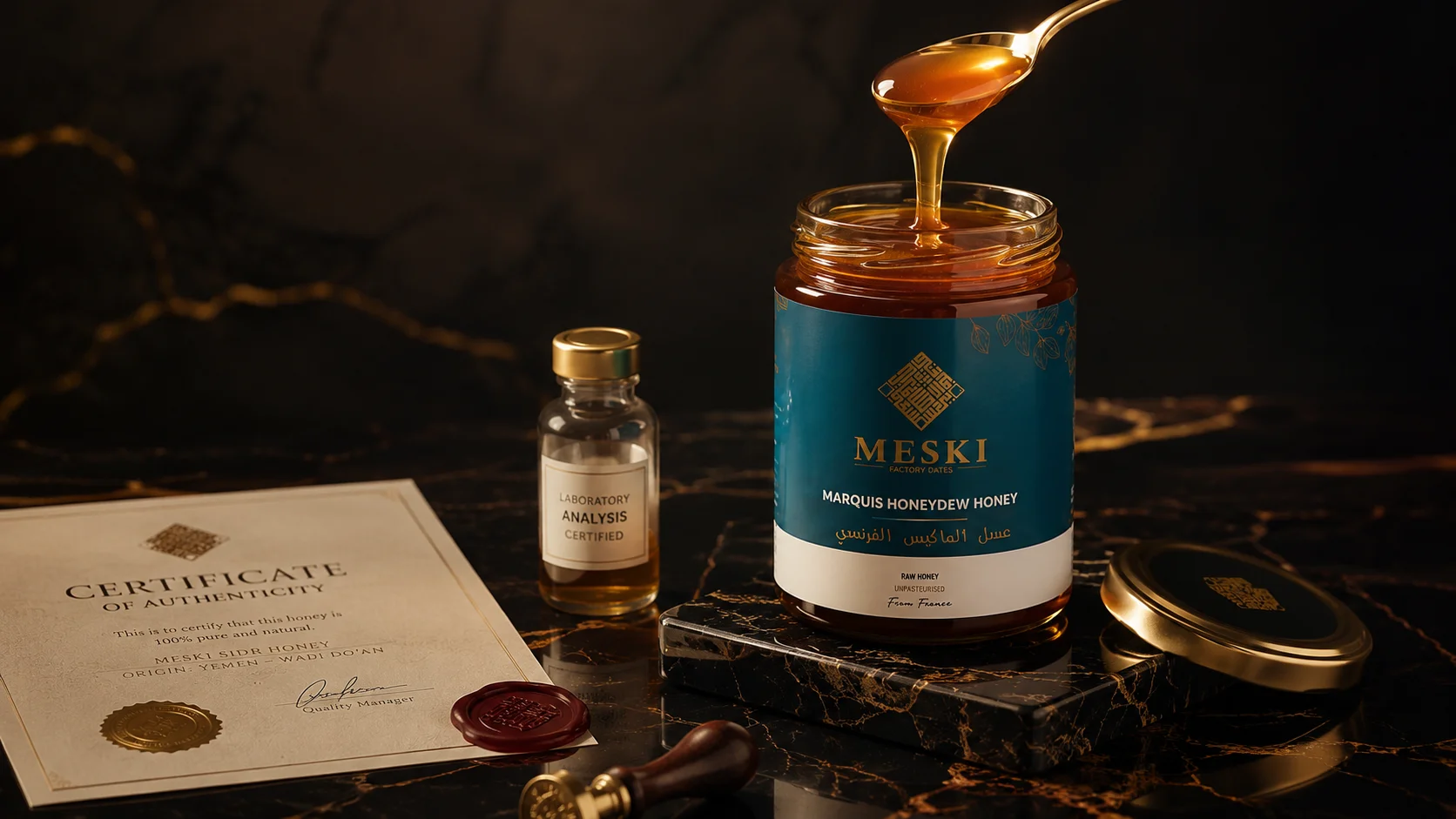
Few products in the world of fine food carry the weight of expectation that authentic Sidr honey does. Revered across the Arab world for centuries and now commanding prices that rival rare truffles, genuine Sidr honey is also one of the most counterfeited food products in the UAE. This guide exists for the buyer who refuses to be deceived — whether purchasing for the household table, as a prestigious gift, or as a considered investment in quality.
What Is Authentic Sidr Honey?
Authentic Sidr honey takes its name from the Ziziphus spina-christi tree — known in Arabic as السدر — a species of profound cultural and ecological significance across the Arabian Peninsula. Its nectar is not harvested year-round: the Sidr tree flowers in specific seasonal windows, and bees have only a narrow period each year to collect its nectar before the bloom ends. This biological constraint is the first reason genuine Sidr honey is rare — and the first reason the market for imitation product is so active.
Sidr honey is an expression of place, tradition, and biological rarity. Understanding what makes it genuine is not merely a matter of consumer prudence — it is an act of respect for the beekeeping heritage that produces it.
Where Does Genuine Sidr Honey Come From?
Sidr honey is produced wherever the Sidr tree grows and blooms. The most celebrated origins share a combination of altitude, arid climate, and unbroken generational beekeeping tradition.
The Benchmark of Sidr Excellence
Wadi Hadramout, Wadi Do’an, and the highlands of Shabwa combine altitude, arid climate, and centuries of unbroken beekeeping tradition. Yemeni Sidr from Do’an — harvested by families whose methods trace back generations using traditional hollowed-tree hives — is the benchmark against which all other Sidr varieties are measured. Prices for genuine Yemeni Sidr regularly reach significant premiums per kilogram for top grades.
Mountain Sidr with Depth of Character
Oman’s mountainous interior produces a distinguished Sidr honey characterised by a slightly lighter profile but comparable depth. Omani Sidr carries its own heritage value and is fully authentic in its own right — distinct from its Yemeni counterpart, not inferior to it.
Emirati Sidr — Local Heritage, Distinct Identity
The UAE — particularly the elevated terrain of the Hajar Mountains — supports native Sidr trees. Locally harvested Emirati Sidr honey carries its own provenance and heritage value. A jar labelled simply “Sidr honey” tells you almost nothing; a jar specifying Wadi Do’an, Yemeni highlands, or Omani mountain-source tells you a great deal.
Why Authentic Sidr Honey Commands a Premium Price
The premium attached to genuine Sidr honey is not marketing. It is the product of three converging realities:
When demand significantly outpaces supply — as has been the case in the UAE and Gulf markets for the past decade — the conditions for adulteration become almost irresistible for unscrupulous traders. This is the market reality every buyer must understand before opening their wallet.
Key Sensory Signs of Genuine Sidr Honey
Sensory evaluation is not a substitute for laboratory verification, but it remains a valuable first filter. A buyer who knows what genuine Sidr honey looks, smells, and tastes like is already ahead of the majority of the market.
| Attribute | Genuine Sidr Honey | Suspicious Indicator |
|---|---|---|
| Colour | Deep amber to warm burnt-orange; reddish undertone in light | Pale golden or near-transparent |
| Texture | Dense; flows slowly in thick sheets; crystallises naturally over time | Runny, watery, homogeneous |
| Aroma | Complex floral — warm, slightly woody, lingering depth | Caramel note (heat treatment) or flat and neutral (dilution) |
| Taste | Rich, layered sweetness; characteristic mild bitterness at finish; coats the palate | Purely sweet with no complexity; artificial aftertaste |
| Crystallisation | Natural process — a positive indicator of minimal processing | Absence of crystallisation over time in raw honey may be the more suspicious condition |
How to Read a Honey Label Correctly
A honey label is a document, not merely a decoration. Reading it correctly is one of the most practical skills a discerning buyer can develop. Every element of a credible label carries informational weight.
Country and Region of Origin
Look for a specific named region — Wadi Do’an, Wadi Hadramout, Shabwa, or specific Omani provinces. Vague origins such as “Middle East” or absent origins entirely are a red flag.
Floral Source Declaration
The label should clearly state “Sidr” or Ziziphus spina-christi as the monofloral source. “Blend” or “mixed floral” is inconsistent with a premium Sidr claim.
Processing Declaration
Look for “raw”, “cold-extracted”, or “unfiltered”. Absence of any processing statement may indicate heat treatment that compromises quality and denatures natural enzymes.
Batch Number and Harvest Date
Reputable producers trace every batch. A harvest date — ideally indicating the specific seasonal harvest — demonstrates traceability. Its absence should prompt questions.
Certificate of Analysis (CoA)
Premium producers provide, or make available upon request, a laboratory report from an accredited third-party testing facility. If a seller cannot provide one, that absence speaks volumes.
Red Flags to Watch For
Be cautious of: prices dramatically below market (genuine Sidr at a few dirhams per gram is implausible); labels printed in low resolution or with translation errors; sellers who cannot name the beekeeper or valley of origin; and products sold in unlabelled or poorly sealed containers claiming to be premium Yemeni Sidr.
Laboratory Tests That Verify Honey Quality
The uncomfortable truth about honey adulteration is that sophisticated fraud can pass most home tests and even some laboratory methods. The technology arms race between fraudsters and quality auditors is ongoing. However, the following tests represent the current best standards available to buyers and retailers seeking a verified Certificate of Analysis.
NMR Profiling — The Gold Standard
Nuclear Magnetic Resonance (NMR) profiling analyses honey at the molecular level, generating a chemical fingerprint that reveals adulteration with sugar syrups and verifies geographic origin against a reference database. A CoA that includes NMR profiling from an accredited laboratory carries the highest evidentiary weight. When a premium honey brand presents NMR-backed certification, it is demonstrating a level of transparency that distinguishes it categorically from traders who rely on visual inspection alone.
Pollen Analysis (Melissopalynology)
The microscopic analysis of pollen grains within honey verifies both the floral source and the geographic region of origin. Genuine Sidr honey will contain characteristic pollen from the Ziziphus species. Ultra-filtered honey — which has had its pollen stripped out — cannot be verified by this method, and pollen removal is itself a recognised indicator of deliberate origin-concealment.
C4 Sugar Test
The C4 isotope ratio analysis detects the addition of cane or corn sugar syrups, which carry a different carbon isotope ratio from authentic floral honey. While fraudsters have developed partial workarounds using certain rice or beet-derived syrups, it remains a valuable screening tool and should be present on any credible Certificate of Analysis.
Common Myths About Authentic Honey — Debunked
A number of widely circulated home tests for fake Sidr honey have taken on a life of their own — particularly on social media. Acting on false confidence is more dangerous than acknowledged uncertainty.
| The Myth | The Reality |
|---|---|
| Pure honey will not dissolve in water | False. Pure honey is naturally water-soluble. This test is meaningless. |
| The thumb test (honey stays on thumb) proves purity | False. Adulterated honey made with thick syrups passes it easily. |
| Crystallised honey is fake or spoiled | False. Crystallisation is natural in raw honey and often a positive indicator of minimal processing. |
| Expensive honey is always authentic | False. A high price is necessary but not sufficient. The premium market has attracted sellers who price high without substantiation. |
| Colour alone confirms Sidr origin | False. Colour can be adjusted by blending with dark honeys or caramel agents. It is a starting indicator, not a verification. |
How to Avoid Fake Sidr Honey
The most effective protection against counterfeit Sidr honey is a combination of source transparency, documentation, and supplier accountability. Here is a practical framework:
Demand Named-Origin Sourcing
Buy from brands that can name the specific valley, beekeeper family, or farm of origin — not merely the country. “Yemen” alone is insufficient; “Wadi Do’an, harvested by a named beekeeping family” is meaningful.
Request the Certificate of Analysis
Verify the availability of a third-party CoA before purchasing, particularly for quantities above a single jar. Insist that it includes NMR profiling or pollen analysis for the highest confidence level.
Be Sceptical of Unsubstantiated Claims
“Ancient recipe”, “royal grade”, and similar language is marketing unless backed by traceable sourcing. Legitimate provenance speaks for itself and comes with documentation.
Understand Realistic Price Ranges
Premium Yemeni Sidr commands a significant price per gram. A product priced dramatically below market for comparable claims deserves scrutiny — genuine scarcity cannot be arbitraged away.
Choose Established Specialists
Purchase from dedicated honey specialists rather than general marketplace aggregators where product provenance cannot be independently verified. At Meski Dates Factory, based in Sharjah, every Sidr honey variety — from Yemeni Do’ani Sidr to Omani mountain Sidr to locally harvested Emirati Sidr — is sourced with full provenance documentation and available with laboratory verification.
Questions to Ask Before Buying
The following questions, asked of any supplier, will quickly reveal the depth of their knowledge and the credibility of their sourcing. A supplier who answers with fluency and documentation has earned a level of trust; one who deflects or generalises should be approached with caution.
Your Pre-Purchase Checklist
1. Which valley or specific region does this honey come from? 2. Which seasonal harvest is this — primary or secondary? 3. Do you have a Certificate of Analysis from an accredited third-party laboratory? 4. Does the CoA include NMR profiling or pollen analysis? 5. How was the honey extracted — cold-pressed or centrifuged? 6. Has the honey been heat-treated or filtered? 7. What is the moisture content? (Above 20% increases fermentation risk and is inconsistent with premium raw honey.)
Where to Buy Authentic Sidr Honey in the UAE
The UAE is both one of the world’s most important markets for premium Sidr honey and, regrettably, one of the most saturated with imitation product. In this environment, the choice of supplier is everything.
Look for brands that operate with full transparency about their supply chain — ideally UAE-based specialists who source directly from beekeeping families in Yemen, Oman, or the Emirates themselves, and who provide documented laboratory verification for each batch. Physical traceability — knowing that a given jar came from a specific harvest, a specific beekeeper, a specific valley — is the mark of a house that takes authenticity as seriously as it does presentation.
At Meski Dates Factory, based in Sharjah, our Sidr honey selection is built on exactly this principle. For buyers seeking both heritage and transparency, we invite you to explore our curated collection — including our signature Do’ani Sidr Honey Infused with 23-Carat Gold, a fusion of centuries-old tradition and the contemporary art of gifting in the Gulf.
Explore Meski’s Verified Sidr Honey Collection
Every jar sourced with full provenance documentation. Laboratory verification available. From Wadi Do’an to the Hajar Mountains — authentic Sidr honey, delivered across the UAE.
How to Store Premium Sidr Honey Properly
Acquiring genuine Sidr honey is only the first act of stewardship. How you store it determines how long its character is preserved.
Container: Always Glass
Store raw honey in glass, not plastic. Glass does not interact with honey’s natural acidity, maintains a proper seal, and prevents moisture exchange with the environment.
Temperature: Stable and Cool
Store at stable room temperature, away from heat sources and direct sunlight. Excessive warmth accelerates fermentation and degrades enzymes. Refrigeration is not necessary — it promotes rapid crystallisation but causes no harm to the honey itself.
Light: Keep It Dark
UV exposure degrades light-sensitive enzymes and alters colour over time. A dark pantry or cupboard is ideal for preserving the full aromatic profile of your Sidr honey.
Seal: Always Close Tightly
Honey is hygroscopic — it absorbs moisture from the air. Always close the lid tightly after each use. Moisture content above approximately 20% can trigger fermentation in raw honey.
Frequently Asked Questions About Authentic Sidr Honey
No. Sidr honey is produced wherever the Sidr (Ziziphus) tree grows and blooms — including Yemen, Oman, the UAE, Saudi Arabia, and parts of Pakistan. Yemeni Sidr, particularly from Wadi Do’an and Wadi Hadramout, is among the most celebrated, but Omani and Emirati Sidr honeys carry their own distinct character and provenance. Geographic origin matters — always ask for specifics.
The definitive answer requires laboratory testing — specifically NMR profiling and pollen analysis. Sensory evaluation and label scrutiny are useful first filters, but they cannot replace scientific verification for high-value purchases. Always request a Certificate of Analysis from an accredited third-party laboratory before committing to a significant quantity.
Crystallisation is a natural chemical process in raw honey and is generally a positive indicator of minimal processing. The ratio of glucose to fructose, temperature, and the presence of natural pollen and beeswax particles all influence how quickly crystallisation occurs. To reliquefy, gently warm the sealed jar in a bowl of warm (not boiling) water.
Premium Yemeni Sidr honey from verified origins commands a significant premium per kilogram — particularly for top grades from Wadi Do’an. Be sceptical of any product priced dramatically below what comparable certified honeys command, regardless of the claims on the label. Genuine scarcity and traceability have a real cost that cannot be eliminated without compromising one or the other.
Yes. Meski Dates Factory is committed to full transparency in sourcing and verification. Certificates of Analysis and provenance documentation are available for our Sidr honey range. Contact us directly for details on any specific variety in our collection.