
Honey Academy — Meski · Dubai · Sharjah
The Honey
Pairing Guide
What goes with honey? Bread, obviously. But also meat, cheese, coffee, sport, and a conversation about a bowl of walnuts at midnight. A personal guide to combinations that actually work — and an invitation to tell us yours.

Most people use honey the same way their whole lives: in tea, on bread, occasionally in a recipe that calls for it. Which is fine. But honey has a range that most jars never get to demonstrate — because the person using them never experiments. We started experimenting. Some of the results were exactly what you would expect. Some were surprising. One — grilled meat with Samar honey — was the kind of discovery that makes you wish you had found it ten years earlier. Here is what we learned. And we genuinely want to know what you have found.
The Combinations We Return To
These are not recommendations from a food guide or a chef’s tasting menu. They are the combinations that found their way into our kitchen and stayed there — the pairings that became habits because they worked too well not to repeat.
Grilled Meat with Samar Honey
This is the one that surprises people every time. Samar honey — from the Acacia tree native to the UAE and Arabian Peninsula — has a slight bitterness beneath its sweetness. That bitterness is the key. Applied to grilled meat — lamb, goat, even a well-seasoned chicken — just before the last minutes of cooking, it caramelises at the edges, cuts through the fat, and adds a depth that no marinade or sauce achieves in quite the same way.
This is not fusion cuisine. It is a combination that Arab cooking has used for centuries in various forms — the pairing of sweet and savoury, of honey and roasted meat, is one of the oldest flavour principles in the region. The specific combination of Samar honey with grilled meat simply makes the logic explicit. Try it once with lamb chops. You will not need further convincing.
Warm Moroccan Bread, Butter, and Sidr Honey
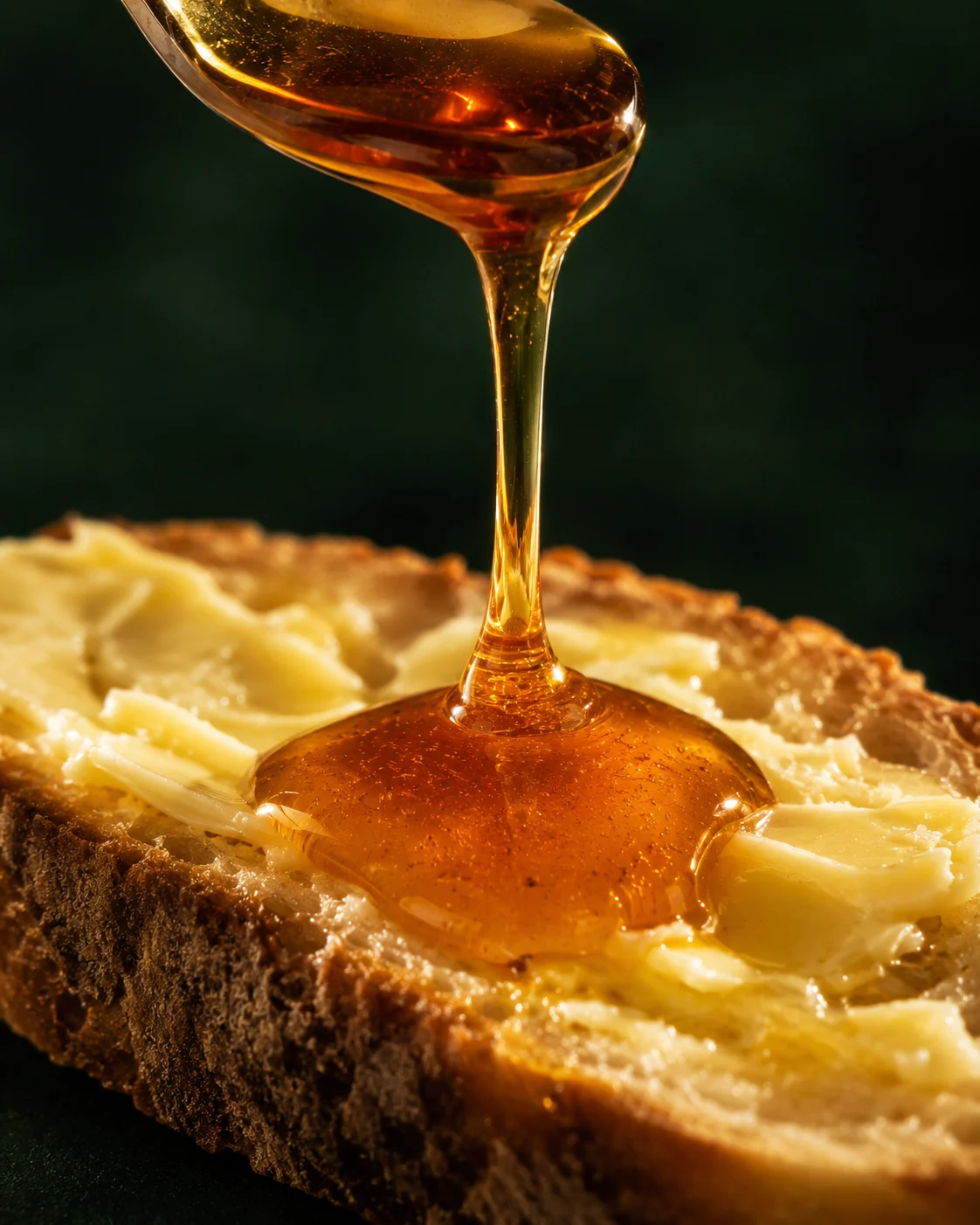
This is the combination that requires almost nothing to prepare and produces something that feels disproportionately good. Moroccan bread — khobz, the round flatbread baked in a clay oven until the crust is just firm enough to resist — straight from the oven while still warm, with good butter that melts into it, and then Sidr honey drizzled over the butter while it is still pooling.
Yes, it is indulgent. Yes, it is simple. That is the entire point. The warmth of the bread opens the honey’s aromatic compounds. The butter rounds out the Sidr’s slight woodiness and carries it further across the palate. The three ingredients do not compete — they amplify each other in the way that only very simple combinations of genuinely good ingredients can.
Khobz is the best vehicle for this. But any bread that is warm, slightly dense, and has been properly made will work. What does not work is cold bread from a plastic bag. The warmth is not optional.
Walnuts, Honey, and Ginger — Before Sport
This started as a practical decision and became a habit. Before training — whether it is a morning run in the cooler months of the UAE winter or a gym session at any time of year — a small handful of walnuts, a teaspoon of raw Sidr honey, and a pinch of fresh ginger provides something that a commercial pre-workout product does not: nothing artificial, nothing that requires reading a label with a chemistry degree, and no crash afterward.
The walnuts provide sustained fat and protein. The honey provides immediate glucose from its glucose content and slower-release energy from the fructose. The ginger adds a warming effect that is not merely placebo — ginger’s documented thermogenic properties are real, if modest. Together they create a pre-sport combination that is effective, natural, and — unlike most pre-workout food advice — actually pleasant to eat.
This works best with a raw honey rather than a processed one — the full enzymatic profile and the aromatics that heat destroys are part of what makes the combination feel as good as it does.
Six Pairings — What the Honey World Knows
Beyond our own experiments, there are pairings that the culinary world has arrived at through centuries of collective trial. Here are six categories — each with a recommendation for which honey works best and why.
The pairing works because of contrast: cheese is savoury, fatty, complex — honey is sweet, aromatic, and cuts through fat the way acidity does in wine. For soft cheeses — labneh, fresh goat cheese, burrata — a lighter, more floral honey works best: Sidr from Hatta, acacia, or a good Moroccan wildflower. The honey should not overpower the cheese. For aged or sharp cheeses — a robust manchego, a strong blue — you need a honey with enough intensity to match: Yemeni Sidr from Hadhramaut, buckwheat, or a dark mountain honey. A single rule: drizzle, don’t drown. The ratio matters.
The most common honey use in the Gulf — and the one most often done wrong. The error is adding honey to boiling tea: temperatures above 40°C begin to degrade the enzymes and volatile aromatic compounds that make premium honey worth its price. Let the tea cool to drinking temperature first, then add the honey. It dissolves perfectly at drinking temperature. For Karak tea, a mild honey that does not compete with the spices works better than an intense Sidr — try a lighter acacia or a Moroccan wildflower. For plain green or white tea, Sidr from Hatta is the right match: the honey’s complexity complements the tea’s subtlety without burying it.
Less intuitive than tea, more interesting when it works. A teaspoon of raw honey in black Americano — not the espresso itself, which is too hot, but the diluted Americano at drinking temperature — replaces sugar with something that adds its own aromatic layer to the coffee rather than just sweetening it. Sidr honey with its caramel-woody notes pairs particularly well with medium or dark roast coffee: both carry similar flavour profiles and they reinforce each other rather than competing. Avoid delicate single-origin light roasts, where the honey’s intensity will simply overwrite the coffee’s subtlety. Avoid adding honey directly to the espresso — the temperature is too high and the concentration too intense.
The Samar honey and grilled meat combination above is the most specific example, but the principle is broader. Honey works with meat for a reason that flavour science explains clearly: the Maillard reaction — the browning of meat surfaces — is accelerated and enhanced by the sugars in honey, producing more complex caramelised flavours at the surface while the interior remains juicy. Applied in the last few minutes of cooking (not at the start, where it burns), honey creates a glaze that does something no marinade can reproduce. For red meats, use a darker, more robust honey. For poultry, a lighter floral honey. For lamb specifically — where the slight gaminess of the meat benefits most from a sweet-savoury contrast — Samar or a mountain Sidr is the most natural companion.
The rule: replace sugar with honey using a ratio of 0.75 to 1 — honey is sweeter per gram, so you need less. For no-heat desserts — with yoghurt, on fruit, drizzled over ice cream — any quality raw honey works and the choice is about flavour compatibility. For baked desserts, be aware that honey adds moisture and browning — reduce other liquids slightly and lower the oven temperature by 15°C to prevent over-browning. At temperatures above 40°C, the premium properties of raw honey are reduced, so for baked applications there is no reason to use your finest Sidr — save it for uncooked uses where its full complexity can be tasted.
The most ancient pairing and the one that most people underestimate. The bread matters as much as the honey — a warm, dense, properly made bread is the ideal vehicle because it has enough structure to carry the honey’s weight without dissolving into it. Cold bread, sliced bread, commercial bread — these are not the same. For the Moroccan khobz combination described above, the equation is warmth + butter + Sidr. For Arabic regag or khameer, a lighter honey is more appropriate — Ghaf honey from the UAE, acacia, or a good Moroccan wildflower. For sourdough, a dark Sidr stands up to the bread’s acidity and creates a genuine counterpoint. The rule across all variations: warm the bread. Always warm the bread.
Now Tell Us Yours
Every serious honey eater has a combination that surprised them — a pairing they found by accident, or inherited from their family, or discovered in a country they visited and brought home in their memory if not in their luggage.
We genuinely want to know. Not for marketing purposes. Because the best knowledge about honey — like the best knowledge about most things — exists in the accumulated experience of people who have actually paid attention, not in the official guides written by people who get paid to write guides.
Send us your combination. Tell us which honey, which food, what the context was, and what happened when you tried it. If it is as good as some of the ones above, we will share it here with your name on it — or without, if you prefer.
Share Your Combination
WhatsApp us your favourite honey pairing at +971 56 381 3589 — or tag us on Instagram @meskidatesfactory. Which honey. Which food. What happened. We are listening.
Questions About Honey Pairings
It depends on the cheese. For soft, mild cheeses — labneh, fresh goat, burrata — a lighter, more floral honey works best: Sidr from Hatta, acacia, or a Moroccan wildflower. For aged, sharp, or blue cheeses — where the flavour intensity is high — you need a honey with enough character to match: Yemeni Sidr from Hadhramaut, dark mountain honey, or buckwheat. The general rule: match the intensity of the honey to the intensity of the cheese. And always drizzle rather than pool — the ratio of honey to cheese on the palate matters significantly.
Add it after the tea has cooled to drinking temperature — not to boiling tea. Temperatures above 40°C begin to degrade the natural enzymes and volatile aromatic compounds that make premium raw honey worth buying. Honey dissolves easily at drinking temperature — you do not need the boiling water to dissolve it. This is the single most common way that people inadvertently reduce the value of the honey they are using.
You can, but at temperatures above 40°C the premium enzymatic and aromatic properties of raw Sidr are reduced. For baked applications, save a less expensive raw honey and reserve your Sidr for uncooked uses where its full character can be appreciated. The exception is using honey as a glaze on meat in the last minutes of grilling — the temperature exposure is brief and the caramelisation effect on the surface is genuinely worth it. In that application, the flavour complexity of a good Sidr does come through in the finished result.
A raw honey with a good glucose-fructose balance — Sidr honey performs well here because its natural composition provides immediate energy from glucose and sustained release from fructose, without the sharp spike and crash of refined sugar or processed energy products. A teaspoon — not a tablespoon — about 20 minutes before training, alongside walnuts and a small amount of fresh ginger, is a pre-sport combination that is practical, natural, and actually pleasant to eat. More detail in the article above.
Arabic coffee — qahwa — is typically served unsweetened with cardamom, saffron, and sometimes clove. Adding honey to qahwa would work against its traditional character, which is deliberately bitter and aromatic as a counterpoint to dates. The combination of qahwa and dates, with honey on the dates, works well — the bitterness of the coffee, the sweetness of the date, and the aromatic depth of the honey create three distinct layers on the palate. For Turkish or espresso-based coffee, honey in the Americano at drinking temperature is the better application.
The Honeys Behind These Pairings
The combinations in this guide use raw honeys from identified origins — Emirati Sidr from Hatta, Samar from the Arabian Peninsula, Moroccan wildflower — because the flavour differences between honeys are real and they matter in pairing. Generic honey from a supermarket shelf has been processed to a uniformity that removes the character that makes these combinations interesting.
Explore the range