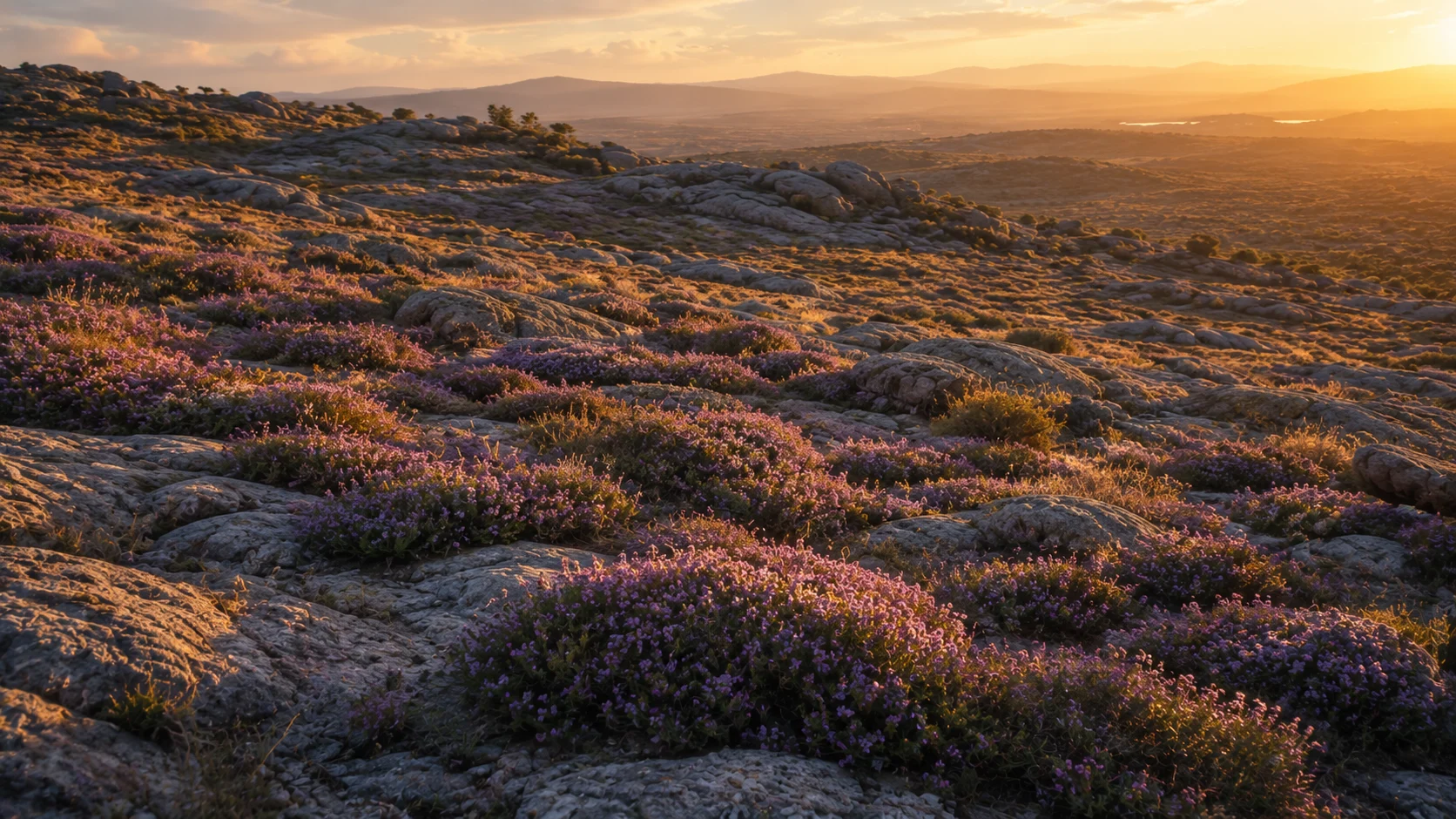
Spain · Castilla-La Mancha · Valencia · Soria
Spanish
Thyme Honey
عسل الزعتر الإسباني
The smallest plant in this whole Atlas gives one of its loudest honeys.
Across the dry granite hillsides of central and eastern Spain, wild thyme grows low, unglamorous, and easy to miss — until its brief flowering turns an entire hillside into a single, unmistakable flavour.
Terroir
Garrigue country, low to the ground
Wild thyme carpets the dry, sun-baked scrubland of Castilla-La Mancha, and further east through Valencia’s Sierra Mariola and La Safor, and the mountains around Soria — granite soils, full sun, almost no shade.
Unlike every tree this Atlas otherwise follows, thyme offers the bees nothing to climb toward. It grows as low tufts, barely knee-height, its small purple flowers easy to overlook from anywhere but up close.
| Location | Castilla-La Mancha, Valencia (Sierra Mariola, La Safor), Soria, Spain |
| Landscape | Dry granite scrubland, full sun, minimal shade |
| Plant | Wild thyme — Thymus vulgaris |
| Bloom | April to May |
| Harvest | Late spring into summer, typically May to July |
“Crush a single thyme leaf between your fingers, and you already know what an entire hillside of it, worked by ten thousand bees, must taste like.“
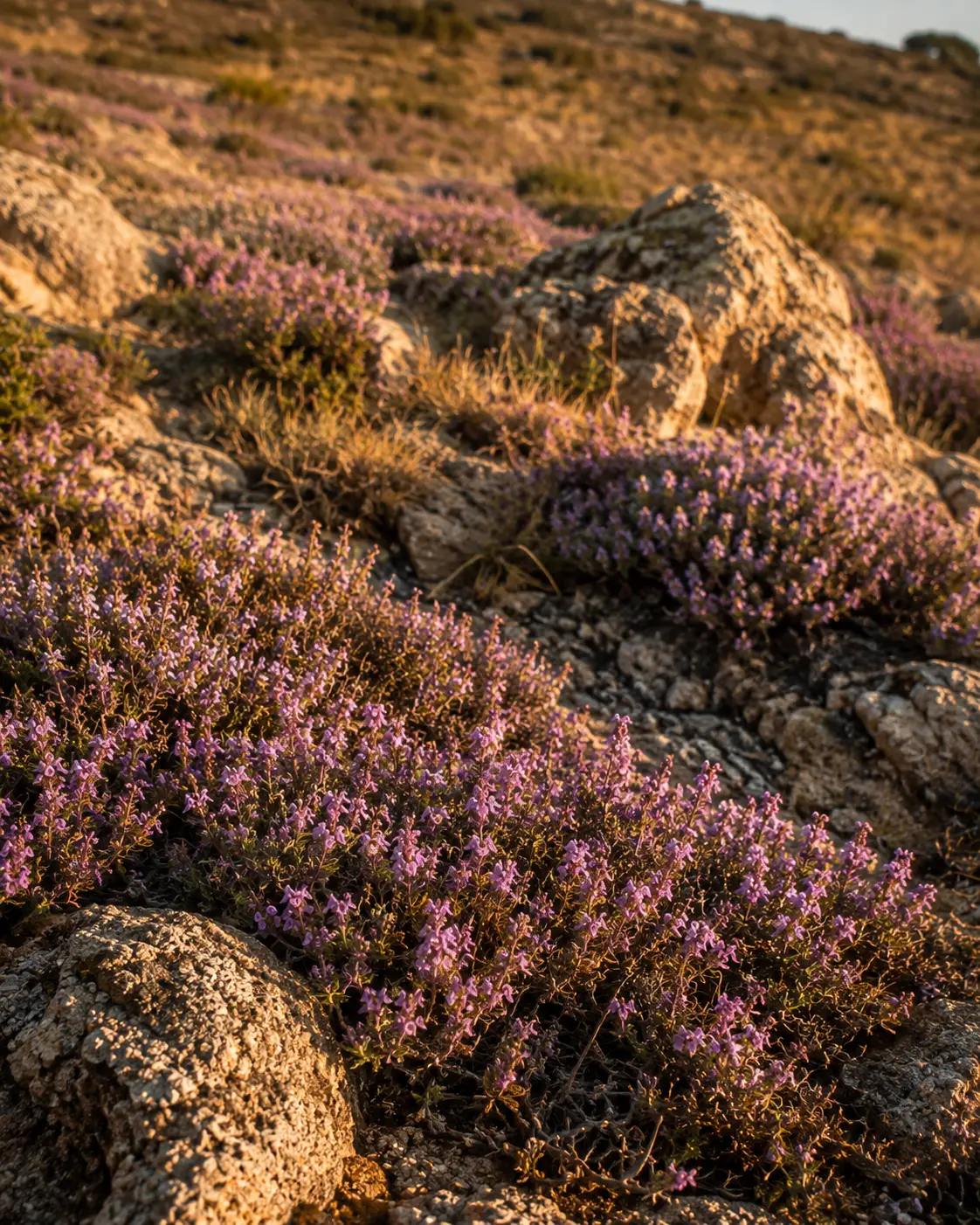 Castilla-La Mancha · thyme scrubland
Tradition
A garrigue plant that outgrew its own kitchen shelf
Thyme has flavoured Mediterranean kitchens for as long as anyone can trace — but thyme honey is a newer specialisation, prized precisely because the plant’s intense oils survive the trip from leaf to nectar to jar.
Spain has become one of Europe’s principal sources for it, exporting to neighbouring countries whose own thyme harvests fall short of demand — a quiet trade most jars never mention.
Long-standing
A kitchen herb first
Thyme flavoured Mediterranean cooking and medicine for centuries before anyone thought to isolate its honey as its own variety.
Modern beekeeping
A monofloral in its own right
Beekeepers learned to time hives precisely to the brief thyme bloom, isolating a honey that had previously only existed blended into wildflower jars.
Ongoing
A quiet export
Spain’s thyme harvest now supplies not only its own market but neighbouring countries whose domestic thyme production cannot meet demand.
Today
Still a race against a short window
The bloom remains exactly as brief as it always was — a beekeeper’s timing still decides everything.
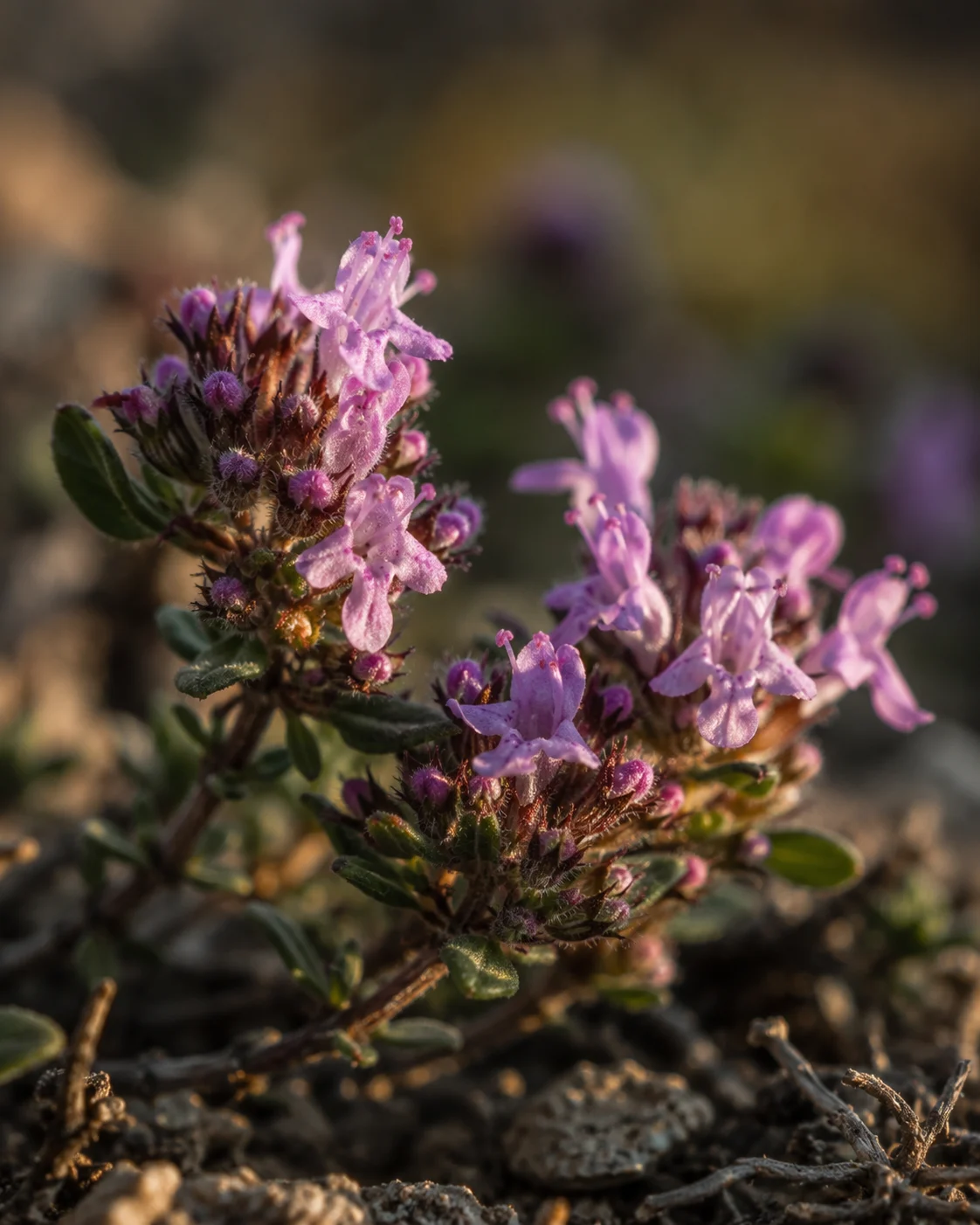 Thyme blossom · Castilla-La Mancha
“A flower barely the size of a fingernail, and still the whole hillside can’t keep the secret.”
— The House of Meski
Rarity
Intense, and gone within days
Thyme’s flowering is famously described by beekeepers as an intense flow that lasts only briefly — long enough to fill supers if the timing is right, and short enough that a delayed hive placement can miss it almost entirely.
Why it cannot scale
Thyme does not compensate for a late hive placement. Miss the flowering window, and the honey simply is not there to gather.
Beekeeping
Hillside beekeepers, moving with the bloom
Beekeepers who work this harvest follow the thyme bloom across the hills and mountains by truck, positioning hives just ahead of flowering rather than waiting to see where the bees end up foraging.
The practice
Extraction is standard modern practice throughout — smoker, uncapping knife, extractor — the skill here lies entirely in timing, not in the tools.
Sensory reading
A small plant with an outsized voice
Texture
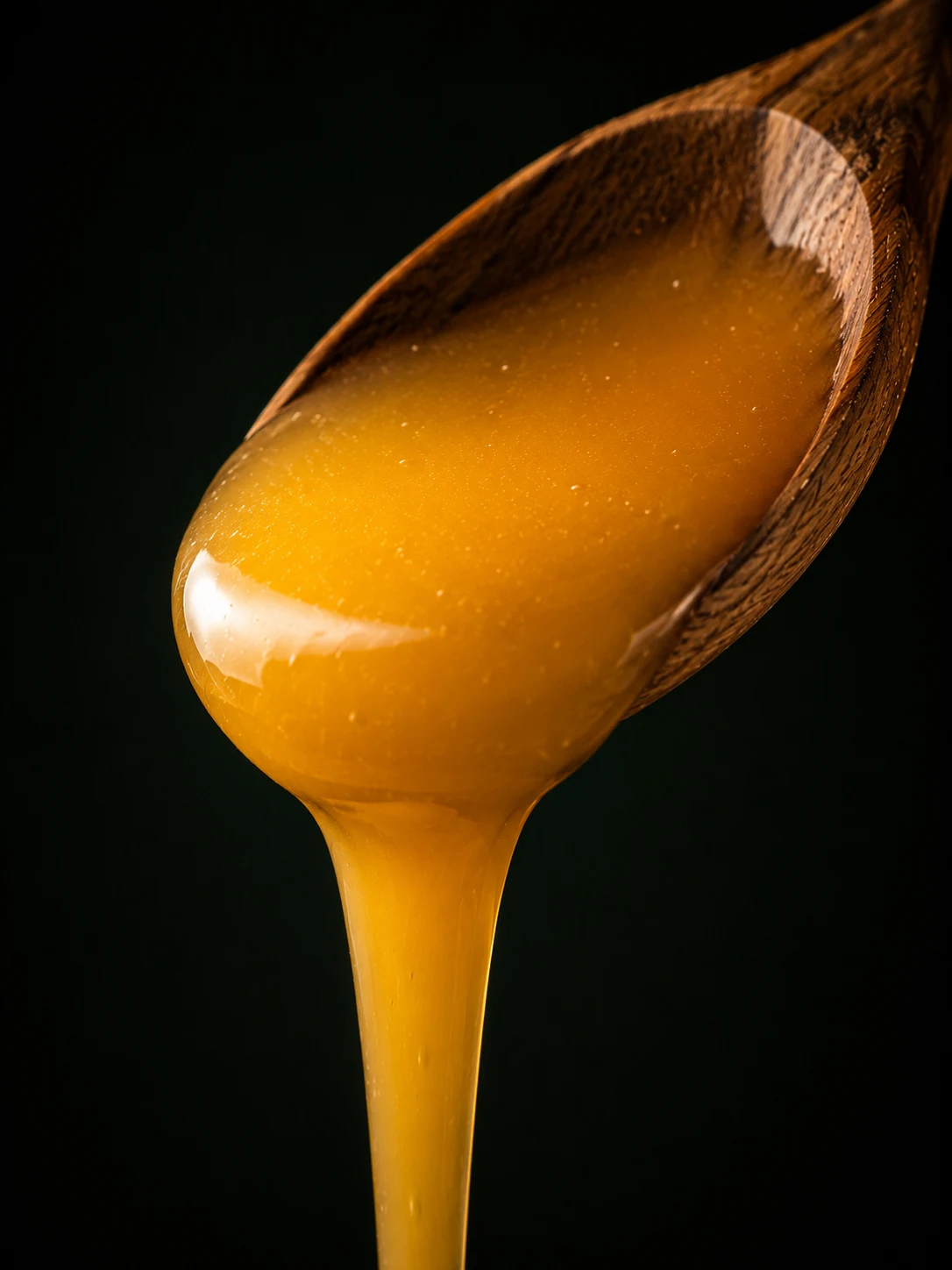
Creamy and dense, resisting crystallisation far longer than its intensity might suggest.
Harvest notebook
From the field — a hillside that speaks once a year
For most of the year, Castilla-La Mancha’s thyme scrubland looks like nothing in particular — low, grey-green, easy to drive past without a second look.
Then, for a matter of weeks each spring, it turns purple and the whole hillside seems to hum. Beekeepers who know the rhythm are already there, hives in place before the first flower fully opens.
What returns is a honey that carries the plant’s entire character intact — proof that a flavour this concentrated doesn’t need a tree, or a season longer than a fortnight, to make itself unmistakable.
Pairings
How to serve it
Herbaceous and intense — built to stand up to strong, savoury company.
Meski rating
An editorial reading, not a certification
Six criteria of the House, judged in tasting. This rating describes the appellation, is revised for each lot presented, and replaces no analysis or certificate.
Provenance
The Meski Confidence Chain
Rare honey is one of the most counterfeited foods in the world, and Sidr is no exception. Confidence does not come from a single certificate — it comes from a chain that stays continuous, from bloom to jar.
Read: How to read a rare honeyAnalysis describes the sample received by the laboratory. It does not automatically prove that every jar sold under the same name comes from that sample. A continuous chain does.
Continue the Atlas
An origin is never an island
Compare not to name a winner, but to understand what place, season and craft shift in the cup.