
Separating genuine rarity from marketing — and understanding what price actually tells you about what is in the jar.
Walk through any specialty food market in Dubai or Doha and you will find two jars sitting side by side. One costs thirty dirhams. The other costs three thousand. Both are labelled honey. The question most buyers ask — quietly, and a little uncomfortably — is whether the difference is real. The honest answer: sometimes the premium honey price is justified by genuine rarity and documented craft. Sometimes it is inflated by packaging and positioning. The skill lies in telling the difference.
The short answer
A premium honey is not expensive because someone decided it should be. It is valuable because exceptional quality is naturally limited. Rare botanical sources, constrained annual yields, labour-intensive harvesting, independent laboratory testing and responsible beekeeping all carry costs that find their way, inevitably, into the final price. The jars that cost more without any of these foundations are simply expensive — not premium.
Does an Expensive Honey Always Mean Better Quality?
No. And this is perhaps the most important thing to say at the outset.
Research and market observation consistently show that price alone is not a reliable indicator of honey purity or quality. Honey fraud — the dilution of real honey with sugar syrups, corn syrup or low-grade imports — is a documented global problem that affects products at various price points, including some that present themselves as premium. An expensive jar with attractive branding can conceal a product that has been heated, filtered beyond recognition, or blended with cheaper material.
This matters because it reframes the question entirely. The issue is not whether a high price guarantees quality — it does not. The real question is: what specific, verifiable factors genuinely make some honeys cost more to produce? When those factors are present and documented, the higher price becomes logical. When they are absent, it becomes marketing.
Rarity is not created by price. Price is often the consequence of genuine rarity.
Why Some Premium Honeys Are Naturally Rare
The scarcity behind a genuinely rare honey is not invented in a boardroom. It is written into the biology of the plant, the calendar of the season, and the map of the terrain.
A Question of Botany, Not Branding
Monofloral honeys — those produced predominantly from the nectar of a single plant species — are the clearest illustration of natural scarcity. Sidr honey, sourced from the Ziziphus spina-christi tree, is perhaps the most discussed example in the Gulf and Arab world. The Sidr tree blooms for a limited window each year. Bees must work that window. If the flowering is poor, the yield falls. There is no workaround, no reserve stock to compensate.
Total annual production of genuine Sidr honey from Yemen — one of its primary origins alongside Oman and parts of the UAE — is estimated at between 300 and 500 tonnes. Compare this to the tens of thousands of tonnes produced by larger commercial honey categories globally, and the arithmetic of scarcity becomes clear. A genuine monofloral Sidr honey at a high cost is not a commercial decision. It is a mathematical one.
The same logic applies to other rare botanical sources: Omani Samar and Frankincense honey, derived from trees found in specific mountain environments, or honeys from protected forest zones where hive density is deliberately kept low to preserve floral balance. These are not marketing narratives. They are production realities.
Geography as a Constraint
Location is not simply a label on a jar. It is a constraint on production. Beehives placed in Yemen’s remote Hadramawt valleys or in Oman’s Dhofar mountain region cannot be scaled the way an industrial operation in a flat agricultural zone can. Roads are difficult. Transportation is slow. The beekeeper may travel for hours to reach hives that are deliberately kept far from pesticide-treated farmland. That distance and isolation protect the honey’s purity — and they cost time and money that eventually appear in the price.
The Real Cost of Responsible Beekeeping
Behind every jar of genuine premium honey is a production process that is deliberately slow, deliberately careful, and consequently expensive.
The Labour Behind a Single Jar
Artisan beekeeping at the level required for a genuinely premium product is slow work. Hives are inspected carefully and frequently. Chemical treatments are avoided or strictly limited, which means the beekeeper must manage disease and parasites through methods that are more time-consuming and less predictable than a simple application of miticide. Colonies are maintained for their health and longevity, not pushed to maximum output.
In traditional beekeeping communities across Yemen, Oman and the broader Arabian Peninsula, honey production has been passed down through family lineages for generations. The knowledge of when to harvest, how to read the comb, and how long to allow the nectar to cure naturally before extraction is not written in any manual. It is accumulated over decades and transmitted between generations. That knowledge has a value that no industrial process can replicate — and it cannot be mass-produced.
Hive Health, Time, and Yield
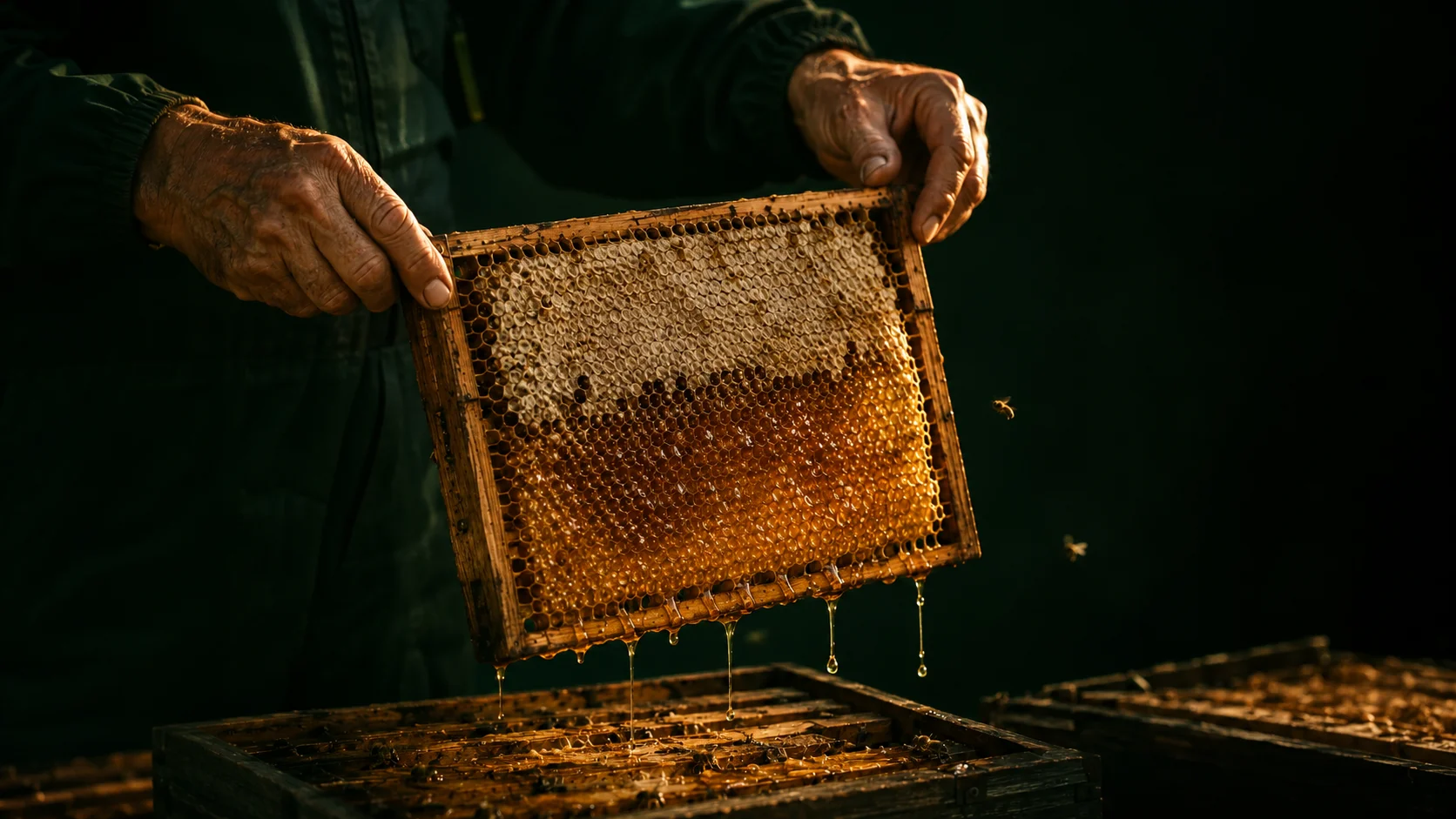
A responsibly managed hive produces less honey than one run for volume. The beekeeper leaves adequate stores in the hive for the colony’s own survival, rather than extracting every available frame. Honey is not harvested before it is properly cured — meaning the moisture content has dropped naturally to a stable level that prevents fermentation. This takes time. Industrial producers often harvest early and apply heat or other methods to reduce moisture quickly, which alters the honey’s composition and reduces its complexity of flavour.
The result of all these choices is a lower yield per hive. Fewer jars per season. A higher cost per unit that cannot be negotiated away without compromising what makes the product worth having.
Botanical alignment
Hives placed at the right moment near the right flowering species — Sidr, Samar, Frankincense — in their natural habitat, not a managed field.
Patient harvesting
Frames removed only when honey is fully cured. No early extraction, no forced drying. The beekeeper waits for nature, not the calendar.
Cold extraction
No heat applied during extraction. Enzymes, pollen and aromatic compounds remain intact — the entire sensory and traceable profile is preserved.
Independent laboratory analysis
An accredited external lab verifies botanical origin, sugar purity, moisture content, HMF levels and pesticide residues before any jar is sealed.
Harvesting, Testing and Traceability
Raw honey, in its strictest sense, is honey that has not been pasteurised or fine-filtered, and that retains its natural pollen, enzymes and aromatic compounds. Producing and maintaining this standard requires discipline at every step of the chain — from the moment the frames are removed from the hive to the moment the jar is sealed.
Extraction must be done without excessive heat. Filtration, if applied at all, must be minimal — enough to remove wax fragments and debris, not enough to strip the pollen that gives the honey its botanical fingerprint. That pollen is not only part of the flavour profile; it is the key to honey traceability. With pollen analysis, a competent laboratory can confirm whether a honey genuinely comes from the plant source and geographic region claimed on the label.
What Lab Analysis Actually Costs
Independent laboratory testing is a cost that serious producers absorb and pass on honestly. A rigorous analysis — checking for sugar adulteration, pesticide residues, moisture content, HMF levels (a marker of heat damage or ageing), antibiotic residues and botanical origin — is not cheap. For a small-batch artisan producer, this cost represents a significant proportion of the price per jar. For a producer cutting corners, it is simply skipped.
When you buy a honey that comes with a certificate of analysis from an accredited external laboratory, you are not paying for a piece of paper. You are paying for the verification that the product in your hands is what it claims to be. That is a meaningful part of the premium — and one that is easy to overlook when comparing prices on a shelf.
Honey adulteration: how it works
Adulteration typically involves adding cheaper sugars — corn syrup, rice syrup or sugar cane derivatives — to dilute natural honey and increase volume. In some cases, ultra-filtration removes the pollen entirely, making botanical and geographic origin impossible to verify. Adulterated products may pass visual tests but will fail rigorous laboratory analysis checking for C4 sugar markers and pollen composition.
Luxury Packaging — Protecting a Unique Gift
A jar of honey that has taken twelve months of botanical alignment, careful beekeeping, responsible harvesting and thorough testing to reach you deserves to arrive in a way that acknowledges its singularity. This is not vanity. It is coherence.
In the Gulf, the gift carries as much meaning as the object inside it. Honey has long been among the most prized offerings in Arabian culture — given at celebrations, at the conclusion of Ramadan, at weddings and as a mark of respect between families. A luxury Sidr and Samar honey gift box presented with clear provenance and a moment of narrative communicates something that a generic jar in a plastic sleeve cannot. The packaging does not create the value; it honours it.
The materials, the printing, the structural design, the weight and texture of a premium honey gift box — all of these carry cost. For very limited editions, such as Emirati Sidr Honey infused with 23-carat gold, the packaging is also part of the product’s identity: it signals that what is inside is not a commodity, and that the person receiving it is being offered something considered and rare. At Meski, this coherence between content and presentation is a deliberate editorial choice, not a sales technique.
Do’ani Sidr
Sourced from remote valleys inaccessible by industrial logistics. Short bloom window, low yield, high demand. Among the most verified and traceable honeys in the Meski collection.
Omani Sidr & Samar
Mountain terrain, strict traditional harvesting, generational knowledge. The Omani beekeeping tradition is among the oldest on the Arabian Peninsula.
Emirati Sidr & Samar
Native Sidr and Samar trees found across the UAE’s interior. Meski sources directly from Emirati beekeepers maintaining traditional practice in a modern supply chain.
Choosing Value Instead of Marketing
So how does a buyer navigate this honestly? A few markers are worth holding onto.
| Signal | What it means | Worth paying more for? |
|---|---|---|
| Single-origin label with region + season | Traceable production | Yes |
| Third-party lab certificate | Independent verification of purity | Yes |
| Cold-extracted, coarsely filtered | Pollen and enzymes intact | Yes |
| Limited annual stock | Consistent with genuine rarity | Yes |
| Vague origin (“mountain”, “wild”) | Unverifiable claim | Caution |
| Perfectly clear, never crystallises | Possible ultra-filtration or heating | No |
| Unlimited year-round availability | Inconsistent with monofloral scarcity | No |
Final Thoughts
There is a particular kind of clarity that comes from understanding what you are actually paying for. A premium honey produced with integrity is not expensive because of a number someone chose. It is expensive because genuine quality — rare botany, constrained geography, patient beekeeping, honest testing, coherent presentation — accumulates costs that cannot be wished away.
At the same time, a high price without these foundations is simply a high price.
The buyer who learns to ask the right questions does not need to distrust every expensive jar, nor to dismiss every affordable one. What they need is the ability to read behind the label — to see not just the product, but the choices, the constraints and the care that either justify the cost or do not.
As The House of Meski sees it: a jar of honey holds the decisions of the beekeeper, the patience of the season, and the integrity of everyone who handled it before you did. The price should reflect all three — or none of them.
If you are curious about which honeys in the Meski collection are accompanied by documented traceability and independent laboratory certification, our team at Sharjah is available to walk you through each origin and what it represents.
Heritage
Meski works exclusively with beekeeping communities whose practices span generations — Hadramawt, Dhofar, the UAE interior. The knowledge we source is not reproducible at scale.
Provenance
Every origin in our collection is named to the region, not just the country. Traceability is not a marketing claim. It is a condition of working with us.
Verification
Independent laboratory certification is a non-negotiable part of the Meski selection process. We do not list a honey we cannot document.
Explore honeys with documented traceability
Each product in the Meski Raw Honey and Precious Infusions collections comes from a named origin with a verifiable production story. Browse the range most aligned with this article.
Frequently Asked Questions
Sidr honey is produced from the nectar of the Ziziphus spina-christi tree, which blooms for a short, fixed period each year in specific mountain regions of Yemen, Oman and the UAE. Total annual production is estimated at a few hundred tonnes globally — a fraction of commercial honey categories. Combined with labour-intensive traditional harvesting methods, difficult terrain and high demand, these factors produce a genuinely constrained supply that drives the price upward. Prices for verified Yemeni Sidr honey typically range from USD 150 to 500 per kilogram depending on the origin and the degree of verification.
No. Price alone does not confirm purity. Studies have found that some expensive honeys contain adulterated content, while some modestly priced products are genuinely raw and clean. The most reliable indicators are third-party laboratory certification, clear geographic and botanical traceability, and minimal processing — not the number on the label.
A monofloral honey is produced predominantly from the nectar of a single plant species. This requires the beekeeper to place hives where that plant dominates the surrounding flora, during the specific window when it flowers. The yield is inherently lower than a wildflower blend, the timing is fixed by nature, and the result has a distinctive flavour and profile that cannot be replicated year-round. These constraints justify a higher price when the claim is verified.
Ask for a certificate of analysis from an independent, accredited laboratory. Check that the label specifies a geographic origin and botanical source — not just a country. Look for minimal processing (cold extraction, no fine filtration). Natural crystallisation over time is a positive sign, not a defect. If a producer cannot explain where their hives are and how the honey was harvested, the price is difficult to justify regardless of its level.
Look for clear single-origin labelling with regional specificity — Hadramawt, Dhofar, or a named UAE governorate — accompanied by a laboratory analysis certificate. Ask whether the honey is cold-extracted and unfiltered or only coarsely filtered. Prefer producers who can name the beekeeper or cooperative at origin. In the UAE market, both genuine premium honeys and heavily marketed products coexist; the difference is almost always legible if you ask the right questions before purchasing.