
From the frankincense highlands of Dhofar to the temples of Rome — the road that carried civilizations.
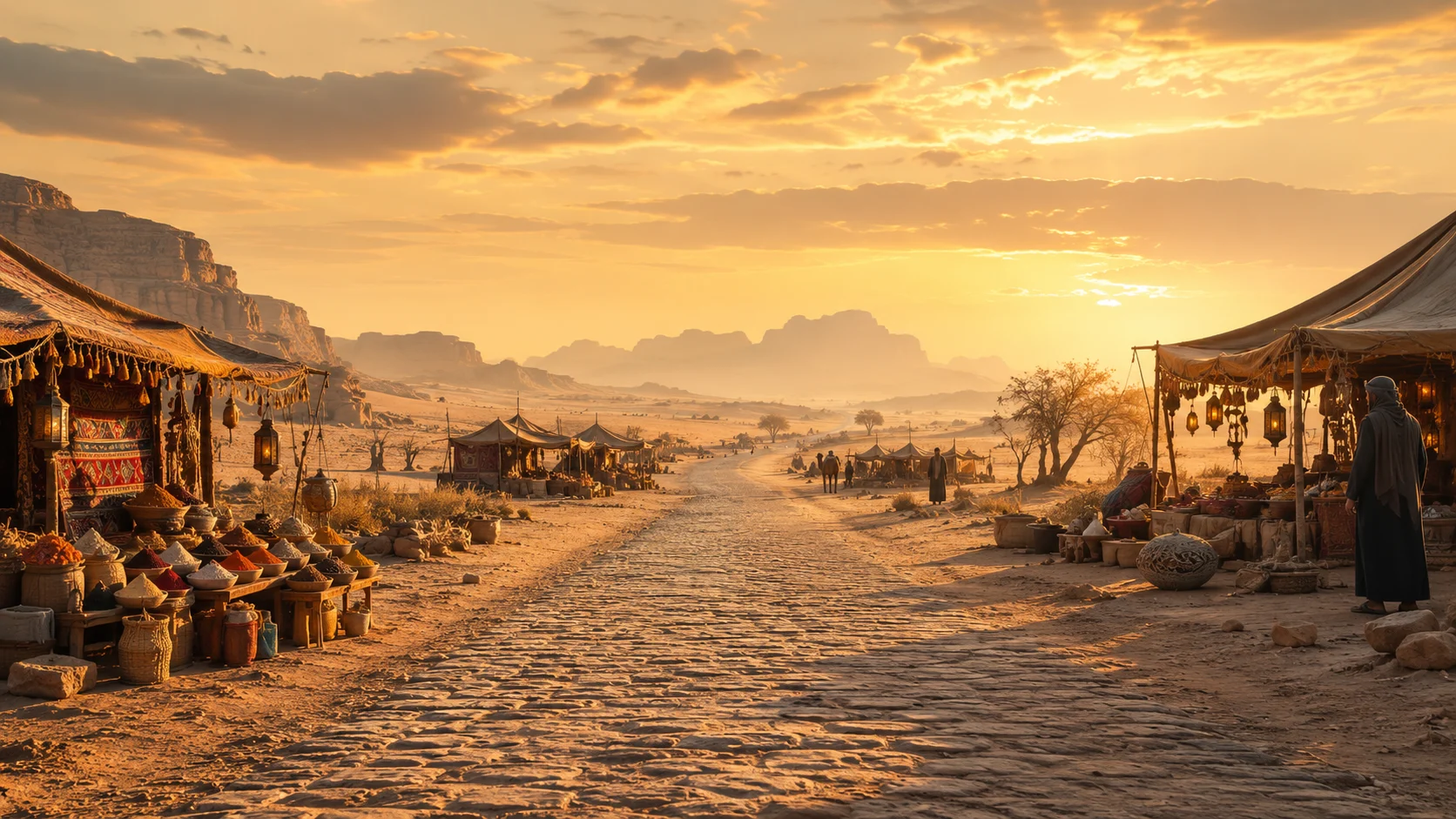
There are roads that carry merchandise, and then there are roads that carry civilizations. The ancient Incense Route belongs to the second category — one of the most consequential arteries in human history: a vast network of desert tracks, mountain passes and sea lanes that for more than a millennium connected the southern tip of the Arabian Peninsula to the temples, courts and markets of Egypt, Rome, Mesopotamia, Greece and beyond. To understand it is to understand Arabia’s earliest claim to global significance — long before oil, long before modernity, in an age when the treasures of the earth were measured in aromatic tears wept by desert trees.
Arabia Before the Route — A Land of Hidden Abundance
The popular imagination tends to picture the ancient Arabian Peninsula as a vast, impassable emptiness peripheral to the great civilizations of the Nile and the Tigris. History corrects this misconception with considerable force. By the early second millennium BCE, the southern reaches of the peninsula — what the Greeks would later call Arabia Felix, “Happy Arabia” — sustained sophisticated urban societies built not on conquest but on commerce. Their wealth came from something the rest of the ancient world could not produce and could not live without.
The Trees That Built an Empire
Frankincense and myrrh are the resins of two specific tree genera — Boswellia and Commiphora respectively — whose natural habitat is restricted to the arid, fog-shrouded highlands of southern Arabia and the Horn of Africa. The Boswellia sacra that still grows in the Dhofar mountains of Oman and in parts of Yemen is perhaps the most geographically exclusive commercially valuable plant in history: it thrives precisely because the conditions that make other agriculture impossible — thin soil, scorching heat, minimal rainfall — are what it requires. To scratch the bark and watch the resin bleed out in pale, fragrant tears is to witness something that ancient peoples understood as a gift from beyond the human world.
These resins were not luxuries in any superficial sense. They were, to the ancient mind, essential. In Egypt, frankincense was burned in temple rituals as early as the Old Kingdom, and the Egyptian Ebers Papyrus — dating to around 1500 BCE — records both myrrh and frankincense as ingredients in wound treatments and the embalming process. In Mesopotamia, Babylonian priests required incense for every act of divine communion. In Jerusalem, frankincense was integrated into burnt offerings at the Temple. In Rome, by the first century CE, Pliny the Elder estimated that Arabia exported some 1,500 tonnes of frankincense and 450 tonnes of myrrh to Rome annually, at a cost to the empire of 100 million sesterces per year. The trees that produced this wealth grew in places only southern Arabians could reach — and that geographic monopoly was the foundation of everything.
Living Heritage
The Boswellia sacra frankincense tree still grows wild in Oman’s Dhofar region today. Meski sources honey from the same landscapes where these ancient trees have bled their precious resin for millennia — a living link to the world’s oldest aromatic trade. Discover our Omani Samar & Frankincense Honey, a tribute to this unbroken heritage.
The Civilizations That Depended on Arabian Incense
The demand for Arabian aromatics was ancient, universal and essentially inelastic. No civilization that burned offerings to its gods — and virtually all of them did — could ignore the aromatic resins that made those rituals complete. The rising column of incense smoke was not poetic metaphor; it was, across dozens of distinct religious traditions from the Nile to the Ganges, the physical medium through which human prayers ascended to the divine. Myrrh, darker and more bitter than frankincense, carried its own portfolio of significance: sacred anointing oil, embalming agent, medicine. Ancient Egyptians called it phun and associated it with the divine, importing it from the Land of Punt — believed to correspond to the Horn of Africa and parts of southern Arabia — as early as the Fifth Dynasty, around 2400 BCE.
This convergence of universal religious demand and narrow geographic supply created a commercial imperative that would, over centuries, shape the political map of the ancient world. The question was not whether incense would travel north from Arabia Felix; it was who would control the passage — and extract the toll.
The Road Itself — Cities, Caravans and Desert Crossings
The Incense Route was not a single road. It was an evolving system: a braided network of land and maritime paths that shifted in response to political change, drought, the rise and fall of kingdoms, and the relentless ingenuity of merchants seeking to minimize cost and maximize margin. Yet through the centuries of its operation — scholars generally trace its most active overland phase from roughly the third century BCE to the second century CE — a recognizable main artery persisted across the western edge of the Arabian Peninsula.
From Shabwah to Gaza: The Main Artery
Shabwah, in the Hadhramaut region of what is now southeastern Yemen, served as the traditional starting point of the overland route. It was here that the frankincense harvested in Dhofar and the wider Hadhramaut hinterland converged, weighed, taxed and loaded onto camels for the long march north. From Shabwah, caravans moved through the ancient kingdom of Qataban, past the great temple complexes of Marib — capital of the kingdom of Saba, the civilization associated in Abrahamic tradition with the Queen of Sheba — and through the Nejd plateau northward toward the Hijaz.
The route then passed through Najran, a prosperous oasis city that functioned as a critical waypoint, before continuing north through the Hejaz mountains toward Dedan (near modern Al-‘Ula in Saudi Arabia), Tayma, and eventually into the territory of the Nabataeans, whose capital at Petra commanded the final passage to the Mediterranean. The Roman-era geographer Strabo compared the density of traffic along the desert caravan tracks to that of an army on the march. A caravan crossing the full length of the route would spend the better part of two to three months on the road. The dromedary — carrying loads of around 200 kilograms across terrain that would destroy wheeled vehicles — made the entire enterprise possible.
The Nabataeans — Masters of the Desert Passage
No people defined the Incense Route more thoroughly, or benefited from it more spectacularly, than the Nabataeans. Originally a semi-nomadic Arab people, the Nabataeans had by the fourth century BCE established themselves as the indispensable intermediaries of the incense trade — the masters of every viable passage between the production zones of southern Arabia and the consumption markets of the Mediterranean. Their genius was not merely commercial but logistical: they understood the desert’s water as no other people did, constructing elaborate systems of cisterns, channels and hidden reservoirs that allowed caravans to cross territory that appeared waterless to outsiders.
Their capital, Petra — carved from rose-red sandstone cliffs in what is now southern Jordan — was the fulcrum on which the entire northern section of the route balanced. Every caravan moving from Arabia toward Gaza or Damascus passed through Petra, paid its toll and resupplied. The Nabataeans grew, according to multiple ancient accounts, extraordinarily wealthy. Diodorus of Sicily recorded that they resisted all attempts at subjugation by maintaining mobility across their desert domain with a discipline bordering on the martial.
The Great Caravan Cities: Petra, Hegra and the Stations of Power
South of Petra, the Nabataean city of Hegra — known today as Mada’in Salih, in Saudi Arabia’s Al-‘Ula region, and now a UNESCO World Heritage Site — served as the second great node of Nabataean power on the route. Its monumental rock-cut tombs, whose decorated facades echo those of Petra with an intimacy that speaks of shared architectural grammar, attest to a city that was simultaneously a waystation, a tax station and a place of permanent settlement. Inscriptions found at the site record the multilingual traffic of the route: Nabataean, Greek, and various South Arabian scripts appearing within proximity of one another — the linguistic residue of a trade that was also a conversation between worlds.
Further north, Tayma served as a desert crossroads of remarkable antiquity, its great well — Bir Haddaj — providing the water that made extended desert passage survivable. At Dedan (near Al-‘Ula), the Lihyanite kingdom had established itself as an important regional power, leaving behind rock art and inscriptions testifying to millennia of human passage. Date palms had thrived in the Al-‘Ula valley since the first millennium BCE, offering shade, fruit and fodder along a route where sustenance was never guaranteed.
To the south, in what is now Yemen, the ancient city of Marib — capital of Saba and home to a dam that irrigated much of what is now desert — represented the extraordinary hydraulic civilization that frankincense wealth had helped finance. According to UNESCO’s documentation of the ancient Yemeni caravan route, the South Arabian kingdoms maintained fortified cities, temples, palaces and sophisticated agricultural infrastructure whose sophistication rivalled that of any contemporary Mediterranean civilization.
The Source: Land of Frankincense
The Dhofar highlands produced the world’s most prized Boswellia sacra resin. Today a UNESCO World Heritage Site, the region still yields frankincense and sustains a living aromatic culture that stretches back over three millennia.
The Kingdoms: Saba, Qataban, Hadramites
From Shabwah to Marib, the South Arabian kingdoms controlled production, taxation and initial transit of incense. The Marib Dam irrigated a civilization of extraordinary sophistication, financed by aromatic wealth.
The Passage: Nabataean Heartland
Hegra (Mada’in Salih) and Dedan in the Al-‘Ula valley were the great mid-route nodes, where caravans rested, resupplied and paid transit tolls. Saudi Arabia’s first UNESCO inscription (2008) honours this heritage.
The Gateway: Rose-Red Capital
Every caravan moving from Arabia toward Gaza or Damascus passed through Petra. The Nabataean capital grew to extraordinary wealth as the indispensable northern middleman of the ancient incense economy.
The Legacy of a Route — Culture, Faith and the End of an Era
It would be a diminishment to describe the Incense Route as primarily an economic phenomenon. Trade, at the scale the route operated, is always also cultural transmission: the exchange of ideas, gods, languages, technologies and aesthetic sensibilities that travels invisibly alongside the visible cargo. The Incense Route was, for over a thousand years, one of the world’s great channels of civilizational contact.
Beyond Trade: How the Incense Route Shaped Civilizations
The architectural language of the Nabataeans — a synthesis of Hellenistic, Egyptian and indigenous Arabian forms — is itself a document of what happens when cultures are forced into sustained, profitable contact. The bilingual inscriptions at Hegra, the Hellenistic pediments on Nabataean tomb facades, the appearance of Indian goods in Mediterranean markets and Mediterranean glassware in Arabian archaeological sites: all of these attest to a world far more interconnected than historical narratives of isolated antiquity allow.
The route carried religious ideas with particular intensity. The incense itself, after all, was a theological object — a substance that enabled communion between humanity and the divine. The trade in it necessarily brought into contact the religious traditions of Egypt, the Levant, Arabia, Persia, Greece and Rome. The three gifts attributed in Christian tradition to the Magi — gold, frankincense and myrrh — are, among other readings, a compressed image of the Incense Route’s full cargo manifest: precious metals and aromatics, the twin currencies of the ancient world’s devotional economy, arriving from the east along paths that the route had established.
Provenance & Heritage
Meski sources directly from the landscapes the Incense Route made legendary — Oman’s Dhofar region and the Emirates. Every jar carries millennia of Arabian aromatic heritage.
Savoir-Faire
Just as Nabataean traders mastered desert logistics across generations, Meski’s producers apply ancestral knowledge to raw honey harvesting — no shortcuts, no compromises.
Unbroken Tradition
The Boswellia sacra trees of Dhofar still produce the same resin that once funded empires. Our frankincense-infused honeys are a direct tribute to that living continuity.
The Route’s Decline and Its Enduring Imprint
The decline of the Incense Route was gradual rather than sudden, and driven by several converging forces. The most decisive was the Roman exploitation of the monsoon winds that allowed ships to sail directly from Egyptian Red Sea ports to the incense-producing coasts of southern Arabia and the Horn of Africa. The Periplus Maris Erythraei — an anonymous first-century merchant’s guide likely composed in Roman Egypt — describes these maritime routes in practical detail, signalling that the overland monopoly was already being circumvented. When Rome formally annexed the Nabataean kingdom in 106 CE — creating the province of Arabia Petraea — it absorbed an empire already hollowed out by maritime competition.
Later, in Late Antiquity, the spread of Christianity through the Roman Empire — and the early Christian rejection of incense burning as an idolatrous practice — dramatically reduced Western demand for Arabian aromatics, collapsing the Roman market with a thoroughness that no military campaign could have achieved. Yet the route did not simply end; it transformed. The Hijaz corridor that the incense caravans had once travelled became, in the Islamic era, one of the great pilgrimage routes of the world, with Mecca and Medina at its devotional heart.
Today, the physical traces of the Incense Route are among Arabia’s most extraordinary cultural assets. The Negev desert cities of Avdat, Haluza, Mamshit and Shivta — the Mediterranean terminal of the Nabataean network — are inscribed as a UNESCO World Heritage Site since 2005. Hegra (Mada’in Salih) in Saudi Arabia received its own UNESCO inscription in 2008, the first such designation in the Kingdom’s history. In Oman, the Land of Frankincense — encompassing the ancient port of Khor Rori, the Wadi Dawkah frankincense tree reserve and the archaeological sites of Al-Balid and Shisr — was inscribed by UNESCO in 2000.
For those who travel today through the landscapes of southern Arabia — through Dhofar’s silver-green highlands where Boswellia sacra trees still bleed their fragrant resin into the mountain air, through the rock-city silence of Hegra at dawn, through the date-palm corridors of Al-‘Ula — the Incense Route is not history in the abstract. It is geography made legible. The stones still know the weight of the caravans.
3rd century BCE
Nabataean dominance of northern Incense Route established. Petra becomes the indispensable middleman between Arabia and the Mediterranean.
1st century CE
Roman ships exploit monsoon winds to reach Arabian coasts directly, beginning the slow bypass of overland intermediaries.
106 CE
Rome annexes the Nabataean kingdom, creating the province of Arabia Petraea. Petra enters its long decline.
Late Antiquity
Spread of Christianity collapses Roman incense demand. The route transforms but its infrastructure — oases, cities, knowledge — persists.
2000–2008 CE
UNESCO inscribes the Land of Frankincense (Oman), the Incense Route Negev cities, and Hegra (Saudi Arabia) — a formal global recognition of the route’s world heritage status.
Carry a Piece of the Route Home
The frankincense highlands of Oman — the very source of the ancient Incense Route — still yield their precious harvest. Meski honours this unbroken heritage with honeys infused with the living resins of Dhofar.
Frequently Asked Questions About the Incense Route
The Incense Route — sometimes called the Incense Road or Spice Route of Arabia — was an extensive network of overland and maritime trade paths connecting the frankincense and myrrh-producing regions of southern Arabia (primarily present-day Yemen and Oman) and the Horn of Africa to the great consumer markets of the ancient Mediterranean, Mesopotamia and South Asia. Active from at least the early second millennium BCE to the early centuries CE in its overland form, it was one of the longest-operating and most lucrative commercial arteries in the ancient world.
Frankincense was valued primarily for its irreplaceable role in religious ritual: in ancient Egypt, Mesopotamia, Israel, Greece and Rome, the burning of aromatic incense was integral to temple worship, sacrifice and communication with the divine. Beyond the religious dimension, frankincense and myrrh had documented uses in medicine, cosmetics and embalming across multiple ancient cultures. Because both resins could only be harvested from trees growing in a narrow geographic zone of southern Arabia and the Horn of Africa, their supply was inherently limited — which made their price, for most of antiquity, extraordinary.
The main overland route traditionally began in Shabwah, in the Hadhramaut region of present-day Yemen, and ended at the Mediterranean port of Gaza. Along the way, it passed through key nodes including Marib, Najran, Dedan (Al-‘Ula), Tayma, Hegra (Mada’in Salih) and Petra, before crossing the Negev toward the coast. Maritime branches extended from southern Arabian and East African ports across the Red Sea and Indian Ocean.
The decline was gradual and multi-causal. The single most important factor was Rome’s exploitation of monsoon winds to establish direct maritime trade routes from Egyptian Red Sea ports to southern Arabia, bypassing the overland intermediaries entirely. The Roman annexation of the Nabataean kingdom in 106 CE further weakened the overland network. Later, in Late Antiquity, the spread of Christianity through the Roman Empire — and the early Christian rejection of incense burning as an idolatrous practice — dramatically reduced Western demand for Arabian aromatics. Internal conflict among South Arabian kingdoms also played a role in weakening the supply side.