
From the wind-carved cliffs of Dhofar to the incense burners of a Dubai majlis, frankincense has shaped trade, spirituality and hospitality across Arabia for millennia.
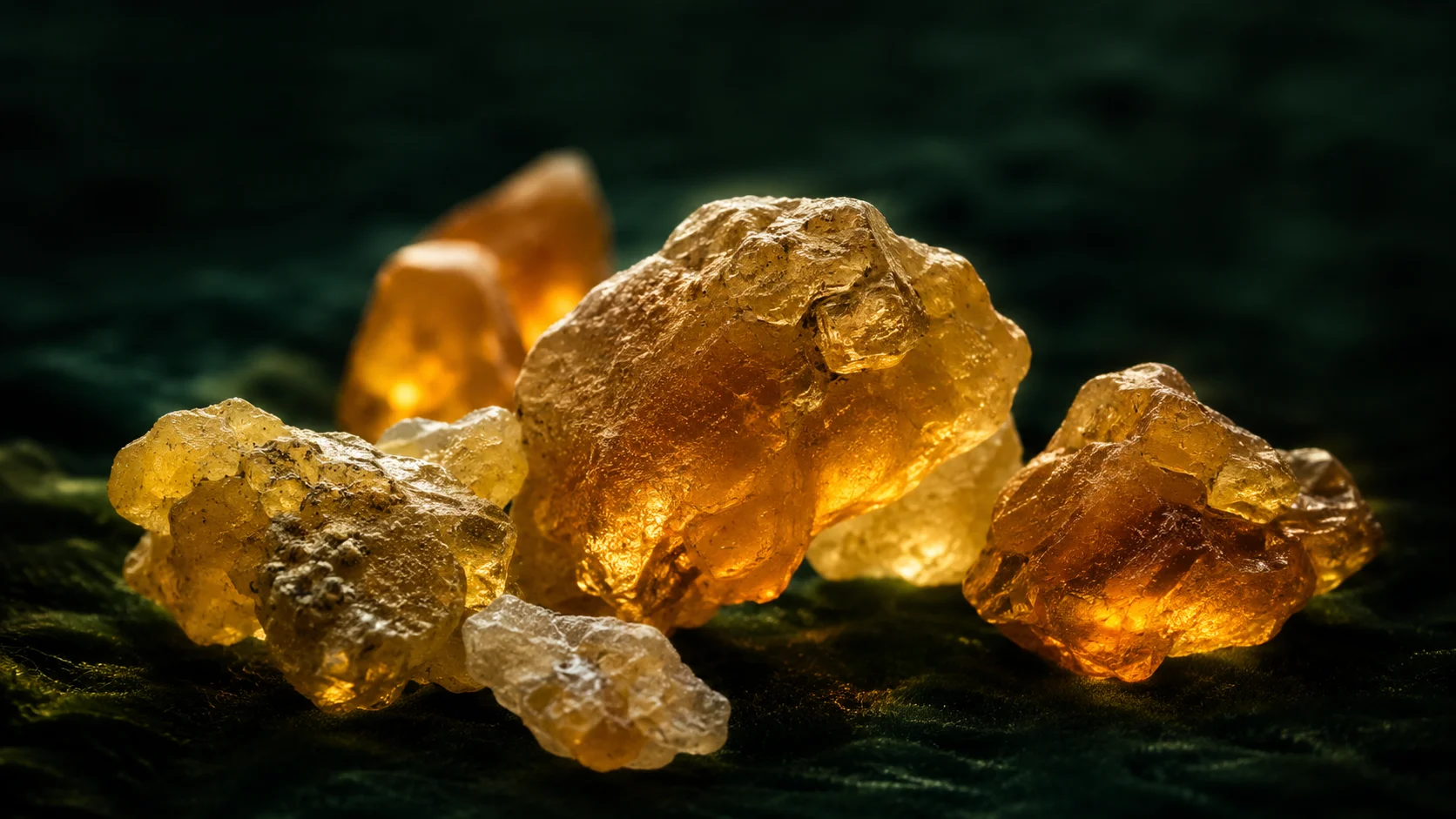
There is a moment, familiar to anyone who has sat in a well-kept majlis in Oman or the UAE, when a small ceramic burner is placed at the centre of the room and pale smoke begins to rise. The scent arrives before you quite register it — woody, resinous, faintly citrus, with a warmth that seems to settle into the walls themselves. That scent is luban (اللبان), the Arabic name for frankincense, and it has been rising from the same southern Arabian hills for at least three thousand years.
Frankincense is one of those rare substances that has meant something to almost every civilisation it reached. Egyptians burned it in temple rituals. Romans carried it across the Mediterranean at prices that rivalled gold. The ancient kingdoms of southern Arabia built their wealth, their cities and their political power almost entirely upon its trade. And today, in the souqs of Salalah, the perfume houses of Dubai and the private homes of the Gulf, it remains a living tradition — not a museum piece.
What Is Frankincense?
Frankincense is an aromatic resin harvested from trees of the genus Boswellia, most notably Boswellia sacra, which grows in the arid highlands and coastal escarpments of southern Oman, parts of Yemen and the Horn of Africa. The resin is produced when a harvester — traditionally called a naqqab — makes careful incisions in the bark. The tree responds by exuding a milky liquid that slowly hardens into translucent tears or chunks, ranging in colour from pale silver-white to amber-green. These are collected by hand, sorted by size, colour and clarity, then dried before being traded.
Also known in the Western world as olibanum, the substance is chemically complex: a mixture of resins, gum and essential oils. When heated, it releases the volatile compounds responsible for its distinctive smoke — a fragrance that scholars of sensory history describe as simultaneously grounding and elevating, which may explain why so many cultures independently chose it for sacred use.
Ancient Incense Routes: How Frankincense Moved the World
The incense trade that carried frankincense out of Arabia and into the ancient world was one of the most consequential commercial networks ever established. At its height, roughly between the third century BC and the second century AD, the route linked the frankincense-producing highlands of Dhofar and the Hadramaut valley in Yemen with markets as distant as Rome, Alexandria, Babylon, and the Indus Valley. Some historians have proposed that frankincense was among the very first commodities to be traded on what could genuinely be called a worldwide scale.
The system operated through two complementary networks. Overland caravans, moving north through the Arabian Peninsula via a chain of fortified oases and watering points, carried the resin through present-day Saudi Arabia and into the Nabataean city of Petra, before reaching the ports of the eastern Mediterranean. Meanwhile, maritime routes departed from the natural harbour of Khor Rori on the Omani coast, carrying cargoes toward India, East Africa and the Persian Gulf ports of Dilmun.
The cities that controlled these routes grew fabulously wealthy. Ubar — the semi-legendary caravan hub in the Dhofar interior, sometimes called the Atlantis of the Sands — is thought to have functioned as both a storage depot and a commercial clearing house for frankincense bound for Greece, Persia and Rome. The kingdoms of Saba, Qataban and the Hadramaut in present-day Yemen taxed every consignment that passed through their territory. The Nabataeans, masters of desert navigation, took their share further north. The fragrance of frankincense was, in the most literal sense, the smell of ancient commerce.
The Land of Frankincense and the UNESCO Legacy
In 2000, UNESCO inscribed the Land of Frankincense (Ard al-Bakhur) as a World Heritage Site — a recognition that the Dhofar region of southern Oman does not merely contain ruins, but preserves a coherent landscape of trade, cultivation and cultural exchange. The inscription covers four sites: the Wadi Dawkah nature reserve, where ancient Boswellia sacra trees still stand at altitudes above 600 metres; the archaeological port of Khor Rori; the medieval entrepôt of Al-Baleed; and the inland oasis site of Shisr, near the location associated with Ubar.
Together, these sites do something rare: they allow a visitor to trace the full arc of the frankincense trade, from the tree itself to the ships that carried its harvest outward. The Wadi Dawkah trees — some over a hundred years old, reaching heights of five or six metres — are among the oldest surviving specimens of the species that sustained an entire civilisation.
Frankincense in Arabian Culture
To understand frankincense in the Gulf today is to understand that it has never been only an export commodity. Long before it became a luxury item for Roman senators or an ingredient in European cathedral incense, it was simply part of daily life across the Arabian Peninsula — present at births and burials, at weddings and at prayer, in the home and in the marketplace.
In Oman, frankincense use is continuous rather than ceremonial. Households burn it not only for guests but as a matter of daily routine — a habit as ordinary as making coffee, and as meaningful. In the UAE, where Emirati families maintain deep Omani and Yemeni cultural ties through generations of trade and migration, frankincense burning is woven into the fabric of hospitality. It is not uncommon for an Emirati host to pass the incense burner among guests at the end of a meal, an act of generosity that carries the same symbolic weight as offering the best food or the most carefully prepared qahwa.
In Qatar, the tradition of scenting the home before receiving guests is similarly observed. The mabkhara — the incense burner — occupies a position in the household that no synthetic air freshener or scented candle has ever displaced. It is an object of craft and inheritance: in many families, mabkharas pass from one generation to the next, their patina deepening with years of use.
The Mabkhara and the Ritual of Welcome
The mabkhara itself deserves attention as an object. Traditionally made from carved stone, fired clay or ornate metal — brass, copper and occasionally silver — its design has remained essentially unchanged for centuries. A bowl, elevated on a pedestal, with openings to allow airflow beneath the burning charcoal and the resin placed on top. Simple in principle, endlessly varied in execution: from the rough clay burners sold in Salalah’s Al Husn Souq to the jewelled silver pieces commissioned by Gulf families for festive occasions.
The ritual of the mabkhara being passed from guest to guest — each person drawing the smoke toward their clothing, their hair, sometimes their beard — is not incidental. It is the ceremony made tangible: the host offering fragrance as a form of blessing, the guest receiving it as a mark of belonging. Scent, in this context, becomes a social language.
The Source
Dhofar’s highlands produce Boswellia sacra, the world’s most prized frankincense. The tradition of harvesting runs in specialist families for generations.
The Living Tradition
Emirati hospitality is inseparable from frankincense. The mabkhara circles every majlis; the gesture of passing smoke is a language of welcome.
The Home Ritual
Scenting the home before receiving guests remains a deeply observed practice. The mabkhara is an heirloom, not a decorative piece.
Traditional Uses Through History
Beyond its role in scenting and ceremony, frankincense has been used across Arabia and the broader Middle East for an extraordinary range of purposes. In traditional Omani practice, the resin has been chewed — particularly the pale, semi-transparent grades — as a breath freshener and as part of oral care routines. Pregnant women in some communities traditionally received frankincense as part of postnatal care. It has been used to prepare garments, to preserve food storage spaces and to fumigate homes after illness. In the ancient world, Egyptian embalmers incorporated it into mummification preparations; Greek and Roman physicians prescribed it for a variety of conditions.
A Note on Traditional vs. Medical Claims
The uses described here are documented historical and ethnographic practices, handed down through oral and written tradition. Modern scientific research into frankincense compounds — particularly the boswellic acids present in the resin — is ongoing and exploratory. Frankincense should not be presented as a treatment or cure for any specific medical condition. The traditional uses described belong to the cultural history of the substance, not to contemporary medical guidance.
Understanding Omani Frankincense Grades
Not all frankincense is alike, and in Oman the differences are taken seriously. Boswellia sacra trees in Dhofar grow across four distinct ecological zones — Hojar, Nejd, Shazr and Sha’b — and each zone produces resin with recognisably different characteristics.
| Grade | Zone | Colour | Aroma Profile | Typical Use |
|---|---|---|---|---|
| Hojari (incl. Royal Green) | Hojar mountains | Silver-white to pale green | Clean, citrus-resinous, refined | Premium burning, chewing, gifts |
| Nejdi | Nejd plateau | Pale amber | Warm, slightly sweet | Burning blends, daily use |
| Shazri | Shazr valley | Amber to light brown | Earthy, moderate complexity | Everyday household burning |
| Sha’bi | Sha’b coastal zone | Dark brown, sticky | Heavy, earthy, smoky | Blended incense, commercial use |
Frankincense in Modern Luxury
The contemporary luxury industry has rediscovered frankincense with considerable enthusiasm. In perfumery, Omani frankincense notes appear in the olfactory architecture of several significant modern fragrances — including those produced by Amouage, the Muscat-based house whose founding was specifically linked to the preservation and promotion of the Dhofar frankincense tradition. In cosmetics, boswellic acid extracts are incorporated into high-end skincare formulations, though consumers should approach marketing claims in this space with the same careful reading they would apply to any cosmetic ingredient.
In the gift economy of the Gulf — where the art of offering something carefully chosen is a social practice with real cultural weight — frankincense occupies an important position. Quality Hojari resin, presented in a decorated box alongside a hand-crafted mabkhara, is a gift that speaks a culturally fluent language. It does not need to be explained. The recipient understands immediately that thought, knowledge and generosity have gone into its selection.
At The House of Meski, we observe this tradition of considered gifting closely. The same principle that guides the selection of our Omani Samar & Frankincense Honey — sourcing from known origins, refusing to compromise on quality for volume, offering the ingredient in a form worthy of its history — applies equally to our understanding of what makes an Arabian gift genuinely memorable.
Harvest with expertise
The naqqab reads the tree, times the incision precisely, and respects the rest cycles that keep old Boswellia sacra specimens alive for over a century.
Grade with knowledge
Colour, translucency, aroma and zone of origin determine grade. Royal Green Hojari demands the highest level of discernment from buyer and seller alike.
Offer with intention
Whether in a mabkhara passed hand to hand, or in a curated gift box, frankincense carries meaning only when it is chosen with care.
Protecting an Ancient Heritage
The story of frankincense is not without its shadows. Boswellia sacra trees are slow-growing and sensitive to over-tapping. When harvesters cut too frequently — driven by rising global demand — the trees cannot regenerate their resin reserves fast enough, and their long-term health is compromised. Researchers working in Dhofar have observed signs of this pressure on older tree populations in certain areas.
Oman has responded with structured conservation efforts. The Wadi Dawkah reserve, included in the UNESCO inscription, operates a formal protection programme. The Amouage fragrance house has funded a parallel initiative specifically targeting the health of Dhofar’s oldest trees. Traditional harvesting knowledge — passed down through specialist families who understand the rhythm of the tree, the precise timing of each tapping cycle, the signs that a tree needs rest — is itself recognised as something worth preserving.
This is a pattern familiar to anyone who follows the world of rare agricultural ingredients: the moment global appreciation peaks, the conditions that made the ingredient possible come under strain. The frankincense harvest has survived three thousand years of continuous trade. Whether it survives the enthusiasm of the next fifty will depend on how seriously the producing communities, the consuming markets and the governing institutions take their shared responsibility.
Traceable Origin
At Meski, every ingredient we source comes with a known provenance. We apply the same standard to our Omani honey selections as the finest frankincense traders apply to their resin: know the tree, know the harvest, know the hands.
Heritage, Not Nostalgia
Frankincense is not a relic. It is a living practice. We believe that celebrating it — through education, through story, through products that honour its origins — is the most meaningful form of preservation.
Considered Gifting
The Gulf gift economy is built on intention. Whether you choose a Custom Luxury Honey Gift Box or our frankincense-infused honey, the gesture carries the weight of the world it comes from.
Final Thoughts
Frankincense arrived in the ancient world as a luxury and stayed as a necessity. Its smoke has marked the edges of the sacred and the domestic for so long that in many parts of Arabia the two categories have quietly merged — a home that smells of frankincense is already, in some sense, a welcoming place. That continuity is remarkable. The same resin that loaded onto Nabataean caravans in the third century BC still rises from ceramic burners in Abu Dhabi apartments and Salalah family homes today. The aroma has not changed. The gesture of offering it has not changed.
What changes is our awareness of how rare such continuity is — and how worth protecting.
If you are drawn to the intersection of Omani heritage and exceptional raw ingredients, explore our Omani Samar & Frankincense Honey — a single jar where the tradition of luban meets the craft of Omani beekeeping. Or discover our Omani Sidr Honey, harvested from the same ancient landscape that gave the world its finest resin.
Bring Omani Heritage to Your Table
Our frankincense-infused honey and raw Omani honeys are sourced with the same rigour we bring to every story we tell. Origin known. Quality uncompromised.
Frequently Asked Questions
Frankincense is an aromatic resin harvested from trees of the Boswellia genus, primarily Boswellia sacra, native to the highlands of southern Oman, Yemen and parts of the Horn of Africa. The resin is collected as hardened tears after deliberate incisions are made in the bark. It has been used for millennia in religious ceremony, trade and daily hospitality across the Arabian Peninsula and beyond.
Frankincense (luban) is the raw resin harvested directly from Boswellia trees. Bakhoor is a prepared blend of aromatic wood chips — typically oud — infused with resins, oils and spices. Both are burned in a mabkhara, but raw frankincense is generally considered purer and more traditional. Frankincense can also be used as an ingredient within bakhoor blends.
Royal Green Hojari, harvested from Boswellia sacra trees in the Hojar mountain zone of Dhofar, is widely regarded as the finest grade. Its pale green-to-silver tears, high translucency and clean, citrus-resinous aroma distinguish it from lower grades. Sha’bi, from coastal zones more affected by monsoon rains, is the most common grade for everyday burning blends.
The ancient incense trade route linking Dhofar and Yemen to the Mediterranean flourished roughly from the third century BC to the second century AD. It was one of the most profitable commercial networks of the ancient world, sustaining entire kingdoms in southern Arabia and giving rise to cities — including the Nabataean capital Petra — whose wealth depended almost entirely on taxing and trading frankincense moving northward. UNESCO recognised key Omani sites on this route as a World Heritage Site in 2000.
Frankincense resin should be stored in an airtight glass or ceramic container, away from direct sunlight and humidity. Properly stored, high-quality Hojari tears retain their aromatic complexity for years. Avoid plastic containers, which can interact with the volatile oils in the resin. In the Gulf climate, a cool cupboard away from kitchen steam is ideal — refrigeration is not necessary.
There is documented concern among researchers and conservationists about the long-term health of Boswellia sacra populations in Dhofar and Yemen. Over-tapping — making too many incisions too frequently — prevents trees from regenerating their resin reserves and weakens them over time. Oman has responded with conservation measures at the Wadi Dawkah reserve, and traditional harvesting communities who understand the appropriate tapping cycle play a central role in sustainable management.