
From the wounded forests of Southeast Asia to the royal courts of Arabia — why this rare resinous wood became the defining fragrance of Gulf culture and timeless refinement.
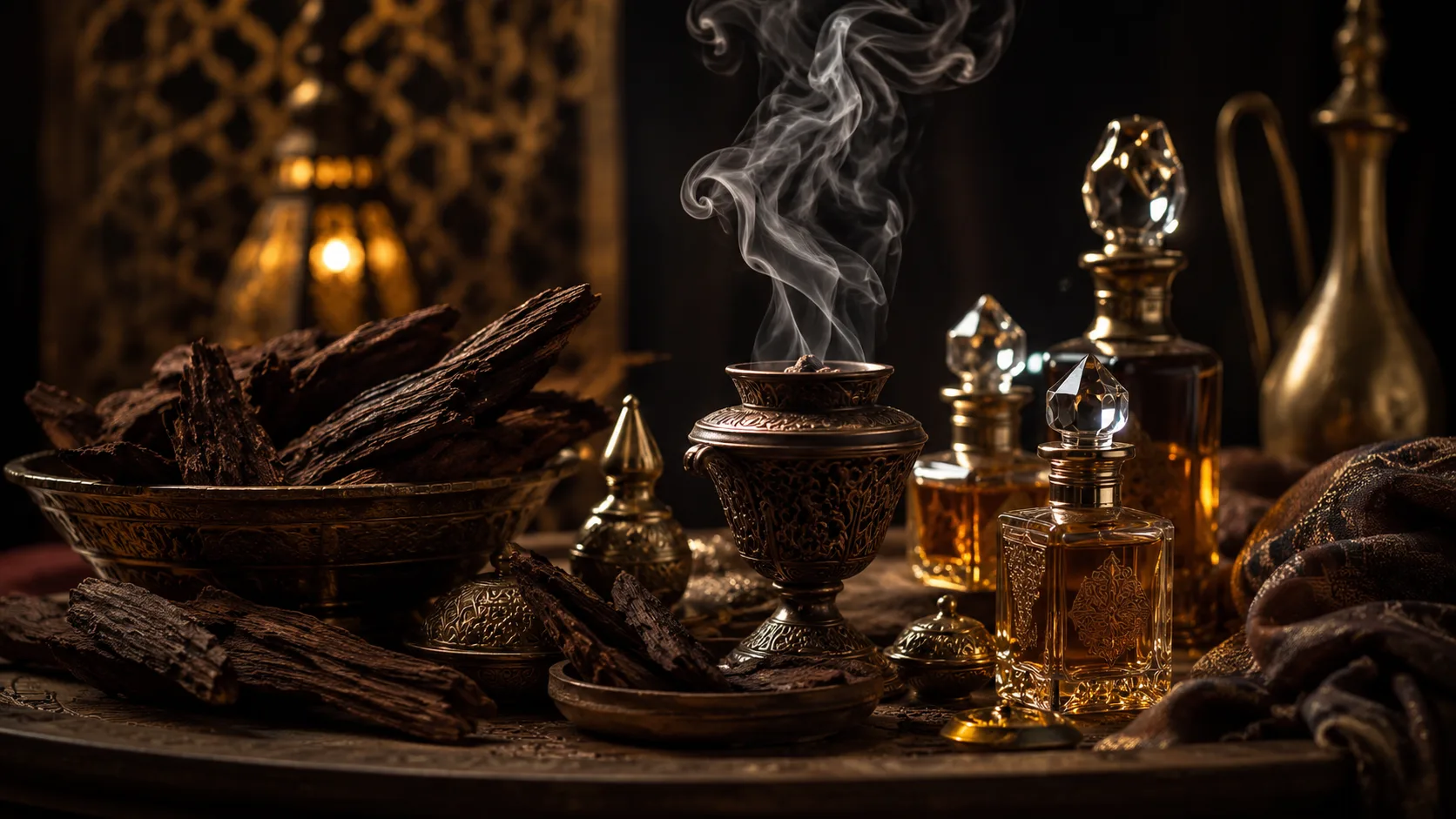
Oud — the dark, resinous heartwood of the Aquilaria tree — is not merely a fragrance. It is a civilisation’s most intimate olfactory record: a scent that has travelled sacred fires, Silk Road camel trails and Indian Ocean currents for over two millennia, arriving in the homes of Sharjah, Dubai, Riyadh and Muscat exactly as it always has: as an act of welcome, dignity and memory.
The Scent That Carries a Civilisation
There are fragrances that please, and then there are fragrances that mean something. Oud belongs to the second, rarer category — a category so rarefied that it contains, in the estimation of many perfumers and cultural historians, perhaps only one true member.
Walk into a home in Dubai on a Thursday evening, and you will know it before you reach the door. That deep, dark, otherworldly warmth rising through the air is not candle wax, not incense in the Western sense, not the generic sweetness of a department store counter. It is oud — or more precisely, it is the burning of agarwood chips in a brass mabkhara, the perforated incense burner passed from room to room as a gesture of welcome, beauty and prayer.
To understand oud is to understand something essential about Arabian luxury: that true refinement is never loud. It does not announce itself through logos or price tags. It announces itself through rarity, through history, through a scent so complex and layered that perfumers in Paris and Tokyo have spent decades trying to decode it — and have largely succeeded only in acknowledging how much remains beyond their reach.
This is the story of oud: where it comes from, how it travelled the ancient world, why it became the defining fragrance of Gulf culture, and why — in an era of synthetic shortcuts and algorithmically designed bestsellers — it continues to stand apart as one of the most prestigious natural ingredients in all of perfumery. Just as Meski, rooted in Sharjah at the crossroads of this living tradition, understands that the finest Arabian gifts carry the weight of provenance, so too does oud carry centuries within every note.
Chapter I — Born from Wound: The Natural Alchemy of Agarwood
The Aquilaria Tree and Its Secret
To begin at the beginning, one must travel far from the Arabian Peninsula — to the dense tropical forests of Southeast Asia, to the highlands of Assam in northeastern India, to the river valleys of Cambodia, Laos, Vietnam and Indonesia. Here, in conditions of heat and humidity that most trees would find unremarkable, grows the Aquilaria — a tall, pale-barked evergreen that, in its healthy state, is notable for almost nothing at all.
The wood is light-coloured, faintly scented at best. There are seventeen known species in the Aquilaria genus, and while all can theoretically produce agarwood, only a fraction do so under natural conditions. Scientists have confirmed what traditional harvesters have known for generations: the tree’s extraordinary transformation is not a gift it gives freely. It is a wound it carries with dignity.
Why Only the Wounded Tree Produces Fragrance
The process begins with injury. When an Aquilaria tree is damaged — whether by a lightning strike, a burrowing insect, a machete cut, or the infiltration of a particular mould strain — it responds the way all living things respond to existential threat. It mobilises. Its immune system activates. And what it produces as its deepest layer of defence is a dense, dark, extraordinarily aromatic resin that slowly saturates the heartwood from within.
Peer-reviewed research has documented this process in precise molecular terms: the dominant fungi involved include Lasiodiplodia theobromae and Phaeoacremonium parasitica, and their invasion triggers the production of chromones and sesquiterpenes — volatile organic compounds responsible, ultimately, for oud’s distinctive olfactory signature. The more extensive the infection, the darker and denser the wood becomes; the richer the resin, the more complex and precious the material it yields.
What makes this remarkable — and what underpins oud’s extraordinary rarity — is that the transformation takes time on a scale that defies commercial logic. Significant resin yields are generally associated with trees aged fifty years and older. And even among wild Aquilaria populations, it is estimated that no more than ten percent of trees ever become infected and produce agarwood at all.
Rarity by Nature — and by Design
The result is an ingredient that cannot be hurried, cannot be manufactured, and cannot be replicated in a laboratory with anything approaching the original’s complexity. A kilogram of premium-grade oud oil can trade at figures between ten thousand and fifty thousand US dollars, depending on origin, age and grade — making it, weight for weight, among the most valuable aromatic substances on earth. Synthetic oud accords exist, and many are skilfully composed; but among connoisseurs in the Gulf and beyond, they are understood to be approximations. Tributes, at best. The real thing is something else entirely.
Chapter II — A Journey Across Centuries: The History of Oud from Sacred Texts to Silk Roads
Ancient Worlds and Sacred Fires
Agarwood is one of the very few aromatic substances whose historical footprint spans multiple civilisations, faiths and millennia simultaneously. Academic historians tracing the use and trade of agarwood have documented its presence in texts as ancient as the Mahābhārata, the Sanskrit epic whose oldest layers date to approximately the ninth century BCE. The Christian Bible references it as aloes or aloeswood in several passages. The Buddhist Jātaka tales mention it as a precious aromatic offering.
In each of these contexts, the message is consistent: agarwood was not an everyday commodity. It was reserved for the sacred, the royal, the profoundly significant. It was burned in temples before deities, carried in processions of state, offered as tribute by rulers who understood that its rarity was itself a form of eloquence. To give oud was to give time, distance and transformation — the three things that money, in every era, most struggles to buy.
The Animalic Heart
Indian oud, particularly from the Assam highlands, is prized for its deep animalic warmth and leathery resonance. Among the oldest documented sources in historical trade networks.
Sweet Refinement
Cambodian and Vietnamese ouds tend toward sweeter, fruitier, more refined profiles — preferred by many Gulf connoisseurs for personal wear and contemporary blending.
Earthy Depth
Indonesian agarwood is often described as earthy and profoundly deep — favoured for bakhoor blending and ceremonial burning traditions across the Arabian Peninsula.
The Trade Routes That Carried It West
The story of how oud travelled from the forests of Southeast Asia to the incense burners of the Arabian Peninsula is, in large part, the story of the ancient world’s most ambitious commercial networks. During the early centuries of the Common Era, a sophisticated commercial web had already formed across the Java Sea and the Indian Ocean, linking the aromatic forests of the Indonesian archipelago to the port cities of India and, through them, to the Persian Gulf and the Red Sea.
The overland Silk Road carried oud chips alongside silk bolts, porcelain vessels and lapis lazuli — the high-value, low-weight goods best suited to the gruelling distances between East and West. The maritime routes did the same, but faster and in larger volume. By the time of the Sasanian (Neo-Persian) Empire, which flourished between the third and seventh centuries CE, the trade in aromatics — agarwood foremost among them — was already an established pillar of the regional economy, and Arabian and Persian merchants were among its most active participants.
Forests of Southeast Asia
Aquilaria trees produce resin in the highlands of Assam, the valleys of Cambodia, Vietnam, Laos and the islands of Indonesia.
Indian Ocean Maritime Routes
Indian merchants systematise westward trade, moving agarwood through established sea networks toward the Arab world — faster and in greater volume than overland routes.
The Silk Road
Oud chips travel overland alongside silk, porcelain and lapis lazuli — the high-value, low-weight currency of intercontinental luxury trade.
Arabian Peninsula & Persian Gulf
By the Sasanian period (3rd–7th century CE), oud trade is a structural pillar of the regional economy. The Gulf becomes both endpoint and custodian of the tradition.
Oud in the Heart of Islamic Civilisation
When Islam emerged in the seventh century on the Arabian Peninsula, it encountered a culture already deeply attuned to fine aromatics. The new faith did not suppress this affinity — it absorbed and elevated it. Hadith literature reflects that the Prophet Muhammad, peace be upon him, is described in Islamic tradition as holding pleasant scents in high regard, and the use of oud in personal grooming and communal spaces became woven into the broader fabric of Islamic practice and etiquette in the centuries that followed.
Editorial note on Islamic references
The connection between Islamic tradition and the appreciation of pleasant fragrances is well-established in hadith literature and scholarly Islamic sources. The editorial team is advised to review the exact formulation used in this paragraph to ensure alignment with the desired register for a Gulf audience, in keeping with the note transmitted by Agent A.
This is not simply a matter of religious prescription; it is cultural testimony. In the societies shaped by Islamic civilisation across the Arabian Peninsula, Persia and beyond, the burning of oud and the wearing of oud-based fragrances became markers of refinement, spiritual preparedness and social grace. To arrive at a gathering carrying the scent of oud was — and in much of the Gulf, remains — a statement of intention: I come with care. I come with honour. I come prepared to receive you well.
Chapter III — The Language of Hospitality: Oud in Gulf Culture and Luxury Life
The Mabkhara and the Art of Welcome
In the homes of Saudi Arabia, the UAE, Oman, Qatar, Kuwait and Bahrain, the mabkhara — the traditional perforated incense burner, typically fashioned from brass, silver or ornately carved wood — occupies a role that has no precise equivalent in Western domestic culture. It is not merely decorative. It is not simply functional. It is relational.
When guests arrive, the mabkhara is prepared with burning coals and chips of agarwood or bakhoor — a pressed blend of oud, rose water, musk and other aromatics. It is passed deliberately from person to person, held close to allow the rising smoke to perfume clothing, hair and hands. The gesture is one of the oldest expressions of Gulf hospitality: I share my most valued possession with you. I welcome you into the fragrance of my home.
Oud as Identity — Not Merely Perfume
What distinguishes oud from other luxury ingredients — what separates it from, say, rare truffles or aged Burgundy — is that its significance in the Gulf has never been primarily about exclusivity as a social performance. It has been about continuity. About connection to something larger than the individual moment.
Studies of Gulf domestic culture indicate that the overwhelming majority of households across the UAE incorporate oud-based products into their regular rituals — not as occasional luxury events, but as weekly or even daily practices. On Fridays, after prayers, the scent of oud drifts through neighbourhoods across the Arabian Peninsula in a gesture that is simultaneously religious, familial and aesthetic. At weddings and Eid celebrations, the gift of a fine oud blend or a beautifully crafted mabkhara carries emotional weight that no commercial perfume in a designer box could fully replicate.
This is, in the deepest sense, what Arabian luxury has always understood that Western luxury is still learning: that the most precious things are not those that are newest, but those that carry the longest memory. It is the same understanding that inspires Meski’s Emirati Sidr Honey Infused with 23-Carat Gold — a gift whose value lies not in novelty, but in provenance and intention.
| Occasion | Oud Format | Cultural Significance |
|---|---|---|
| Guest welcome | Bakhoor / Mabkhara | Highest gesture of hospitality |
| Friday prayers | Burning agarwood chips | Spiritual preparation and communal identity |
| Weddings & Eid | Gifted oud blends / mabkhara | Emotional and relational weight beyond any commercial gift |
| Personal grooming | Dahn al-Oud (oud oil) | Mark of refinement, elegance and care |
| Global luxury market | Synthetic oud accords | Accessible tribute — not equivalent to natural agarwood |
The Global Renaissance of a Timeless Ingredient
In recent decades, oud has crossed its traditional geographical boundaries and entered the vocabulary of global luxury perfumery with a confidence that would have surprised no one who understood its history, and that has surprised nearly everyone who did not. Houses from Paris to London to Tokyo have released oud-centred compositions. Niche perfumers have built entire identities around their interpretation of agarwood. The global luxury niche perfume market, valued at approximately 4.72 billion US dollars in 2026, is projected to reach sixteen billion by 2035 — and oud sits at the heart of much of that growth.
Yet the international appetite for oud has not been without its complications. The rapid increase in demand has placed wild Aquilaria populations under severe pressure, prompting CITES (the Convention on International Trade in Endangered Species) to list several Aquilaria species and require documentation of sustainable sourcing. Efforts toward cultivated agarwood — using biological inoculation techniques that accelerate the tree’s natural resin-producing response — have expanded significantly in countries including Cambodia, Thailand and Vietnam.
Meanwhile, for those who have grown up with oud in their homes, the global trend has been observed with a mixture of pride and discernment. The luxury market has come, quite literally, to the Peninsula — and those who have kept the tradition alive for generations know better than most what the real thing smells like. The same discernment that a Gulf family applies to choosing genuine oud is applied when selecting authentic Do’ani Sidr Honey — provenance is not a marketing detail; it is the substance itself.
Why Oud Will Never Be Ordinary
There is a quality to genuine oud that resists easy description — a quality that perfumers return to again and again without fully exhausting. It is warm and cool at once. It is ancient and immediate. It carries wood and earth and something that has no name in the vocabulary of perfumery — something that speaks, perhaps, to the fact that what you are smelling is a tree’s deepest response to mortality: its most intimate, most concentrated expression of life.
That is not a quality that can be engineered in a laboratory. It is not a quality that fashion seasons can confer or revoke. And it is not, ultimately, a quality that belongs to the luxury market alone — although the luxury market has had the good sense to recognise and honour it.
Oud belongs, first and always, to the culture that carried it across centuries of trade routes and sacred fires, across the camel trails of Arabia and the ocean currents of the Indian Ocean, into the domestic rituals of tens of millions of homes from Riyadh to Muscat to Sharjah. It belongs to the tradition of generous welcome — the mabkhara passed between hands, the fragrant smoke rising to greet a guest. In the same spirit, the Royal Sidr Honey Collection from Meski embodies this same philosophy: that a gift of true refinement carries within it a traceable origin, a living culture and an intention that no mass-produced luxury can replicate.
Provenance You Can Trace
At Meski, based in Sharjah at the heart of this living tradition, every product reflects a heritage rooted in authenticity — from the forests that yield agarwood to the bees that produce our honeys.
Culture You Can Touch
Arabian luxury is not a marketing category. It is a centuries-old language of hospitality, generosity and care — one that Meski is committed to translating into every gift and every offering.
Memory That Lasts
The most meaningful gifts carry the longest memory. Oud, like the finest honey, is not about novelty — it is about depth, continuity and a connection to something larger than the moment of giving.
Discover the Art of Arabian Gifting
From the ancient tradition of oud to the rarest honeys of the Arabian Peninsula — Meski curates gifts that carry the weight of genuine provenance and cultural heritage.
Frequently Asked Questions About Oud
Oud (also written oudh, from the Arabic عود) is the aromatic resinous heartwood produced by certain species of Aquilaria trees, primarily native to South and Southeast Asia. When the tree is wounded or infected by specific fungi, it produces a dark, fragrant resin as a defence response. This resin-saturated wood — known internationally as agarwood — is harvested, distilled into oil, or burned as incense, and is considered one of the most precious aromatic materials in the world.
Several factors converge to make genuine oud extraordinarily rare and costly. The resin only forms in Aquilaria trees that have been infected — an estimated ten percent of wild trees under natural conditions. The formation process typically takes decades, with significant yields associated with trees fifty years of age or older. Wild populations are now under conservation protection due to overharvesting. The combination of biological scarcity, long maturation time, regulatory constraints and labour-intensive harvesting places authentic oud oil at price points ranging from tens of thousands of dollars per kilogram for premium grades.
In the Gulf states — the UAE, Saudi Arabia, Oman, Qatar, Kuwait and Bahrain — oud is used in multiple forms. Chips of agarwood or pressed bakhoor blends are burned in traditional incense burners called mabkhara, particularly when receiving guests or marking important occasions such as Eid, weddings or Fridays after prayers. Oud oil (dahn al-oud) is applied directly to the skin or clothing as a personal fragrance. Oud is also a central ingredient in both traditional and contemporary Arabian perfumery. Culturally, its use is understood as a mark of hospitality, elegance and respect.
Pure oud refers specifically to the resinous agarwood or the oil distilled from it. Bakhoor is a broader term for blended incense products that typically combine oud chips or powder with other aromatic ingredients such as rose water, musk, sandalwood and ambergris, pressed into chips or cones and designed for burning. While all high-quality bakhoor contains oud as a key component, the terms are not interchangeable — oud is one ingredient within the wider world of Arabian aromatic culture that bakhoor represents.
Synthetic oud molecules — particularly those based on sesquiterpene chemistry — have improved significantly, and several are now used in high-quality niche perfumery. However, natural agarwood oil contains hundreds of distinct molecular compounds, many of which have not been fully characterised by science, and whose combination produces an olfactory complexity that current synthesis cannot fully reproduce. Among Gulf connoisseurs and serious collectors, genuine natural oud remains the unambiguous standard. Synthetics are understood as tools for accessibility — useful and sometimes beautiful, but not equivalent to the original.