
Arabic Perfume
Oud, Musk, Amber and the Art of Arabian Fragrance — a journey through five thousand years of scent, trade and hospitality
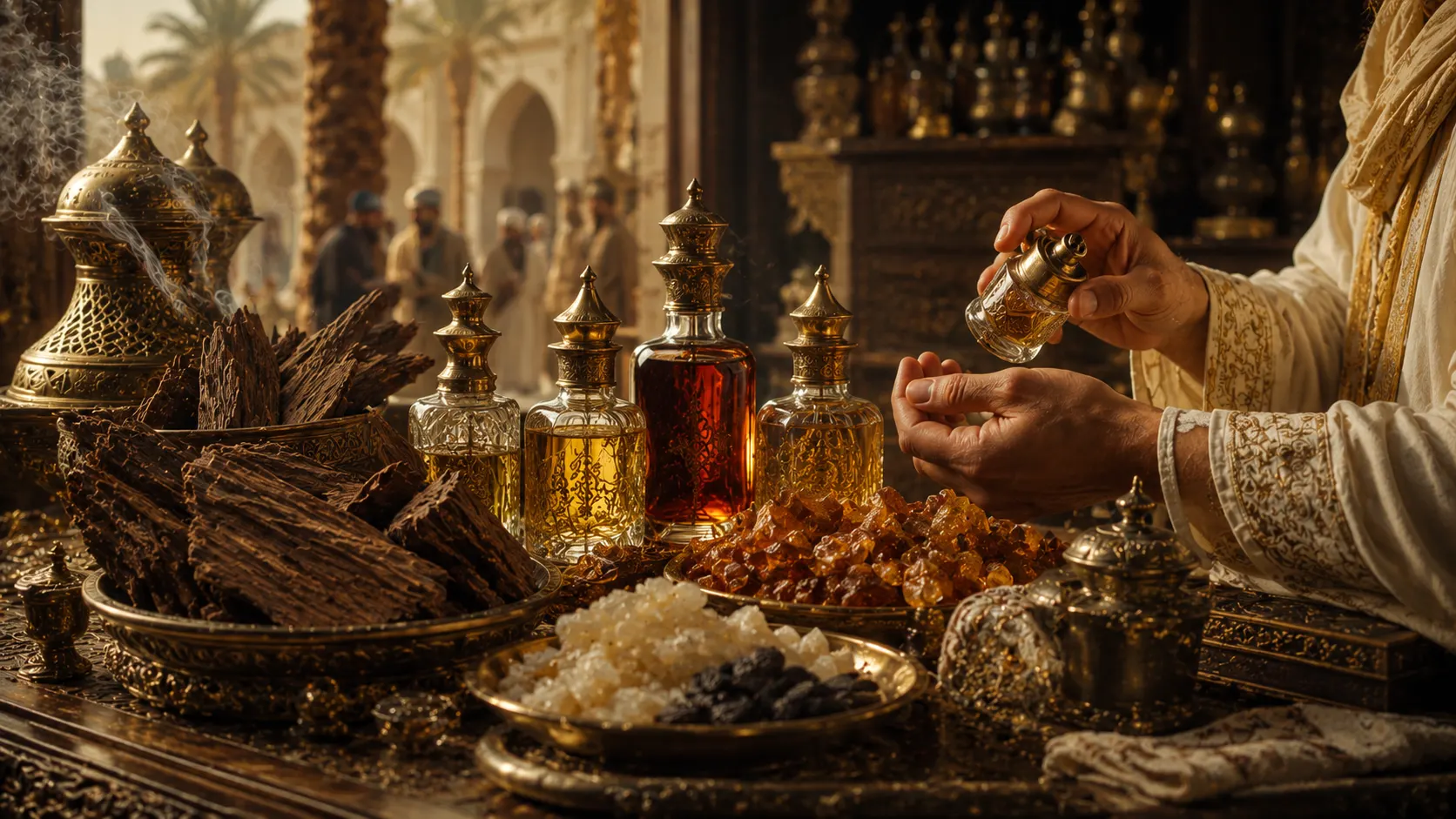
Arabic perfume is one of the oldest living arts on earth. Walk through a Dubai souq at dusk and the air changes before you see the shops: something deep and woody rises from one direction, something sweeter drifts from another, then the unmistakeable smoke of burning wood crosses your path — a merchant warming chips of pale resinous wood over a small charcoal brazier for a customer whose kandura billows gently above it. He is not simply buying a scent. He is completing a ritual that his grandfather performed, and his grandfather before him.
What Is Arabic Perfume? A Cultural Answer, Not Just a Fragrance
Arabic perfume — known broadly as itr or ittar (عطر), a word rooted in the Arabic verb meaning to give fragrance — differs from its Western counterpart in several fundamental ways. Most traditional Arabic fragrances are oil-based rather than alcohol-based, which makes them longer-lasting on the skin and more respectful of Islamic traditions that generally favour alcohol-free personal care. Their compositions tend towards warmth, depth and complexity, built around resins, woods and botanically sourced ingredients that unfold slowly over hours rather than minutes.
But the more important difference is philosophical. In the Arab world, perfume is not an accessory chosen to complete an outfit. It is a language. It communicates welcome, respect, piety, generosity and belonging. The gesture of offering incense to a guest carries as much social meaning as offering food or coffee. Scent in this tradition is hospitality made invisible.
A different relationship with fragrance
In Arabian culture, a fragrance is rarely worn for oneself alone. It is offered — to every person who enters the room, to every guest who leaves the house. This social dimension has no real equivalent in Western perfumery traditions.
The Origins of Arabian Perfumery
The history of Arabian perfumery reaches back further than any single date can contain. The incense trade of the Arabian Peninsula — centred on frankincense from the Dhofar region of Oman and myrrh from Yemen — was well established by the third century BCE. Ancient Sumhuram, a port city in Dhofar, served as a departure point for resin-laden caravans heading north towards Egypt, Greece and Rome. The Romans burned such enormous quantities of frankincense that entire centuries of political stability in southern Arabia depended on the demand of distant temples.
Long before the word perfume entered any European language, Arabian merchants were trading aromatic materials with India, Persia, East Africa and eventually China. Agarwood — the resinous heartwood that becomes oud — was documented as a trade commodity as early as the third century CE, moving along both the Silk Road and the maritime monsoon routes that connected the Gulf ports to Southeast Asian forests. In the markets of Basra and Baghdad, the price of oud fluctuated with the seasons and the safety of the sea lanes. Pirates and storms could raise the price of a vial of oil in a matter of months.
These were not casual transactions. Fragrance was already currency, medicine, offering and identity simultaneously.
The Islamic Golden Age and the Science of Scent
The transformation of Arabian perfumery from ancient craft to refined science occurred largely during the Islamic Golden Age, between roughly the eighth and thirteenth centuries. The polymath Jabir ibn Hayyan, known in the West as Geber, developed early chemical processes that advanced the understanding of aromatic compounds. His contemporary Al-Kindi wrote Kitab Kimiya al-Itr — the Book of the Chemistry of Perfume — one of the earliest systematic studies of fragrance ever composed, describing over a hundred recipes and distillation methods.
The figure whose contribution to fragrance history is most enduring, however, is Ibn Sina — known in Europe as Avicenna — born in 980 CE in the region of Bukhara. Among his many achievements, Ibn Sina refined the process of steam distillation to extract pure essential oils and rose water from flowers. Before his work, liquid perfumes were thick, imprecise blends of crushed petals steeped in oil. After it, the world had access to something entirely new: a delicate, precise and reproducible aromatic liquid. Rose water from Persia became one of the most widely traded commodities of its era, reaching China, India and beyond.
Oud — The King of Arabian Fragrances
No single ingredient defines Arabian perfumery more completely than oud (عود). The word itself means wood in Arabic, but the substance is something far more particular: the dark, resin-saturated heartwood that forms inside certain Aquilaria trees when they become infected by specific mould species. Not every Aquilaria tree produces oud. In fact, the majority never will. The infection, the tree’s response to it, the species, the soil and the age of the wood all combine to create something that cannot be manufactured or hurried. This is why high-quality natural oud has historically traded at prices comparable to gold by weight.
Aquilaria trees grow primarily in the forests of Southeast Asia — India, Cambodia, Vietnam, Laos, Indonesia and parts of Bangladesh — yet oud became synonymous with Arabian identity rather than the cultures of its geographic origin. This is itself a story of trade, desire and cultural absorption. Arab merchants who brought agarwood from Southeast Asian ports did not merely import a product. They elevated it, blended it, burned it in rituals and ultimately made it a cornerstone of their civilisation.
In traditional Arab culture, oud oil represented wealth and social distinction. A man who wore pure oud oil in the souq announced something about himself without words. Today that association has not disappeared — it has deepened. The finest oud oils continue to command extraordinary prices in Gulf markets, and family-run oud houses in Dubai — some operating for generations — remain among the most knowledgeable dealers in the world.
Why Not All Oud Is the Same
Oud varies enormously depending on its origin. Cambodian oud tends to be sweet, slightly fruity and refined. Indian oud — particularly from Assam — is earthier, darker and more animalic. Vietnamese and Laotian varieties occupy a spectrum between these poles. Experts and collectors distinguish between them the way wine lovers distinguish between appellations.
Most oud sold in consumer markets today is a blend: natural oud oil extended with synthetic molecules, or entirely synthetic compounds designed to approximate the smell of the real thing. This is not inherently dishonest — the technology behind synthetic oud has advanced considerably — but it is useful to understand the distinction. The word oud on a perfume bottle tells you very little without knowing the concentration, the origin and whether the fragrance contains any genuine agarwood at all.
Burning oud chips, rather than wearing oil, is a separate and equally important tradition. The selection of wood quality for burning involves its own knowledge and vocabulary, passed between generations of Gulf families like any other form of connoisseurship.
The Great Ingredients of Arabian Perfumery
Luban — The Resin of Dhofar
Harvested from Boswellia sacra trees in Oman’s southern mountains, frankincense has been traded for over three thousand years. The finest grade, hojari, grows in a narrow microclimate belt in the Dhofar highlands and is regarded as the world’s purest frankincense. Annual Omani production is estimated between 80 and 100 tonnes.
Misk — A Symbol of Paradise
Musk holds a position of particular reverence in Arabian perfumery, mentioned in Islamic tradition as a fragrance of the gardens of paradise. Natural animal musk is now protected under CITES. Most musk used today is synthetic — white musk, soft musk — each with a distinct character that differs from the deeper, more complex original.
Anbar — The Sea’s Rarest Gift
A rare waxy substance produced naturally in the digestive tract of sperm whales and found after years of ocean ageing. Its origins were mysterious to medieval sailors. After oxidation at sea, it develops a complex marine-earthy-musky character that functions as a powerful fixative. It has been valued in Arabian perfumery for over a thousand years. Most modern alternatives use the synthetic molecule ambroxan.
The City of Roses — Saudi Arabia
Rosa damascena grown above 1,800 metres near Taif, blooming for only a few weeks each spring. Harvested at dawn before heat destroys the essential oils, then steam-distilled into a rose oil among the most valued in the world. In 2024, the cultural practices of the Taif rose were inscribed on the UNESCO Representative List of Intangible Cultural Heritage of Humanity.
Frankincense and Myrrh: The Resins of the South
Before oud became the dominant note of Arabian perfumery, two resins preceded it in importance: frankincense (luban, لبان) and myrrh (murr, مُرّ). Both are gum resins harvested by cutting the bark of specific trees. Frankincense comes primarily from the Boswellia sacra tree, which grows under conditions of remarkable ecological specificity — limestone soil, specific monsoon patterns, warm winters and persistent sun. The ancient port of Al Baleed in Dhofar, now a UNESCO World Heritage Site, once stood at the centre of the frankincense trade that connected southern Arabia to the Mediterranean.
Myrrh, whose name derives from the Arabic murr meaning bitter, comes from the Commiphora trees of Yemen, Somalia and Ethiopia. It has a heavier, darker character — warm, earthy, slightly medicinal — and has been used in incense, perfume and traditional medicine across the ancient world.
In Omani homes today, frankincense is still burned to welcome guests and purify rooms. Its smoke is not decoration. It is presence. For those curious about this living tradition, our article on Arabian hospitality and its rituals explores how fragrance and welcome have always been inseparable in Gulf culture.
Amber and Ambergris: Understanding the Difference
Confusion between amber and ambergris is common in perfumery and worth clarifying carefully. The word amber in Western perfumery typically refers to a warm, resinous accord constructed from ingredients like labdanum, benzoin and vanilla — a fragrance family rather than a single natural substance. It is a construction, not an extract.
Ambergris (anbar, عنبر) is something else entirely. A rare, waxy substance produced in the digestive tract of the sperm whale, expelled naturally and found floating on the ocean surface or washed ashore after years of oxidation at sea. When freshly collected, ambergris can smell sharp and unpleasant. After years of exposure to salt, sunlight and air, it develops an extraordinarily complex, marine-sweet, earthy and musky character that functions as a natural fixative — anchoring and amplifying all other fragrance notes around it. Ambergris has been valued in Arabian perfumery for over a thousand years, and pieces found on Gulf beaches were historically treated as exceptional gifts from the sea.
How Perfume Became Part of Daily Life
In the Gulf, perfume is not reserved for special occasions. It is integrated into the daily rhythm of life in a way that few other cultures match. A man leaving for Friday prayers may apply oud oil to his wrists and neck. A woman welcoming family home may light bakhoor before they arrive. A host preparing a gathering will scent the room before guests do. The habit begins in childhood and never leaves.
Bakhoor and the Mabkhara
Bakhoor (بخور) is not simply incense in the Western sense. It is typically a preparation of agarwood chips or powder soaked in aromatic oils — oud, rose, musk, sandalwood, amber — and allowed to absorb these materials over time. When placed on a small charcoal brazier, the mabkhara (مبخرة), and gently heated, bakhoor releases a dense, complex and enveloping smoke that clings to fabric, hair and furnishings for hours. Unlike many incense traditions elsewhere, bakhoor is not burned to mask other smells. It is the smell. It is a deliberate, considered presence.
In Emirati tradition, burning bakhoor for a guest is an act of the highest respect. It says: I have prepared for your arrival. You are welcome here. Take this scent with you when you leave, so that wherever you go today, something of this house travels with you.
Dakhoon (دخون) is a related Emirati tradition: a finer powder, typically made from oud combined with rose, musk and sandalwood, used to scent clothing directly by passing the garment through the rising smoke. A freshly scented kandura or abaya, warmed by dakhoon before prayers or before a gathering, carries an entirely different quality from perfume applied by spray.
Scent as Hospitality
The connection between fragrance and hospitality in the Gulf runs so deep that it can be difficult to separate one from the other. In the majlis — the traditional reception room that serves as the social heart of an Emirati or Saudi home — the mabkhara circulates among guests just as the coffee pot does. Both are offerings. Both express the host’s desire to honour his guests with the finest things available.
During Ramadan, this dimension intensifies. Homes are perfumed more deliberately. Gifts of oud oil, attar and bakhoor are exchanged between families with the same care devoted to food. On Eid, new clothes are scented. The Prophet Muhammad ﷺ is recorded in hadith narrations to have loved pleasant scent and encouraged its use on days of prayer and gathering — a tradition that remains vivid in daily Gulf life.
A note on Islamic tradition and fragrance
The use of pleasant fragrance is encouraged in Islamic tradition, particularly for prayer, gatherings and welcoming guests. The preference for oil-based, alcohol-free perfume among many Muslim consumers reflects both religious sensibility and a cultural heritage that long predates modern alcohol-based formulations.
The Art of Layering Fragrances
One of the most distinctive practices in Gulf perfumery is the deliberate layering of multiple scents to create a personal fragrance composition. This is not improvisation. It is a practised skill, passed through families and perfume houses alike, that draws on an intimate knowledge of how different ingredients interact on skin and fabric over time.
Rose water on the skin
A light application of rose water cleanses and prepares the skin, providing a delicate floral base that will support everything applied above it.
Attar oil at pulse points
A concentrated attar — perhaps rose, musk or oud — is applied to wrists, neck and behind the ears. The warmth of pulse points activates the oil and releases its top notes first.
Heavier oud oil on clothing
A second application of a richer oud or resinous oil is placed on fabric rather than skin, extending the composition’s duration and adding depth.
Bakhoor smoke to finish
Standing over the mabkhara, the smoke settles into fabric and hair. This final layer evolves over hours: lighter floral notes present at first meeting, giving way to wood and resin as the day continues.
Classical Arabic texts on aromatics already understood the concept of primary and secondary notes — what the structure of a fragrance means through time. Research by historians Amar Zohar and Efraim Lev, examining recorded perfume recipes from the ninth century CE, found evidence of this structural understanding long before European perfumery developed its modern vocabulary of top, heart and base notes. The modern fragrance industry did not invent the architecture of a scent. It inherited it.
Modern Arabian Perfume Houses
The Arabian perfume industry has grown substantially over recent decades. Traditional houses established in the mid-twentieth century — Ajmal, founded in 1951 in Dubai, Al Haramain, Rasasi, Swiss Arabian — developed from family operations into international brands. A new generation of niche Arabian fragrance houses has also emerged, particularly in Dubai and Riyadh, combining traditional ingredients with contemporary presentation.
The GCC fragrance market is commonly estimated at several billion US dollars in value and continues to grow, attracting both global luxury houses and independent artisans. The Gulf remains one of the highest per-capita spending markets for perfume in the world. These figures are not merely commercial statistics. They reflect a culture in which fragrance is not optional.
It is worth noting differences within the Gulf. Saudi Arabian consumers show a historically stronger preference for traditional compositions and established heritage houses. Emirati buyers in the UAE tend to be more open to international niche brands alongside local traditions. Omani culture places particular emphasis on frankincense, which occupies a central role that oud occupies in other Gulf states. These distinctions matter for anyone seeking to truly understand Arabian perfumery rather than reduce it to a single uniform tradition.
A Heritage That Continues to Travel
Arabian perfumery has always moved. It moved along the monsoon winds from the forests of Southeast Asia to the ports of the Gulf. It moved through Hajj caravans that carried Taif rose water back to distant lands. It moved through Arab traders on the Silk Road who introduced the courts of China and Persia to the smoky depth of agarwood. It moved into European perfumery — quietly and largely unacknowledged — through medieval scholars whose distillation methods eventually reached France. And it continues to move today, through the international careers of Gulf perfumers and the growing fascination with oud in London, Paris, New York and Tokyo.
There is something remarkable about a tradition that has endured for at least five thousand years without losing its essential character. The smoke of a mabkhara in a Dubai majlis carries within it the same ingredients that once scented the temples of ancient Rome, the courts of Mughal India and the libraries of Baghdad at the height of Islamic civilisation. The gesture of offering fragrance to a guest has not changed. The welcome it communicates has not changed. Only the world around it has grown larger, and the audience for it has grown wider.
For those encountering Arabian perfumery for the first time — whether in a Dubai souq, an Omani market or through a small bottle of attar oil — the experience rarely stays at the level of a pleasant smell. Something older and deeper tends to stir. Perhaps that is what the tradition has always intended.
Fragrance and the finest gifts of the Arabian Peninsula share the same roots: a civilisation built on generosity, craftsmanship and the desire to offer the best. Those curious to explore the flavours and aromas that define this world may find that Omani Samar and Frankincense Honey offers an unexpected bridge — a taste in which the same frankincense that perfumes a room also leaves its trace in what you share at the table.
طاب وقتكم وعطّر الله أوقاتكم بأجمل الذكريات
Frequently Asked Questions About Arabic Perfume
Arabic perfumes are typically oil-based rather than alcohol-based, which makes them longer-lasting on skin and suitable for those who prefer alcohol-free products. They tend to use heavier, warmer ingredients — oud, musk, amber, frankincense — that unfold slowly over hours. Western perfumes rely more on fresh, floral or citrus-forward profiles and alcohol-based carriers that project strongly at first but dissipate faster. Beyond chemistry, the two traditions differ culturally: in the Arab world, perfume is deeply linked to hospitality, religious practice and social identity in ways that have no direct Western equivalent.
Oud is the resin-saturated heartwood that forms inside certain Aquilaria trees when they become infected by a specific mould. The infection does not occur in all trees, and the process takes many years. The resulting wood is harvested, dried and either burned as chips or steam-distilled into a highly concentrated oil. High-quality natural oud is genuinely rare: wild Aquilaria trees have declined significantly across Southeast Asia due to overharvesting, and farmed alternatives require years of careful cultivation. Prices for the finest grades can be comparable to precious metals by weight.
Bakhoor is a preparation of agarwood chips or powder soaked in aromatic oils — typically oud, rose, musk and sandalwood — then dried and burned on a small charcoal brazier called a mabkhara. The rising smoke is used to scent rooms, clothing and hair. In Gulf culture, passing the mabkhara among guests is a traditional act of hospitality. The related Emirati tradition of dakhoon involves a finer powder used specifically to scent garments directly.
Attar — also written as ittar or itr — is an oil-based perfume, traditionally made by steam distillation of flowers, herbs or aromatic woods. The technique was significantly advanced by Ibn Sina in the tenth century and remains in use today, particularly in India, where the city of Kannauj has been a centre of attar production for centuries, and across the Middle East. Because attar contains no alcohol, it is widely used among Muslim communities and tends to have a more intimate, skin-close quality than alcohol-based fragrances.
No, they are quite different. Amber in perfumery typically refers to a warm, resinous accord built from labdanum, benzoin, vanilla and similar materials — it is a fragrance construction, not a single natural ingredient. Ambergris (anbar), by contrast, is a rare natural substance produced in the digestive tract of sperm whales, found floating at sea or washed ashore after years of ocean ageing. It develops a complex marine-earthy-musky character and serves as a powerful fixative. Natural ambergris has been used in Arabian perfumery for over a thousand years. Most modern perfumes use synthetic alternatives such as ambroxan.
The Taif rose (Rosa damascena) grows in the mountains near the city of Taif in western Saudi Arabia, at elevations above 1,800 metres. It blooms for a few weeks each spring and is harvested at dawn before heat destroys its essential oils. The resulting rose oil and rose water are among the most valued in the world. In 2024, the cultural practices associated with the Taif rose were inscribed on the UNESCO Representative List of Intangible Cultural Heritage of Humanity. The city is known in Arabic as Madinat al-Wurud — the City of Roses.
Yes, very actively. Frankincense (luban) from Oman’s Dhofar region remains a living cultural tradition. Omani families burn it to welcome guests and purify homes. The ancient port of Al Baleed in Dhofar, from which frankincense caravans once departed for distant markets, is now a UNESCO World Heritage Site. The finest Omani grade, hojari, comes from a narrow mountain microclimate and is widely regarded as among the highest quality in the world.
Layering is the practice of combining multiple fragrances to create a single personal composition. In Gulf tradition, a sequence might begin with rose water on the skin, followed by an attar oil at pulse points, then a heavier oud oil on clothing, finished with bakhoor smoke that settles into fabric and hair. Each layer adds a different dimension, and the composition evolves over hours. This practice draws on a classical understanding of aromatic structure that can be traced in Middle Eastern fragrance texts from the ninth century CE.
The Fragrance of Frankincense, Tasted
Frankincense has perfumed Arabian homes for millennia. At The House of Meski, it has also found its way into honey — a rare and beautiful meeting of two ancient traditions from the same land.