
How Ibn Battuta Preserved a Lost Civilization
He left home at twenty-one for a pilgrimage. He was away for twenty-nine years. What he left behind is the most vivid record of the medieval Islamic world ever written.
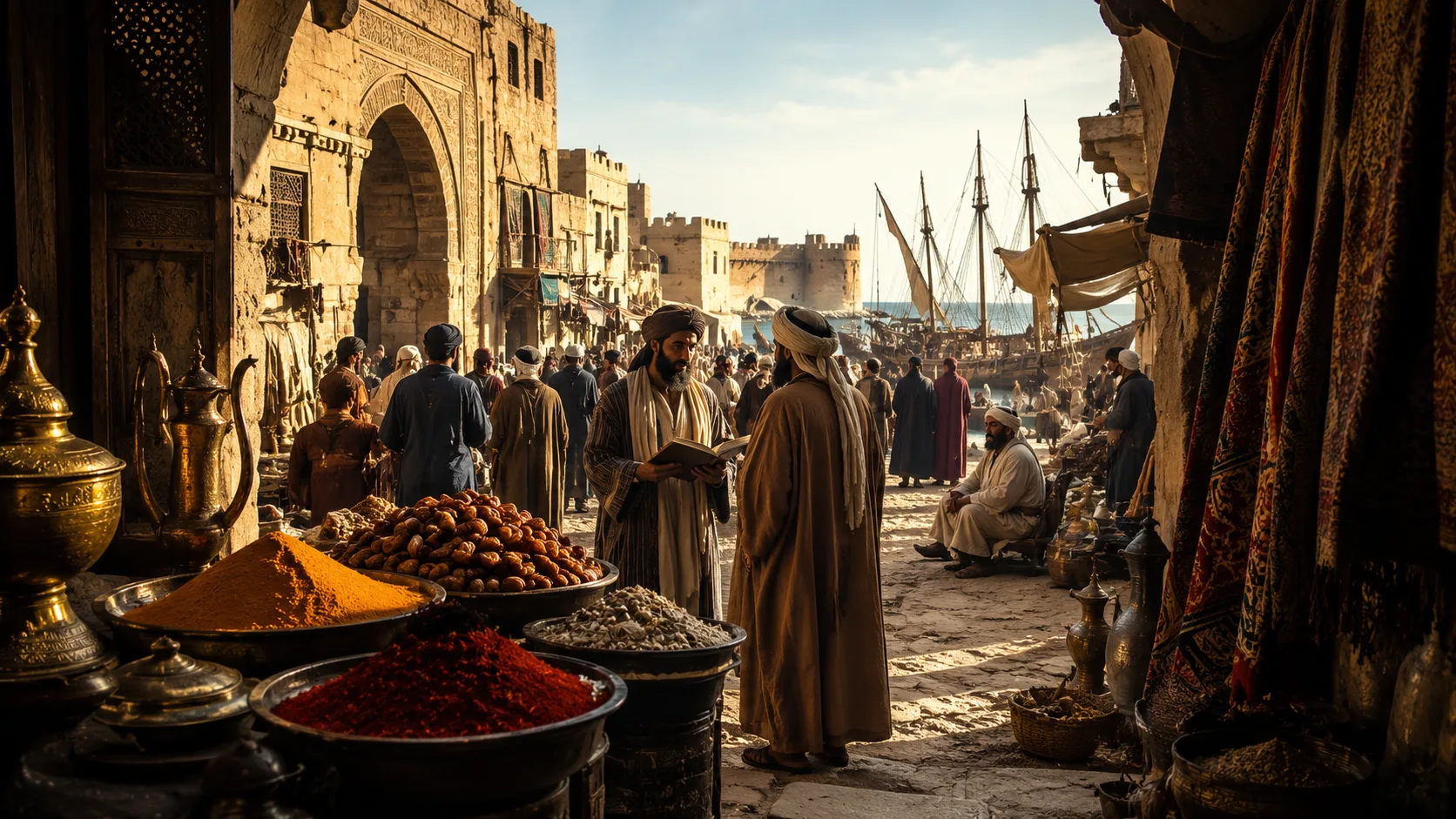
In 1325, a young scholar from Tangier set out on pilgrimage and never quite came home. Over twenty-nine years, Ibn Battuta crossed what would today be more than fifty countries, covered an estimated 75,000 miles, and sat before sultans, merchants, mystics and ordinary people across the length of the medieval Islamic world. When he finally dictated his account — the Rihla — he produced something no deliberate historical project could have created: a civilization seen from the inside, at the level of the meal, the market, the prayer and the road.
The Young Man Who Left and Never Quite Came Back
Tangier in 1325 was a prosperous Moroccan port city under Marinid rule, connected by sea to Al-Andalus and by road to the caravan routes of the Sahara. Ibn Battuta came from a family of Islamic legal scholars. His father and grandfather before him had served as qadis — judges trained in the Maliki school of jurisprudence that dominated North Africa and much of the western Islamic world. He was educated, ambitious, and by his own account restless in a way that a legal career in a familiar city would never satisfy.
He was twenty-one years old when he left home. He rode out on a June morning in 1325, heading east along the North African coast, and he wept — his own word — because he had said goodbye to his parents and was not certain he would see them again. The journey he intended was a hajj, the pilgrimage to Mecca every Muslim is called to make at least once in a lifetime. He planned to be away for perhaps a year.
He was away for twenty-nine.
The idea of the hajj offered him a socially respectable reason to travel. Pilgrimage was not merely a duty; it was, in the medieval Islamic world, a form of education. Scholars undertook it to collect knowledge along with merit — to meet other learned men, to study in foreign cities, to gather manuscripts and legal opinions. The great tradition of Islamic travel writing, the rihla literature, had existed for centuries before Ibn Battuta was born. He was stepping into a recognised genre as much as into an unknown road.
What he could not have anticipated was that the road would not release him. He stopped first in Tunis, then in Cairo, then in Syria and the Holy Cities. He delayed, he detoured, he was hired and appointed again. He married and divorced with a frequency that startled those who read his account centuries later. He fathered children he sometimes never saw again. The pilgrimage that was meant to take a year became a quarter-century of accumulation — and it was only when the Marinid Sultan Abu Inan Faris more or less ordered him home that he finally came to rest in Morocco, an old man by medieval standards, his memory the only notebook he had ever kept.
What the Rihla Actually Is — And What It Is Not
The full title of the work is Tuḥfat al-Nuẓẓār fī Gharāʾib al-Amṣār wa-ʿAjāʾib al-Asfār — translated variously as A Gift to Those Who Contemplate the Wonders of Cities and the Marvels of Travelling. It was dictated, not written. Ibn Battuta talked; a young Andalusian scholar named Ibn Juzayy listened and shaped the raw material into literary Arabic prose. The dictation took place around 1355 and 1356, more than two decades after many of the events described.
This is the first thing honest readers should hold in mind: the Rihla is a remembered document, not a contemporaneous journal. Ibn Battuta kept no diary during his travels. When he finally sat before Ibn Juzayy, he was reconstructing decades of experience from memory, from conversation, and — as scholars including Ross E. Dunn and Tim Mackintosh-Smith have examined carefully — from other travel texts he had read or heard quoted along the way.
A Note on Reliability
Some passages describing Alexandria, Mecca, Medina and several Tigris valley towns appear to have been borrowed, with varying degrees of acknowledgement, from the earlier rihla of the twelfth-century Andalusian traveller Ibn Jubayr. Certain portions of the account of China have puzzled historians, and some scholars argue Ibn Battuta may never have reached the Chinese mainland. None of this makes the Rihla fraudulent — it makes it human, and medieval. Tim Mackintosh-Smith discovered unknown manuscripts at Cairo’s Al-Azhar University copied in Ibn Battuta’s own hand during his time in Damascus in 1326, corroborating at least that portion of the chronology. The appropriate stance is neither uncritical acceptance nor fashionable scepticism.
The Rihla is a monumental document of fourteenth-century Islamic civilisation — imperfect, personal, at times exaggerated and at times brilliantly precise. Its value lies not in its completeness but in its texture.
The Road as a Living World: Caravans, Dangers and the Kindness of Strangers
The medieval Islamic world was, above all else, a world in motion. Trade caravans crossed the Sahara and the steppes of Central Asia. Pilgrims moved in their tens of thousands toward Mecca each year. Scholars traveled to sit at the feet of distant teachers. The roads — overland and maritime — were not merely routes connecting places. They were civilisational arteries, carrying not only goods but ideas, legal opinions, fashions, recipes, diseases, books and news.
The Anatomy of a Medieval Caravan
When Ibn Battuta joined the great Syrian pilgrimage caravan bound for Mecca, he entered one of the most organised social institutions of the medieval world. The caravan moved at night in summer, torches lighting the path of thousands of camels and covered litters, so that the countryside gleamed and the darkness was turned into a kind of travelling day. Enormous brass cauldrons called dasts were carried on camels and used to cook food for the poor. There was a hierarchy within the caravan: those who rode litters lined with silk, those who walked, those who served, those who had paid for passage and those who had nothing but hope and the obligation of the road.
The caravan also carried animated bazaars. Merchants set up stalls at each halt. Food, fruit, luxury goods and cloth changed hands in the middle of the desert. The great pilgrimage was simultaneously a market fair, a legal convention, a social gathering and a religious exercise — something no single word in any language quite captures.
When the Road Turned Hostile
He was not a naive observer. The Rihla documents the real dangers of medieval travel with a directness that no literary embellishment can obscure. At the valley of al-Ukhaydir, a stretch of desert so forbidding that Ibn Battuta compared it to a gate of hell, he recorded the story of a caravan caught by a samoom, the scorching desert wind. The water ran out; both those who sold and those who bought perished. Their story had been carved into a rock in the valley — already, in his time, an inscription of collective memory.
He himself was robbed near the beginning of his journey. He fell seriously ill in India. In the Indian Ocean, sailing with an embassy to China, his ship sank in a storm; most of his possessions, his gifts for the Chinese Emperor, his carefully assembled wealth — all lost. He arrived in the Maldives effectively destitute. He described being summoned by Muhammad bin Tughluq, Sultan of Delhi, whom he served for seven years and whom he recognised as simultaneously the most generous and the most terrifying ruler he had ever encountered.
What Ibn Battuta preserved in recording these dangers was something medieval chronicles rarely bothered with: the physical and psychological experience of long-distance travel. The anxiety of an empty water skin. The relief of finding a zawiya — a Sufi lodge — where a stranger would be fed and sheltered. The particular dread of entering a new sultan’s court with gifts that might be judged insufficient.
Inside the Markets: Commerce as Cultural Archaeology
If you want to understand a civilization, go to its markets. Ibn Battuta understood this instinctively. He did not simply record what was sold. He recorded who sold it, who bought it, what currency was used, what prices things fetched, and what the arrangement of the stalls revealed about the values of the city they served. The medieval Islamic market — the souq or bazaar — was not merely a commercial space. It was a theatre of urban life, a place where social hierarchies were negotiated and displayed, where the legal obligations of honest trade were publicly visible, and where the boundary between the sacred and the commercial was deliberately blurred.
Cairo, the Mother of Cities
When Ibn Battuta arrived in Cairo in 1326, a young man in his early twenties fresh from the relative modesty of Moroccan city life, he was by his own account overwhelmed. He called it Umm al-Dunya: the Mother of the World. What struck him was not simply its size, though Cairo was then among the largest cities on earth. It was its density. The markets cascaded through the city in an almost unbroken stream from dawn to after sunset. The Nile carried goods from Sudan. The Red Sea routes brought the spices and textiles of the Indian Ocean trade.
He noticed the hospitals — the bimaristans — with something approaching reverence unusual for a traveller of his era. Cairo’s Mansuri Hospital had separate wards for men and women, for surgical cases and for those suffering fevers, and offered food, treatment and music to patients regardless of their origin or ability to pay. He noted it not as a curiosity but as a standard — a sign of what a properly organised Islamic city should offer its people.
He returned to Cairo in 1348, and the city he found was unrecognisable. The Black Death — al-waba — had arrived. He described the dead being carried to burial in their hundreds, then in their thousands. These descriptions form one of the most important eyewitness accounts of the plague in the Arabic literary tradition. Ibn Battuta was there.
The Ports of the Indian Ocean
For Ibn Battuta, a port was not simply a place where ships arrived and left. It was a social ecosystem. At Dhofar on the Arabian coast, he observed a custom of particular elegance: when a ship arrived, the local merchants did not rush to trade. They first invited the captain and the ship’s writer to the ruler’s palace, and entertained the entire crew for three days. Only after this hospitality was the business of commerce transacted. Relationships preceded transactions. Goodwill was an investment in future voyages.
At Calicut on the Malabar Coast of India — then one of the greatest trading ports in the world — he described the enormous Chinese junks that dwarfed every other vessel in the harbour. He counted their sails, noted their construction, and described the private cabins wealthy merchants rented for the crossing, complete with private latrines and, sometimes, gardens growing in wooden containers on deck. The arrangement of space on a ship reveals the hierarchy of a trading civilisation.
The Table of the World: Food, Hospitality and What People Actually Ate
Ibn Battuta ate with everyone. He dined with sultans on dishes of rice cooked in butter and topped with whole roasted chickens. He ate with Sufi mystics who lived on dates and water and considered the simplicity of their meals a form of prayer. He was given flour and rice and cowpea meal by a village woman in Mali in exchange for a piece of salt and a handful of cloves. He described the markets of China as full of frogs and pigs and dogs alongside chickens that he noted, with characteristic precision, were larger than any he had seen in the west.
The Grammar of Hospitality
What the Rihla documents above all is that hospitality in the medieval Islamic world was not a personal virtue but a structural institution. It had grammar and protocol. It had geography — the zawiya, the Sufi lodge that existed in almost every city and many villages, where a stranger could arrive, claim shelter in the name of God, and be fed and housed for three days without question. It had economics — the waqf system, pious endowments that funded these institutions independently of the whims of rulers. And it had hierarchy: the quality of the welcome you received was calibrated to your perceived status, and Ibn Battuta was acutely, sometimes acerbically, aware of this calibration.
In Mali, he was initially disappointed by the hospitality of Mansa Sulayman, who sent him — after all the grandeur of the royal court — three loaves of bread, a piece of beef and sour curds. Ibn Battuta’s irritation is audible across six centuries. He compared this meagre welcome to the extraordinary generosity of ordinary people he had met along the road. He was making, without quite articulating it, a sophisticated observation about where power resides: not always in palaces.
Meals That Crossed Borders
Food in the Rihla is never merely food. It is cultural information. When Ibn Battuta fell ill after eating a local dish upon first arriving in Mali — he was bedridden for two months — the episode is not a complaint about local cooking. It is evidence that the medieval world, despite its networks of trade, remained made of genuinely distinct food cultures. Across the breadth of the Islamic world, a single legal and religious framework held, but the tables beneath it could not have been more different: the saffron rice of Persia, the teff injera of Ethiopia, the millet porridge of West Africa, the coconut curries of the Malabar Coast, the preserved fish of the Maldives, the mutton broth of the Central Asian steppes.
That diversity is itself a historical argument. Ibn Battuta was not travelling through a monolithic civilisation. He was travelling through a civilisation that had found enough common ground — language, law, faith, commercial trust — to allow a man from Morocco to move with relative freedom across the width of the known world, while still encountering genuine foreignness at every table.
Rulers, Courts and the Theatre of Power
Ibn Battuta met more than sixty sultans, kings, emirs and governors during his travels. He understood courts with a legal scholar’s precision: who sat where, who rose when, what gifts were offered and what their value signalled, which gestures conveyed allegiance and which conveyed contempt. He documented the ceremonial architecture of power — the carpets, the parasols, the litters, the slaves who stood with drawn swords — with the eye of a man who had spent years learning that the way power arranged itself in space was itself a form of communication.
Muhammad bin Tughluq: The Most Generous and Most Dangerous Sultan
No ruler in the Rihla occupies more pages or inspires more ambivalence than Muhammad bin Tughluq, Sultan of the Delhi Sultanate, whom Ibn Battuta served as a senior judge for approximately seven years. He was, Ibn Battuta wrote, the most generous man alive — and also a man whose generosity existed in permanent and terrifying proximity to his capacity for violence. The same sultan who awarded arriving scholars gifts of thousands of silver dinars was also capable of executing advisors on impulse.
Ibn Battuta himself lived under this shadow. He saw men he knew killed. He was, at one point, himself in danger. When the sultan offered him a position as ambassador to the Mongol court of China — an honour freighted with the implicit understanding that it was also a convenient way to be rid of an inconvenient judge — Ibn Battuta accepted with a relief that his own prose barely conceals. Getting away from Muhammad bin Tughluq alive was itself an achievement.
What his account of the Delhi court preserves is irreplaceable: a firsthand portrait of one of the most powerful and most eccentric rulers in medieval South Asian history, seen not by a court chronicler with an obligation to flattery, but by a foreign judge who had no particular reason to lie.
Mansa Sulayman of Mali: A King Who Surprised Him
His account of the Mali Empire, which he visited in 1352, is one of the most historically significant portions of the entire Rihla. It is one of only a handful of firsthand accounts of the empire from this period, and historians studying medieval West Africa have returned to it repeatedly, cautiously and gratefully.
Mansa Sulayman held court under a great dome, seated on a platform called a bembe, dressed in a golden skullcap. Before him stood armed slaves; above him, royal musicians with drums and trumpets; around him, the elaborate protocols of a court that was simultaneously African and deeply Islamic. The Friday prayers were conducted with the same care and form that Ibn Battuta would have recognised from Cairo or Delhi. And yet the court ceremony, the instruments, the social relations between men and women, the practices of greeting and of eating — these were entirely, specifically, irreducibly Malian.
Ibn Battuta’s discomfort with certain local customs is evident. He was sometimes judgmental, sometimes baffled. But his discomfort is itself the evidence: this was not a derivative civilisation paying court to an imported religion. It was a living culture that had absorbed Islam and made something new of it.
Religious Life Across a Continent
Ibn Battuta was a devout man. He performed the hajj not once but six times. He sought out scholars, saints and mystics in every city he entered. He recorded the call to prayer heard from a mosque in China with audible emotion: the sound of the adhan rising from a minaret in a country where it had no reason to exist was, for him, one of the genuine wonders of the world.
The Sufi Lodges and the Invisible Network
Perhaps no institution receives more consistent attention in the Rihla than the Sufi lodge — the zawiya, sometimes called a khanqah in the eastern Islamic world. These institutions, scattered across every Muslim country and many beyond, served simultaneously as hostels, schools, shrines, welfare centres and spiritual communities. For a traveller with no credit and no local connections, the zawiya was survival. You arrived, you invoked the name of the sheikh, and you were fed and housed for as long as need required.
Ibn Battuta documented Sufi masters, their followers, their practices and their occasionally astonishing asceticism with the precision of a legal scholar and the wonder of a genuinely curious man. He visited shrines across Anatolia, Persia, India and Central Asia, recording not only the names of the saints buried there but the living communities that had grown around their tombs. The Sufi networks of the medieval Islamic world were as important to the circulation of people and ideas as any trade route, and Ibn Battuta mapped them more thoroughly than any other single source of his era.
The Hajj as a Cross-Cultural Encounter
He performed the pilgrimage to Mecca for the first time in 1326. He would return five more times. Mecca during the hajj was perhaps the single most cosmopolitan gathering on earth in the fourteenth century — tens of thousands of people from every corner of the Islamic world, speaking Berber and Persian and Swahili and Malay and Arabic and Turkish, dressed in the same simple white garments of the ihram, walking the same circuits around the Kaaba, reduced by ritual to something approaching common humanity before dispersing back into the extraordinary diversity of their ordinary lives.
Ibn Battuta’s descriptions of Mecca are among the portions scholars have found most influenced by Ibn Jubayr’s earlier account. But even if certain passages were borrowed, the texture of his experience — the crowds, the heat, the emotion, the legal debates he observed among scholars of different schools — belongs to him.
Women, Law and Cultural Friction: The Ibn Battuta Nobody Mentions
The popular image of Ibn Battuta tends toward the heroic: the lone scholar, the fearless traveller, the bridge between civilisations. A more complete reading of the Rihla reveals a more complicated man.
He married repeatedly — at least ten times, probably more — taking wives in almost every region where he stayed for any length of time and divorcing them when he moved on. He took concubines. He fathered children he sometimes never acknowledged. In the Maldive Islands, where he served briefly as chief judge, he attempted to impose his Maliki legal standards on a population that had its own relationship to Islamic practice. He discovered that women there went bare-shouldered — a custom he found un-Islamic and promptly tried to end. He failed. His own rueful description of his failure is one of the most quietly revealing moments in the entire book.
It reveals, first, the limits of legal authority at the edges of empire. It reveals, second, that Islamic practice in the fourteenth century was not a single thing but a vast and contested diversity of local accommodations. And it reveals, third, that Ibn Battuta was capable of observing his own failure with something between frustration and honesty — a quality not always present in medieval texts.
Among the Turks and Mongols, he observed with visible discomfort that women moved freely in public alongside men, speaking to strangers, conducting business, riding alongside their husbands. He called it strange. He recorded it anyway. In doing so, he preserved evidence of social arrangements that no official court history of the Mongol steppe would have bothered to note.
The Plague, the Cities and an Eyewitness to Catastrophe
In the autumn of 1348, Ibn Battuta entered a world that was dying.
The Black Death — al-waba, the contagion — had moved across the Islamic world with a speed and thoroughness that no human institution could resist. He encountered it first at Alexandria, then at Damascus, then at Cairo. His descriptions are not dramatic in the literary sense; they are almost clinical, which gives them their power. At Damascus, he observed the population gathering for communal prayer and supplication in the great Umayyad Mosque — not an act of desperation but an act of organised faith, the city confronting catastrophe according to the forms it knew. He noted mortality figures that historians acknowledge may be approximate, as a function of imperfect memory or the chaos of the moment itself.
What no historian disputes is that Ibn Battuta was present. He was not writing about the plague from a safe distance or assembling secondhand reports. He walked through cities in the middle of it. He described the specific texture of collective grief: the way people moved, the way markets emptied and prayers multiplied, the way a civilisation that had organised itself around hospitality and commerce found itself in a world where touching a stranger could mean death.
This section of the Rihla is among its most historically precious — a firsthand Islamic eyewitness account of one of the most devastating events in human history, written at the intersection of medical catastrophe, religious response and social disintegration.
Where the Rihla Falters — and Why That Matters
Honest engagement with the Rihla requires acknowledging its weaknesses without allowing them to eclipse its strengths.
Ibn Battuta did not keep a diary. He dictated from memory, decades after many events occurred. Some of his chronologies are confused — his account of his movements through Anatolia is geographically incoherent in places, doubling back across hundreds of miles in ways that suggest he was reassembling fragments of a journey he had not committed carefully to mind. His account of China puzzles historians: he describes the Yellow River in terms that suggest confusion with other waterways, omits details one would expect from a man who had actually walked through the country, and describes features that other evidence makes difficult to confirm. Some scholars believe he compiled his Chinese account from the testimonies of Arab and Persian merchants he met in Southeast Asian ports.
He was not above bias. He judged cultures by Maliki legal standards he had absorbed in Morocco and never fully questioned. He was irritated by rulers who did not give him gifts he considered appropriate to his status. He could be dismissive of cultures in language that reflects the prejudices of his time and class.
And yet: when Tim Mackintosh-Smith spent years in the field retracing Ibn Battuta’s routes, what he found was not a fraud but a profoundly human document. Flawed, personal, sometimes borrowed, often brilliant. The manuscripts he discovered at Al-Azhar, copied in Ibn Battuta’s own hand, confirm his presence in Syria precisely where the Rihla places him. The details that can be verified — market customs, architectural features, social protocols, legal practices — align with what other evidence from the period shows. The inaccuracies are real. So is the achievement.
What He Preserved Without Knowing It
The fourteenth century did not know that it was ending.
Within decades of Ibn Battuta’s return to Tangier, the world he had documented would begin to fracture in ways no single traveller could have anticipated. The Black Death would kill between a third and a half of the population of the Mediterranean and Middle East. The Mongol states that had maintained the security of the Central Asian trade routes would collapse. The Delhi Sultanate that had employed him would shrink and eventually transform. The Mali Empire whose court he had visited would be superseded. The great Indian Ocean trading networks would be disrupted by the arrival of Portuguese ships at the end of the fifteenth century.
The civilization Ibn Battuta had walked through — the Dar al-Islam at its most connected, most cosmopolitan and most self-confident — was not permanent. Nothing is. But it left a record. Not in the official histories of dynasties, but in the account of a man from Tangier who could not stop moving, who ate everything, argued with everyone, married impulsively and observed relentlessly, and who sat down at the end of it all and talked for a year about what he had seen.
He told his scribe about a caravan lit by torches crossing a desert at midnight. He described the feel of Chinese silk in a Sufi lodge in Anatolia. He remembered the taste of a dish in Mali that put him in bed for two months. He recorded the sound of the call to prayer rising from a minaret he had not expected to find at the edge of the known world. He noted the grief of a plague-emptied city. He preserved, in passing, the name of a woman in the Maldives who laughed at his attempt to cover her shoulders.
These are not political facts. They are not strategic intelligence. They are, however, the things that make a civilization legible to the centuries that come after it. They are the things that allow us, today, to understand not merely that the medieval Islamic world existed, but that it was lived in — that real people woke up in it every morning, ate breakfast in it, worried about the price of water and the mood of sultans, said their prayers and sold their silk and welcomed strangers at the door.
Ibn Battuta did not set out to be a historian. He set out to perform a pilgrimage and never quite came home. What he left behind is something that no deliberate historical project could have produced: the record of a world seen from the road, from the table, from the courtroom, from the ship — seen from the inside, by someone who was living the civilisation he was documenting, rather than merely observing it.
That is why the Rihla endures. Not because it is perfect. Because it is irreplaceable.
Tangier — The Beginning and the End
Ibn Battuta was born in Tangier in 1304 into a family of Maliki legal scholars. He departed in 1325 and returned, at the order of the Marinid Sultan, around 1354. His dictation of the Rihla took place on Moroccan soil. The world’s greatest medieval journey began and ended in the Maghreb.
Mali — One of History’s Most Precious Accounts
Ibn Battuta visited the Mali Empire in 1352. His description of Mansa Sulayman’s court is one of only a handful of firsthand historical records of the empire from this period. Historians of medieval West Africa continue to study it with great care.
Delhi — Seven Years in the Shadow of a Dangerous Sultan
Ibn Battuta served as a senior judge under Muhammad bin Tughluq of the Delhi Sultanate for approximately seven years. His account of the court remains one of the most vivid firsthand portraits of a medieval South Asian ruler ever written.
Further Reading: The Scholarly Road Behind the Rihla
For those wishing to read the Rihla in English, the most widely cited academic translation is the multi-volume edition by H.A.R. Gibb, published by the Hakluyt Society and Cambridge University Press. A more accessible edition with scholarly notes was edited by Tim Mackintosh-Smith, who also wrote a trilogy retracing Ibn Battuta’s routes in the present day — Travels with a Tangerine, The Hall of a Thousand Columns, and Landfalls — which serves as an excellent companion to the original text. Ross E. Dunn’s The Adventures of Ibn Battuta: A Muslim Traveler of the 14th Century remains the definitive scholarly biography and historical contextualisation in English.
Frequently Asked Questions About Ibn Battuta and the Rihla
Ibn Battuta (1304–1368/69) was a Moroccan scholar and traveller from Tangier who spent approximately twenty-nine years travelling across the medieval Islamic world and beyond. He covered an estimated 73,000 to 75,000 miles — more than any other traveller of his era. His importance lies not primarily in the distance he covered, but in the document he produced: the Rihla, which provides an unparalleled firsthand account of fourteenth-century Islamic civilisation, including its markets, courts, religious institutions, social customs, food traditions and daily life.
The Rihla — whose full title translates as A Gift to Those Who Contemplate the Wonders of Cities and the Marvels of Travelling — is the account of Ibn Battuta’s journeys, dictated to the Andalusian scholar Ibn Juzayy around 1355–1356. It was composed from memory rather than contemporaneous notes, and belongs to a recognised genre of Islamic travel writing. It covers travels across North Africa, the Middle East, East Africa, Persia, Central Asia, India, the Maldives, Southeast Asia, China, Anatolia and West Africa.
The question of the Rihla’s reliability is debated among scholars and deserves a nuanced answer. Many passages have been corroborated by other historical evidence and by Tim Mackintosh-Smith’s field research, which discovered manuscripts copied in Ibn Battuta’s own hand at Al-Azhar University in Cairo. Some portions appear to borrow from earlier travel writers, especially Ibn Jubayr. His account of China contains geographical errors that lead some historians to question whether he reached the Chinese mainland. The scholarly consensus treats the Rihla as an invaluable but imperfect source: it must be read critically, cross-referenced where possible, and interpreted within the literary conventions of its time.
Ibn Battuta travelled considerably further than Marco Polo. Estimates for Polo’s total journey distance range from approximately 15,000 to 24,000 miles. Ibn Battuta’s journey, covering an area equivalent to more than fifty modern countries over twenty-nine years, is estimated at 73,000–75,000 miles. The comparison is useful as a scale reference, but should not be turned into a competition: the two men were from different cultures, travelling for different purposes, through different worlds. Each produced a document of profound historical value in its own right.
Ibn Battuta documented an extraordinary range of everyday experience: the organisation of pilgrimage caravans, the layout of city markets and the goods traded in them, the hospitality customs of different regions, the food eaten at different social levels, the structure of courts and the behaviour of rulers, the role of Sufi lodges in sustaining travellers and scholars, the practice of Islamic law across vastly different local contexts, marriage customs, dress, architecture, agriculture, port commerce and the social position of women. Taken together, these observations constitute something closer to ethnography than to conventional travel writing.
Yes. Ibn Battuta was in the Middle East and North Africa during the 1348 outbreak of the Black Death. He passed through Alexandria, Damascus and Cairo during the height of the epidemic and recorded mortality figures, collective religious responses and the atmosphere of the afflicted cities. While historians note some inconsistencies in his figures, his eyewitness descriptions remain among the most vivid and historically significant Islamic accounts of the plague.
Ibn Battuta served as chief judge — qadi — in the Maldive Islands for approximately eight to nine months, having arrived there after losing most of his possessions in a shipwreck in the Indian Ocean. He attempted to impose stricter Maliki legal standards on the population, including requiring women to cover their shoulders in public. He failed in this and several other reforming efforts, made political enemies and eventually left under circumstances he describes with an unusual degree of self-awareness. His account of the Maldives is one of the few detailed historical records of the islands from this period.
The most widely cited academic translation is the multi-volume edition by H.A.R. Gibb, published by the Hakluyt Society and Cambridge University Press. A more accessible edition with scholarly notes was edited by Tim Mackintosh-Smith. Ross E. Dunn’s The Adventures of Ibn Battuta: A Muslim Traveler of the 14th Century (University of California Press) is considered the definitive scholarly biography and historical contextualisation in English and is an excellent starting point for general readers.
The House of Meski: Products Born from the Same Roads
The trade routes Ibn Battuta walked were also the routes that carried frankincense from Oman, Sidr honey from Yemen and the Arabian Peninsula, and the saffron that graced the tables of medieval courts from Persia to Morocco. At The House of Meski, we source from these same origins — products that carry the memory of a civilisation in every jar.
Seven centuries after he left Tangier, Ibn Battuta remains one of the most generous witnesses the world has ever produced — generous with his attention, his astonishment, his hunger to understand. He documented a civilisation not from above, in the language of conquest, but from within it, at the level of the meal, the market, the prayer and the road. May that quality of curiosity never leave us.