
Dubai’s honey market is extraordinary — and extraordinarily uneven. This guide helps you navigate it with clarity, asking the right questions and recognising the signals that separate genuinely great honey from a beautifully packaged one.
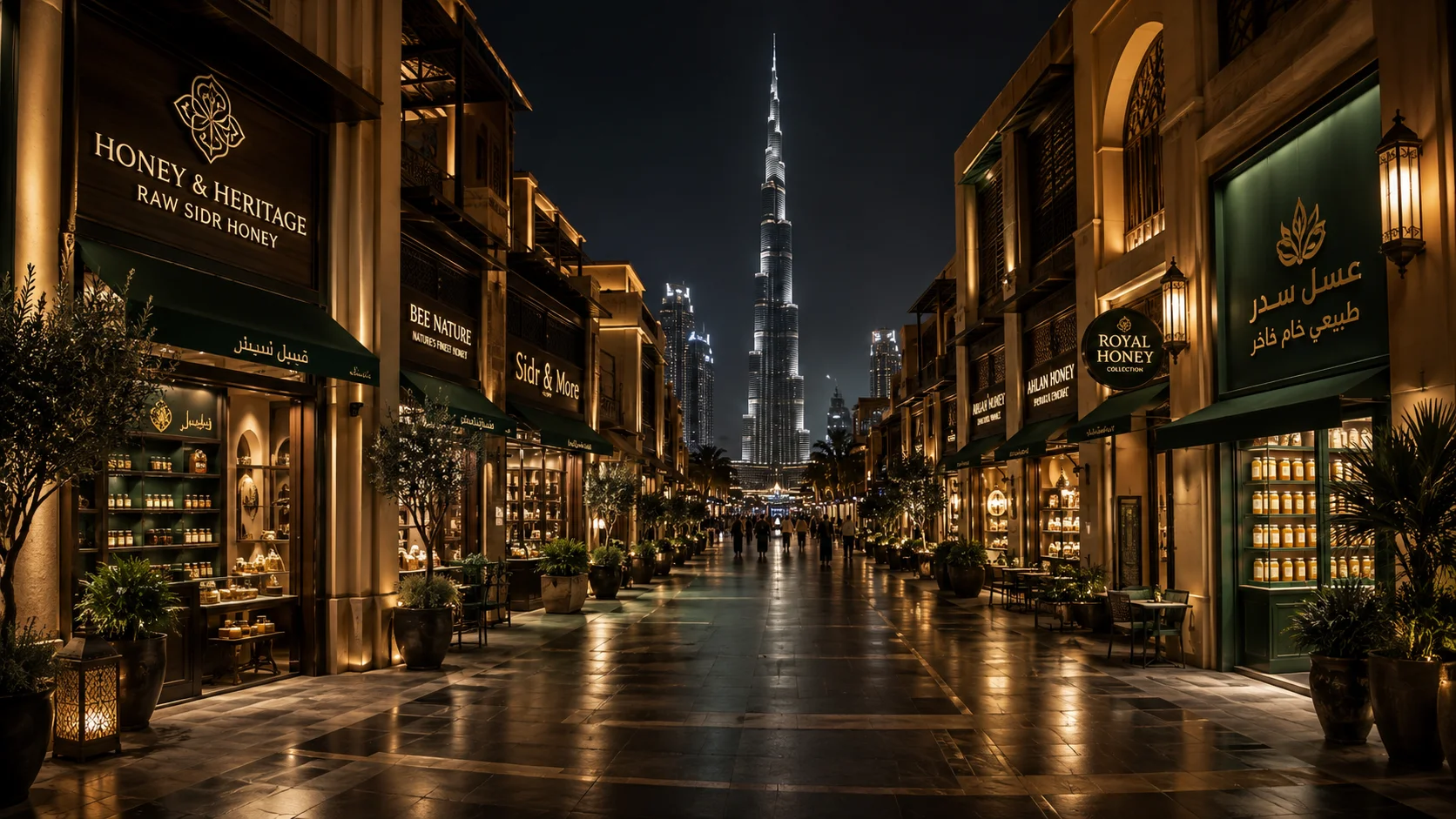
Dubai is one of the world’s most remarkable places to buy honey — but also one of the most complex. Authentic raw honey, Sidr from Wadi Do’an, Omani mountain varieties and rare single-origin miels all share shelf space with products that are far less than they claim. This guide gives you the knowledge to tell the difference.
Why Dubai Offers So Many Different Honeys
The UAE does not produce honey at industrial scale — its geography and climate make that virtually impossible. What it does exceptionally well is act as a convergence point. Dubai and the wider Emirates sit at the crossroads of ancient trade routes that once carried frankincense, spices and honey across the Arabian Peninsula, the Horn of Africa and the Indian subcontinent. That heritage lives on in a remarkably open, well-connected import economy.
A serious honey retailer based in Sharjah or Dubai can source directly from beekeepers in the Hadhramaut valleys of Yemen, the Jebel Akhdar of Oman, the highlands of Ethiopia, the maquis of Corsica or the alpine meadows of the Balkans. The proximity to Yemen — the undisputed homeland of the world’s most prized Sidr honey — gives Gulf-based buyers a distinct advantage over their counterparts in Europe or North America. Freshness, supply chain length, and direct producer relationships are all potentially superior here.
That same openness, however, creates the conditions for a crowded, uneven market. Low barriers to entry, high consumer appetite, and limited systematic retail enforcement mean that extraordinary quality and significant mediocrity can sit on neighbouring shelves, in nearly identical packaging, at wildly different price points. For a deeper look at how Dubai’s position on ancient trade routes shapes its honey culture today, see our upcoming Heritage Series on the Meski blog.
Honey Fraud: A Global Concern
Peer-reviewed research and international food safety bodies confirm that honey ranks among the top ten most fraud-prone food products in the world. Authentic Yemeni Sidr can retail between AED 800 and AED 2,500 per kilogram — making it a high-value target for adulteration. Knowledge is your best protection.
What Makes a Premium Honey?
Before you can choose well, you need to know what you are choosing between. Premium honey is not simply expensive honey. It is honey that fulfils three interconnected conditions: traceable origin, minimal processing, and verifiable freshness.
Origin and Floral Source
The single most important quality signal is specificity of origin. A label that says «pure honey» or «natural honey» tells you almost nothing. A label that says «Sidr honey, Wadi Do’an, Hadhramaut, Yemen, harvest season 2024–2025» tells you everything that matters. Genuine premium honey comes from a named floral source — Sidr (Ziziphus spina-christi), Samar, Manuka, Thyme, Chestnut — and from a specific, named geographic region. Pollen analysis, the gold standard of honey authentication, can verify whether the honey in your jar truly came from the trees it claims. Authentic Yemeni Sidr should contain at minimum 60% Ziziphus pollen under microscopic analysis.
Our Do’ani Sidr Honey — sourced directly from Wadi Do’an — and our Emirati Sidr Honey are examples of named-origin, fully traceable raw honeys. Each carries a specific harvest region, not simply a country of origin.
Processing Method
Raw honey is honey that has not been pasteurised (heated above approximately 40°C) and has not been ultra-filtered. Both processes make honey look more uniform and last longer on a retail shelf. Both processes destroy or significantly reduce the natural enzymes, pollen content and aromatic complexity that define great honey. Genuine raw honey is slightly hazy or opaque — not crystal clear. It may contain fine particles of beeswax, pollen or propolis. It may crystallise over time. These are not flaws. They are evidence of integrity.
Moisture, Freshness and Lab Markers
Technical quality in honey is measurable. Moisture content below 17–18% is a standard marker of well-harvested, properly matured honey. HMF (hydroxymethylfurfural) levels below 15 mg/kg indicate freshness and the absence of heat abuse during storage or transit. Diastase activity above 8 Schade units confirms enzymatic integrity. A producer who can provide third-party laboratory analysis for their honey is a producer who has nothing to hide. This is not an unreasonable expectation for a product priced at several hundred dirhams per jar.
How to Recognize a Trusted Producer
The market is noisy. Every honey on every shelf in Dubai claims to be authentic, raw, premium, and exceptional. So how do you actually tell the difference?
The most reliable indicator is not the jar. It is not the logo. It is not the Instagram feed. It is the willingness and ability of the producer to answer specific questions — and the consistency of their answers.
They name their beekeepers or source regions
Not just «Yemen» — but a valley, a tribe, a family. Specificity is accountability.
They assign batch or lot numbers to each jar
Every jar can be traced back to a specific harvest, a specific hive location, a specific season. Without this, traceability is a marketing claim, not a system.
They are transparent about their lab results
Third-party testing for purity, authenticity and freshness is the cost of operating with integrity at a premium price point. A producer who resists sharing results is telling you something important.
They talk about their honey with restraint and precision
Producers who use sweeping superlatives — «the most powerful honey in the world» — are almost always selling something other than truth. Real expertise sounds quieter and more specific.
Questions to Ask Before Buying Honey
Whether you are buying in person at a speciality retailer in Dubai, ordering online, or considering a gift set for a valued guest, these questions cut through the noise quickly. A producer who welcomes them is a producer worth trusting. One who deflects or responds with marketing language has answered your real question already.
| Question | What a good answer looks like |
|---|---|
| Where exactly was this honey harvested? | Named region, valley or apiary — not just a country |
| What is the floral source? | Specific monofloral name (Sidr, Samar, Chestnut…) |
| What season was it harvested? | A precise year and season |
| Has it been heated or ultra-filtered? | No pasteurisation — minimal straining only |
| Is there a lab certificate for this batch? | Yes, including pollen analysis, moisture and HMF |
| Does the jar carry a batch or lot number? | Yes, traceable to a harvest record |
| How is it stored and shipped? | Temperature-controlled — especially critical in UAE summers |
Why Transparency Matters More Than Marketing
Dubai’s luxury market has cultivated a sophisticated consumer — one who has learned that the price of a product and the quality of its packaging are imperfect proxies for what is actually inside. The same intelligence applies to honey.
Marketing can create desirability. Transparency creates trust. And in a category as complex and fraud-prone as premium honey, trust is the only currency that holds its value over time.
A beautifully designed label with gold typography and evocative Arabian imagery can be produced by a packaging studio in a matter of days. A documented supply chain — from a named beekeeper in the Hadhramaut to a lot-numbered jar in your hands — takes years to build. One is cosmetic. The other is the product.
The irony of the premium honey market is that the producers most worthy of your trust are often the least aggressive in pursuing your attention. Their honey, when it is genuine, speaks for itself — in colour, in aroma, in texture, and in the very specific way it tastes of somewhere real.
Hadhramaut — Wadi Do’an
Home of the world’s most prized Sidr honey. Wild Ziziphus spina-christi trees, harvested once a year by families who have kept this tradition for generations. Gulf proximity means shorter supply chains and superior freshness compared to Western markets.
Jebel Akhdar & Dhofar Highlands
Mountain altitude, frankincense-scented flora and skilled Omani beekeepers produce Sidr and Samar honeys of remarkable complexity. A terroir-driven product that rewards the attentive buyer.
Maquis & Cap Corse
AOP-certified Corsican honeys from wild maquis and chestnut groves — among the most strictly protected designations in European gastronomy. A benchmark for what geographical certification can mean in practice.
We Select Honey as if It Were for Our Own Family
At Meski Dates Factory, we do not claim to make the best honey in the world. That is not how we think about what we do.
What we do — honestly and without apology — is source, verify, and present honey exactly as we would for our own table. The Sidr we stock is the Sidr we serve to our own guests. The lab standards we apply to what we sell are the standards we hold ourselves to as consumers. The question we ask before adding any honey to our range is not «will it sell?» but «would we be proud to offer this to someone we respect?»
There is a great deal of excellent honey available in Dubai. There is also a great deal that is not what it claims to be. We are not in the business of telling you that we are the only honest option — that would itself be a form of dishonesty. What we will tell you is this: we do not sell anything we have not verified. We do not use marketing language we cannot substantiate. And we do not ask you to believe our words.
We invite you to judge our honey by its transparency, its craftsmanship, and its respect for quality. If that resonates, we would be honoured to welcome you.
Direct-source traceability
Every honey in our range is linked to a named origin, a harvest season and a lot number. We can tell you exactly where it came from — and show you the paperwork.
Third-party lab verification
We apply the same quality standards to what we sell as we do to what we serve our own family. No exceptions at any price point.
Heritage & expertise
Rooted in a region where honey has been a mark of hospitality and generosity for centuries, Meski brings that cultural understanding to every sourcing decision.
Explore Our Verified Raw Honey Range
From Do’ani Sidr to Omani Frankincense and AOP Corsican varieties — every honey we offer comes with a named origin, transparent sourcing and third-party quality assurance.
Final Thoughts
Dubai offers you one of the world’s most extraordinary honey markets. To navigate it well, you need less marketing and more knowledge — fewer promises and more specific answers. The questions exist, the standards exist, and the truly exceptional producers exist. They are findable, if you know what to look for.
Ask where the honey comes from. Ask how it was processed. Ask for the lab results. And pay attention to how a producer responds — not just to what they say, but to the comfort with which they say it.
The best honey in Dubai is not necessarily the most famous one. It is the one backed by honesty, provenance and care. That combination, when you find it, is unmistakable.
Explore the Meski Royal Sidr Honey Collection — and ask us anything. We welcome every question.
Frequently Asked Questions about Buying Honey in Dubai
Dubai’s market includes both exceptional producers and some with very inconsistent quality standards. As with any premium food category globally, adulteration exists. The best protection is buying from producers who offer verifiable traceability, third-party lab results and named-origin sourcing.
Genuine Sidr honey has a distinctive dense texture, a complex amber-to-dark-gold colour, and an aroma that is unmistakably rich and floral. It should never be water-thin or crystal-clear. For complete certainty, ask for a pollen analysis certificate — authentic Yemeni Sidr should contain a significant proportion of Ziziphus spina-christi pollen.
Because «premium honey» covers an enormous range — from well-sourced local Emirati varieties to extremely rare, once-a-year harvested Yemeni Sidr from specific valleys. Origin scarcity, harvest yield, supply chain integrity and verification costs all contribute to price differences that are often entirely legitimate.
At minimum: a named floral source, a specific country and region of origin, harvest season or date, processing description (raw / unheated / minimally strained), and a batch or lot number. The absence of any of these is a reason to ask questions before purchasing.