
Culture & Traditions · Travel & Places
The Great Caravans of the Tafilalet
Before modern roads, there were tracks, halts and oases. In the Tafilalet, the desert did not only separate. It also connected.
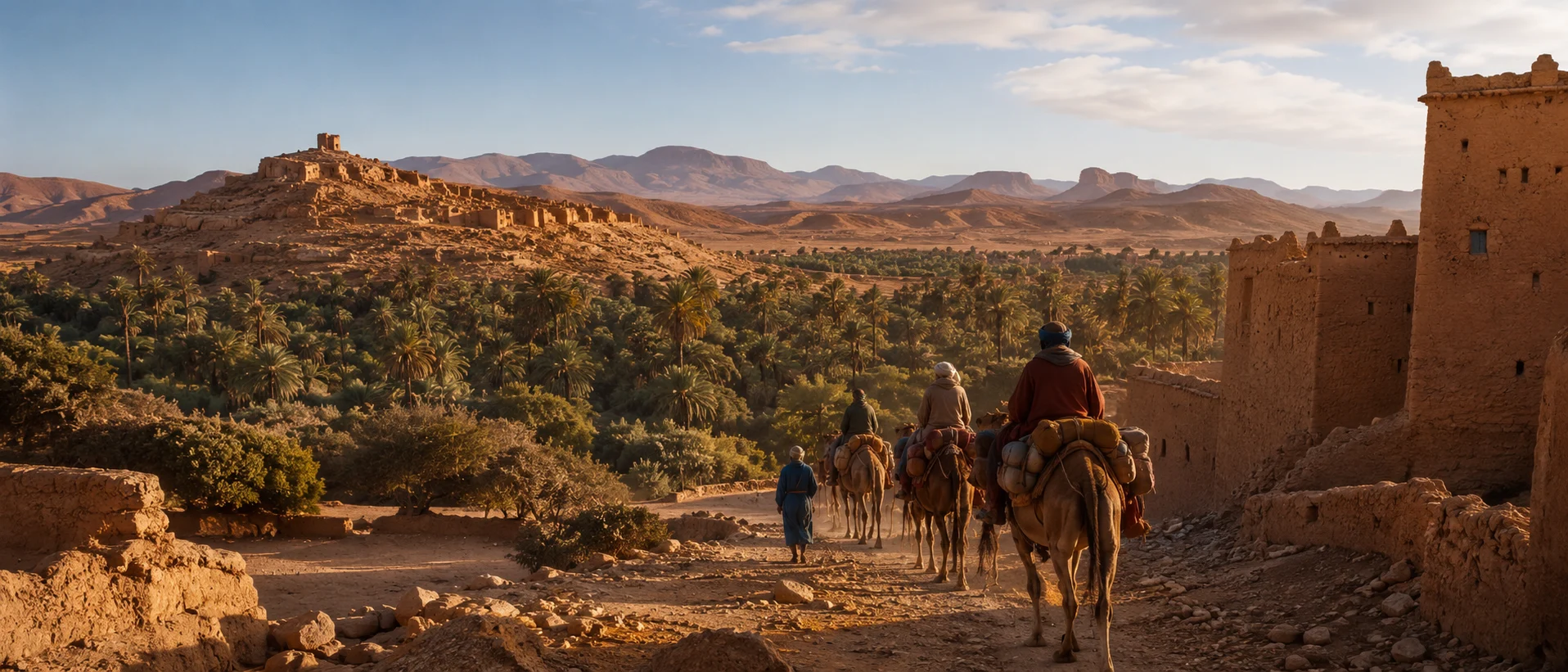
When you grow up close to an oasis, you learn early that the desert is not only a border.
It separates, of course. It exhausts. It imposes its own rules.
But it also opens roads.
The Tafilalet belongs to that world: a place where water decides much, where palm groves make rest possible, and where ancient routes once carried people, goods, news and ambitions farther than we often imagine today.
The desert as a space of connection
From a distance, the great caravans seem to have crossed emptiness. In reality, they crossed a landscape organised by memory, water, knowledge of routes and the intelligence of people who knew how to read the terrain.
The desert was not the absence of roads.
It was a road that demanded more knowledge.
The place of the Tafilalet
The Tafilalet cannot be understood only as one Moroccan region among others. For centuries it was a hinge between the Maghreb, southern oases and trans-Saharan exchange.
Caravans found more than passage there. They found storage, markets, hospitality and life.
In that world, oases were not scenery. They were conditions of possibility.
Sijilmassa and the idea of a centre
Any discussion of the caravan history of the Tafilalet eventually leads to Sijilmassa.
The name matters because the place mattered.
It reminds us that southeastern Morocco once held a major centre of circulation and exchange, a point of departure, arrival and redistribution.
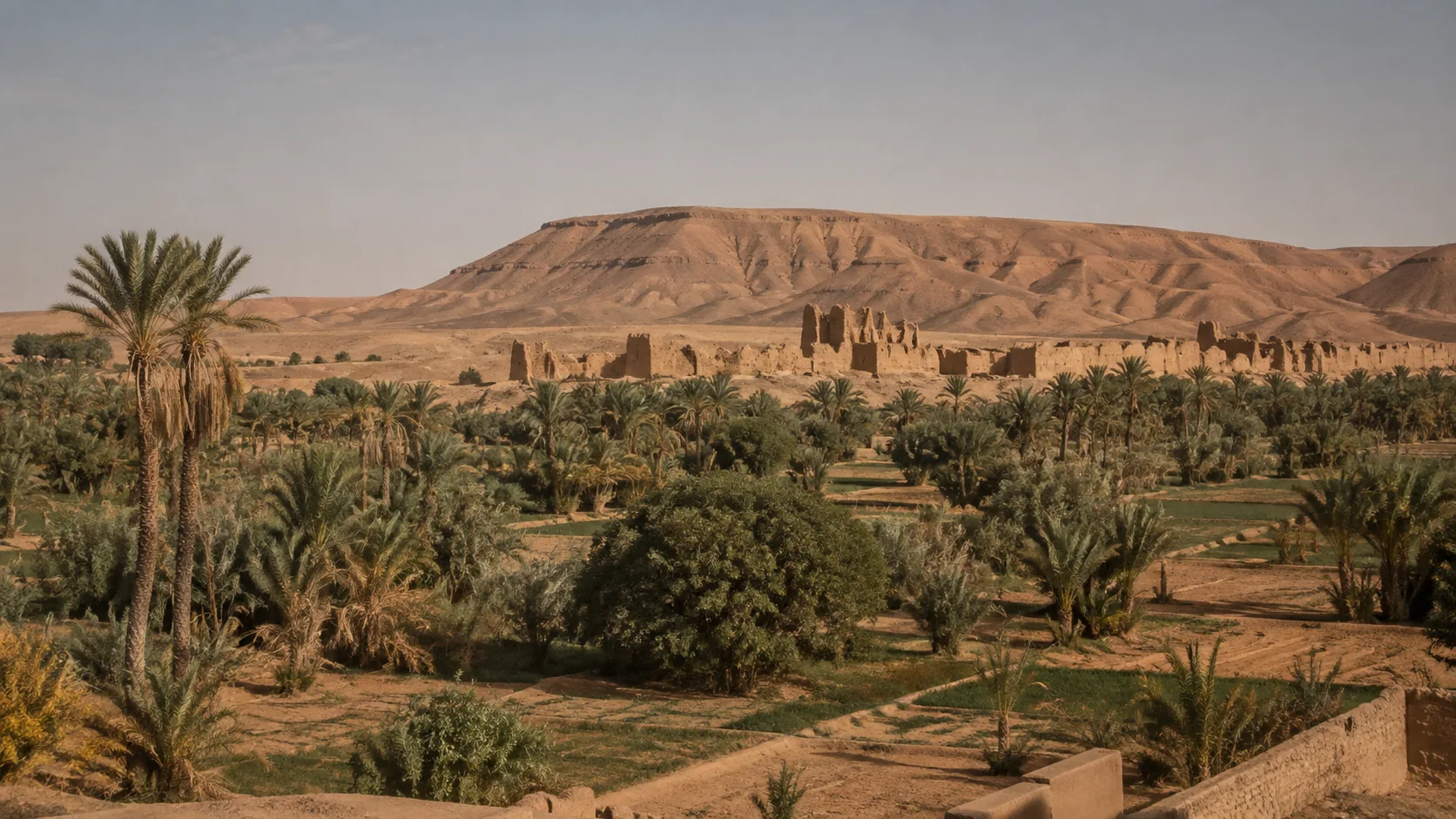
An oasis is never only a landscape. It becomes a civilisation when water, patience and human passage learn to live together.
Meskaoui
What the caravans really carried
They moved goods, naturally. But they also moved information, languages, customs, religious influences, clothing styles and ways of doing business.
A caravan did not arrive with cargo alone.
It arrived with a world.
Routes, but also lives
The history becomes more human when we stop looking only at trade.
We have to imagine guides, merchants, animals, nights, calculations of water, political agreements and the fragile balance on which every journey depended.
Ancient routes often survived because a season was good, an oasis remained healthy and passage was politically possible.
Why this matters to us
For many families and many memories, the Tafilalet remains foundational.
You can return to it through dates, villages, palm groves, earthen architecture and family stories. But you can also return through one simple idea: the oasis was historically a place of openness, not retreat.
It protected. It nourished. And at the same time, it connected.
When passage becomes culture
The caravans are interesting not only for what they moved but for what they left behind: a culture of passage, attention to the guest, respect for water, and a way of creating dignity in a demanding environment.
Perhaps that is why these stories still speak to us.
They are not only about the past. They help explain the sensitivity of oasis cultures themselves.
Even today, a small irrigation channel, an old palm grove or an earthen wall can remind us that this landscape once helped connect the Sahara to the wider world.
Tafilalet, Oases and Caravan Roads
Yes. The Tafilalet sat where Saharan routes met the Maghreb, making its oasis settlements important to movement, exchange and the redistribution of goods travelling between regions.
An oasis offered what a desert journey could not do without: water, food, shade, rest and human settlement. Caravan geography therefore depended as much on viable stopping places as on the direction of the route itself.
Caravans carried commercial goods, but also news, languages, religious ideas, manuscripts, customs and relationships. Their cultural impact lasted longer than many individual cargoes.
Because stopping created markets, settlement, storage, hospitality and long-term connections. Over time, the oasis became part of the commercial system rather than a passive point along the road.
Long histories of receiving travellers can leave cultural habits around hospitality, exchange and attention to water and food. The route may disappear, while some of the social instincts shaped by passage remain.
Return to the Tafilalet
From the great caravan crossroads to Ksar Meski, the oasis is both geography and memory.