
Jumeirah is one of the places where Dubai can be luxurious without making tradition disappear.
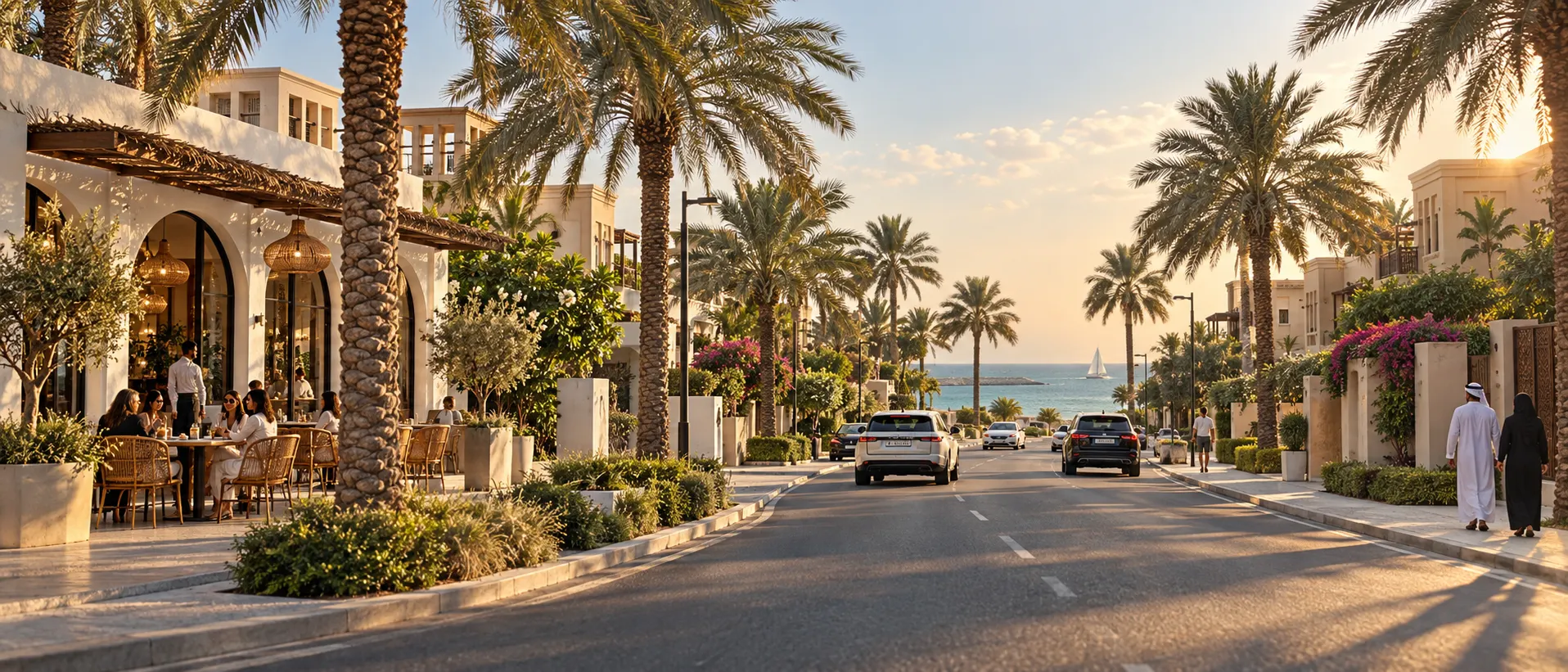
There are parts of Dubai that announce themselves before you arrive. Downtown does it with height. Sheikh Zayed Road does it with speed. Jumeirah is different. For me, its charm is that it can be calm, traditional, modern and visibly luxurious at the same time without forcing me to choose which version of Dubai I am supposed to prefer.
Why I Keep Coming Back to Jumeirah
I have always appreciated Jumeirah for a reason that is difficult to reduce to one landmark. It is not simply the beach, not simply the restaurants, and certainly not simply the expensive addresses. It is the feeling of moving through a part of Dubai where different worlds sit beside one another without needing to cancel each other out.
On one stretch you pass a mosque, a quiet villa and a small neighbourhood café. A few minutes later there is a fashionable restaurant, a polished car at the valet and a beach destination designed with every detail considered. Continue again and the road becomes residential, almost ordinary by Dubai standards. The sea appears between buildings, then disappears again. This rhythm is what I like.
Some luxury districts can make you feel that you have arrived with the wrong shoes, the wrong watch or the wrong reservation. Jumeirah rarely gives me that feeling. That is only my personal impression, of course, but even when the luxury is obvious, there is often enough familiarity around it to soften the distance. Families walk, people stop for coffee, someone is carrying takeaway food, another person is coming back from the beach. Life continues around the expensive things.
I sometimes call it, with a smile, a kind of traditional bling-bling. The luxury is there. You can see it. But very often it borrows from familiar Arab forms, courtyards, arches, shaded passages, majlis-like spaces, lanterns, wood, stone and water. It does not always ask tradition to leave the room before modernity enters.
Start in Jumeirah 1, Where the City Begins to Slow Down
If I want to understand Jumeirah rather than simply arrive at a destination inside it, I prefer to approach it as a road. Jumeirah Road, often called Jumeirah Beach Road, lets the neighbourhood unfold gradually. Jumeirah 1 is a good place to begin because it still feels connected to the older city while already opening toward the coast.
The Etihad Museum sits close to this northern end of Jumeirah and preserves the story of the formation of the United Arab Emirates. I like that as a starting point. Before beaches, restaurants and hotels, there is a reminder that the country itself is young, and that many of the streets we now take for granted belong to a period of extraordinary change within living memory.
Nearby, Jumeirah Mosque gives the road another kind of anchor. It is one of those buildings that can become familiar if you drive past it often, yet it still changes the atmosphere around it. In a city where architecture frequently competes for attention, a mosque does something different. It marks time. It reminds you that the road is not only for consumption, entertainment or movement.
This combination is already very Jumeirah to me: national history, a mosque, villas, traffic, cafés, the sea not far away, and a city that has never stopped rebuilding itself around the people already living there.
J1 Beach and the New Version of the Coast
Jumeirah 1 also shows how quickly the coast can reinvent itself. The former La Mer area reopened in a new form as J1 Beach, a beachfront dining and beach-club destination. It is polished, international and intentionally glamorous. You can arrive for a meal, spend time by the water or simply notice how Dubai keeps rewriting the same piece of coastline for a new generation.
I do not see this as a contradiction with the quieter Jumeirah around it. It is more like another layer. Dubai has always absorbed outside influences quickly, sometimes almost too quickly, then made them part of the local landscape. At J1 Beach, Mediterranean, Asian and other international dining concepts sit on a coast that still belongs to an old Dubai neighbourhood.
The interesting thing is not whether every new development feels traditional. Most do not, and they do not need to. What interests me is that you can leave a polished beachfront venue, return to Jumeirah Road and within minutes be back among low-rise villas, mosques, bakeries, neighbourhood restaurants and streets that feel far more residential.
That change of scale is part of the pleasure. You do not need to decide whether you came for modern Dubai or for something calmer. On this road, the two keep interrupting each other.
Do Not Turn Jumeirah Into a Checklist
The easiest way to make Jumeirah boring would be to treat it as a list of attractions. Stop one, photograph this. Stop two, eat here. Stop three, move on. I think the road works better if you leave some space for accident.
Drive slowly when traffic allows. Look at the restaurant signs. Notice a place you have passed ten times without seeing. Stop for coffee because the terrace looks comfortable, not because an algorithm told you it was number one. If you are hungry, choose a restaurant because the smell or the people inside make you curious. There are enough cafés and restaurants along the Jumeirah corridor that discovery can be part of the day rather than a problem to solve in advance.
That is one of the differences between Jumeirah and Downtown for me. Downtown often encourages a destination mentality. You go to Dubai Mall, Burj Khalifa, a particular restaurant or hotel. Jumeirah can reward the opposite. The road itself can be the plan.
It also makes the neighbourhood feel more human. A great city is not only a collection of places worth booking. Sometimes it is a road where you can change your mind three times before lunch.
Mercato, and a Road That Refuses One Style
Continue along Jumeirah Beach Road and Mercato appears as another example of Jumeirah refusing to settle on one visual language. The mall opened in 2002 and was designed with Italian Renaissance influences. It is not Emirati architecture pretending to be ancient, and that is exactly why it fits this part of Dubai in an unexpected way.
Jumeirah has never been visually pure. You can see Mediterranean references, Gulf villas, contemporary glass, Islamic architecture, beach-club minimalism and older residential forms within a relatively short drive. That mixture might be chaotic in another place. Here it often feels normal.
Mercato is also a reminder that not every shopping experience in Dubai needs to be a mega-mall. It serves the surrounding community while still attracting visitors, and its scale feels closer to the neighbourhood than the enormous retail destinations elsewhere in the city.
I would not travel to Jumeirah only to visit a mall. But if I am already on the road, it makes sense as one of those places where you can stop, cool down, have coffee, buy something small and then continue. Again, the road is more interesting than the checklist.
Jumeirah 2 and Jumeirah 3: Luxury Without a Wall Around It
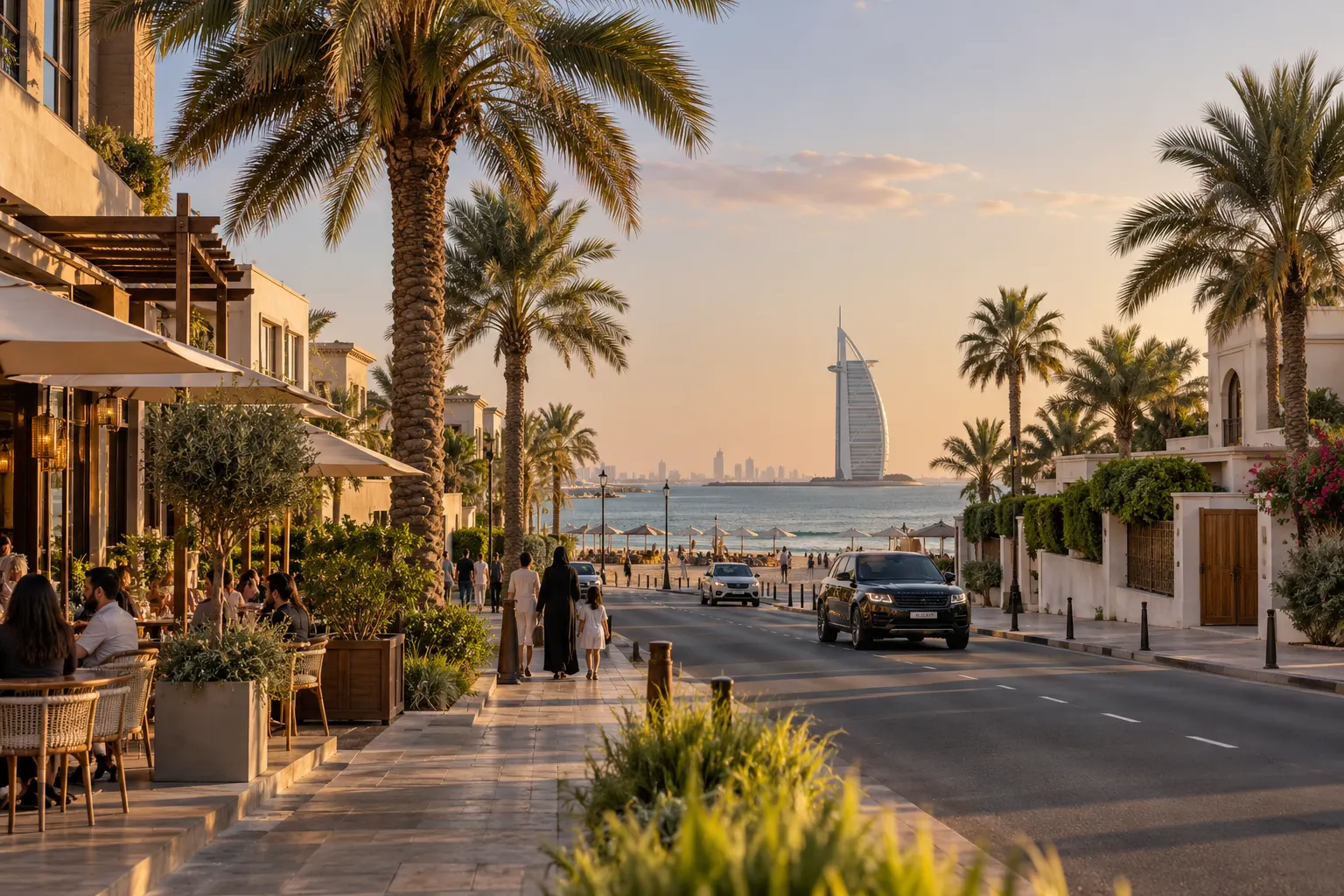
As the road continues through Jumeirah 2 and Jumeirah 3, the neighbourhood becomes one of those places where wealth is obvious without always being theatrical. There are large villas, landscaped entrances, beautiful cars and expensive restaurants. Nobody needs to pretend otherwise.
Yet much of Jumeirah still feels low-rise and open compared with the vertical districts of Dubai. The sky is easier to see. The road occasionally gives you a line toward the water. Residential streets branch away from the main traffic. A mosque minaret may appear above trees rather than between towers.
This is where my idea of Jumeirah as a comfortable middle ground becomes strongest. If you love luxury, there is plenty of it. If you prefer a simple coffee, a walk near the sea or a family meal, you can find that too. I do not feel that one cancels the other.
Perhaps this is because Jumeirah developed as a lived-in coastal district rather than as a single master-planned spectacle. It contains layers, and layers are forgiving. A neighbourhood that has had time to accumulate schools, mosques, homes, restaurants, old habits and new ambitions usually feels less like a stage set.
The Sea Keeps Reappearing
For all the restaurants and villas, the sea is what keeps Jumeirah from becoming just another affluent road. Sometimes you see it directly. Sometimes you only feel that it is close because the light changes, the air opens or a side street ends in blue.
Dubai is famous for what rises into the sky, but Jumeirah is often better understood horizontally. Road, villa, palm, beach, horizon. The scale changes how you move. You are less likely to spend the whole time looking upward.
This is also why I like coming here without a complicated plan. A beach stop can become a coffee. Coffee can become dinner. Dinner can become a walk. If the weather is good, there is no need to rush back toward the towers.
And if you are visiting Dubai for the first time, Jumeirah gives you something important: proof that the city is not only Downtown, Dubai Marina or the inside of a mall. There are different Dubais, and some of them are quieter.
Restaurants Are Part of the Geography
Food is not an appendix to Jumeirah. It is part of how the road works. Restaurants and cafés create reasons to stop, and because the neighbourhood attracts residents, visitors and people from across Dubai, the food reflects the city itself.
You can move from Gulf flavours to Levantine food, from casual breakfast to refined dining, from coffee and pastries to restaurants built around international concepts. I would rather describe that range than pretend there is one definitive Jumeirah cuisine.
The important part for me is the habit of stopping. In many places, the road is only what connects two destinations. Here, the road keeps trying to become the destination. A terrace catches your eye. A place is busier than usual. You remember someone told you about a bakery nearby. Suddenly the day changes.
This may sound small, but small discoveries are often what make us return to a neighbourhood. Major attractions are usually visited once. A road with good habits can become part of your life.
Tradition Here Is Not Frozen in a Museum
When people say they want to see the traditional side of Dubai, they often imagine that tradition must be found only in the oldest districts. Deira, Bur Dubai and the Creek are essential for understanding the city, but tradition also survives by adapting inside newer and wealthier spaces.
In Jumeirah, that can mean the continued importance of the mosque, family homes, hospitality, Arabic coffee, dates, perfume, modesty in some spaces, or the way an architectural detail borrows from older Gulf forms. None of this turns a modern restaurant or luxury hotel into a historical site. It simply shows that modernisation does not erase every social habit at once.
This matters to me because I do not want a choice between a Dubai that is supposedly authentic and a Dubai that is supposedly artificial. Real cities are messier than that. People carry traditions into new buildings. Families continue old habits inside modern homes. A gift can be placed in a luxury box without losing the meaning of giving.
Jumeirah makes that mixture easy to see because it does not hide either side.
A Simple Jar or a Luxury Box, the Gesture Comes First
Because MESKI works with honey and gifts, I naturally notice how people carry food and presents into these environments. Jumeirah is full of occasions where a gift makes sense: a family invitation, a dinner, a hotel stay, Ramadan, Eid, a thank-you, a client visit, a birthday, or simply arriving at someone’s home without wanting to come empty-handed.
That does not mean every gift needs to be expensive. A good jar of Sidr honey can be enough. A box of two origins can tell a larger story. For a more formal occasion, the same honey can be presented with saffron, silver or gold. The ingredients and packaging may change, but the social idea is familiar: you bring something worth sharing.
I like this connection because it mirrors Jumeirah itself. Simplicity and luxury can exist on the same road. Honey can sit at breakfast with bread and coffee, or it can appear in a formal gift box. Neither version automatically has more meaning. Context matters.
MESKI does not need to pretend to have a shop on Jumeirah Road to be part of that story. We deliver across Dubai. What matters more is being honest about what is in the jar, where it came from and why someone might want to give it.
Where Part II Begins
If you keep driving southwest, Jumeirah eventually changes character again. The Burj Al Arab begins to dominate the horizon. The architecture becomes more theatrical. Waterways, hotels, restaurants and a modern interpretation of the old souk begin to gather around one place.
That is where I would stop this first journey, because Madinat Jumeirah deserves its own article. It raises a different question from Jumeirah 1, 2 and 3. Can a place be openly luxurious, deliberately designed and still make traditional forms feel welcoming rather than decorative?
I already know my answer is not simply yes or no. That is why Part II begins at the entrance to Madinat, where Dubai’s version of traditional bling-bling becomes impossible to ignore, and, I admit, difficult not to enjoy.
Jumeirah Dubai: Practical Questions
No. Jumeirah is the long coastal district closer to central Dubai and includes areas such as Jumeirah 1, 2 and 3. JBR means Jumeirah Beach Residence and is a separate high-rise waterfront district farther southwest near Dubai Marina.
Jumeirah Road, commonly called Jumeirah Beach Road, is the coastal road running through the Jumeirah neighbourhood. It links residential areas, beaches, cafés, restaurants, mosques and shopping stops and is one of the best ways to experience the district gradually.
J1 Beach is in Jumeirah 1 on Dubai’s coast. It occupies the former La Mer area and now focuses on premium beachfront restaurants, beach clubs and seaside experiences.
Yes. The district is much more than its luxury hotels. Beaches, cafés, restaurants, Jumeirah Mosque, neighbourhood streets and the drive along Jumeirah Road can all be enjoyed without staying in a five-star property.
For this kind of journey, a car or taxi makes it easy to follow Jumeirah Road and stop when something interests you. The point is not to rush through every landmark but to combine a few planned stops with time for cafés, food and the coast.
MESKI accepts deliveries across Dubai according to its current UAE shipping policy. Delivery timing should always be checked when ordering, especially for gifts needed for a specific dinner, event or hotel stay.
Continue the Journey
If this story brought you here, continue through related stories from The House of Meski.