
Before the UAE had international airports, one Imperial Airways aircraft landed at Al Mahatta and placed Sharjah on a route between Britain and India.
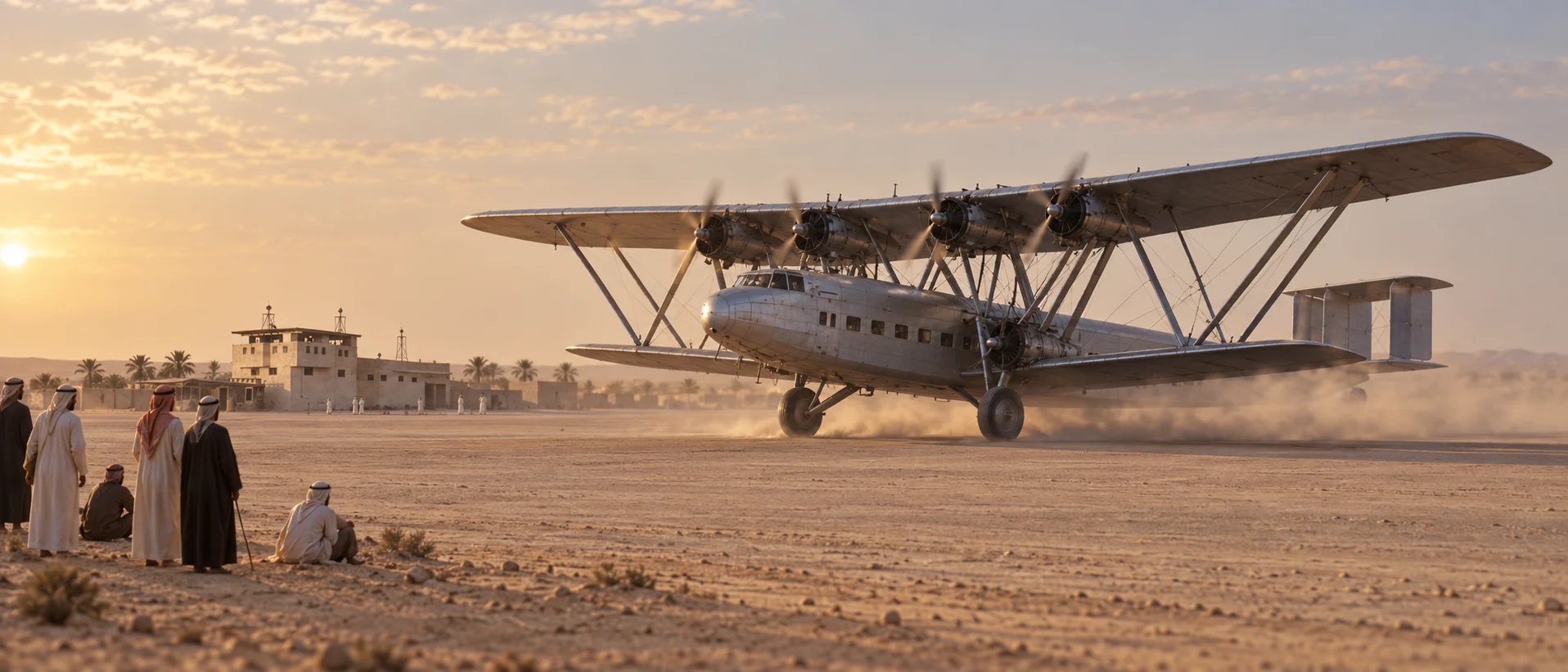
Long before airport terminals became part of everyday Gulf life, an aircraft arrived over Sharjah and landed on a new strip of ground at Al Mahatta. It stayed briefly, then continued its journey. The event was small in duration and enormous in consequence: the old world of dhows and overland travel had just acquired another road, this time through the sky.
Before the Airports, the Gulf Moved at the Speed of Sea and Desert
It is difficult to imagine the Emirates without aviation. Today a flight path over the country can cross airports, highways, ports, towers and suburbs in minutes.
In 1932 there was no United Arab Emirates. Sharjah belonged to the Trucial States, and movement was still dominated by sea routes, pearling, coastal trade, small boats and overland journeys.
Then an aircraft appeared in that world.
The importance of the event is not that people in Sharjah had never heard of airplanes. The importance is that international civil aviation was about to become physically present in the town, with a runway, passengers, mail, fuel, guards and a regular place on a route linking Britain with India.
Why Sharjah?
The choice of Sharjah was not random.
Imperial Airways needed a reliable stop on the Arabian side of its long route toward India and farther east. Sharjah Airport’s own historical timeline records that the first airfield was built at Al Mahatta in 1932 as a stopover from the United Kingdom to India.
The agreement required land, a landing ground, security and facilities for people who might spend the night between flights.
That sounds routine to us now. In 1932 it meant inserting a completely new transport system into a Gulf town whose older economy still depended heavily on sea routes, trade, fishing and pearls.
The Afternoon of 5 October 1932
The date is unusually well documented.
At 4:00 in the afternoon on 5 October 1932, the Imperial Airways aircraft Hanno arrived from Gwadar. Sharjah Airport and official UAE aviation-history sources treat this landing as the beginning of the country’s civil-aviation story.
Sharjah’s ruler, Sheikh Sultan bin Saqr Al Qasimi, dignitaries and residents were waiting.
According to Sheikh Dr Sultan Al Qasimi’s historical account, the aircraft carried four passengers and was loaded with equipment and spare parts. After landing, it was pulled into the protected hangar area while people gathered to look at the machine.
For one afternoon, the future had propellers.
Do Not Imagine a Modern Airport in Miniature
Al Mahatta was not Dubai International with fewer gates.
The early station had to solve the most basic questions first: where does the aircraft land, where is it protected, where do the passengers sleep, who guards the site, how is fuel and equipment handled, and what happens when the next aircraft arrives?
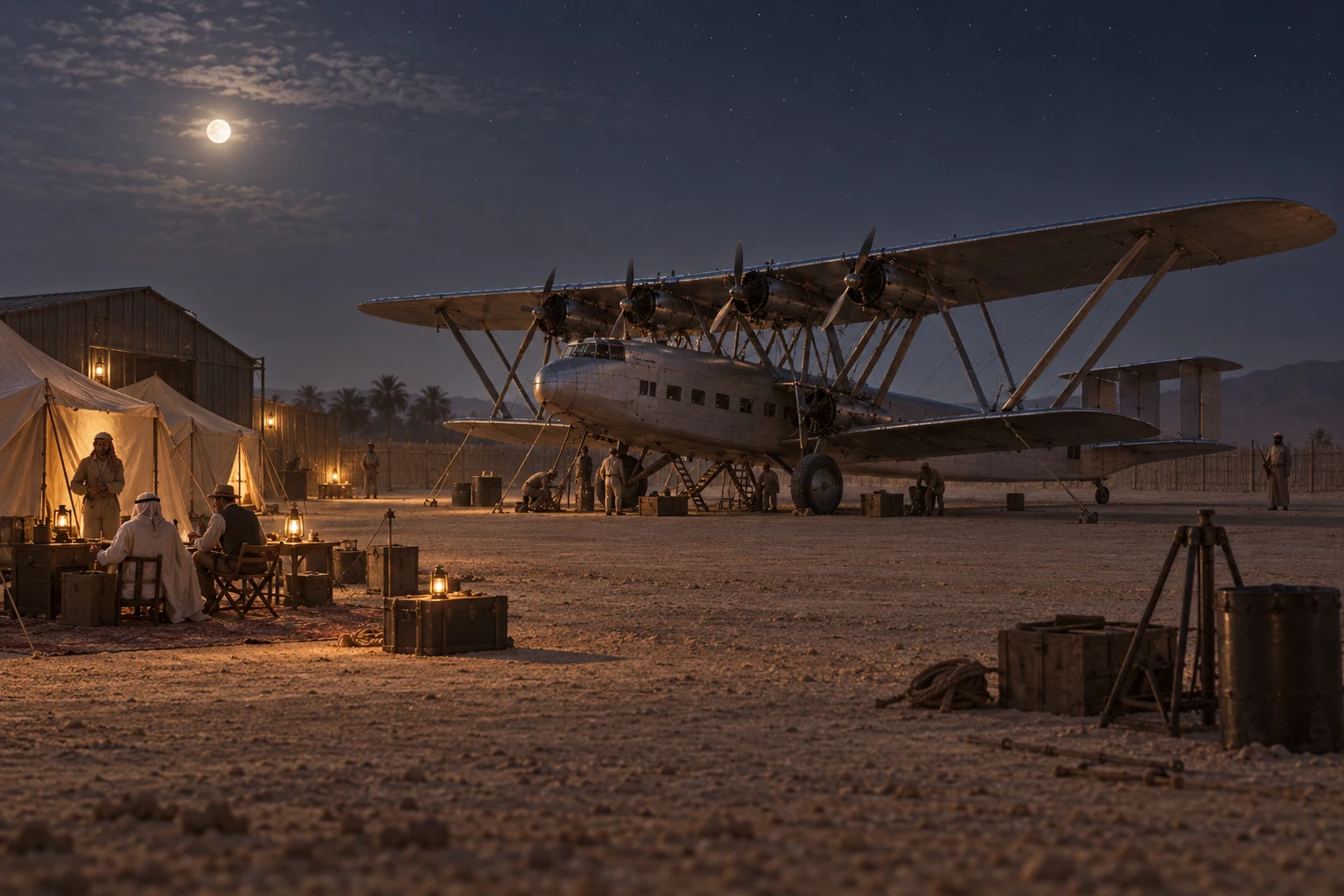
The first passengers were housed in prepared tents because the later fortified rest house was not yet complete.
That detail matters. A new global technology had landed in Sharjah, but the infrastructure around it was still being built almost in real time.
The Airplane Did Not Replace the Dhow
This is the point I want the article to keep returning to.
The first airplane did not arrive and make the older Gulf disappear.
Dhows still carried cargo. Merchants still depended on ports and souqs. Pearling was still part of the region’s economy and memory even as the industry faced severe pressure.
Aviation arrived as another layer.
That is very similar to what happened later with highways, container ports and the Metro: the Emirates often add a new system without instantly erasing the old one.
A Route to India Was Also a Route Through Sharjah
The phrase ‘stopover to India’ can make Sharjah sound like a technical pause.
But a stop creates contact.
Passengers descend. Local workers handle the aircraft. Guards watch the station. Mail moves. Supplies arrive. People in the town see machines, uniforms and travellers connected to places far beyond the Gulf.
A place can enter a global network before it becomes the final destination.
Mail May Have Been as Important as the Passengers
Early aviation carried more than travellers.
Mail, official communications, equipment and time-sensitive information all gained a new speed.
In a world where a letter could otherwise move by ship and overland routes, the aircraft changed the meaning of distance even for people who would never buy a ticket.
That is why the landing belongs to the history of communication as much as to tourism.
The sky became another road for information.
The Town Watched a New Machine Arrive
We have to be careful not to invent reactions that are not documented.
But Sheikh Dr Sultan Al Qasimi’s account explicitly says the arrival caused excitement among people waiting with the ruler. That allows us to imagine the scene without pretending we know every conversation.
Four engines, a huge airframe and a landing on a prepared strip would have looked unlike ordinary local transport.
The most honest reconstruction is simple: people came to see it.
The Fortified Rest House Says Something About the Period
The air station later developed a fortified rest house for passengers and crew.
Its design reflected a reality we often forget when looking backward from a modern city: travellers needed protection, the station required guards, and the air route was passing through a region whose political and security systems were very different from today.
Sharjah Airport historical material describes the station as one of Imperial Airways’ remote outposts.
Aviation did not arrive into ready-made state infrastructure. It helped create the need for new infrastructure.
The First Airport Became a Museum
Al Mahatta no longer functions as Sharjah’s international airport.
The present Sharjah Airport opened in 1977, while the old air-station site was eventually preserved and reopened as Al Mahatta Museum in 2000.
The place that once represented radical modernity became heritage.
There is something almost funny in that reversal. An airplane was once the futuristic object people gathered to admire. Today we visit old aircraft to understand the past.
Sharjah Was Not Waiting to Become Dubai
This article matters because Gulf history is too often told through Dubai and Abu Dhabi alone.
Sharjah had its own commercial, political and cultural trajectory. Its 1932 air station gave it a place on an international route decades before federation and long before the modern airport economy of the UAE.
I do not want to use the story to create a competition between emirates.
The better lesson is that the seven emirates entered modernity through different doors.
Sharjah’s door happened to have a runway.
From Air Station to Cultural Capital
Modern Sharjah is known internationally for museums, books, heritage and cultural institutions. That makes Al Mahatta particularly fitting as a surviving place.
Aviation history sits inside a city that later chose to preserve and interpret its past rather than leave every old structure under new construction.
MESKI itself is based in Sharjah, and our story of where the MESKI name comes from begins from the idea that places matter because memory gives them another life.
Al Mahatta is exactly that kind of place: a piece of infrastructure that became memory.
Before Highways, Another Route Changed the Scale of the Gulf
We recently wrote about Sheikh Zayed Road as a road that watched Dubai grow.
Al Mahatta belongs to the same larger series of transformations, but decades earlier.
One story is asphalt and towers. The other is a landing strip and propellers.
Both ask the same question: what happens to a place when movement suddenly becomes faster?
Aviation and Trade Speak the Same Language
The first Sharjah air station did not invent the Gulf’s habit of connecting distant markets.
The region already knew how to trade across sea lanes linking Arabia, India, Persia and East Africa. What aviation changed was speed and the kind of cargo that could move quickly.
That is why I see the airplane as part of an older commercial instinct rather than a total break with the past.
The dhow and the aircraft look completely different. Both make sense only because somebody wants to reach somebody else.
Even Honey Belongs to This History of Movement
This is not a honey article, and I do not want to force honey into the cockpit.
But MESKI spends a lot of time thinking about provenance and movement: where a harvest comes from, how it reaches the UAE, and how origin is preserved after transport.
A jar of Omani Samar delivered in Sharjah or Dubai is a tiny modern example of something much larger: goods crossing borders faster than earlier generations could have imagined.
Our Sidr vs Samar article looks at Gulf terroirs; Al Mahatta reminds us how dramatically the routes between those terroirs changed.
What the First Flight Did Not Change
An airplane can change distance. It cannot automatically change culture.
People still received guests. Coffee was still poured. Dates still appeared. Families still lived through local rhythms that did not suddenly become British because an Imperial Airways aircraft landed nearby.
Modernity often arrives first as an object.
Then people decide how much of it to adopt, adapt or ignore.
Sources & Further Reading
Sharjah Airport’s official milestones records 1932 as the year the first airfield opened at Al Mahatta as a stopover from the UK to India, while its historical overview identifies the first flight as a defining moment.
For the specific scene of 5 October 1932 — Hanno arriving from Gwadar at 4:00 PM with four passengers — this article uses Sheikh Dr Sultan Al Qasimi’s Tale of a City, Volume II and the account preserved by Emirates News Agency.
Narrative descriptions of what the machine may have felt like to observers are editorial reconstruction. Where a reaction is stated as fact, it is tied to the historical accounts above.
The Day an Airplane Landed in the Desert
On 5 October 1932, the aircraft landed, the passengers stopped, and the flight continued the next day.
That sounds small compared with the airports of the UAE today.
But history is often made of small interruptions. A machine stops for one night. A town joins a route. A new technology becomes ordinary. Decades later, people fly across the world and barely think about the ground beneath the runway.
Al Mahatta reminds us that there was a first landing.
And people came to watch.
Questions People Ask
The first Imperial Airways aircraft associated with Al Mahatta’s regular civil-aviation story landed on 5 October 1932.
Sharjah’s first air station and airfield, built in 1932 as a stopover on Imperial Airways routes linking Britain with India.
Historical accounts identify the aircraft as Hanno, a Handley Page HP42 operated by Imperial Airways.
The documented 5 October 1932 flight arrived from Gwadar and continued onward the next day toward Bahrain.
Sheikh Dr Sultan Al Qasimi’s account records four passengers.
No. The modern Sharjah Airport opened in 1977. The old Al Mahatta site later became a museum.
The historic site reopened as Al Mahatta Museum in 2000.
It marks the beginning of regular civil-aviation infrastructure in what later became the UAE and placed Sharjah on an international route decades before federation.
Follow the Roads That Changed the Emirates
From a 1932 landing strip in Sharjah to highways, mountains and modern Gulf trade, the UAE’s story is also a story of how people learned to move.