
I knew Dubai before Burj Khalifa. The road was already there. What changed was everything that grew around it — towers, Metro, abundance, and the way old traditions learned new forms.
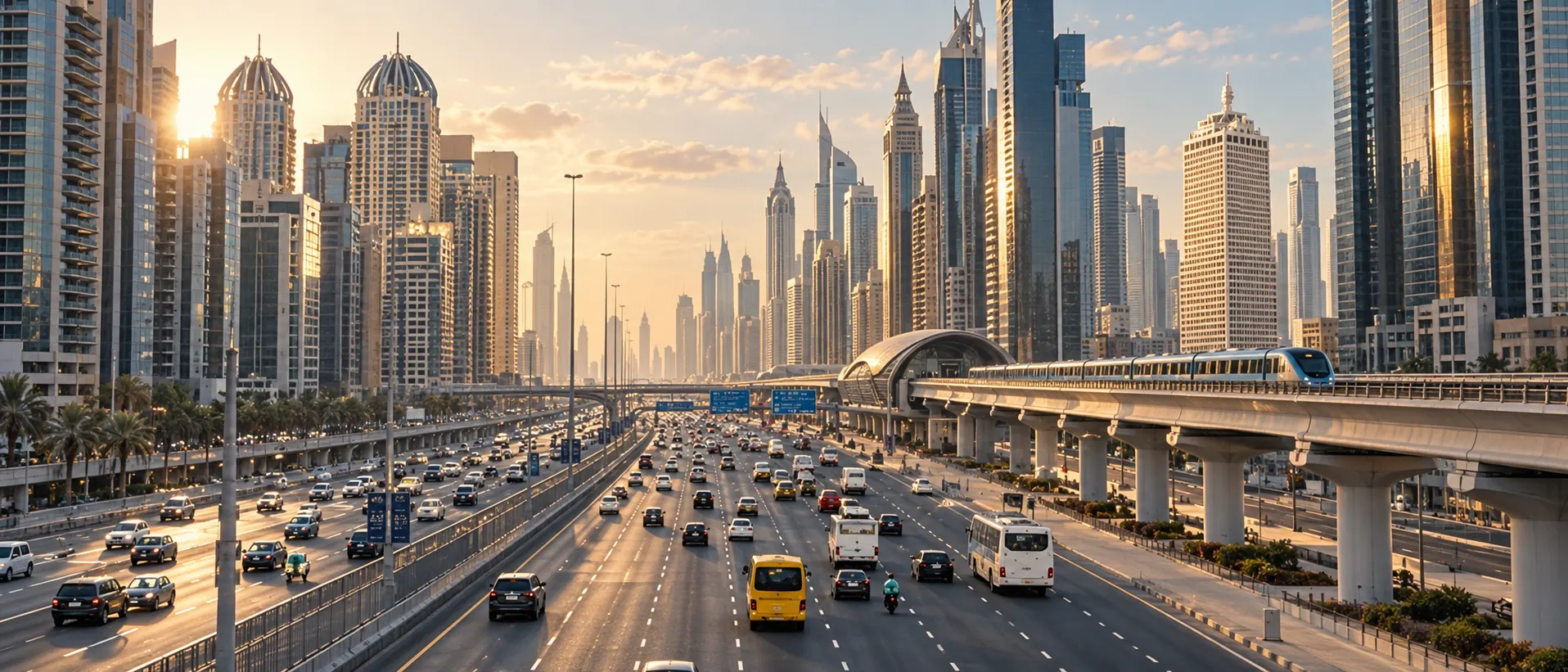
Some roads take you from one place to another. Sheikh Zayed Road also takes me from one memory of Dubai to another. I knew this city before Burj Khalifa, when the same road already carried towers, hotels and construction but the spaces between them felt larger. Today I recognise the route and still catch myself wondering how much city has grown into the gaps.
I Knew Dubai Before Burj Khalifa
I knew Dubai before Burj Khalifa changed the skyline.
Sheikh Zayed Road was already there. Dubai was already a city. There were towers, hotels, traffic, construction sites, offices and places we recognised. I do not remember an empty desert waiting for somebody to invent Dubai, because that would not be true to what I saw.
What I remember is space.
More space between buildings. More places where the eye could travel farther. Fewer towers competing for the same piece of sky. And when I drive the road today, that is what surprises me most: I recognise the route, but so much of the space around it has been filled.
I did not discover a new road. I watched the same road become another world.
The Road Was Changing Long Before I Arrived
My own memory begins much later than the beginning of Sheikh Zayed Road, so it is important not to confuse personal memory with history.
In the early 1970s, the road was known as Defence Road. Archive photographs show a very different corridor: open land, sparse development and, in one famous image, camels crossing a largely empty carriageway near what later became the First Interchange.
That image is powerful because it is real, not because it supports the easy cliché that Dubai was ‘nothing’. Dubai already had a trading city around the Creek, Deira and Bur Dubai. Ships, dhows, souqs, merchants and neighbourhoods had been building commercial life for generations.
The road did not create trade from nothing. It gave a growing city a new land artery.
Before Sheikh Zayed Road, the Creek Was the Great Commercial Artery
To understand the road, I think you have to begin somewhere else: Dubai Creek.
Dubai’s own official history describes the Creek as a natural harbour that helped the city grow around fishing, pearling and trade. By the beginning of the twentieth century, Dubai had become a recognised port and Deira’s market was one of the important commercial centres of the coast.
Goods arrived by water. Traditional dhows carried cargo. Merchants worked from the souqs. The Creek connected the city to regional and international trade long before a six- or seven-lane motorway could move thousands of vehicles an hour.
That older commercial Dubai still survives enough to walk through. In What to Buy in Dubai Beyond Malls and Luxury Brands, I wrote about crossing the Creek, walking Deira and looking for objects that still carry a place rather than only a logo.
Sheikh Zayed Road belongs to the next chapter of the same instinct: move people, move goods, connect markets, grow.
Then One Tower Stood Almost Alone
If there is one building that helps explain the road, it is not Burj Khalifa.
It is the original Dubai World Trade Centre tower.
Dubai World Trade Centre records that Sheikh Rashid bin Saeed Al Maktoum commissioned British architect John Harris to design the Trade Centre Tower. In 1979, Sheikh Rashid Tower opened as Dubai’s first major tower and business centre.
Old photographs make the decision look almost surreal today. The tower rises from an area with huge amounts of open land around it. Gulf News later described how many residents wondered why such a building had been placed so far from the main city.
Today the tower can almost disappear among its younger neighbours. That may be the clearest proof that the idea worked.
A Building Can Look Smaller Without Shrinking
This is one of my favourite things about old landmarks in Dubai.
The World Trade Centre did not become shorter. The city simply grew around it.
A building that once dominated photographs now sits beside towers, hotels, exhibition halls, DIFC, the Museum of the Future, Metro infrastructure and road systems that would have been difficult to imagine from those early images.
Sometimes growth is easiest to understand through an object that stayed still.
The tower stayed. The scale around it changed.
From Camels to 4x4s
The phrase sounds almost too easy, but on this road it has a factual image behind it: camels really were photographed crossing the carriageway when the surrounding landscape was far more open.
Today the same corridor carries everything from taxis and delivery vans to family SUVs, buses, supercars and commuters moving between offices, homes, hotels and shopping districts.
I do not see that as a story of one culture replacing another.
A Land Cruiser does not erase the camel from Emirati memory. A motorway does not erase the desert. A skyscraper does not automatically erase the majlis.
The forms change. Some habits remain, some adapt, and some return in new packaging.
The Metro Added a Second Road Above the Road
Then Dubai did something that changed the visual identity of Sheikh Zayed Road again: it built the Metro along large sections of it.
Dubai Metro’s Red Line officially opened on 9 September 2009. RTA records that the first elevated Metro pillar was cast in 2006 between the sixth and seventh interchanges on Sheikh Zayed Road.
For people who knew the road before the elevated tracks became part of the landscape, the difference is easy to forget now because the Metro feels as if it has always belonged there.
It has not.
That is another pattern in Dubai. A new piece of infrastructure arrives, looks strange for a while, then becomes part of the city’s memory so quickly that the older image begins to fade.
And Then Burj Khalifa Changed the Reference Point
Burj Khalifa was inaugurated on 4 January 2010.
For me, that date divides two visual memories of Dubai.
Before it, Sheikh Zayed Road already had a skyline. Emirates Towers, World Trade Centre and many other buildings had already made the corridor unmistakably urban. After Burj Khalifa, however, the city gained a reference point that reorganised the horizon.
You could be on a road you already knew and suddenly measure your position against a tower that had not existed in your earlier memory.
That is why I resist the sentence ‘Dubai became a city when Burj Khalifa arrived.’ It was already a city. Burj Khalifa changed the scale of the city people imagined.
The Spaces Between the Landmarks Are What Changed Most for Me
Tourism photographs focus on landmarks. Memory often notices the gaps between them.
When I think of Sheikh Zayed Road from years ago, I do not only remember individual towers. I remember that one building had more room around it. A construction site looked more isolated. A hotel felt like a destination rather than one name among twenty nearby.
Today the road feels continuous.
Offices become hotels, hotels become residential towers, towers become malls, malls become interchanges, and the next district starts before the previous one has fully ended.
The road did not only become taller. It became denser.
Today RTA Calls It an Economic Corridor, and That Description Fits
Dubai’s Roads and Transport Authority now describes Sheikh Zayed Road as one of the city’s most important arterial and economic corridors.
That is not just promotional language. The road serves Dubai World Trade Centre, DIFC, the Museum of the Future and access toward Burj Khalifa and Dubai Mall, while linking commercial and residential districts across the city.
Even in 2026, the road is still being widened and its intersections rebuilt. RTA completed a two-kilometre widening near Burj Khalifa/Dubai Mall Metro Station in August 2026, increasing that section from six to seven lanes.
The remarkable part is that the road is not treated as finished.
Dubai grew around it, then the road had to grow again.
From Carrying What Was Necessary to Having Almost Everything Within Reach
This is where the story becomes bigger than architecture.
Life in an arid environment once required a much closer relationship with supply, water, season, distance and transport. I do not want to romanticise hardship or pretend people had no food. Dubai was a trading settlement precisely because goods moved through it.
But abundance was not frictionless.
Today the experience is completely different. Drive through modern Dubai and within a short distance you can buy mangoes from South Asia, European cheese, Japanese tea, Ethiopian coffee, Saudi dates, Moroccan olive oil, Omani frankincense, Yemeni honey and food from almost any cuisine you can name.
The old city built prosperity by moving goods. The modern city has made the result visible on almost every shelf.
The Road Carries More Than Cars
A motorway looks like transport infrastructure, but economically it carries relationships.
Staff move to hotels and offices. Ingredients move to restaurants. Exhibitors move toward World Trade Centre. Packages move between warehouses, homes and businesses. Tourists move from airport to hotel to mall. Residents cross districts for work, dinner, school and family.
The road supports the invisible daily movement that makes the visible skyline function.
This is why I like looking at Sheikh Zayed Road beyond the towers. The buildings photograph well. The movement is the real city.
Dubai Did Not Abandon Trade. It Multiplied It.
The Creek did not become irrelevant because Sheikh Zayed Road became powerful. Ports did not disappear because the Metro arrived. Souqs did not vanish because malls opened.
Dubai tends to layer systems rather than replace every previous layer.
Traditional dhows still operate in the city’s maritime trade network. Deira still sells spices, perfume and gold. Modern logistics, free zones, ports, highways, airports and digital delivery now operate at a completely different scale beside that older commercial instinct.
The tools changed dramatically.
The instinct to connect buyer and seller did not.
The Same Is True of Hospitality
This is the cultural part of Sheikh Zayed Road that interests me most.
A visitor can look at the towers and assume the story is simply wealth. But the Gulf’s language of welcome did not begin with luxury hotels.
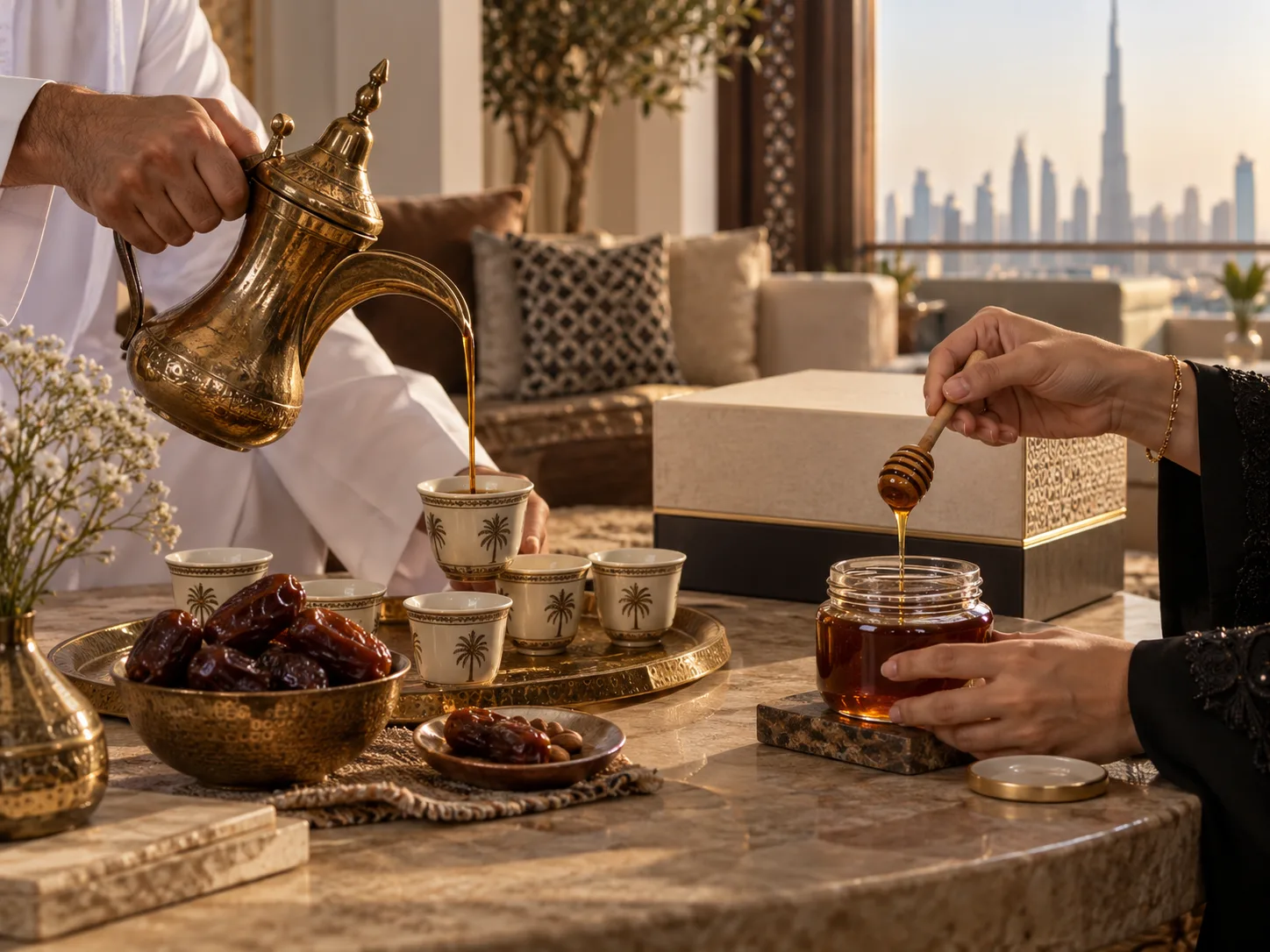
Coffee, dates, food, perfume, incense, honey, the best chair for the guest, the insistence that somebody eat before leaving: these gestures belong to a much older social world.
Today they may appear in a hotel suite, a corporate reception, a family villa, an office majlis or a carefully prepared gift box.
The setting changed. The instinct to honour the guest survived.
From a Spoon of Honey to a Luxury Gift Box
Honey is a useful example because it can live at both ends of this transformation.
It can be completely simple: a jar on the table, bread, coffee, dates, family.
It can also become a formal gift: selected origin, glass, presentation box, gold, silver, saffron, a note for a client or a guest.
At MESKI we work with both worlds. Our Luxury Honey Gifts guide talks about corporate, family and VIP gifting, but the principle I keep returning to is that packaging should never become more important than what is inside.
The tradition is not valuable because we added a box. The box is valuable only if it respects the tradition and the product.
Sometimes Dubai Being Dubai, We Add Gold
I can say this with a smile because we do it ourselves.
We take a food as ancient and simple as honey and sometimes prepare it with precious elements or place it in a presentation designed for a special occasion.
Our Royal Sidr Honey Collection is probably the clearest example: gold, silver and saffron around honeys from different Gulf and Arabian origins.
Is that traditional? Not in the sense that somebody centuries ago was opening our modern gift box.
But the desire to offer something precious to a guest is much older than the box.
That is the distinction I care about.
Luxury Did Not Kill Tradition. Sometimes It Put on Traditional Clothes.
This is something I also feel in Jumeirah, in Madinat, in major hotels and in parts of Abu Dhabi.
The Gulf has become very good at taking traditional architectural forms, coffee rituals, scents, textiles and hospitality codes and placing them inside modern luxury.
Sometimes the result is beautiful. Sometimes it becomes theatre. Usually it is somewhere in between.
Sheikh Zayed Road is the large-scale version of that tension: extreme modernity built in a place where older cultural gestures continue to circulate underneath.
You can dislike the towers and still love the hospitality. You can love the towers and still care about provenance. The city does not force us to choose one identity.
There Is Still Ordinary Life Behind the Glass
Another reason I resist describing Sheikh Zayed Road only through supercars and luxury hotels is that thousands of ordinary working days happen there.
People wait for the Metro. Staff enter offices. Drivers deliver food. Families sit in traffic. Someone is late for a meeting. Somebody else is going home after a twelve-hour shift. A cleaner finishes a floor nobody will photograph. A restaurant receives ingredients before dinner service.
That ordinary rhythm is what turns architecture into a city.
Without it, Sheikh Zayed Road would be a model.
With it, the road is lived.
One Road, Many Dubais
Drive the corridor and you can connect very different versions of Dubai without leaving the same great axis.
World Trade Centre and exhibition Dubai. DIFC and financial Dubai. Downtown and global-icon Dubai. Business Bay and the newer high-density city. Farther south, the road continues toward residential communities, business districts and the direction of Jebel Ali and Abu Dhabi.
And if you leave the road, another Dubai appears very quickly.
Go east toward the Creek and you return to the trading city. Go toward Jumeirah and the pace changes again. Drive far enough toward Hatta and the emirate becomes mountains, farms and bees rather than towers.
Dubai makes more sense when we stop treating one skyline as the entire place.
The Old Photographs Matter Because Memory Is Unreliable
Personal memory is powerful but imperfect.
I can tell you how the road felt to me before Burj Khalifa. Someone who arrived ten years earlier will remember another road. Someone who arrived in 1975 remembers something I never saw.
That is why archive photographs matter. They correct the temptation to turn our own period into ‘old Dubai.’
The famous photographs of the World Trade Centre with open land around it, or camels crossing near Defence Roundabout, belong to a Dubai before my own memory.
My story begins later.
The road had already transformed several times before I ever drove it.
What Has Really Remained the Same?
Not the buildings.
Not the number of lanes.
Not the cars.
Not the skyline.
Perhaps the strongest continuity is ambition joined to trade: the belief that movement creates opportunity.
The Creek moved goods and people. The road did the same on land. The Metro added another layer. Ports, airports and logistics multiplied the scale.
And in homes and majlis, the older language of receiving people adapted to all of it.
The Same Road, a Different Dubai
When I drive Sheikh Zayed Road now, I do not feel that the old Dubai disappeared in one dramatic moment.
I feel that layers accumulated.
A tower appeared. Then another. The Metro arrived. Burj Khalifa changed the skyline. Districts filled in. Hotels multiplied. Interchanges grew. Traffic became heavier. The road itself kept being widened and rebuilt.
And still, somewhere after the drive, somebody pours coffee for a guest.
Somebody opens dates.
Somebody brings honey.
Sometimes the jar is simple. Sometimes, Dubai being Dubai, we add a little gold.
The road looks almost nothing like its earliest photographs. The gesture is easier to recognise.
What I Take From Sheikh Zayed Road
I do not look at Sheikh Zayed Road as proof that Dubai replaced tradition with modernity.
I see something messier and more interesting.
The city changed the scale of trade, transport, architecture and abundance. It learned to move people faster and goods farther. It built upward, then built a Metro through the middle, then kept widening the road because even that was not enough.
But culture did not sit still waiting to be demolished. It moved too.
Hospitality became hotel service and family majlis. Traditional foods became restaurant menus and luxury gifts. Honey remained honey, even when we put it in a box.
That is why this road stays interesting to me.
I knew it before Burj Khalifa.
I still know the road.
I just keep meeting a different Dubai on it.
Questions People Ask About Sheikh Zayed Road
The corridor was known as Defence Road in the 1970s. Historical reporting and archive photography also refer to the former Defence Roundabout near today’s First Interchange.
Early archive images show long stretches with very sparse development and open land, especially around the World Trade Centre area. Dubai itself, however, already had established trading districts around the Creek, Deira and Bur Dubai.
Dubai World Trade Centre states that Sheikh Rashid Tower opened in 1979 as Dubai’s first major tower and business centre.
The Dubai Metro Red Line officially opened on 9 September 2009. Much of its elevated alignment became a defining visual feature along Sheikh Zayed Road.
Burj Khalifa was officially inaugurated on 4 January 2010.
Yes. RTA continues to upgrade the corridor. In August 2026 it completed a two-kilometre widening near Burj Khalifa/Dubai Mall Metro Station, expanding that section from six to seven lanes.
This article does not make that claim. Dubai’s older trade history was strongly centred on the Creek, maritime commerce, souqs and regional routes. The modern road belongs to a later transport era.
Honey is used here as a cultural example: an old food and hospitality gift that can still be served simply or presented today in a modern luxury box. The product changed less than the presentation around it.
Keep Following Dubai Beyond the Skyline
Sheikh Zayed Road is one chapter. The Creek, Jumeirah, Hatta, the souqs and the majlis each reveal another way Dubai changed without becoming only one thing.