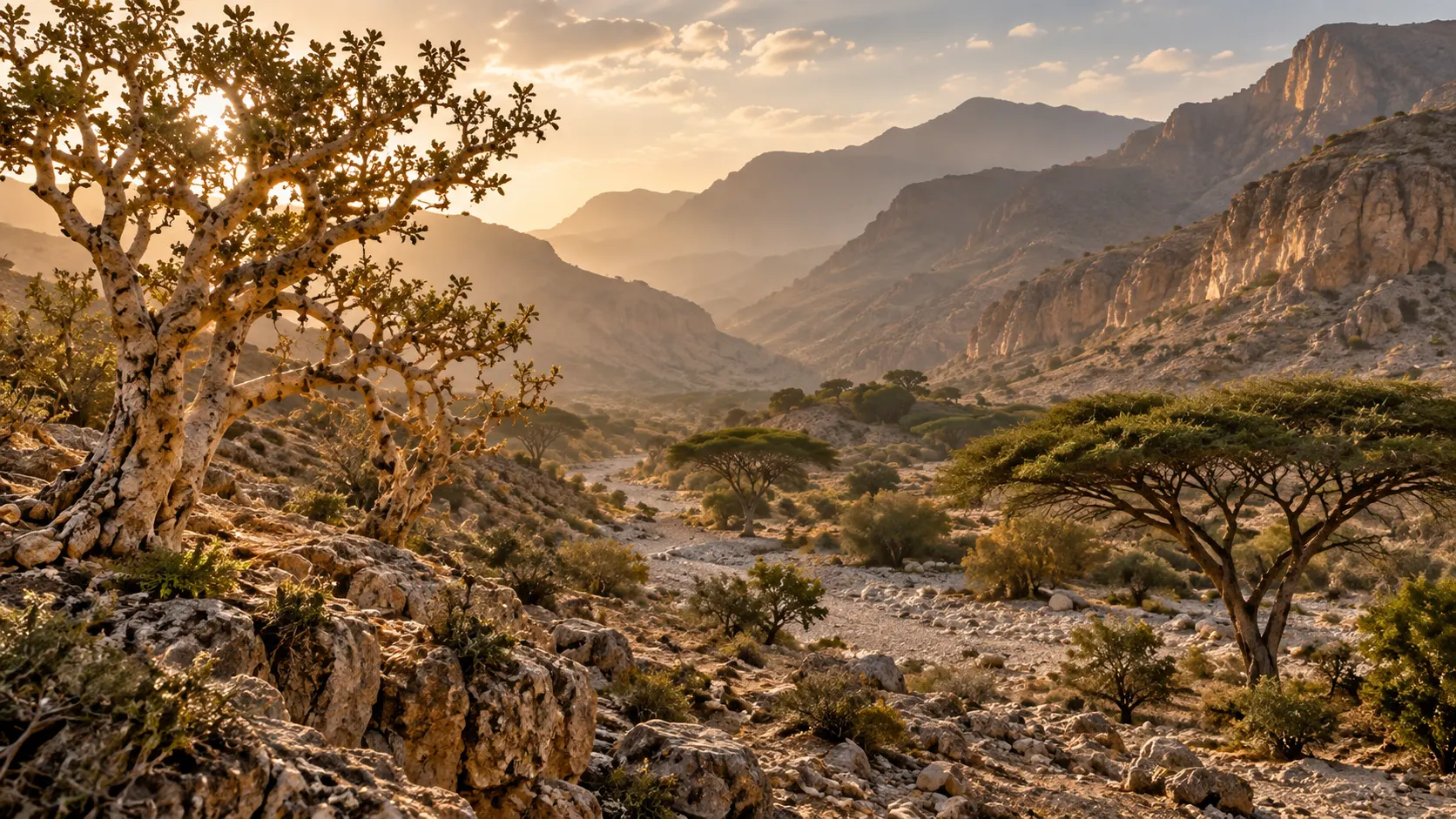
Oman · Frankincense & Samar · Transitional Harvest
Frankincense & Samar
Honey
عسل اللبان والسمر العُماني
A transition honey between two Omani blooms — one of the Atlas’s best examples of why a named lot can be more honest than a rigid monofloral label.
An Omani beekeeper described this honey as a harvest formed between frankincense and Samar flowering phases. Oman News Agency has also reported an award for a product described as frankincense with Samar honey. The precise composition, however, belongs to each lot.
Terroir
A honey that lives between floral seasons
Some honeys are easiest to understand as monoflorals. Others are more honest when treated as transition harvests. Frankincense & Samar belongs to the second category.
The idea is simple: bees work what is blooming around them. If a harvest bridges Boswellia and Samar phases, the result can carry both influences without either one needing to become a marketing absolute.
| Location | Oman — exact apiary should be specified by lot |
| Landscape | Dryland and wadi forage across changing bloom phases |
| Floral source | Frankincense (Boswellia sacra) with Samar (Vachellia tortilis) influence |
| Harvest | Lot-dependent transition between floral phases |
| Character | Mixed-origin profile; should not be overclaimed without traceability |
“Sometimes the most truthful origin is not one flower, but the moment between two.“
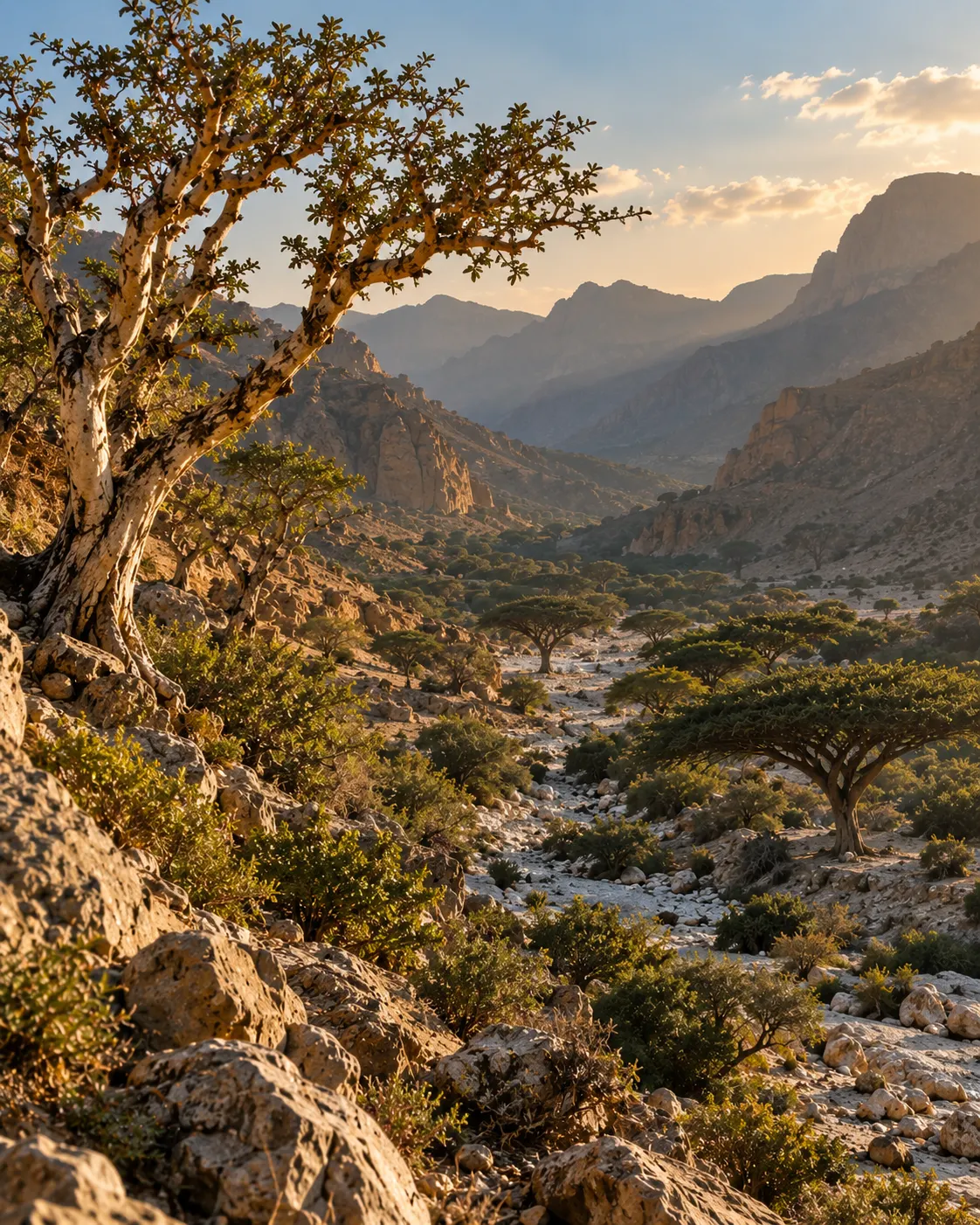 Oman · Transitional bloom
Editorial rule
Do not force a monofloral story where one may not exist
This fiche is intentionally cautious. The category is documented, but the proportion of frankincense and Samar can vary. A serious jar should state where and when it was harvested rather than hiding behind a romantic two-flower name.
Tradition
A beekeeper’s explanation becomes an Atlas question
This honey entered the Meski story through direct tasting with an Omani beekeeper, who described it as a harvest connected to the period between floral phases.
That field explanation is valuable, but it is not a laboratory certificate. The Atlas keeps both truths together: respect the beekeeper’s knowledge, and keep the claim proportional to the evidence.
Frankincense bloom
Frankincense bloom
Boswellia flowers create one seasonal forage.
Samar bloom
Samar bloom
Vachellia tortilis adds a darker acacia register.
Transition
Transition
Bees work the overlap or succession between available sources.
2026
2026
An Omani frankincense-with-Samar honey receives international recognition.
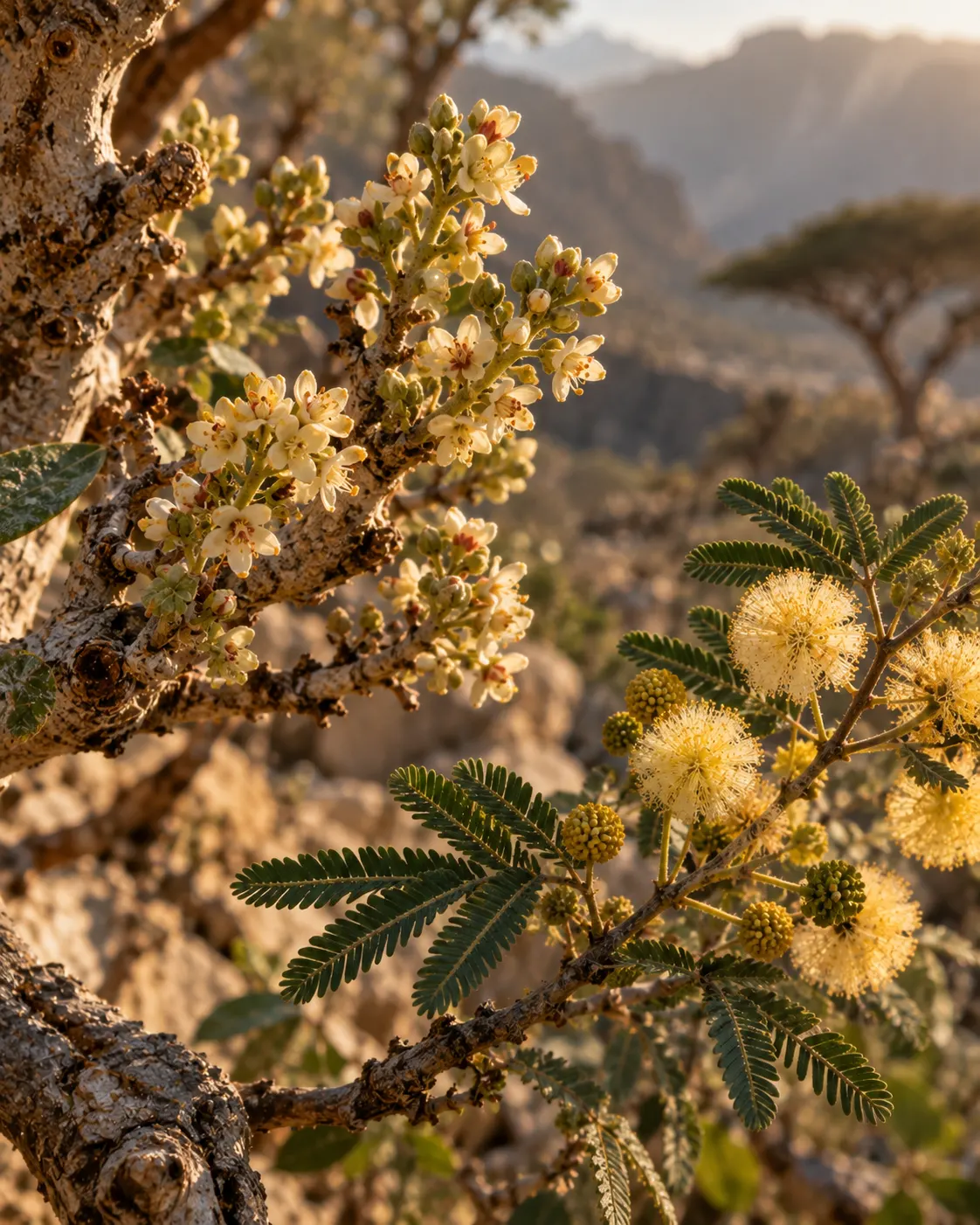 Botanical detail · Oman
“Sometimes the transition itself is the origin.”
— The House of Meski
Rarity
Rare because transitions are harder to repeat than recipes
A transition harvest depends on timing. Weather, bloom overlap, colony strength and apiary position can all shift the balance from one season to the next.
Why the uncertainty is useful
A careful label is more valuable than false precision.
Beekeeping
The beekeeper reads the overlap
Here, beekeeping skill is partly observational: knowing which plants are flowering, when one phase gives way to another and how the colonies respond.
The practice
The strongest version of this honey is therefore not the one with the grandest name, but the one with the clearest harvest notes.
Sensory reading
Floral lift meeting darker acacia depth
Texture
Medium to dense, depending on the floral balance and the specific lot.
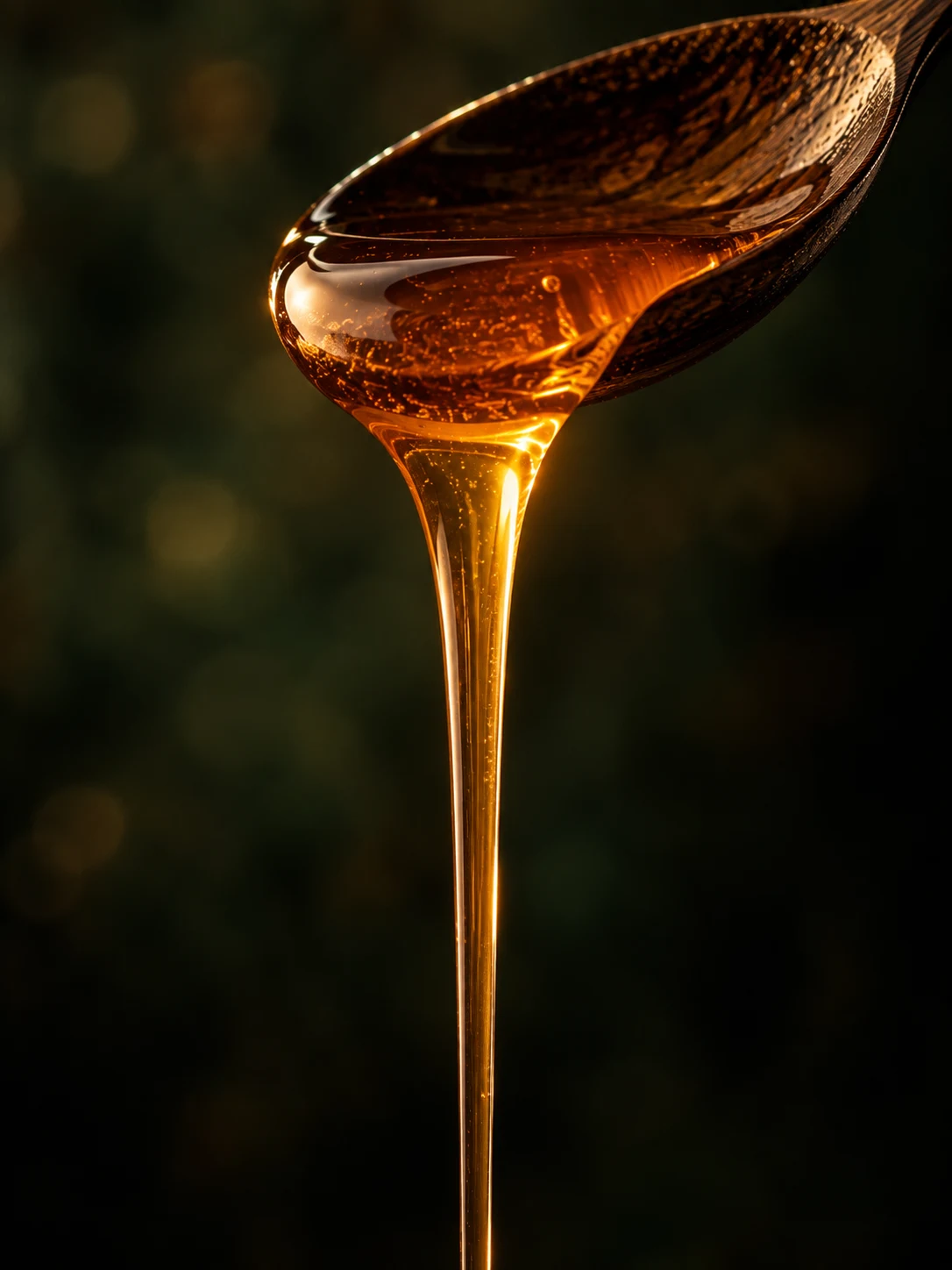
Harvest notebook
A honey about honesty more than purity
This is exactly the sort of honey the Atlas should keep nuanced. It can be fascinating without pretending that two floral sources always appear in a fixed ratio.
Pairings
How to serve it
Bittersweet and full-bodied — treat it as a rare thing to taste alone before adding anything else.
Meski rating
An editorial reading, not a certification
Six criteria of the House, judged in tasting. This rating describes the appellation, is revised for each lot presented, and replaces no analysis or certificate.
Provenance
The Meski Confidence Chain
Rare honey is one of the most counterfeited foods in the world, and Sidr is no exception. Confidence does not come from a single certificate — it comes from a chain that stays continuous, from bloom to jar.
Read: How to read a rare honeyAnalysis describes the sample received by the laboratory. It does not automatically prove that every jar sold under the same name comes from that sample. A continuous chain does.
Continue the Atlas
An origin is never an island
Compare not to name a winner, but to understand what place, season and craft shift in the cup.